


Setting Up a Canadian Subsidiary for a US Company: 2026 Strategic Guide
- jzanglaw
- Jul 7
- 12 min read
Updated: 5 days ago
Is your expansion into the Canadian market a mere administrative checkbox, or is it a calculated shield against regulatory volatility? Most US executives view the northern border as a simple extension of their domestic operations, yet they quickly encounter the friction of director residency rules and the complexities of the Investment Canada Act. When setting up a canadian subsidiary for a us company, the choice between federal and provincial jurisdiction isn't just a matter of paperwork; it's a fundamental decision that dictates your long-term fiscal efficiency and operational autonomy.
You likely recognize that navigating cross-border compliance requires more than just a basic understanding of corporate law. This guide provides the technical clarity you need to master tax structuring and regulatory alignment within the 2026 landscape. We'll examine the strategic advantages of specific provinces like British Columbia and Alberta where residency requirements differ, analyze the latest Investment Canada Act thresholds, and provide a clear roadmap for establishing a secure, high-stakes presence in the Canadian market. By aligning your corporate structure with current provincial tax incentives and federal regulations, you transform a legal requirement into a robust competitive advantage.
Table of Contents
Evaluating Corporate Structures: Branch Office vs. Canadian Subsidiary
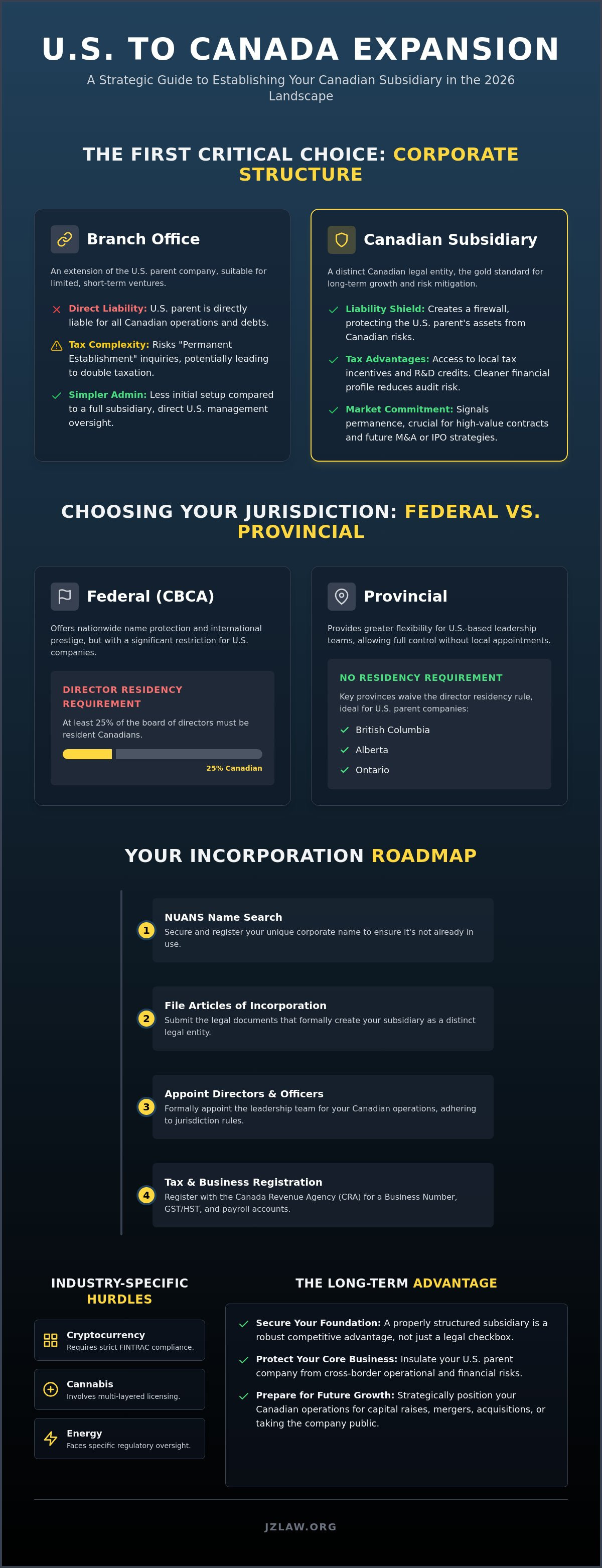
The decision to cross the 49th parallel involves more than just market analysis; it requires a rigorous evaluation of the legal vehicle used to facilitate entry. A branch office is essentially an extension of the US entity, meaning the parent company remains directly liable for all Canadian obligations. Conversely, a subsidiary is a distinct legal person. When setting up a canadian subsidiary for a us company, you create a robust firewall that isolates Canadian operational risks from your domestic assets. This separation is foundational for long-term stability and risk mitigation.
Understanding the historical context and regulatory framework of Foreign ownership of companies of Canada reveals a landscape that rewards structural clarity. Operating as a branch often triggers complex "Permanent Establishment" (PE) inquiries from the Canada Revenue Agency. These inquiries can lead to disputes over how much global income is attributable to Canadian activities, potentially resulting in double taxation. A subsidiary simplifies this by filing its own tax returns and maintaining its own books, which reduces the audit footprint of the US parent and provides a cleaner financial profile.
When a Branch Office Makes Sense
A branch office might be appropriate for ventures with a finite timeline or minimal physical presence. If your firm is executing a single, short-term contract or providing remote services with low liability exposure, the administrative ease of a branch may outweigh the benefits of incorporation. It allows US-based management to maintain direct oversight without the initial costs of managing a distinct corporate minute book. However, this simplicity often comes at the cost of increased exposure for the parent organization.
The Strategic Case for a Canadian Subsidiary
For businesses targeting sustained growth, the subsidiary model is the gold standard. It signals a permanent commitment to the market, which is often a prerequisite for securing high-value contracts with Canadian government entities or major financial institutions. Beyond optics, a subsidiary provides access to local tax incentives and research and development credits that aren't typically available to foreign branches. This structure is particularly vital when preparing for future corporate transactions, such as mergers or local acquisitions. Setting up a canadian subsidiary for a us company ensures your business is viewed as a domestic player, streamlining the path toward scaling or eventual exit strategies within the Canadian economic ecosystem.
Selecting the Right Jurisdiction: Federal vs. Provincial Incorporation in 2026
Choosing where to file your articles of incorporation is a pivot point that dictates your board's composition and your brand's regulatory reach. While federal incorporation under the Canada Business Corporations Act (CBCA) offers nationwide name protection and a certain level of international prestige, it imposes a strict director residency requirement. Specifically, at least 25% of your board must be Canadian residents. For many US firms, this mandate creates an immediate hurdle in maintaining executive alignment. If your leadership team is entirely US-based, you might find the provincial route more conducive to your operational goals.
When setting up a canadian subsidiary for a us company, you must weigh these federal benefits against the flexibility of provincial statutes. Jurisdictions like Ontario, Alberta, and British Columbia have eliminated director residency requirements entirely. This allows a US parent company to appoint its own executives to the Canadian board without searching for local candidates simply to satisfy a quota. These Tips For Taking Your Brand Global emphasize that while cultural alignment is key for marketing, legal alignment often starts with selecting a jurisdiction that respects your existing management structure.
The Federal Advantage (CBCA)
The CBCA is the preferred choice for enterprises seeking a truly national presence. It grants the right to use your corporate name in every province and territory, protecting your brand identity as you scale. However, the 25% residency rule remains a significant consideration. If your strategy involves operating across multiple provinces simultaneously, the federal path provides a cohesive framework, though it requires a commitment to local board representation. The online filing fee for federal incorporation remains at $200 CAD, making it a cost-effective entry point for those who can satisfy the residency criteria.
Provincial Favorites: Ontario, Alberta, and BC
Provincial incorporation offers a more streamlined path for companies prioritizing control. Ontario (OBCA) and Alberta (ABCA) are particularly attractive in 2026 due to their modernized corporate laws. Alberta, for instance, is the logical hub for entities involved in oil and gas law, offering a regulatory environment tailored to energy sectors while maintaining zero residency requirements for directors. British Columbia continues to be a staple for tech and service industries due to its long-standing openness to foreign ownership. Regardless of where you incorporate, remember that you must still complete extra-provincial registration in every province where you maintain a physical office or hire employees. Identifying the most efficient path requires a strategic assessment of your long-term corporate goals to avoid unnecessary administrative friction.
Navigating Industry-Specific Regulatory Hurdles: Cannabis, Crypto, and Energy
Expansion into the Canadian market requires more than just corporate filings; it demands a sector-specific strategy to navigate high-stakes regulatory frameworks. While the initial process of setting up a canadian subsidiary for a us company involves choosing a jurisdiction, the operational reality is governed by federal and provincial oversight bodies. Every new business establishment by a non-Canadian entity triggers a mandatory filing under the Investment Canada Act. For US investors, the 2026 review threshold for direct acquisitions is $2.179 billion in enterprise value, though cultural industries like publishing or film face much stricter scrutiny at just $5 million.
Cannabis Licensing for US Entities
US brands entering the Canadian cannabis space encounter a dual-layered licensing system. Health Canada manages federal production and security, while provincial boards control distribution and retail. Navigating this cannabis licensing guide is essential to understanding the security clearance requirements for non-resident directors and officers. As of March 12, 2026, new regulations permit transparent windows on packaging and multi-packs of edibles, yet the marketing restrictions remain significantly more conservative than those in many US states. Strategic structuring is required to ensure your subsidiary's promotional activities don't inadvertently violate federal law.
Crypto and Emerging Tech Compliance
Digital asset firms must align with the evolving standards of cryptocurrency law, which now includes the implementation of the OECD's Crypto-Asset Reporting Framework (CARF) in 2026. If your subsidiary functions as a crypto exchange, you're required to register with FINTRAC as a Money Services Business (MSB). The enactment of the Stablecoin Act on March 26, 2026, also introduced new requirements for fiat-backed assets. Legal safeguards are particularly critical for Decentralized Autonomous Organizations (DAOs) seeking to establish a Canadian arm, as provincial regulators continue to refine the distinction between securities and commodities for digital tokens.
For energy sector subsidiaries, particularly those located in Calgary, compliance with the Alberta Energy Regulator (AER) is paramount. Canada's push toward net-zero emissions by 2050 has accelerated regulatory changes, including the federal Clean Electricity Regulations. Additionally, Amendment 18 to the Energy Efficiency Regulations, effective since January 1, 2026, imposes stricter standards on equipment manufacturing. Setting up a canadian subsidiary for a us company in the energy space requires a proactive approach to these environmental mandates to ensure long-term operational viability and avoid the risks of non-compliance in a transitioning economy.
Step-by-Step Incorporation: From Director Residency to Tax Registration
Executing the transition from a US-centric model to a cross-border enterprise requires a disciplined administrative sequence. When setting up a canadian subsidiary for a us company, the process begins with a NUANS name search and reservation. This report ensures your corporate identity doesn't conflict with existing trademarks or business names across the country. For a federal corporation, this search typically costs between $13.80 and $60 CAD. Once your name is secured, you'll draft your Articles of Incorporation and Bylaws, which define the internal governance and share structure of the new entity.
The third step involves appointing your board of directors. If you've chosen a federal structure, you must ensure at least 25% of these individuals are Canadian residents. Following this, you'll apply for a Business Number (BN) from the Canada Revenue Agency. This number serves as the foundation for all subsequent tax registrations, including Corporate Income Tax, Payroll, and the Goods and Services Tax (GST) or Harmonized Sales Tax (HST). In Ontario, for instance, the HST rate is 13%, while Alberta maintains a 5% GST with no provincial sales tax. Finalizing the setup requires establishing formal intercompany agreements. These documents are vital for transfer pricing compliance, ensuring that transactions between the US parent and the Canadian subsidiary are conducted at arm's length to satisfy both IRS and CRA auditors.
Tax Structuring and Financial Setup
Success in the Canadian market depends heavily on sophisticated tax structuring to manage the repatriation of profits. You must carefully navigate "thin capitalization" rules, which generally limit the tax-deductibility of interest on debts to non-resident shareholders if the debt-to-equity ratio exceeds 1.5:1. Opening a Canadian bank account is also a critical hurdle; due to strict Anti-Money Laundering (AML) and Know Your Customer (KYC) protocols, US owners often find that this process takes several weeks longer than anticipated. Proper planning here prevents the "trapped cash" scenario where profits cannot be efficiently moved back to the US parent.
Post-Incorporation Compliance
Maintaining your subsidiary's legal standing requires more than just an initial filing. You'll need to file annual returns; for federal corporations, the online fee is a modest $12 CAD; and keep your corporate minute book updated. It's also vital to recognize that US "at-will" employment contracts are generally unenforceable in Canada. Canadian law requires "reasonable notice" or pay-in-lieu for terminations without cause. You'll also need to register for provincial workers' compensation and, depending on the province, employer health taxes. To ensure your expansion remains compliant with these evolving standards, it's prudent to engage professional legal counsel who can manage these multi-jurisdictional requirements seamlessly.
Strategic Legal Oversight: Managing Your Canadian Expansion with JZ Law
Moving beyond the initial mechanics of setting up a canadian subsidiary for a us company, businesses must look toward the horizon of their Canadian lifecycle. A strategic legal partner doesn't just file papers; they architect a structure capable of weathering regulatory shifts and facilitating major liquidity events. Whether your objective is to dominate a local niche or use Canada as a springboard for global capital, your corporate governance must be airtight; similarly, evaluating your technical infrastructure with ZANGAARD can help ensure your operational model is equally robust from day one. This proactive approach ensures that the subsidiary remains a valuable asset rather than a liability for the US parent.
Effective management of a cross-border entity requires a deep understanding of how Canadian and US legal frameworks intersect. This is especially true when mitigating litigation risks. By implementing robust corporate governance and clear intercompany agreements early, you protect the parent company from operational fallout in the Canadian market. This level of oversight is what distinguishes a mere administrative setup from a truly strategic expansion. It's about building a resilient foundation that can support rapid scaling without the friction of regulatory non-compliance. For businesses that also require guidance on moving personnel into the United States, check out Law Offices of Peg Yang, P.C. for specialized legal support.
Scaling Toward Public Markets
For many high-growth firms, the Canadian subsidiary serves as a vital component in the path toward taking companies public. Structuring your entity to meet the rigorous requirements of the Toronto Stock Exchange (TSX) or even preparing for a future NASDAQ listing requires foresight. This includes ensuring your financial statements are prepared to meet Canadian audit standards and that your board composition adheres to evolving securities regulation. JZ Law provides the technical oversight necessary to manage these complex filings, ensuring your growth-stage firm is positioned for a seamless listing on either side of the border.
Boutique Legal Counsel for High-Stakes Expansion
Generic legal advice often fails to account for the unique pressures of innovative sectors. If your business operates in the volatile realms of cryptocurrency, energy, or cannabis, you need counsel that understands the nuances of the Alberta Energy Regulator or the latest MSB requirements from FINTRAC. Setting up a canadian subsidiary for a us company in these industries involves navigating a maze of security clearances and proactive risk mitigation that generic firms simply don't specialize in.
Direct access to John Zang’s strategic counsel ensures that your expansion isn't just compliant, but competitive. By prioritizing proactive corporate governance, you minimize the risk of cross-border litigation and maximize your market agility. If you're ready to move beyond basic incorporation and build a resilient Canadian presence, schedule a consultation with JZ Law to discuss your Canadian subsidiary strategy.
Architecting Your Cross-Border Success
Expanding into the Canadian market is a sophisticated strategic maneuver that rewards precision. By selecting the right jurisdiction to bypass residency quotas and aligning your corporate structure with 2026 tax standards, you've already mitigated the most common entry risks. Successful setting up a canadian subsidiary for a us company depends on integrating these legal realities into your broader business objectives, whether you're navigating the nuances of the Alberta Energy Regulator or the security protocols of Health Canada. A well-structured subsidiary doesn't just provide a local presence; it serves as a robust vehicle for tax optimization and future capital raises.
JZ Law provides the high-stakes expertise necessary to manage this complexity. From specialized tax structuring for cross-border growth to the technical rigor required for taking companies public on global exchanges, we act as your strategic partner. Our deep proficiency in Cannabis, Crypto, and Energy law ensures that your expansion remains resilient against regulatory volatility and operational friction. Secure Your Canadian Expansion with JZ Law today and build a foundation designed for long-term scalability. The path to the Canadian market is clear when you have the right legal architecture in place.
Frequently Asked Questions
Do I need a Canadian resident director to set up a subsidiary?
Whether you need a Canadian resident director depends entirely on your chosen jurisdiction of incorporation. If you incorporate federally under the CBCA, at least 25% of your directors must be Canadian residents. However, provinces like Ontario, Alberta, and British Columbia have eliminated this requirement, allowing US companies to appoint an entirely non-resident board of directors while maintaining full legal compliance.
How long does it take to incorporate a company in Canada from the US?
The actual filing of articles of incorporation typically takes between one and five business days, provided your NUANS name search is already complete. While the legal birth of the corporation is rapid, the entire process of setting up a canadian subsidiary for a us company; including tax registration and bank account setup; often requires four to six weeks due to rigorous banking AML protocols.
What are the tax advantages of a Canadian subsidiary vs. a branch?
A subsidiary provides a robust shield against the tax complexities that often plague branch offices, such as the risk of the US parent being audited by the Canada Revenue Agency. By operating as a distinct legal person, the subsidiary can access specific provincial tax credits and small business rates that aren't typically available to foreign branches, while also simplifying the repatriation of profits through strategic intercompany agreements.
Can a US company own 100% of a Canadian subsidiary?
Yes, a US parent corporation can maintain 100% ownership and control over its Canadian subsidiary. There are no general requirements for Canadian citizens or residents to hold equity in the company, except in specific regulated sectors like telecommunications or broadcasting. This allows US firms to maintain total executive and financial oversight of their northern operations without the need for local partners.
What is the Investment Canada Act, and does it apply to my small business?
The Investment Canada Act is a federal law that requires all non-Canadian investors to notify the government when establishing a new business in Canada. While small businesses rarely trigger a full "net benefit" review due to high enterprise value thresholds, the filing of a notification form is mandatory for every new setup. It's a procedural step that ensures your investment is officially recorded with federal authorities.
Do I need a separate bank account for my Canadian subsidiary?
You must establish a separate Canadian bank account to maintain the corporate veil and ensure clean financial reporting. Using a US account for Canadian operations complicates GST/HST remittances and can lead to the commingling of funds, which jeopardizes your liability protection. You should start the application early, as Canadian banks require extensive documentation from US owners before approving new corporate accounts.
How much does it cost to set up a Canadian subsidiary in 2026?
The government filing fees for setting up a canadian subsidiary for a us company are relatively modest, with federal incorporation costing $200 CAD and Ontario provincial incorporation set at $300 CAD. You also need to budget for a NUANS name search, which typically ranges from $13.80 to $80 CAD. These figures don't include the professional legal fees required for drafting customized bylaws and intercompany agreements.
Can I use my US trademark in Canada for my new subsidiary?
A US trademark doesn't provide automatic protection north of the border, so you must register your marks with the Canadian Intellectual Property Office (CIPO). While your US reputation has value, legal exclusivity in Canada is only granted through a domestic registration. It's vital to conduct a Canadian trademark search before incorporation to ensure your corporate name doesn't infringe on existing local rights.


Comments