


The 2026 Corporate Compliance Checklist for Alberta Businesses
- jzanglaw
- Jul 10
- 12 min read
Updated: Jul 20
Would you risk the administrative dissolution of your enterprise or a $500,000 fine simply because a clerical deadline slipped through the cracks of an increasingly complex regulatory environment? For many directors, the anxiety surrounding overlapping provincial and federal mandates is a constant burden, particularly as Alberta undergoes a modernization review of its Personal Information Protection Act and enforces stringent workplace safety standards. You likely recognize that in 2026, corporate governance is no longer a mere administrative formality. It's a strategic necessity that preserves the integrity of your business and facilitates high-stakes transactions. This comprehensive corporate compliance checklist alberta organizations require will bridge the gap between legal theory and operational reality, providing the precise roadmap you need to satisfy the Alberta Business Corporations Act and federal requirements.
You'll gain access to a structured framework that covers everything from mandatory AT1 tax filings to specialized industry licensing and the essential maintenance of minute books. By following this guidance, you can confidently mitigate the risks of audits and litigation, ensuring your corporation remains a robust vehicle for growth, whether you're managing a private entity or preparing for a public offering.
Table of Contents
Understanding Alberta Corporate Compliance in 2026
Corporate compliance in Alberta represents much more than a series of annual filings. It's the strict legal adherence to the Alberta Business Corporations Act (ABCA) or federal statutes for entities incorporated under the Canada Business Corporations Act. In 2026, we've seen a definitive shift in the Western Canadian market. Compliance has evolved from a clerical task into a central pillar of strategic risk management. This evolution is driven by increased oversight, the modernization of provincial privacy laws, and a zero-tolerance approach to regulatory lapses. Understanding where your entity fits within the broader Canadian Corporate Law Framework is the first step in building a robust corporate compliance checklist alberta leaders can rely on to protect their enterprise value and facilitate future corporate transactions.
The Alberta Advantage vs. Regulatory Responsibility
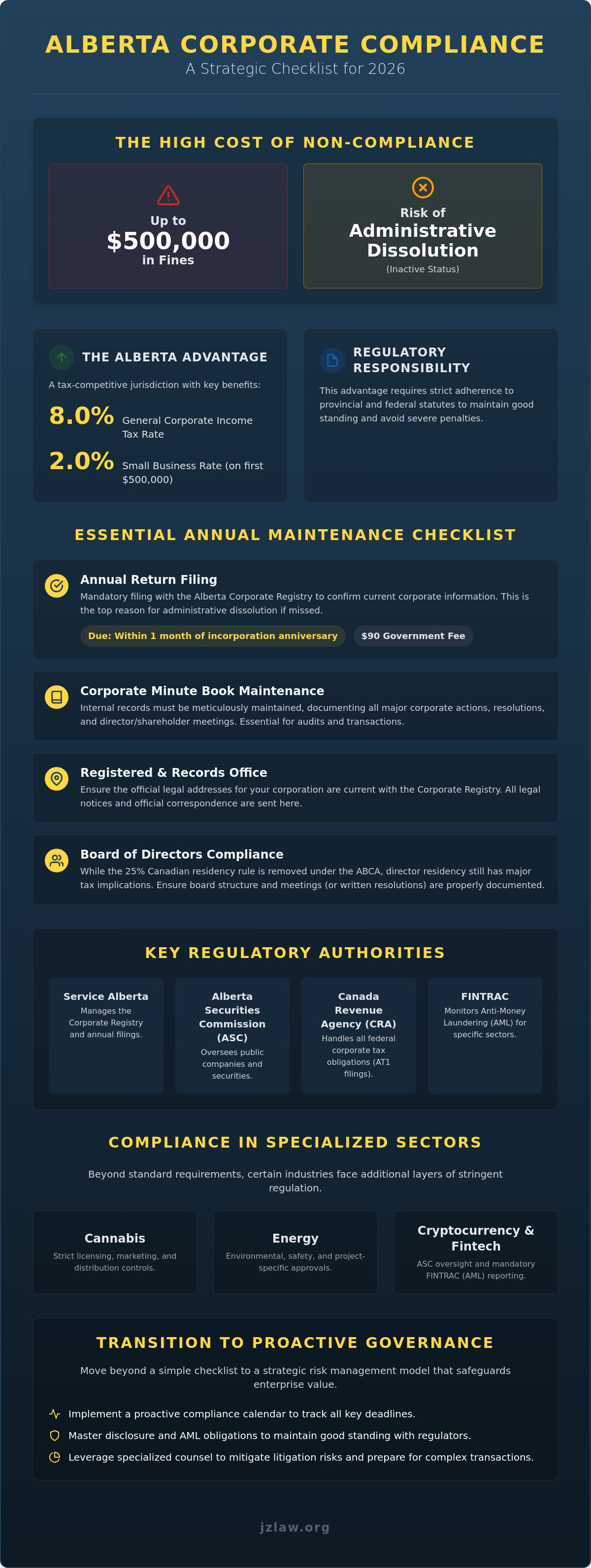
Alberta remains the most tax-competitive jurisdiction in North America. The 2026 provincial budget confirmed the general corporate income tax rate stays at 8.0%, while small businesses benefit from a 2.0% rate on the first $500,000 of active income. This creates a combined general rate of 23% when federal taxes are included. However, this "Alberta Advantage" comes with a weight of significant regulatory responsibility. Low taxes don't imply lax oversight. The Alberta Corporate Registry requires a precise annual return filing, which currently carries a $90 government fee, to maintain your corporation's active status. Failing to meet these deadlines can lead to administrative dissolution. It's a risk that far outweighs the minimal cost of diligent maintenance and professional tax structuring.
Primary Regulatory Bodies for Alberta Corporations
Effective governance requires navigating several overlapping jurisdictions. Service Alberta manages the Corporate Registry, ensuring the foundational data of your business remains accurate and public. For firms involved in securities regulation or those aiming at taking companies public, the Alberta Securities Commission (ASC) provides the necessary oversight and continuous disclosure mandates. At the federal level, the CRA handles complex tax structuring, while FINTRAC monitors anti-money laundering (AML) compliance. This is particularly vital for the innovative cryptocurrency law and fintech sectors currently expanding in Calgary. Each of these bodies has updated its enforcement protocols for 2026, making a proactive approach to your corporate compliance checklist alberta essential for long-term stability.
The distinction between provincial and federal paths is often misunderstood. While the ABCA governs internal affairs for locally incorporated companies, federal statutes often dictate how those same companies interact with the broader national economy. In 2026, the intersection of these laws has become more complex. Directors must now account for modernized privacy reviews and updated workplace safety penalties that can reach $500,000 for a first offense. Maintaining compliance is no longer just about staying active; it's about staying protected in a high-stakes environment.
Essential Corporate Governance and Annual Maintenance
Maintaining the structural integrity of your entity requires more than just meeting financial obligations. Every corporate compliance checklist alberta businesses follow must prioritize the mandatory filing of the Annual Return with the Alberta Corporate Registry. This filing, which confirms your corporation's current status and information, is due each year within one month of your anniversary of incorporation. Neglecting this $90 government filing isn't a minor oversight; it's the primary trigger for administrative dissolution. Beyond the registry, your internal records must reflect the 2026 fiscal reality. This includes ensuring your Registered Office and Records Office addresses are current, as these serve as the legal touchpoints for service of documents and official correspondence.
Minute Book Audit: A Legal Necessity
A neglected minute book is often the silent killer of corporate transactions. When sophisticated investors or buyers conduct due diligence, they look for a complete, unbroken record of shareholders, directors, and officers. Your 2026 records must include the Register of Individuals with Significant Control (ISC), a mandatory transparency requirement. Documenting every share issuance and transfer with precision is essential for effective tax structuring and avoiding future disputes. If you haven't reviewed these files lately, a professional audit can prevent significant delays during a sale or merger.
Director Liability and Indemnification
The Alberta legal landscape places heavy statutory duties on directors. You're personally liable for up to six months of unpaid wages and certain provincial tax debts if the corporation fails to meet its obligations. Reviewing your indemnification agreements and D&O insurance is a critical step in your 2026 governance strategy. It's about creating a safety net that matches your professional ambition. If you're unsure about your current exposure, seeking expert corporate counsel can help secure your personal and professional assets while ensuring your corporate compliance checklist alberta remains fully updated.
Specialized Regulatory Compliance: Cannabis and Energy
While foundational governance ensures your corporation remains a legal entity, specialized sectors in Western Canada operate under layers of stringent, industry-specific oversight. For enterprises in the cannabis and energy sectors, a corporate compliance checklist alberta must account for the rigorous mandates of the Alberta Gaming, Liquor and Cannabis Commission (AGLC) and the Alberta Energy Regulator (AER). In 2026, these bodies have shifted toward a data-driven enforcement model. This means that technical errors in reporting are no longer viewed as administrative oversights but as significant regulatory breaches. Proactive management of these requirements is essential for maintaining your social license to operate and protecting your long-term capital investments.
Alberta Cannabis Retail and Production Standards
Operating within the cannabis sector requires a dual-track approach to legal adherence. You must align your operations with the federal Cannabis Act while strictly following the provincial cannabis licensing frameworks established by the AGLC. In 2026, inventory reporting and provincial sales data must be submitted with absolute precision to avoid audits. Executives should also prioritize security clearance updates well in advance of expiry dates, as the federal backlog remains a persistent hurdle. Marketing and promotion restrictions have also tightened; any digital presence must now employ robust age-gating technologies that meet the latest provincial standards to avoid significant administrative penalties.
Oil and Gas Sector: AER and Environmental Compliance
The energy landscape in 2026 is defined by a heightened focus on liability management and environmental stewardship. Adhering to oil and gas law mandates now involves navigating complex AER directives regarding methane emissions and site closure timelines. The regulator has increased its scrutiny of the Liability Management Rating (LMR) system, requiring firms to demonstrate clear financial capacity for reclamation. Indigenous consultation is no longer a peripheral concern; it's a core compliance pillar. You must document meaningful engagement and community consultation processes to satisfy both provincial requirements and the expectations of institutional investors who prioritize Environmental, Social, and Governance (ESG) reporting.
ESG reporting has transitioned from a voluntary disclosure to a mandatory reporting pillar for many mid-cap and large-cap firms in 2026. This includes detailed tracking of carbon intensity and workplace safety metrics. With OHS administrative penalties reaching up to $10,000 per day per contravention, the cost of non-compliance is immense. To ensure data accuracy in safety reporting, the standards upheld by Zenith Sales & Calibrations Pty Ltd show how rigorous equipment calibration is a vital component of a robust safety and compliance strategy. Integrating these specialized requirements into your broader corporate compliance checklist alberta ensures that your organization doesn't just meet the minimum legal standard but sets a benchmark for operational excellence in a competitive global market.
Securities, Crypto, and Financial Reporting Compliance
For entities moving beyond basic operational maintenance, the financial reporting landscape in 2026 presents a sophisticated set of requirements. Your corporate compliance checklist alberta must now account for continuous disclosure obligations if you're a reporting issuer. The Alberta Securities Commission (ASC) mandates timely filings that go far beyond the simple annual returns discussed in previous sections. You're required to manage insider reporting through the System for Electronic Disclosure by Insiders (SEDI) and ensure all private placements comply with the Alberta Securities Act. These aren't just administrative hurdles. They're the legal safeguards that maintain investor confidence and protect your board from regulatory scrutiny.
Cryptocurrency and Blockchain Regulatory Framework
The 2026 environment for digital assets is defined by rigorous AML and FINTRAC standards. If your firm operates as a Money Services Business (MSB), you must navigate the complexities of cryptocurrency law with precision. This includes establishing robust custody protocols and security standards that satisfy both provincial and federal regulators. Tax treatment for corporate crypto holdings has also become more nuanced in 2026. You'll need a proactive approach to tax structuring to ensure your digital portfolio doesn't create unexpected liabilities during a provincial or federal audit.
Preparing for the Public Markets
Transitioning from a private entity to a public one is a transformative process that requires a rigorous compliance foundation. The prerequisites for taking companies public include at least two to three years of audited financial statements and a comprehensive review of internal control certifications. Board composition is another critical factor. TSX and TSX-V listings demand specific governance standards, including independent director requirements and established audit committees. Meeting these benchmarks early ensures a smoother transition when market conditions are favorable for an IPO. If you're preparing for a capital raise or a strategic exit, it's prudent to consult with a securities regulation expert to ensure your filings are beyond reproach.
Integrating these sophisticated financial mandates into your corporate compliance checklist alberta is the only way to ensure your organization is ready for the scrutiny of the public markets. In 2026, the cost of a missed filing or an incomplete disclosure isn't just a fine; it's a potential loss of market access and enterprise reputation. By treating financial compliance as a strategic asset, you position your firm as a reliable and transparent player in Western Canada's growing economy.
Strategic Implementation: Moving Beyond the Checklist
Transitioning from a reactive posture to a proactive governance model is what separates enduring enterprises from those vulnerable to regulatory volatility. While the foundational corporate compliance checklist alberta businesses rely on provides the necessary legal baseline, strategic implementation requires a forward looking approach. You should establish a dedicated compliance calendar for the 2026 fiscal year that aligns your corporate filings with tax structuring deadlines and industry specific reporting cycles. This synchronization ensures that your organization remains in a state of constant M&A readiness, which is essential in a market where strategic opportunities often demand rapid execution.
Integrating your compliance records into your broader business strategy also has a direct impact on your enterprise valuation. When your entity enters the due diligence phase of a merger or acquisition, or even during complex negotiations involving real estate law, the state of your minute book and your history of regulatory filings become primary metrics of institutional integrity. A flawless record signals to sophisticated investors and lenders that your business is managed with meticulous care, thereby reducing perceived risk and potentially improving the terms of your commercial transactions.
Risk Mitigation and Audit Preparedness
Effective risk management involves conducting internal audits before provincial or federal regulators intervene. You don't want your first interaction with an ASC or AER auditor to be a defensive one. By implementing robust document retention policies and regular record reviews, you can identify and rectify administrative gaps in a controlled environment. If your corporation receives an inquiry from the AGLC or the Alberta Securities Commission, having an organized, legally vetted response protocol prevents the escalation of minor inquiries into full scale investigations. It's about maintaining a position of strength through prepared transparency.
The JZ Law Approach to Strategic Compliance
At JZ Law, we view compliance as the bedrock of corporate strategy rather than a mere administrative burden. Leveraging the deep expertise of John Zang in complex regulatory environments, we provide customized frameworks that cater to the unique needs of high growth startups and established public companies alike. Our approach focuses on the proactive elimination of risks, ensuring that your 2026 operations are not only legally sound but also strategically optimized for expansion and capital events. We invite you to consult with JZ Law to secure your corporation’s 2026 compliance strategy and ensure your business remains a leader in the Alberta market.
By positioning a comprehensive corporate compliance checklist alberta at the center of your operations, you protect your assets and your reputation. In the 2026 economic landscape, professional diligence is your most valuable competitive advantage. Don't leave your corporate standing to chance; treat governance with the same strategic focus you apply to your primary business objectives.
Securing Your Corporate Future in 2026
The 2026 regulatory landscape in Alberta demands a definitive transition from reactive maintenance to a sophisticated, proactive governance strategy. By adhering to a comprehensive corporate compliance checklist alberta leaders rely on, you'll protect your enterprise from administrative dissolution and the severe $500,000 financial penalties associated with OHS breaches. We've examined how foundational tasks like minute book audits and annual returns create the transparency required for high-stakes corporate transactions and successful public offerings. In specialized sectors like cannabis, energy, and cryptocurrency, this diligence is even more critical to maintaining your operational license and investor trust.
JZ Law offers a boutique approach specifically tailored to these complex, high-stakes industries. Principal lawyer John Zang brings deep expertise in securities and cannabis regulation, providing the strategic counsel necessary to navigate Western Canada's evolving legal framework. Whether you're a high-growth startup or an established public firm, your governance shouldn't be a source of anxiety; it's a strategic asset. Secure Your Corporate Compliance with JZ Law today and ensure your organization is positioned for long-term stability. Your commitment to professional excellence deserves a robust legal foundation.
Frequently Asked Questions
What is the deadline for filing an Alberta corporate annual return in 2026?
Your Alberta corporate annual return must be filed with the Corporate Registry within one month following your corporation's anniversary of incorporation. For 2026, the government filing fee remains $90. Meeting this deadline is a foundational element of your corporate compliance checklist alberta strategy, as failing to file will eventually lead to the administrative dissolution of your entity by the registry.
Do I need a lawyer to update my Alberta minute book?
While you aren't legally mandated to use a lawyer to update your minute book, professional oversight ensures your records withstand the scrutiny of a tax audit or a potential buyer. An incomplete minute book often derails complex corporate transactions. Legal counsel provides the precision needed to document resolutions and share transfers correctly, which is vital for long-term risk mitigation and maintaining corporate integrity.
What are the 2026 FINTRAC requirements for Calgary-based crypto exchanges?
Calgary-based cryptocurrency exchanges must register as Money Services Businesses (MSBs) with FINTRAC and implement a comprehensive Anti-Money Laundering (AML) program. In 2026, this includes appointing a compliance officer, developing written policies, and conducting regular risk assessments. These rigorous standards are designed to prevent financial crimes and ensure your platform meets both federal and provincial securities regulation benchmarks in an evolving digital landscape.
How does the Alberta Business Corporations Act affect director residency in 2026?
The Alberta Business Corporations Act no longer requires a minimum percentage of Canadian resident directors, providing significant flexibility for international enterprises. This modernization allows you to compose a board based on expertise rather than geographic location. However, you should still consider the tax structuring implications of your board's residency, as the CRA and provincial tax authorities may use director residency to determine the corporation's overall tax status.
What happens if my Alberta corporation fails to file its annual return?
If your corporation fails to file its annual return, the Alberta Corporate Registry will eventually strike the entity from the register, resulting in administrative dissolution. Once dissolved, your corporation legally ceases to exist, which can lead to the freezing of corporate bank accounts and the loss of limited liability protection for directors. Reinstating a dissolved corporation involves significant legal costs and complex administrative hurdles that are easily avoided through timely filing.
Are there specific compliance requirements for cannabis retail in Alberta for 2026?
Cannabis retailers in Alberta must adhere to strict AGLC reporting mandates, including precise inventory tracking and provincial sales data submissions. In 2026, compliance also involves following updated marketing and promotion restrictions that require robust age-gating for all digital platforms. Integrating these industry-specific rules into your corporate compliance checklist alberta is essential for maintaining your retail license and avoiding the heavy administrative penalties associated with non-compliance.
How often should a corporation conduct a legal compliance audit?
You should conduct a legal compliance audit at least once per year or immediately preceding any high-stakes corporate transaction. A regular audit identifies administrative gaps before they attract the attention of regulators like the ASC or AER. This proactive approach minimizes the risk of litigation and ensures your internal records are always ready for external due diligence, which is critical for maintaining enterprise value during a sale.
Does JZ Law handle compliance for companies going public on the TSX?
Yes, JZ Law specializes in securities regulation and provides comprehensive counsel for companies preparing for initial public offerings on the TSX and TSX-V. Led by John Zang, the firm manages the complex disclosure requirements and governance standards needed for a successful transition to the public markets. Our boutique approach focuses on ensuring your entity meets every prerequisite for a strategic capital raise while mitigating the risks associated with public reporting.


Comments