


Vancouver Cannabis Production License: How Long Approval Takes
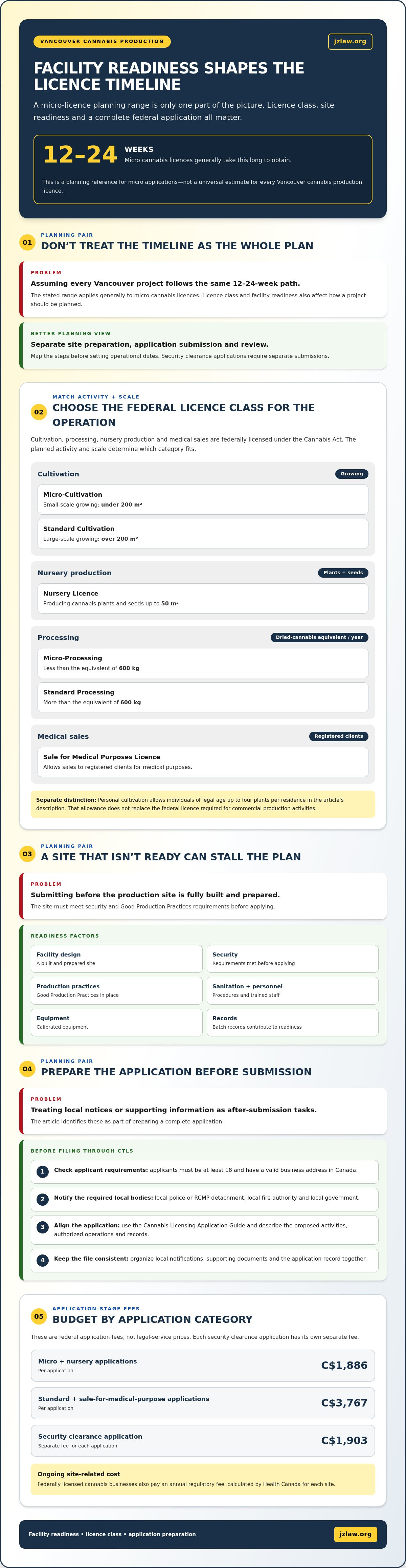
Facility readiness can shape a cannabis licence timeline before Health Canada begins reviewing an application. Micro cannabis licences generally take 12-24 weeks to obtain, but that range isn’t a universal estimate for every Vancouver cannabis production licence. Before a federal application is submitted, the site must be fully built and meet security and Good Production Practices requirements.
If you’re planning a cannabis production operation in Vancouver, it’s understandable to want a clear approval timeline before committing to a site or investment. Start by separating the licence requirements from facility readiness: the application cannot proceed as planned if the site is not prepared to meet the applicable requirements.
This article explains what the 12-24-week range covers, why facility security, sanitation and production practices matter, and how the federal application process fits into a Vancouver project. It also outlines where licensing counsel can help bring the regulatory and business considerations together before submission.
Table of Contents
How long does it take to get a cannabis licence in Canada?
Micro cannabis licences generally take 12-24 weeks to obtain. That timeframe is not a universal estimate for every Vancouver cannabis production licence: the licence class and the readiness of the facility both matter. Cultivation, processing, nursery production and medical sales are federally licensed under the Cannabis Act, according to the Department of Justice Canada.
What are the requirements for a cannabis production licence in Canada? Applicants need the appropriate federal licence for their activities, and the site must be fully built and meet security and Good Production Practices requirements before applying. Facility design, sanitation procedures, trained personnel, calibrated equipment and batch records all contribute to production readiness.
The licence class follows the operation’s purpose and scale. A Micro-Cultivation Licence is for growing on a small scale, defined here as under 200 m², while a Standard Cultivation Licence applies to growing on a large scale, defined here as over 200 m². A Nursery Licence covers producing cannabis plants and seeds up to 50 m². These categories help distinguish a small cultivation operation from a larger growing site or dedicated nursery.
Processing has its own scale distinction. A Micro-Processing Licence is required for small-scale processing using less than the equivalent of 600 kg of dried cannabis per year. A Standard Processing Licence is required for processing more than the equivalent of 600 kg of dried cannabis per year. A Sale for Medical Purposes Licence allows sales to registered clients for medical purposes. Federal processing licence holders may also sell cannabis products to retail licence holders across Canada.
Personal growing is different from operating a licensed production business. The Cannabis Act allows individuals of legal age to cultivate up to four cannabis plants per residence, and British Columbia maintains the same four-plant limit for personal cultivation. This allowance does not replace the federal licence required for commercial cultivation, processing, nursery production or medical sales. For a production project, an essential early decision is matching the planned activity, scale and facility to the appropriate licence class.
Health Canada cannabis licence applications
Federal applicants submit through Health Canada’s Cannabis Tracking and Licensing System (CTLS). The application route depends on the licence class and the proposed activities.
Health Canada Application Process
The CTLS is Health Canada’s online system for submitting federal cannabis licence applications. Applicants must be at least 18 years old and have a valid business address in Canada. Before submitting an application, they must notify their local police force or RCMP detachment, local fire authority and local government. These notifications are part of preparing a complete application, not a step to leave until after submission.
The Cannabis Licensing Application Guide explains the application process and the information required for most licence classes. Align the application with the proposed activities, such as cultivation, processing, nursery production or sales for medical purposes. This helps ensure the application accurately describes the operation, its authorized activities and its records.
Application Timelines
Micro cannabis licences generally take 12-24 weeks to obtain, as noted above. That range provides a planning reference for micro applications, rather than a single timeline for every federal licence class. Health Canada application timelines also depend on preparing the required information and completing the steps that apply to the specific application.
For a Vancouver project, schedule site preparation, application submission and review as distinct stages. Micro and standard applications fall under different licence categories, while security clearance applications require separate submissions. Mapping these elements before setting operational dates helps separate licensing work from the wider launch plan.
Preparation and Fees
Federal application-screening fees depend on the licence category: micro and nursery applications are C$1,886 per application, while standard and sale-for-medical-purpose applications are C$3,767 per application. Each security clearance application has a separate C$1,903 fee. These are application fees, not legal-service prices.
Before filing, organize the application information by licence class and proposed activities. Keep local notifications, supporting documents and the application record together so the submission is consistent and easy to review. Federally licensed cannabis businesses also pay an annual regulatory fee, calculated by Health Canada for each site. Account for both application-stage and ongoing site-related costs.
For support aligning a federal application with the project’s licensing requirements, cannabis licensing counsel can help address the legal considerations.
Municipal zoning and other regulatory requirements
Key risks include choosing a site that conflicts with local land-use rules or submitting an application that does not match the proposed operation. Assess Vancouver’s municipal requirements alongside federal requirements before committing to a property.
Municipal Zoning Requirements
Municipal zoning determines whether a proposed site and its intended use comply with local land-use rules. Federal authorization alone does not establish that a site is suitable. Assess the specific parcel and planned activities before treating it as a production location.
A 30-day desktop screen can identify initial site-selection issues, followed by a 60-day field-diligence plan. These recommended planning intervals help assess a location; they are not licence approval periods. Early review can expose land-use conflicts before site commitments become difficult to change.
Applicant Eligibility and BC Requirements
Federal applicant eligibility includes age and business-address criteria, as well as compliance history. Applicants must have complied with alcohol and tobacco tax and control laws for the past 5 years. That makes the applicant’s regulatory record relevant during planning, not merely an administrative detail to address after choosing a site.
Cannabis businesses in British Columbia may need to meet provincial requirements before selling, producing or supplying cannabis. The Cannabis Distribution Act gives the BC Liquor Distribution Branch exclusive wholesale distribution of non-medical cannabis and exclusive provision of online sales. These provincial rules affect how a proposed business can operate and distribute products.
Application Refusals and Risks
A practical application risk is a mismatch between the proposed activities, the site and the authority requested. A Vancouver location that conflicts with applicable municipal land-use rules may undermine the project, even if the federal application is prepared separately. Review the site and operating model together to identify potential problems before submission.
British Columbia also restricts anyone under 19 from possessing, consuming, selling, marketing or assisting with cannabis sale or consumption. Contraventions can result in penalties from C$2,000 to C$100,000, and imprisonment of up to twelve months for various contraventions. These consequences underscore why provincial requirements belong in the project’s operating plan.
Facility security, sanitation, and Good Production Practices
For a federal cannabis application, facility readiness means more than finishing construction. The site must be fully built and meet security and Good Production Practices requirements before submission.
Facility Security
Facility security involves preparing the site to meet applicable federal requirements. Address this before filing, because the site must be fully built and compliant when the application is submitted.
Consider the physical layout, access points and movement of people and materials through production areas. When planning perimeter and interior controls, looking at specialized physical security resources such as linkssystems.co.uk can illustrate how modern speed gates, barriers, and access control hardware function in regulated facilities. These details connect the site design to the proposed operation, rather than leaving security as a late-stage construction task.
Keep facility drawings consistent with the operational description. For example, production and storage areas shown in the drawings should match the premises described in the application. A coherent site plan makes it easier to assess how the physical facility supports its intended use.
Good Production Practices
Good Production Practices (GPP) cover facility design, sanitation, personnel training, equipment calibration and batch record-keeping. Each element supports a different part of production, from maintaining suitable working conditions to documenting activities.
Write sanitation procedures for the facility’s actual rooms and equipment. Training records should reflect personnel responsibilities, while calibration records document equipment checks. Batch records should, in turn, connect production activities with their documentation.
These elements should reflect the planned workflow. Written procedures that differ from daily practice can create gaps between documented processes and the operation. Develop procedures around the proposed activities, then align facility design, staff training, equipment records and production documentation before submission.
In British Columbia, site planning also sits alongside applicable provincial and local requirements. Addressing property considerations early can help keep facility plans coherent across the project. For guidance on site-related legal considerations, discuss real estate law issues.
JZ Law: John Zang Services
JZ Law provides cannabis licensing support to businesses assessing federal requirements, facility readiness and the regulatory steps involved in a production project. Seek legal guidance before submitting an application, committing further resources to a site or matching the proposed operation to its licence category.
JZ Law’s services also include advice on corporate matters such as taking companies public and securities regulation. These services may be relevant when a cannabis venture’s licensing plans intersect with broader corporate or capital-market decisions. The right focus depends on the questions your business needs to resolve.
For a Vancouver production project, consider legal counsel when licensing obligations and business planning need to be addressed together. Contact JZ Law to discuss your cannabis licensing matter.
Set the project up for its next decision
Before advancing a Vancouver cannabis production licence project, align the business plan with the decisions still to be made. Clarify who is responsible for site, operational and corporate decisions, and keep those responsibilities clear as plans develop. A consistent decision-making process can help the business address emerging issues while staying focused on its commercial objectives.
Legal input can help when regulatory planning intersects with wider business choices. The discussion might focus on a specific licensing question, a proposed transaction or how the venture’s structure supports its next stage. Considering these points together early gives you a clearer basis for deciding what to do next.
JZ Law’s work includes Cannabis Licensing and corporate services. To discuss the legal considerations for your project, contact JZ Law about your cannabis licensing plans. A considered next step can help you move forward with greater clarity and purpose.
Frequently Asked Questions
What types of cannabis production licences does Health Canada issue?
Health Canada issues federal licences for cultivation, processing, nursery production and sales for medical purposes. Cultivation and processing each have micro and standard classes, while nursery production has its own licence category. A Sale for Medical Purposes Licence authorizes sales to registered clients. The appropriate category depends on the business’s activities and the scale or purpose of its operation.
How do you apply for a cannabis production licence through Health Canada?
Apply through Health Canada’s Cannabis Tracking and Licensing System (CTLS). The applicant must be at least 18 years old and have a valid business address in Canada. Before submitting, notify the local police force or RCMP detachment, local fire authority and local government. Prepare the application for the intended licence class and activities, with the required site and operational information organized consistently.
How much does a Canadian cannabis production licence application and annual renewal cost?
Screening fees are C$1,886 per micro or nursery application and C$3,767 per standard or Sale for Medical Purposes application. Each security clearance application costs C$1,903. Health Canada also calculates an annual regulatory fee for each licensed site. That annual fee is separate from the application-screening charge; the amounts above do not establish a renewal fee.
How long does it take to get a cannabis production licence in Canada?
Micro cannabis licences generally take 12-24 weeks to obtain. This is a planning range for micro licences, not a timeline that applies to every class. Application readiness also matters: the proposed facility and supporting materials need to align with the activities requested. Build site preparation and application work into the schedule rather than treating the review period as the entire project timeline.
What zoning and business licence rules apply to cannabis production facilities in Vancouver?
A proposed Vancouver facility must comply with the municipal zoning and permitted land use that apply to its specific address and planned activities. Federal cannabis authorization does not determine whether a parcel allows production. Assess zoning and any applicable municipal business-licensing requirements before committing to premises, and ensure the planned cultivation or processing use is permitted at the site.
Does the City of Vancouver allow cannabis cultivation or processing businesses, and where?
Whether a cultivation or processing business can operate depends on the zoning and permitted uses for the specific Vancouver property. Do not assume that a federal licence makes every address suitable. Before choosing a site or proceeding with facility plans, assess the proposed activity against the parcel’s municipal land-use designation and applicable business-licensing requirements.


Comments