


What to Do After a Health Canada Cannabis Recall
A recall notice can leave you with an immediate question: is the cannabis product you have actually affected, and what should happen next? Knowing what to do after a Health Canada cannabis recall starts with checking the exact product and lot against the official notice, not relying on a brand name or headline alone.
It’s understandable to be concerned about possible health effects, returns, disposal, or, if you run a cannabis business, your regulatory responsibilities. The right response depends on your role and the notice’s instructions. Consumers should stop using a product identified in the recall and follow the stated return or disposal guidance. Businesses may need to assess affected inventory, communications, and records in line with the notice and applicable requirements.
This article explains how to confirm whether a specific product is affected, take documented next steps, and preserve useful records. It also outlines when cannabis regulatory counsel may help a licensed business assess its obligations. Legal support complements urgent actions directed by Health Canada; it doesn’t replace them.
Table of Contents
First, confirm whether the Health Canada cannabis recall affects your product
The first step in deciding what to do after a Health Canada cannabis recall is to read the original notice, rather than relying on a headline, social media post, or general description of the product. A recall notice identifies the products or lots subject to a recall and explains the stated reason and recommended actions. Its scope may refer to a brand, product format, lot or batch, sale period, or other package details. Use the notice’s exact wording, and don’t extend its conclusions to products it doesn’t list.
Read the notice in Health Canada’s Recalls and Safety Alerts information, and check for updates before making a final decision. A general overview of a product recall can explain the broader concept, but it can’t determine whether a particular cannabis package is affected or what you should do with it. For that, use the current Health Canada notice.
How to match a package to a recall notice
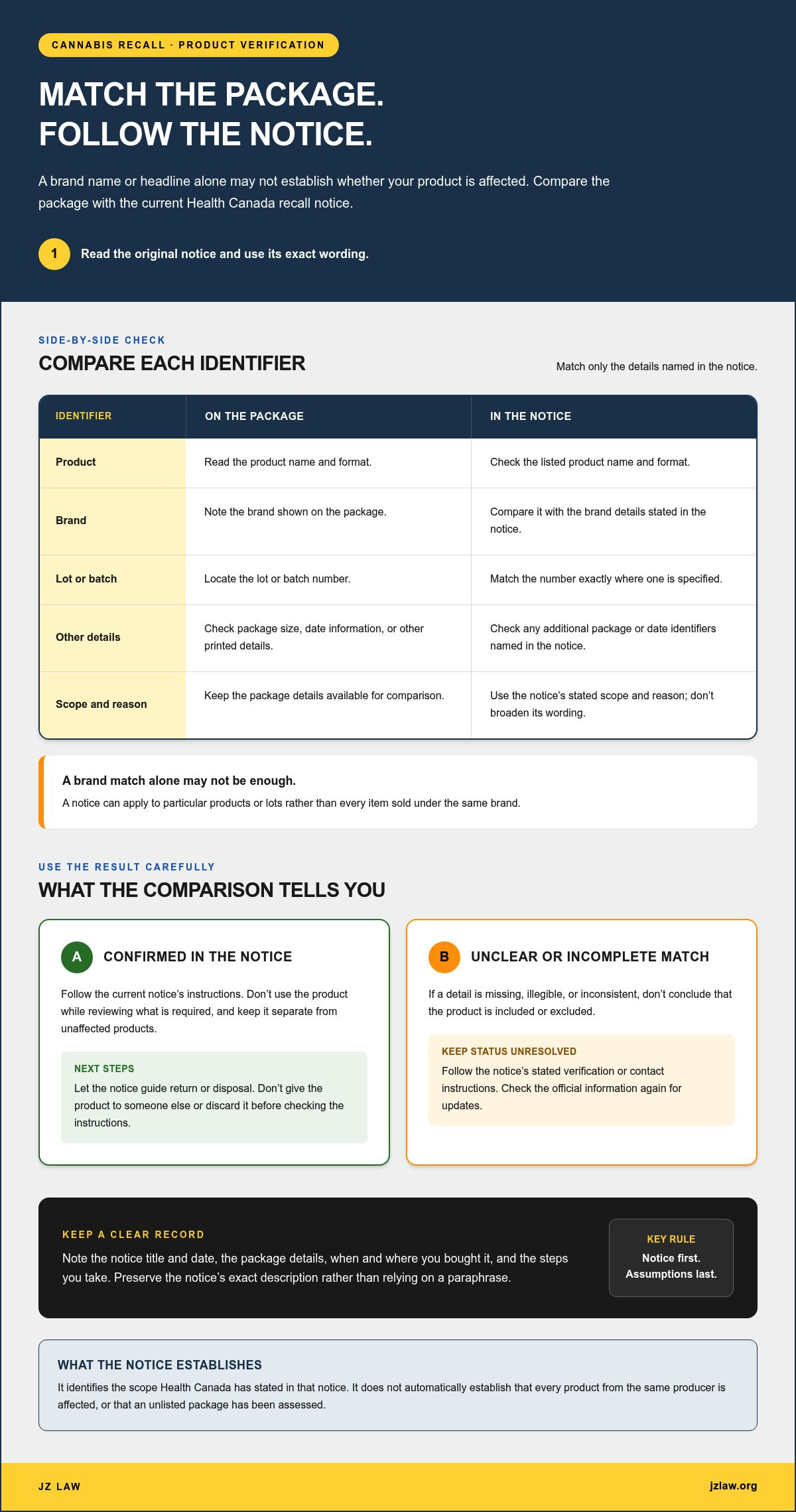
Compare the package directly with the identifiers named in the notice. Check the product name, brand, format, lot or batch number, and any other details specified, such as package size or date information. A matching brand alone may not be enough: a notice can apply to particular products or lots rather than every item sold under that brand.
If the label is difficult to read or the package is no longer available, use a receipt or order record to help identify what you bought. If an important detail is missing, illegible, or inconsistent with the notice, don’t conclude that the product is either included or excluded. Follow the notice’s stated verification instructions.
What the notice does and does not establish
Use the notice’s own wording to understand the stated reason for the recall and which products it covers. For example, a notice may describe a labelling concern or a packaging issue. Don’t broaden that description into an unreported risk or assume that products with different identifiers share the same issue.
A notice establishes the scope Health Canada has identified in that notice. It doesn’t automatically establish that every product from the same producer is affected, or that an unlisted package has been assessed. Check the official information again if time has passed or you’ve received new details, since an updated notice may revise the listed products, lots, or instructions.
For a careful comparison, record the notice’s title and date, then note the package details alongside the identifiers it lists. A simple checklist can help you avoid overlooking a difference:
Product: Compare the name, brand, and format.
Lot: Match the lot or batch number exactly where one is specified.
Other identifiers: Check any additional package or date details named in the notice.
Scope and risk: Preserve the notice’s exact description rather than relying on a paraphrase.
If the comparison remains uncertain, keep the status unresolved and use the notice’s stated verification route. A careful match helps distinguish a confirmed affected product from one that merely appears similar, while keeping your next steps grounded in official information.
What to do immediately after a cannabis product is recalled
Once you’ve confirmed that a package is covered, follow the instructions in the current Health Canada notice. Don’t use the product while you review what the notice requires, and don’t assume that returning it, throwing it away, or keeping it is the right step in every case. Let the notice guide what happens next. If its instructions are unclear, pause and use the stated contact or verification route rather than improvising.
Keep the product and its packaging separate from unaffected cannabis products. This helps prevent accidental use and keeps identifying details available as you follow the recall process. Don’t give the product to someone else. Record the notice title and date, product and lot details, when and where you bought it, and the steps you take. Keep only personal information relevant to the issue, and don’t share private purchase or health details unnecessarily.
If you bought or possess the affected product
Read the notice for its specific directions on stopping use, returning the product, or disposing of it. Retain the package and proof of purchase where practical and consistent with those directions. If the notice doesn’t explain a practical detail, use its stated contact instructions. Don’t send or discard the product before checking the notice.
Keep a brief, dated record of what you did, including any return or disposal steps. If you purchased the product online, an order confirmation may help establish its identity and purchase details; a receipt can serve the same purpose for an in-store purchase. Avoid sharing more personal information than is needed to resolve the recall question.
If you may have experienced an adverse reaction
Seek appropriate medical care for serious, worsening, or urgent symptoms. For urgent medical needs, don’t delay care while trying to complete a report or determine whether the symptoms are connected to the recalled product. A clinician can assess your health; a recall notice alone can’t diagnose or explain an individual reaction.
For accurate follow-up, write down the product name and lot, when and how much you used, when symptoms began, what you experienced, and any care received. Keep notes factual and distinguish what you observed from what you suspect. To report a possible adverse reaction, consult Health Canada’s current official instructions for reporting reactions to health products, including cannabis. Confirm the applicable pathway on Health Canada’s website rather than relying on an old form or third-party directions, since reporting instructions can change.
These records can also help you answer questions from relevant authorities. If you’re a licensed cannabis business managing a recall, regulatory counsel can help assess how the notice applies to your licence, communications, and documented response. This support complements, but doesn’t replace, immediate directions in the Health Canada notice. Cannabis regulatory counsel can help businesses assess those issues in context.
How a cannabis recall affects licensed businesses differently
A consumer’s response usually centres on a specific package and the instructions in the recall notice. A licensed business may need to assess a broader set of questions: which inventory could be affected, where it went, who within the organization is responsible for each response, and what records or communications are required. The practical steps below help distinguish those roles, but the notice and applicable requirements govern the response.
Recall duties depend on the product, licence, facts, and applicable rules. The same notice may raise different operational issues for a licence holder, distributor, or retailer, so don’t assume that one business’s process or timeline applies to another.
Consumer actions versus licence-holder response
This comparison is practical guidance, not a substitute for notice-specific requirements. A consumer can focus on the identified package and purchase history. A business should compare the notice against inventory, sales, distribution, and other relevant transaction records, documenting how it determined which products may be in scope. Map the relevant licence roles and internal decision-makers, then confirm who is responsible for each action before communicating externally.
For a business, the review should be traceable from the notice through the decisions made. Keep the source notice and any updates together with product and lot identifiers, the inventory review, relevant distribution records, decisions, communications, and corrective actions. Record dates and decision-makers, and separate confirmed information from assumptions. This makes it easier to explain what was reviewed and why a particular action was taken.
Records, communications, and regulatory questions
Check the current requirements that apply to the specific licence holder, including relevant licence conditions, internal recall procedures, and provisions of the Cannabis Act and Cannabis Regulations. Don’t rely on a generic checklist or assume every licence class has identical responsibilities. Broader context on Canadian cannabis licensing and regulatory frameworks can help frame that review, but it doesn’t replace checking current rules and the notice itself.
Before sending a notice or making a public statement, identify who needs the information, what has been confirmed, and which instructions govern the message. Preserve a copy of communications and note when decisions are revisited as facts change. If the notice’s scope or the business’s responsibilities are uncertain, cannabis regulatory counsel can help assess the applicable rules, licence conditions, and documented response. That advice supports decision-making; it doesn’t replace immediate directions in the Health Canada notice.
For teams coordinating from Calgary, Toronto, Vancouver, Hamburg, Berlin, Frankfurt, New York City, or Denver, keep the Canadian recall review tied to Health Canada’s notice and assess any separate local obligations independently.
A practical checklist for managing recall response and uncertainty
A consistent process helps consumers and businesses act on what’s confirmed without treating unanswered questions as facts. Use this sequence alongside the current Health Canada notice. If the notice directs an immediate action, follow it while you continue reviewing the details.
Verify: Compare the notice with the product and lot identifiers, and check the official notice for updates.
Isolate or stop use: Don’t use a product identified in the notice; keep it separate and follow the notice’s return or disposal directions.
Document: Record the notice, relevant product and purchase details, decisions, and actions, noting what is confirmed and what remains uncertain.
Communicate: Share accurate, necessary information with relevant people, and identify who is responsible for follow-up if you’re acting for a business.
Review: Revisit the notice and your records as information changes, updating the response when new official details affect the scope or instructions.
For a business, assign an owner to track follow-up and official updates, and make clear who can approve operational decisions and external communications. Avoid presenting a preliminary assumption as a confirmed finding.
Build a clear recall-response record
Keep the notice version and date, affected product identifiers, relevant purchase or inventory dates, and the source for each material decision together. Businesses can add inventory and distribution checks, communications, actions taken, unresolved questions, and the person responsible for each follow-up item. Preserve original records; if a detail needs correction, record the correction with its date and context rather than silently changing the original.
Contemporaneous records support a clearer compliance review because they show what was known, when it was known, and why decisions were made. Dated notes can also help distinguish information available at the time from details learned later.
Know when the issue needs legal assessment
Consider legal advice if the affected scope, licence responsibilities, reporting expectations, communications, or potential liability is unclear. Prompt assessment may be especially useful if a recall involves multiple products, counterparties, or parts of business operations. The applicable requirements depend on the specific facts and licence, so avoid assuming a universal process or deadline.
Keep immediate actions required by the notice moving while legal questions are assessed. Counsel can help interpret applicable rules and licence conditions, organize the response, and identify issues that warrant further review; that advice complements, but doesn’t replace, Health Canada directions.
JZ Law advises businesses on cannabis licensing and regulatory questions arising from recalls. Learn about JZ Law’s regulatory counsel.
When cannabis regulatory counsel can help after a Health Canada recall
A recall can raise legal and operational questions that aren’t answered by comparing a package with a notice alone. For a licensed business, the relevant analysis may depend on the notice’s scope, the product involved, the licence held, applicable licence conditions, and the business’s actions and records. Counsel can help assess how those factors fit together and identify questions that need further review.
Legal advice can be useful when it’s unclear which requirements apply, how to interpret the notice in the context of a licence, or whether communications and response decisions are consistent with the business’s obligations. A review can also help identify gaps in the record or unresolved issues that may affect ongoing compliance planning. The assessment should be grounded in current requirements and the specific facts, not a generic recall template.
That support doesn’t replace immediate directions from Health Canada. Continue taking notice-directed actions while seeking advice on complex questions, and avoid delaying a required response while waiting for a legal assessment. Counsel’s role is to support informed decision-making, not to determine an individual health outcome or guarantee a particular regulatory result.
Questions legal counsel can help assess
Counsel can help identify which licence-holder responsibilities and notice-specific directions apply to the circumstances, and review whether the business’s records, communications, and decisions present unanswered regulatory questions. If a recall affects more than one product, counterparty, or business function, a focused review can help clarify how those issues relate. Advice can also inform future compliance planning without promising a particular outcome.
Prepare for a focused legal consultation
Organize the current recall notice, product and lot details, relevant licence information, and records of the response to date. A concise timeline can show when the business received information, what it did, and when key decisions were made. Separate confirmed facts from assumptions, and list the specific regulatory or operational questions that remain unresolved.
This preparation gives the discussion a clear factual foundation and helps focus attention on the issues that matter to the business. JZ Law advises on cannabis licensing and regulatory compliance, including questions that may arise as a business assesses its response to a recall. For tailored legal analysis, review JZ Law’s cannabis regulatory counsel.
Turn a recall response into stronger future readiness
A recall can highlight where a business’s existing processes need clearer ownership, better coordination, or more reliable records. Once urgent steps are addressed, consider whether the experience points to improvements in staff responsibilities, escalation paths, or how regulatory updates are reviewed. This forward-looking review can help make future decisions more consistent without assuming that every recall will require the same response.
If you’re assessing what to do after a Health Canada cannabis recall and still have questions about your business’s regulatory position, tailored legal analysis can help clarify the issues that depend on your licence and circumstances. JZ Law advises on cannabis licensing and regulatory compliance, with a practice focused on complex regulatory and corporate sectors. Legal advice supports sound business decisions, while directions in the official notice remain central to the immediate response.
Discuss a cannabis regulatory matter with JZ Law to assess the issues affecting your business and plan a considered next step.
Frequently Asked Questions
What should I do first if Health Canada recalls a cannabis product?
Open the original Health Canada recall notice and check whether it identifies the product you have. To decide what to do after a Health Canada cannabis recall, rely on the notice’s current wording, not a repost or headline. Note the notice date and any product identifiers it lists. Whether you’re in Calgary, Toronto, or Vancouver, the same federal notice is the starting point for checking a product sold in Canada.
Should I stop using cannabis immediately after a recall notice?
If the notice identifies your product, stop using it and follow the notice’s instructions. If you’re still checking whether your package matches, set it aside while you verify rather than continuing to use it. Keep it out of reach of children and pets, and don’t pass it to another person. If you feel unwell after use, seek appropriate medical advice, particularly for serious or worsening symptoms.
How do I know whether my cannabis product is part of the recall?
Compare the package with every identifier in the official notice, such as the product name, brand, format, lot or batch number, and package size if specified. For example, a matching brand name alone may not establish that a different lot is included. If the label is damaged or a number is hard to read, use a receipt or order record to help identify the purchase, and leave the match unresolved if key details remain unclear.
Can I return or throw away a recalled cannabis product?
Use the return or disposal directions in the specific recall notice. Don’t assume a retailer will offer a refund or that household disposal is appropriate, because the notice may give different instructions. Keep the original packaging and proof of purchase if practical and consistent with those directions. If the notice doesn’t explain a practical step, follow its stated contact instructions before disposing of the product.
What should a cannabis business do after a Health Canada recall?
A business should assess the notice against its own products, records, and role in the supply chain. For example, a licence holder may need to review production or distribution information, while a retailer may need to check stock and sales records. Assign responsibility for tracking updates and coordinating communications. The applicable response depends on the notice, licence, and facts, so don’t apply another business’s timeline or procedure without checking current requirements.
How do I report an adverse reaction to a recalled cannabis product?
For serious, worsening, or urgent symptoms, seek medical care first. To prepare an accurate report, note the product and lot details, when and how much you used, when symptoms began, and any care received. Then consult Health Canada’s current official guidance for reporting an adverse reaction involving cannabis. Follow the reporting pathway that applies to your situation, and distinguish observed symptoms from assumptions about what caused them.
Does a Health Canada cannabis recall mean every product from that company is unsafe?
No. A recall notice identifies the products or lots within its stated scope; it doesn’t automatically establish that every product from the same company is affected. For example, a notice may name one format or lot while leaving other products unlisted. That distinction doesn’t confirm that an unlisted item has been assessed, so check the latest official notice and compare its identifiers before drawing a conclusion.



Comments