


AGLC Cannabis License Renewal Guide for Alberta Retailers
- jzanglaw
- Aug 3
- 12 min read
An aglc cannabis license renewal is not a mere administrative formality; it is a comprehensive audit of your corporate integrity that can determine the future of your business. You've worked hard to establish your presence in the Alberta market, and the prospect of facing administrative sanctions or operational downtime during the 2026 renewal window is understandably stressful. Whether you're concerned about disclosing complex corporate structural changes or navigating the $1,200 annual fee schedule effective as of June 1, 2026, the pressure to maintain a flawless compliance record is immense.
We recognize that the intricacies of strict background checks and financial audits can feel overwhelming, but these regulatory requirements are manageable with a proactive, strategic approach. This guide will help you master the complexities of the renewal process with precise legal insights designed to protect your retail operations. We'll examine the critical steps for a successful license reissue, including updated SellSafe requirements and the nuances of the AGLC online portal, ensuring your business remains compliant and profitable through 2026 and beyond.
Table of Contents
Navigating the AGLC Cannabis License Renewal Process in 2026
The landscape of cannabis retail in Alberta has matured significantly, shifting from the rapid expansion of early years to a period of stringent regulatory refinement. In 2026, the Alberta Gaming, Liquor and Cannabis Commission (AGLC) has intensified its scrutiny of corporate structures and financial transparency. Successful aglc cannabis license renewal now requires a proactive approach that begins long before your current permit expires. The AGLC mandates a minimum four-week processing window for renewals, but treating this as a mere suggestion is a tactical error. Any complexity in your filing, from changes in beneficial ownership to updated tax structures, can easily extend this timeline, leaving your operations vulnerable.
There's a vital legal distinction between a simple reissue and a comprehensive license renewal. While many retailers view the process as a routine administrative task, the regulator treats it as a fresh opportunity to audit your compliance history. The 2026 regulatory environment demands more rigorous disclosure regarding "Associated Persons" and corporate debt than previous cycles. Falling into the "expiration trap", which is the assumption that you can resolve filing discrepancies after your license date has passed, is a risk that can lead to immediate operational suspension. Continuity isn't guaranteed; it's earned through meticulous preparation.
The Role of the AGLC Online Licensing Portal
The portal serves as the primary gateway for your aglc cannabis license renewal, offering a streamlined interface for fee payments and documentation uploads. However, technical pitfalls often arise from outdated Stakeholder IDs or mismatched account permissions. If your internal corporate records don't align perfectly with the portal’s data, the system may trigger an automatic flag, causing administrative delays that are difficult to rectify as the deadline approaches. Retailers must ensure their digital credentials are current and that the individual managing the submission has the legal authority to bind the corporation.
Legal Consequences of Missed Renewal Deadlines
The stakes for a lapsed license are absolute. If a renewal isn't finalized before the expiration date, the retailer must immediately cease all cannabis sales. This doesn't just halt revenue; it creates significant risks regarding product seizure and the potential for costly reapplications. Beyond the immediate financial loss, directors face professional liability if a license lapses due to negligence. In the eyes of the regulator, an expired license is a sign of poor corporate governance, which can haunt future expansion plans or potential divestiture strategies. Maintaining a clean record is essential for long-term business health.
Mandatory Compliance and Documentation for Alberta Retailers
Building on the strategic timelines discussed earlier, the actual submission via AGLC's Online Licensing Portal requires a precise assembly of current corporate records. The June 10, 2026, update to the Retail Cannabis Store Handbook introduced specific requirements for financial reporting that retailers must not ignore. Your aglc cannabis license renewal depends on the seamless alignment of your municipal business standing with provincial records. If your local permit has lapsed or contains discrepancies in the listed premises address, the AGLC will likely pause your application until the municipal office provides written verification of compliance. This synchronization is often overlooked but remains a primary cause for administrative holds.
Security protocols and physical floor plans also require scrutiny during this window. If you've modified your storage area or adjusted camera placements since your last filing, these changes must be documented and submitted as part of the renewal package. Documenting every alteration to the retail space ensures that your physical site remains in lockstep with the approved plans on file. Failure to disclose physical alterations can lead to a finding of non-compliance during a site inspection, which could jeopardize the entire reissue process.
Updating Corporate and Ownership Structures
Transparency regarding the individuals behind the business remains a cornerstone of the Alberta regulatory framework. Every "Associated Person", including new shareholders or recently appointed members of the Board of Directors, must possess valid background checks that meet current 2026 standards. Corporate restructuring, while often necessary for growth, can complicate your retail license standing if not reported with legal precision. Strategic reporting of complex investment or financing arrangements ensures that the regulator understands the source of funds without triggering unnecessary red flags. We often see retailers struggle when they fail to proactively disclose shifts in beneficial ownership, leading to intense questioning during the review cycle.
Financial Disclosure and Tax Compliance
Financial integrity is under a microscope in 2026. Retailers must demonstrate that their tax structuring remains fully compliant with both Alberta and federal laws to avoid the appearance of instability. JZ Law provides specialized assistance in tax structuring during corporate transitions to ensure your business remains a low-risk candidate for renewal. Preparing for potential AGLC financial audits during the renewal window is a defensive necessity. A clean audit trail protects your operations from the administrative friction that often accompanies complex aglc cannabis license renewal filings. For those managing high-stakes changes, securing expert legal representation can be the difference between a routine reissue and a protracted legal challenge.
Beyond the Portal: Addressing Complex Renewal Challenges
While the technical submission via the AGLC Online Licensing Portal is a necessary step, the real complexity of an aglc cannabis license renewal often lies in resolving underlying legal or operational friction. The regulator's automated systems are designed to identify inconsistencies that go far beyond simple data entry errors. If your retail operation receives a "red flag" notification, it usually signals a deeper concern regarding your corporate standing, such as an undisclosed change in control or a discrepancy in the background check of an "Associated Person." These flags aren't just administrative hurdles; they're formal inquiries that require a structured, evidence-based response to prevent the suspension of your license.
Background check discrepancies are particularly sensitive. AGLC standards for 2026 are unforgiving regarding the disclosure of past legal issues or financial irregularities involving key employees and owners. If an audit reveals a mismatch between your submission and the regulator's findings, the burden of proof shifts to the licensee. Similarly, retailers often find themselves caught in municipal zoning or lease disputes during the renewal window. Because provincial standing is tied to local compliance, a landlord dispute or a change in local land-use bylaws can effectively block a renewal. Managing these transitions requires a strategic approach that addresses the legal root of the conflict before it reaches the regulator’s desk.
Responding to AGLC Administrative Sanctions
Past violations don't have to be a death sentence for your business, but they must be managed with extreme care during the aglc cannabis license renewal process. The AGLC’s administrative sanction guidelines for 2026 categorize violations based on their severity and frequency. If your business is currently facing an investigative inquiry or has been called to a hearing, professional legal representation is vital. We focus on mitigating the impact of previous infractions by demonstrating proactive corrective measures and a commitment to future compliance. Addressing these sanctions head-on prevents them from becoming an insurmountable barrier to your license reissue.
Disclosing Strategic Corporate Transactions
Mergers, acquisitions, and internal reorganizations present significant challenges to the renewal cycle. Any shift in the corporate hierarchy or the introduction of new investors must be meticulously documented to satisfy the regulator's transparency requirements. Ensuring that corporate transactions are properly reported prevents the AGLC from viewing these changes as an attempt to circumvent background checks or disclosure rules. Conduct thorough legal due diligence before you even open the portal. A well-prepared disclosure package demonstrates corporate maturity and protects your operational continuity during high-stakes business sales or acquisitions.
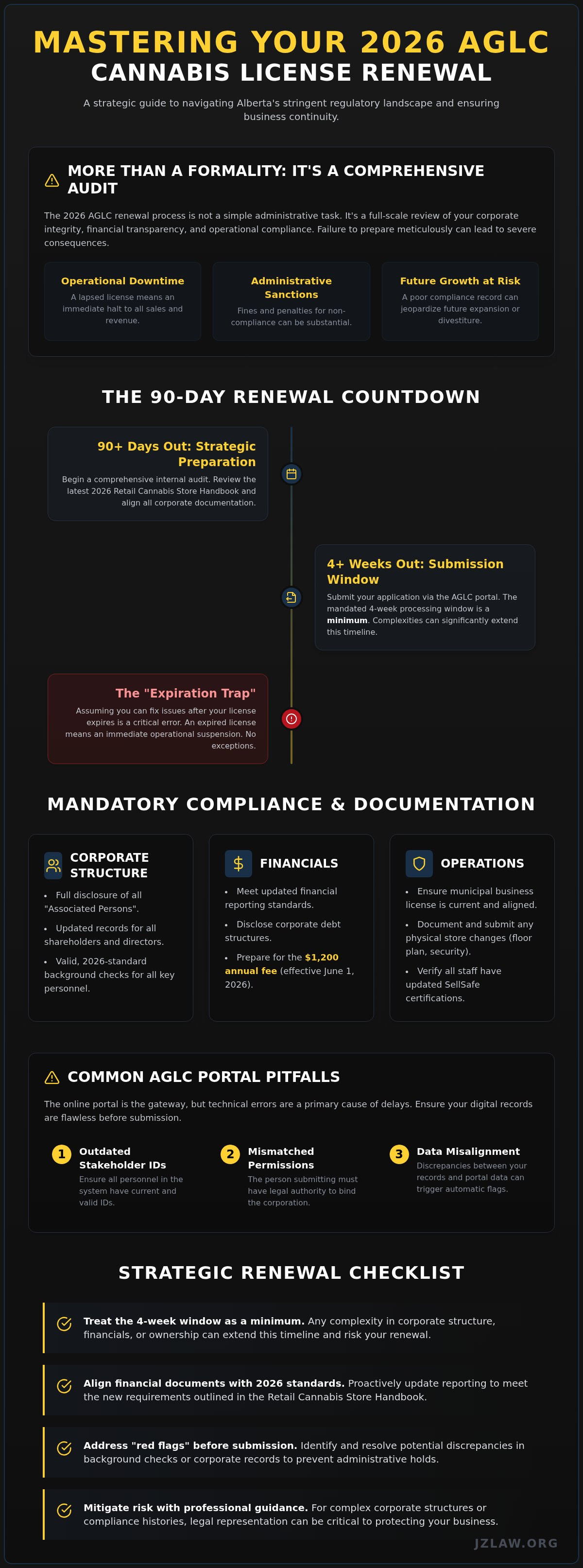
A Strategic Checklist for a Seamless Renewal Cycle
Achieving a successful aglc cannabis license renewal requires a timeline that far exceeds the four-week minimum processing window mentioned earlier. We recommend initiating a comprehensive internal audit at least 90 days before your license expires. This proactive window allows for the rectification of corporate discrepancies or physical site issues that could otherwise derail your submission. A critical first step involves reviewing the Retail Cannabis Store Handbook, specifically the June 10, 2026, policy updates. Ensuring your current operating procedures align with these latest expectations prevents the regulator from identifying systemic compliance gaps during the review.
Staffing compliance is another frequent point of failure during the renewal cycle. You must verify that every employee's SellSafe Cannabis Staff Training is current and documented. While these certifications are valid for five years, tracking expiration dates across a large team is a common administrative oversight that can lead to significant fines. Similarly, conducting a mock compliance audit of your physical premises is vital. This exercise should mirror a formal AGLC inspection, focusing on point-of-sale security, storage access logs, and advertising compliance. Identifying a minor display violation internally is far preferable to having it flagged by an inspector during the renewal window.
Pre-Submission Legal Due Diligence
Before you finalize your portal entry, confirm that your corporate minute book matches your AGLC stakeholder profile with absolute precision. Reviewing cannabis licensing standards helps identify subtle disclosure gaps, such as minor changes in debt financing or secondary business interests of directors, that might trigger an invasive audit. This final legal review of all disclosure documents ensures that your submission is transparent and consistent, reducing the likelihood of administrative friction or follow-up inquiries.
Post-Submission Monitoring and Communication
Once your application is submitted, active monitoring through the Online Licensing Portal is essential to maintain momentum. You must manage correspondence with AGLC inspectors and licensing officers with professional precision. If a "Request for Information" (RFI) is issued, treat it as a high-priority legal inquiry rather than a casual request. A vague or delayed response can be interpreted as a lack of transparency, potentially leading to a more rigorous investigation. Proactive communication demonstrates that your retail operation is managed with the level of diligence the regulator expects in 2026. If you're managing a complex corporate structure, securing professional legal oversight ensures your checklist is exhaustive and your submission remains bulletproof.
How JZ Law Secures Your Cannabis Business Continuity
Securing the longevity of your retail cannabis operation requires more than just meeting the basic administrative requirements of the AGLC. It demands a partnership with a legal team that understands the intersection of provincial regulation and corporate strategy. JZ Law provides the expert counsel necessary to navigate the most complex sectors of the Alberta framework, ensuring that your aglc cannabis license renewal is treated as a critical component of your broader business health. We don't just react to regulatory changes; we anticipate them, providing you with the strategic foresight needed to maintain a clean compliance record in an increasingly competitive market.
Contested renewals often stem from nuanced legal issues that a standard customer care representative cannot resolve. Whether you're facing a background check failure for an "Associated Person" or a dispute over a change in control, JZ Law steps in as a strategic advocate. We specialize in high-stakes regulatory challenges, representing your interests during AGLC hearings or investigative inquiries. By integrating the renewal process into your corporate and securities strategy, we ensure that every disclosure strengthens your standing with the regulator rather than creating new vulnerabilities. This comprehensive approach is essential for retailers who view their license as an asset to be protected and leveraged for future growth.
The JZ Law Regulatory Advantage
John Zang’s extensive experience in cannabis licensing and corporate transactions provides our clients with a distinct advantage. As a boutique firm, we prioritize deep, strategic engagement over high-volume processing. This focus allows us to handle complex tax structuring and intricate corporate reorganizations with the precision they require. Our clients gain peace of mind knowing that their aglc cannabis license renewal is overseen by professionals who understand both the letter of the law and the business realities of the Alberta cannabis market. We provide the stability needed to navigate the evolving 2026 regulatory landscape with confidence.
Contact JZ Law for a Compliance Consultation
Engaging JZ Law for an Alberta cannabis license audit is a proactive step toward securing your business's future. We offer tailored legal solutions for high-growth cannabis enterprises, from initial licensing to taking companies public. If you're approaching your 90-day internal audit window or have received a "Request for Information" from the regulator, our team is ready to provide the high-level representation you need. We'll review your corporate structure, audit your compliance history, and ensure your renewal package is beyond reproach. Protect your license and schedule a consultation with JZ Law today.
Securing Your Retail Future in Alberta's 2026 Cannabis Market
The 2026 regulatory landscape for Alberta cannabis retailers demands more than just adherence to basic deadlines; it requires a sophisticated understanding of how corporate governance influences your standing with the regulator. By initiating a 90-day internal audit and addressing potential discrepancies in background checks or physical site security well before the submission date, you position your business for a seamless aglc cannabis license renewal. This proactive approach mitigates the risk of administrative sanctions and protects the continuity of your operations in an increasingly scrutinized sector.
JZ Law provides the specialized counsel necessary to handle complex corporate transactions and high-stakes regulatory challenges with a global industry perspective. Our boutique firm focus ensures you receive the dedicated attention required to navigate AGLC regulations with absolute precision. Secure your Alberta cannabis operations with a strategic compliance audit from JZ Law. We look forward to helping you maintain a clean compliance record and a resilient retail presence throughout 2026 and beyond.
Frequently Asked Questions
How far in advance should I start my AGLC cannabis license renewal?
You should initiate your internal compliance audit at least 90 days before your current license expires. While the regulator suggests a four-week processing window, this longer timeline allows you to resolve corporate discrepancies or municipal zoning issues without risking operational downtime. Starting early ensures that your documentation is exhaustive and that any "Request for Information" from the regulator doesn't push you past your expiration date.
What happens if my AGLC cannabis license expires before the renewal is processed?
You must immediately cease all cannabis sales and retail operations if your license expires. An expired permit isn't merely a late filing; it's a legal void that makes any continued business activity unauthorized and subject to product seizure. To prevent this, your aglc cannabis license renewal must be fully approved and reissued before the clock runs out on your existing permit.
Do I need to report a change in shareholders during the renewal process?
Yes, all changes in beneficial ownership or the Board of Directors must be disclosed to the regulator. The AGLC treats the renewal cycle as a fresh audit of your corporate integrity and requires transparency regarding all "Associated Persons." Failure to report new shareholders or significant shifts in control can be viewed as an attempt to circumvent background checks, leading to severe administrative sanctions.
Can AGLC deny my renewal based on a past administrative sanction?
The AGLC has the authority to deny a renewal if past sanctions indicate a pattern of non-compliance or a failure of corporate governance. However, a single violation doesn't automatically result in a denial if you can demonstrate proactive corrective measures. We focus on presenting a narrative of improved compliance to ensure that previous infractions don't jeopardize your current standing or future expansion plans.
Is a new background check required for every license renewal cycle?
Associated Persons and key directors must maintain valid, up-to-date background checks that meet 2026 standards. While the requirement for every retail staff member to be a "Qualified Cannabis Worker" was removed in July 2025, the scrutiny on owners and senior management remains intense. You must verify that the background documentation for all controlling individuals is current before you finalize your submission in the online portal.
What are the most common reasons for AGLC renewal delays in 2026?
Delays in 2026 are most frequently caused by discrepancies between municipal business licenses and provincial AGLC records. Other common hurdles include undisclosed changes in corporate debt financing or incomplete financial reporting for the current fiscal year. Technical errors, such as mismatched Stakeholder IDs within the portal, also trigger administrative holds that require manual intervention from a licensing officer to resolve.
How much are the AGLC cannabis license renewal fees for 2026?
The annual fee for a cannabis store license is $1,200, according to the fee schedule that became effective on June 1, 2026. This fee is separate from the initial $400 application fee and must be paid in full through the online portal to complete your submission. Ensuring these funds are available and processed correctly is a fundamental step in maintaining your legal standing to operate in Alberta.
Should I hire a lawyer to handle my AGLC license renewal?
Engaging a lawyer is a strategic decision that provides professional oversight and risk mitigation for your business. For retailers with complex corporate structures or a history of regulatory friction, a lawyer ensures that every disclosure is legally sound and strategically presented. Professional representation transforms the aglc cannabis license renewal into a proactive audit that protects your long-term operational continuity and corporate reputation.


Comments