


Continuous Disclosure Requirements in Alberta: A 2026 Regulatory Guide
- jzanglaw
- 2 days ago
- 12 min read
A single administrative oversight in your SEDAR+ filings is no longer just a clerical error in 2026. It's a direct invitation for the Alberta Securities Commission to exercise its expanded enforcement powers, which now include the authority to halt trading for up to 15 days. Mastering the continuous disclosure requirements alberta issuers face is no longer about simple box-ticking; it's a fundamental pillar of corporate stability. You likely feel the mounting pressure of harmonizing these complex Alberta rules with broader Canadian standards while fearing the reputational and financial sting of a cease-trade order.
We understand that the high cost of late-filing fees and the complexity of the new 2026 voluntary access model can be overwhelming for even the most seasoned reporting issuers. This guide provides the clarity you need to navigate NI 51-102 and specific ASC mandates with precision. You'll gain a thorough understanding of both periodic and event-driven disclosure obligations, ensuring your legal filings aren't just compliant but also strategically aligned with your long-term business objectives. We'll explore the updated filing deadlines for venture and non-venture issuers, the streamlining of investment fund reporting, and the proactive measures required to safeguard your organization against modern regulatory scrutiny.
Table of Contents
Understanding the Framework: NI 51-102 and the ASC
Continuous disclosure represents the foundational obligation of every reporting issuer to provide the public with a timely and accurate stream of material information. This isn't a periodic formality but a constant legal duty that ensures the integrity of the market. In Calgary's dynamic capital markets, the Alberta Securities Commission (ASC) acts as the primary guardian of this transparency. They monitor filings to ensure that investors have access to the same information as corporate insiders, which maintains the trust necessary for capital formation. Without this steady flow of data, the valuation of securities would become speculative rather than evidence-based, undermining the stability of the entire provincial economy.
The primary regulatory vehicle for these obligations is National Instrument 51-102 (NI 51-102). This instrument was developed by the Canadian Securities Administrators (CSA) to harmonize the continuous disclosure requirements alberta and other provinces enforce. By creating a unified standard, the CSA allows issuers to operate across provincial borders without facing a fragmented regulatory environment. While NI 51-102 provides the "how," the Securities Act (Alberta) provides the underlying "why," granting the ASC the power to enforce these rules within the province. This dual-layered approach ensures that local nuances are respected while maintaining national consistency.
The Legal Basis of Continuous Disclosure in Alberta
The Securities Act (Alberta) serves as the legislative bedrock for all market activity. It mandates that once an entity attains "reporting issuer" status, it must adhere to disclosure protocols even if its shares aren't listed on an exchange. Under 2026 Alberta law, a reporting issuer is any entity that has issued securities via a prospectus or has become subject to public disclosure rules through a statutory merger or reorganization. All filings must be submitted through SEDAR+. This process remains vital for those taking companies public.
Who Must Comply? Venture vs. Non-Venture Issuers
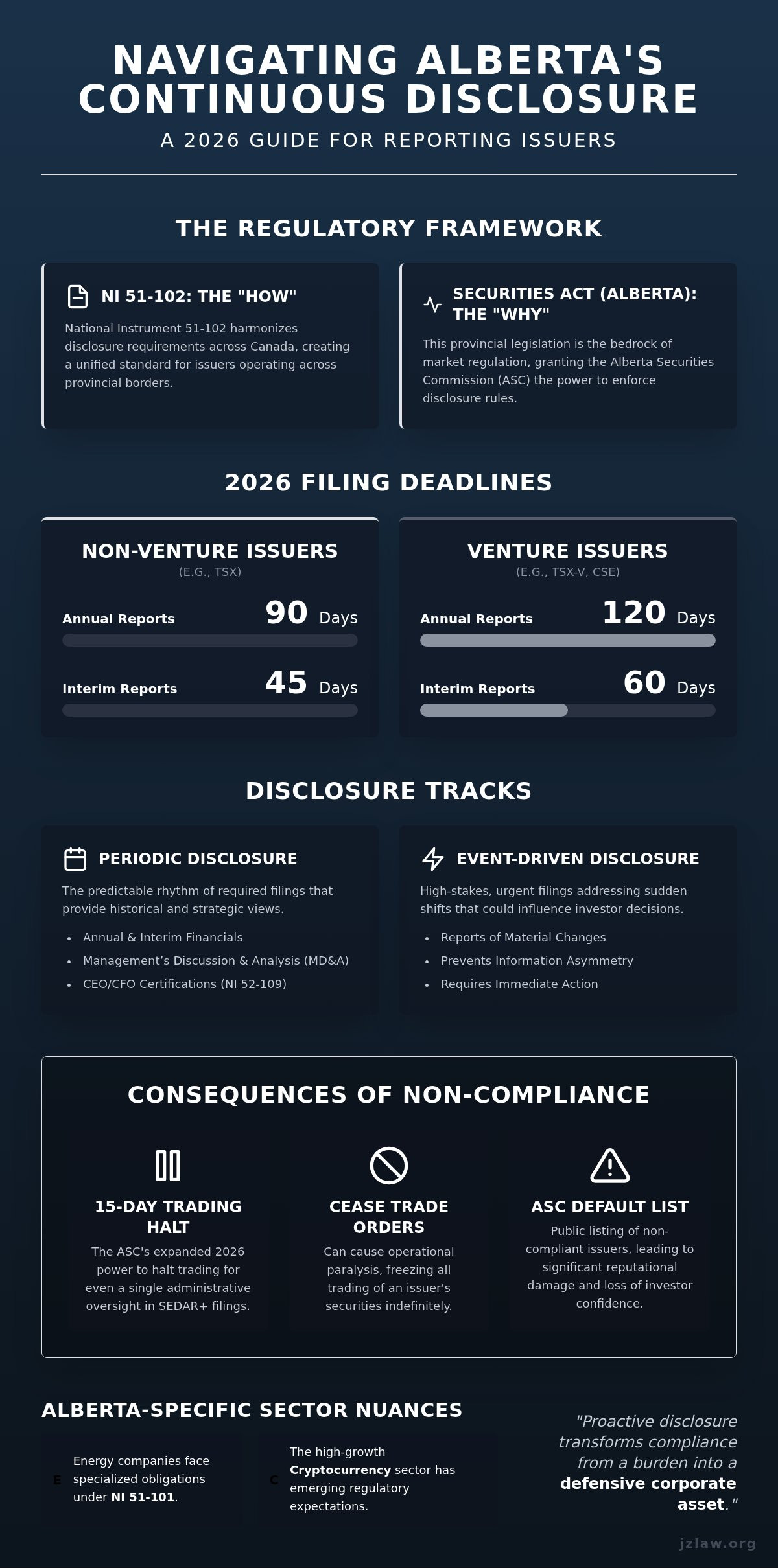
Reporting burdens depend on your classification. Venture issuers, typically on the TSX-V or CSE, have longer filing windows than Non-Venture issuers on the TSX. The 2026 deadlines reflect these distinctions:
Non-Venture Issuers: 45 days for interim reports and 90 days for annual reports.
Venture Issuers: 60 days for interim reports and 120 days for annual reports.
Moving to a senior exchange increases your profile but heightens the continuous disclosure requirements alberta regulators expect you to meet. Strategic planning is essential when transitioning between these tiers.
Periodic vs. Event-Driven Disclosure Requirements
The regulatory landscape in 2026 demands a dual-track approach to compliance. On one hand, you have the predictable rhythm of periodic filings. On the other, you face the high-stakes urgency of event-driven disclosures. Both categories are essential components of the Alberta Securities Commission's disclosure framework, which seeks to prevent information asymmetry in the marketplace. While periodic reports provide a historical and strategic view, event-driven filings address sudden shifts that could influence an investor's decision. Failing to balance these tracks properly can lead to the trading halts mentioned in the previous section.
Annual and Interim Financial Obligations
Annual and interim financial statements serve as the quantitative core of your filings. However, the Management’s Discussion and Analysis (MD&A) is where the real strategic value lies. The ASC focuses heavily on MD&A reviews to ensure issuers aren't just reciting numbers but are providing a clear narrative on liquidity, capital resources, and operational risks. For Non-Venture issuers, the 2026 deadlines are strict: 90 days for annual and 45 days for interim reports. Venture issuers operate on a slightly more relaxed schedule of 120 days for annual and 60 days for interim filings. Compliance also requires CEO and CFO certifications under NI 52-109. These documents confirm that leadership has designed and evaluated internal controls, adding a layer of personal accountability to the continuous disclosure requirements alberta issuers must satisfy.
Material Change Reports and Press Releases
Material changes require immediate action. In the 2026 Alberta market, materiality is defined by whether a change would reasonably be expected to have a significant effect on the market price or value of a security. When such an event occurs, you must issue a news release immediately. This is followed by a formal Material Change Report (MCR) filed on SEDAR+ within 10 days of the change. If disclosure would be unduly detrimental to the company’s interests, such as during sensitive merger negotiations, a confidential MCR may be filed. These are subject to rigorous 10-day renewal periods to ensure the information isn't withheld longer than necessary. Securing the help of an expert in securities regulation can help you determine materiality before the ASC raises questions.
Alberta-Specific Sector Nuances: Oil, Gas, and Crypto
Alberta's regulatory environment is uniquely shaped by its industrial heritage and its current push toward digital innovation. While the general standards discussed in previous sections apply to all reporting issuers, certain sectors face heightened scrutiny due to their technical complexity. The ASC enforces specific instruments that go beyond basic financial reporting to address the specialized data required by energy investors and the novel risks inherent in blockchain technology. Successfully meeting the continuous disclosure requirements alberta mandates for these sectors requires a sophisticated understanding of both technical data and legal frameworks.
National Instrument 51-101 (NI 51-101) serves as the primary standard for oil and gas disclosure. Unlike standard financial statements, NI 51-101 requires issuers to provide detailed technical reports on their resource base annually. This involves filing three critical documents: Form 51-101F1 (Statement of Reserves Data), Form 51-101F2 (Report of Independent Qualified Reserves Evaluator), and Form 51-101F3 (Report of Management and Directors). These filings ensure that the valuation of an energy company is based on verified geological data rather than optimistic projections, protecting the integrity of Calgary's capital markets.
Energy Sector Compliance: Beyond the Financials
Compliance in the energy sector involves reporting proved and probable reserves according to strict Alberta standards. This process requires the involvement of independent qualified reserves evaluators who provide an objective audit of the company's assets. Because of the high stakes involved in resource estimation, the ASC frequently reviews these technical filings for consistency and accuracy. For a deeper look at how these rules integrate with broader operational strategies, you can explore our analysis of oil and gas law.
Crypto and FinTech Disclosure Challenges
The ASC has signaled a proactive stance on digital assets, treating many as securities that trigger full reporting obligations under NI 51-102. Companies operating under the umbrella of cryptocurrency law must address specific disclosure gaps, particularly regarding the custody and security of digital holdings. Regulators are especially concerned with how issuers describe risk factors in volatile markets. Tech firms must also consider how their disclosure patterns affect their market position during corporate transactions. Whether you're managing a traditional energy firm or a blockchain startup, the continuous disclosure requirements alberta enforces are designed to protect the market while allowing for growth.
Consequences of Non-Compliance and ASC Enforcement
The consequences of failing to meet continuous disclosure requirements alberta regulators mandate are both public and punitive. The Alberta Securities Commission maintains a "Default List," a digital ledger of shame that identifies issuers failing to file required documents. Inclusion on this list signals to the market that your entity is in breach of its obligations, often leading to a sharp decline in investor confidence. Beyond public naming, the ASC utilizes Cease Trade Orders (CTOs) to paralyze trading activity. A CTO effectively freezes liquidity, making it impossible for shareholders to exit positions and preventing the company from raising capital. Under the late 2025 amendments to the Securities Act, the ASC's authority has expanded, allowing for 15-day trading halts if they suspect inaccurate or misleading information is being disseminated.
Financial penalties further compound the damage. While registration fees for firms remain at $1,400 for 2026, late-filing fees accrue daily, creating a significant financial burden that can't be easily ignored. Perhaps most critically, the veil of corporate protection doesn't always shield leadership. Directors and officers face personal liability and potential administrative penalties if they authorize or acquiesce in disclosure failures. This personal exposure makes a robust compliance framework a necessity for every board member. If you're facing a potential breach, seeking expert securities regulation counsel is the most effective way to protect your corporate standing.
The ASC Continuous Disclosure Review Program
The ASC doesn't wait for a crisis to examine your books. Their Review Program operates on a dual-track system, selecting issuers through both random sampling and risk-based analysis. Risk factors often include significant changes in financial condition or involvement in high-volatility sectors like crypto or oil and gas. Deficiencies are frequently found in the MD&A, particularly when issuers fail to provide a balanced narrative of their results. When you receive a comment letter, your response must be precise and supported by evidence to avoid escalating the review into a formal investigation.
Curing Disclosure Defaults
Curing a default isn't as simple as just hitting "submit" on a late document. If a CTO is in place, you must apply for a revocation, a process that requires demonstrating that all filings are now current and accurate. Restating and refiling financial statements is often necessary, which can trigger a secondary wave of market volatility. Establishing a proactive internal disclosure policy is the only way to ensure you never land on the Default List. This involves setting clear internal deadlines that precede the ASC's hard dates, allowing for multiple layers of review before any data goes live on SEDAR+.
Strategic Compliance: How JZ Law Protects Issuers
JZ Law transforms the compliance burden from a reactive necessity into a strategic advantage. While many firms view filings as a series of isolated deadlines, John Zang approaches the continuous disclosure requirements alberta issuers face as a vital component of corporate health and market reputation. Our boutique firm specializes in the delicate transition of taking companies public, ensuring that the momentum of a successful listing isn't lost to immediate regulatory friction. By integrating securities law with tax structuring and corporate transactions, we provide a holistic protective shield for mid-cap and venture issuers in Calgary. This integrated approach prevents the common pitfall where a regulatory filing inadvertently triggers an unfavorable tax position or complicates a future merger. We believe that a well-managed disclosure profile is the best defense against market volatility and regulatory scrutiny.
Proactive Disclosure Planning
We don't wait for the end of a quarter to begin the compliance process. Our team works with your board to develop a rigorous 12-month regulatory calendar that anticipates upcoming reporting windows and strategic milestones. This proactive stance includes pre-clearing complex or novel transactions with the ASC to mitigate the risk of later rejection or inquiry. We ensure that your internal teams are aligned with the latest continuous disclosure requirements alberta mandates, reducing the likelihood of last-minute errors. JZ Law maintains an unwavering commitment to precision in cannabis licensing and securities, recognizing that these highly regulated sectors require a meticulous eye for detail and a deep understanding of evolving frameworks.
Strategic Counsel for Calgary Businesses
John Zang brings years of experience in high-stakes regulatory environments, offering Calgary-based founders the kind of tailored legal solutions that larger, more rigid firms often struggle to provide. We understand that your business goals and the 2026 regulatory landscape are constantly evolving, requiring a legal partner who is as dynamic as the market itself. Our counsel goes beyond mere execution; we act as strategic partners who anticipate risks before they manifest as ASC enforcement actions. This boutique approach ensures that every client receives direct access to senior expertise, which is essential when navigating the complexities of modern securities regulation. Contact JZ Law today to schedule a comprehensive disclosure audit and ensure your organization is positioned for long-term stability and growth.
Securing Your Corporate Future in Alberta's 2026 Market
Navigating the current regulatory environment requires more than just meeting deadlines; it demands a strategic alignment of your corporate actions with the Alberta Securities Commission's rigorous expectations. You've seen how the implementation of the voluntary access model and the expansion of ASC enforcement powers have fundamentally changed the stakes for every reporting issuer. Maintaining your corporate standing means mastering the continuous disclosure requirements alberta enforces while balancing the technical nuances of sectors like oil and gas or digital assets.
Effective compliance acts as a defensive asset that preserves market liquidity and investor trust. By moving from a reactive filing mindset to a proactive disclosure strategy, you protect your leadership from personal liability and your company from the operational paralysis of a cease-trade order. Principal Lawyer John Zang leads every case at JZ Law, bringing deep expertise in Calgary’s oil and gas and tech sectors to your specific challenges. We specialize in taking companies public and ensuring post-IPO compliance remains seamless and efficient.
Consult with JZ Law for Expert Securities Counsel to conduct a thorough audit of your current protocols. With the right strategic partner, you can turn regulatory complexity into a foundation for sustained corporate growth.
Frequently Asked Questions
What is the primary regulation for continuous disclosure in Alberta?
The primary regulation is National Instrument 51-102, titled Continuous Disclosure Obligations. This instrument provides a harmonized framework across Canada, ensuring consistent reporting standards for issuers in every province. In Alberta, this national instrument is given legal force through the Securities Act (Alberta). These continuous disclosure requirements alberta companies must follow are strictly monitored by the Alberta Securities Commission to maintain market integrity and protect the interests of provincial investors.
How many days does an Alberta venture issuer have to file annual financial statements?
Alberta venture issuers have exactly 120 days from the end of their financial year to file audited annual financial statements. This deadline also applies to the accompanying Management’s Discussion and Analysis (MD&A). For interim financial reports, the window is shorter, requiring submission within 60 days of the period’s end. These timelines are specifically designed to provide investors with timely data while acknowledging the operational constraints often faced by smaller, emerging companies.
What constitutes a "material change" for an Alberta reporting issuer?
A material change is defined as a significant shift in the business, operations, or capital of an issuer that would reasonably be expected to influence the market price or value of its securities. This includes events such as major acquisitions, significant changes in board composition, or the commencement of critical litigation. When such a change occurs, the issuer must immediately issue a news release and file a formal Material Change Report within 10 days.
Can a company stop its continuous disclosure obligations in Alberta?
A company can only terminate its obligations by successfully applying to cease being a reporting issuer. This process, often called going private, typically requires the issuer to have fewer than 15 security holders in every jurisdiction in Canada and fewer than 51 security holders in total worldwide. The Alberta Securities Commission must approve the application, ensuring that the transition doesn't unfairly prejudice existing shareholders or undermine the transparency of the broader capital market.
What is the difference between a material change and a material fact?
The distinction lies in the scope and the specific event triggering the disclosure. A material change refers to a specific shift in the business, operations, or capital of the issuer. Conversely, a material fact is a broader concept encompassing any information that would significantly affect the market price or value of a security. While material changes require an immediate news release and a 10 day report, material facts are typically disclosed during prospectus offerings or periodic filings.
Does the ASC charge fees for late continuous disclosure filings?
Yes, the Alberta Securities Commission imposes late filing fees that accrue on a daily basis once a deadline is missed. These penalties are designed to encourage punctuality and ensure that the market receives information in a predictable manner. For 2026, these fees can represent a substantial financial burden for non compliant issuers. Persistent failure to pay these fees or file the required documents will eventually result in the issuer being placed on the public Default List.
What is SEDAR+ and is it mandatory for Alberta companies?
SEDAR+ is the mandatory national system used by reporting issuers to file securities related information with Canadian regulators. It's the central repository where investors and the ASC access financial statements, news releases, and material change reports. All Alberta reporting issuers must use this platform to fulfill their continuous disclosure requirements alberta mandates. The system was modernized to streamline the filing process, making it easier for companies to manage their regulatory submissions in a single, secure environment.
How do Alberta’s oil and gas disclosure rules differ from other industries?
Oil and gas issuers must adhere to National Instrument 51-101, which mandates specialized technical disclosure beyond standard financial reporting. This includes annual filings of reserves data and reports from independent qualified reserves evaluators. These rules are unique because they require geological and engineering data to support the company’s valuation. While tech or retail firms focus primarily on financial performance, energy companies must provide transparency regarding their underlying physical assets and the viability of resource extraction projects.


Comments