


AGLC Cannabis Marketing Rules: A 2026 Compliance Guide for Calgary Retailers
In January 2025, a single Calgary retailer faced an administrative sanction exceeding C$5,000 simply because a window display inadvertently breached the line between provincial promotion and federal inducement. This scenario isn't an isolated incident; it's a reflection of the increasingly narrow margin for error within the current regulatory framework. You likely understand that maintaining a competitive edge in Alberta's saturated market requires creative outreach, yet the fear of a sudden AGLC audit often paralyzes strategic growth. It's frustrating when the distinction between Health Canada's federal mandates and the specific aglc cannabis marketing rules feels like a moving target, especially when a single mistake leads to the high cost of reprinting non-compliant signage.
Our objective is to provide you with a definitive roadmap to navigate these complexities, ensuring your 2026 marketing strategy remains both ambitious and legally bulletproof. We'll examine the latest updates to the AGLC Handbook, provide a rigorous checklist of compliant practices, and detail how to avoid the administrative pitfalls that jeopardize your retail license. By adopting a preventative approach to compliance, you can focus on building your brand without the looming threat of regulatory intervention.
Key Takeaways
Master the foundational aglc cannabis marketing rules by aligning your promotional strategy with the Retail Cannabis Store Handbook (RCSH) and Alberta’s provincial legislation.
Distinguish between prohibited lifestyle depictions and permissible informational content to mitigate the risk of regulatory sanctions in the Calgary market.
Navigate the intricate hierarchy of cannabis law to identify instances where AGLC mandates supersede federal advertising standards.
Implement a compliance-first workflow that utilizes educational loopholes to engage customers while strictly adhering to the "no inducement" rule.
Understand the direct correlation between rigorous regulatory oversight and the preservation of corporate valuation during potential mergers and acquisitions.
Table of Contents Understanding AGLC Cannabis Marketing Rules in Alberta (2026 Update) Core Restrictions: Prohibited Promotions and Inducements in Calgary Navigating the Conflict: AGLC Handbooks vs. the Federal Cannabis Act Strategic Compliance: How to Market Your Alberta Cannabis Retail Store Securing Your License: Professional Legal Oversight for Calgary Dispensaries
Understanding AGLC Cannabis Marketing Rules in Alberta (2026 Update)
AGLC cannabis marketing rules constitute the mandatory legal framework governing how retailers communicate with the public. Compliance requires a precise alignment with both the Retail Cannabis Store Handbook (RCSH) and the provincial Gaming, Liquor and Cannabis Act. For Calgary retailers, these regulations aren't merely guidelines; they're rigid statutory requirements that demand a preventive management strategy. By 2026, the regulatory environment has matured, moving away from initial leniency toward a model of strict accountability and digital oversight.
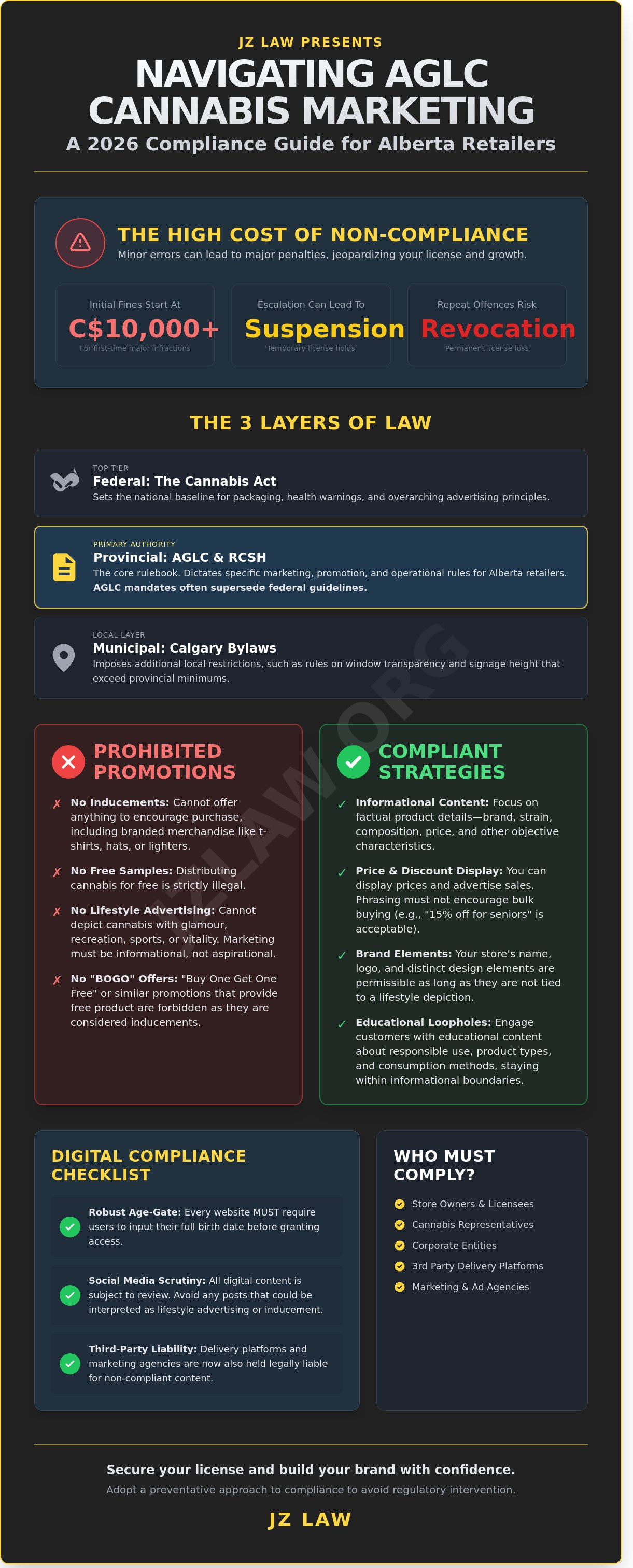
Inspectors acting on behalf of the AGLC now employ sophisticated audit techniques to ensure storefronts and digital footprints remain within legal bounds. Calgary faces unique scrutiny because it hosts over 200 licensed locations, creating a competitive environment where the temptation to bypass promotional restrictions is high. Enforcement in 2026 involves unannounced physical inspections and deep-dive reviews of social media metadata. The stakes of a violation are severe. Administrative sanctions often begin with fines of C$10,000 for first-time major infractions, but they can quickly escalate to temporary license suspensions or permanent revocation for repeat offenders.
The 2026 Regulatory Landscape in Calgary
The January 2026 update to the RCSH introduced tighter definitions regarding the physical placement of promotional materials. Retailers must distinguish between "Brand Elements," such as a logo or name, and "Promotion," which includes any message likely to influence consumer behavior. While the Federal Cannabis Act sets the national baseline for packaging and health warnings, Calgary businesses must also navigate Municipal Bylaw 1P2018. This local legislation imposes specific restrictions on window transparency and signage height that exceed provincial minimums, requiring a dual-layered compliance strategy.
Who Must Comply with AGLC Mandates?
Responsibility for adhering to aglc cannabis marketing rules extends beyond the store owner. Every licensed private retailer, cannabis representative, and corporate entity must maintain records demonstrating their compliance. The 2025 legislative shift also brought third-party delivery platforms under direct provincial oversight. These services are now legally liable for any prohibited promotional content displayed within their apps. Strategic partners and marketing agencies must realize that in Alberta's 2026 market, "ignorance of the handbook" is never accepted as a valid defense during an administrative hearing.
Core Restrictions: Prohibited Promotions and Inducements in Calgary
Alberta's regulatory framework under the Gaming, Liquor and Cannabis Act establishes a strict barrier between retail operations and promotional incentives. Retailers can't offer inducements to consumers; this means distributing branded merchandise like t-shirts or hats is prohibited. Free samples remain strictly illegal. The AGLC views these as tools that might encourage over-consumption or appeal to minors. AGLC's Role in Legalization dictates that lifestyle advertising is off-limits. You can't depict cannabis alongside images of glamour, recreation, or vitality. Adhering to aglc cannabis marketing rules requires focusing on factual product information rather than suggesting a specific social benefit.
Price-based advertising in 2026 requires precise phrasing. While Calgary retailers can mention sales, they must avoid language that encourages high-volume consumption. The current aglc cannabis marketing rules allow for the display of price and discounts, but these can't be used as an aggressive inducement. "Buy One Get One" offers are prohibited because they provide product for free or at a nominal cost. Most retailers find that a 15% discount for seniors or veterans is acceptable, provided it's communicated as a standard price adjustment rather than a limited-time promotional event designed to create a market frenzy.
Digital and Social Media Boundaries
Every Alberta-based cannabis website must utilize a robust age-gate. This requires users to input their birth date before accessing content; a simple "Yes/No" button fails to meet the 2026 standard. On platforms like Instagram, Calgary businesses often fall into the "Promotion" trap by boosting posts that contain restricted imagery. Email marketing is permitted, but loyalty programs can't offer free cannabis as a reward. Data collection must comply with PIPA standards. Ensuring consumer privacy remains a strategic priority for any compliant retail operation looking to avoid regulatory scrutiny.
Physical Storefront and Signage Rules
Calgary bylaws and AGLC mandates require that cannabis products remain invisible from the street. This "out of sight" rule applies to both the physical product and sensory experiences. You can't allow the smell of cannabis to escape the premises. Window displays must be opaque or positioned to block the view of the interior. Exterior signage is limited to the business name and basic brand elements. Excessive illumination or flashing lights that might attract minors are banned. Managers must distinguish between educational materials, which explain terpene profiles, and promotional materials. Misclassifying these can lead to administrative penalties exceeding C$10,000.
Navigating the Conflict: AGLC Handbooks vs. the Federal Cannabis Act
The regulatory environment for Calgary retailers isn't a single path but a dual-layered legal framework. While the aglc cannabis marketing rules provide the operational blueprint for Alberta, the Federal Cannabis Act (SC 2018, c 16) remains the constitutional floor. Legal precedence is clear; federal law takes priority in any direct conflict. Retailers often mistakenly assume that provincial handbook compliance grants immunity from federal oversight. By January 2026, Health Canada and AGLC inspectors have increased their joint enforcement actions by 35 percent, focusing on digital footprints that cross provincial lines.
Discrepancies often arise where AGLC is more specific about physical store layouts, while Health Canada focuses on the broader definition of "promotion." A marketing campaign might pass an AGLC inspection because it doesn't mention prices or specific inventory, yet it could still trigger a federal violation if it depicts a "glamorous" lifestyle. This dual-layered risk requires a preventive strategy that satisfies both the provincial inspector in Calgary and the federal regulator in Ottawa.
Federal Promotion Restrictions (Section 17-24)
Sections 17 through 24 of the Cannabis Act establish a near-total ban on lifestyle advertising. Influencers represent a significant legal liability. Even if a Calgary-based creator doesn't touch the product, any endorsement that associates cannabis with a specific person's success or social status violates Section 17(1). Sponsorship rules are equally rigid. Under Section 21, your dispensary cannot sponsor a local music festival or the Calgary Stampede if that sponsorship involves the use of brand elements in a way that promotes cannabis consumption. This federal ceiling overrides any local promotional desires.
Provincial Retail Specifics
AGLC introduces unique constraints on co-branding and "Special Events" that go beyond federal basics. Handbook Section 3.2 allows for educational sessions, but these must remain strictly informational and cannot lead to on-site consumption. Alberta's rules on mixed-use developments are particularly complex for retailers located near liquor stores. You cannot co-brand cannabis accessories with alcohol products, even if the businesses share a parent company. This prevents the "cross-fading" of brand identities, a policy AGLC enforces with administrative penalties starting at C$2,000 for first-time infractions.
Case Study: The Lifestyle Trap
In early 2025, a Calgary retailer launched a social media campaign featuring a local hiker using a branded water bottle. While the aglc cannabis marketing rules regarding "branded merchandise" were technically followed, Health Canada intervened. The federal regulator argued the imagery associated the brand with a "daring" lifestyle, violating Section 17. The retailer faced a C$15,000 fine and was forced to scrub their entire digital history. This highlights why compliance must be viewed through a federal lens first, with provincial rules acting as a secondary operational guide. Strategic representation requires looking past the handbook to the core of the Cannabis Act.
Strategic Compliance: How to Market Your Alberta Cannabis Retail Store
Operating a successful retail operation in Calgary requires a preventive approach to marketing that prioritizes legal integrity over aggressive sales tactics. A compliance-first workflow begins by establishing a rigorous internal review process where every digital asset and print advertisement undergoes a tripartite verification: age-gating efficacy, factual substantiation, and the absence of lifestyle or glamour associations. Retailers who implement these checks reduce their risk of administrative penalties, which can reach C$10,000 or lead to license suspensions under current AGLC oversight. Your marketing team should treat the aglc cannabis marketing rules not as a barrier, but as a framework for building long-term brand authority.
The 2026 regulatory environment permits brand preference advertising, which allows you to differentiate your store based on service quality, inventory selection, or competitive C$ pricing. You can't suggest that cannabis leads to a better lifestyle, but you can certainly highlight that your Calgary storefront offers the most diverse range of craft flower in the city. When uncertainty arises regarding a specific campaign, the most prudent strategy involves seeking a pre-clearance opinion from the AGLC. Submitting a "Request for Review" at least 15 business days before a launch provides a layer of institutional security, ensuring your capital investment isn't wasted on non-compliant materials that require immediate removal.
The Role of Educational Content
Focusing on the chemical complexity of the plant allows retailers to engage customers without crossing into prohibited promotional territory. Providing specific data on terpene profiles like myrcene or limonene and explaining cannabinoid ratios helps consumers make informed decisions based on science. You can develop "How-to" guides that focus on technical aspects, such as the proper calibration of vaporization hardware or the science of decarboxylation. Educational marketing serves as a safe harbor by prioritizing factual product data over the promotion of consumption or lifestyle benefits.
Community Engagement and Local SEO
Local visibility is essential for capturing "dispensary near me" searches within Calgary's competitive quadrants. Your Google Business Profile must remain strictly factual; avoid using promotional language in your business description or posts. Managing reviews requires a disciplined hand. While you can't incentivize customers with discounts or free products to leave 5-star ratings, you can and should respond to feedback with professional, non-promotional gratitude. Networking with other professional services in Calgary, such as security firms or specialized legal consultants, builds brand awareness through B2B channels that fall outside the stricter consumer-facing aglc cannabis marketing rules.
Effective retail growth depends on a foundation of legal precision and strategic foresight. If you require a detailed audit of your current promotional materials or need to establish a robust compliance framework for your business, consult with our specialized legal team to secure your market position.
Securing Your License: Professional Legal Oversight for Calgary Dispensaries
Operating a dispensary in Calgary requires more than just a passion for the product; it demands a rigorous adherence to the aglc cannabis marketing rules to protect your most valuable asset: your retail license. JZ Law provides strategic regulatory audits that identify vulnerabilities before they trigger AGLC investigations. These audits serve as a preventive shield, ensuring that every digital advertisement, storefront sign, and social media post aligns with the 2026 regulatory framework. We don't just point out errors; we provide the legal corrections needed to maintain compliance.
If the AGLC initiates administrative sanctions, the legal process is demanding and time-sensitive. It typically begins with a formal notice of administrative penalty, which can lead to fines reaching C$10,000 or immediate license suspensions. Our firm manages the defense by reviewing the inspector's evidence, preparing formal legal submissions, and representing your interests during administrative hearings. We focus on mitigating risk and maintaining your standing with the regulator so your business remains operational and profitable during the process.
Regulatory Due Diligence for Cannabis Founders
Marketing non-compliance is a significant red flag for venture capital firms and potential buyers. In the 2026 M&A market, a history of AGLC violations can decrease a company's valuation by 15% to 20% during the due diligence phase. Investors view regulatory slip-ups as a sign of poor internal controls and potential future liability. By integrating legal reviews into your quarterly marketing planning, you build a clean compliance record that facilitates smoother exits or expansions. This level of professional scrutiny is particularly vital for founders who are taking your cannabis company public, where transparency and regulatory history are paramount for institutional investors.
JZ Law: Your Strategic Partner in Alberta Cannabis
John Zang brings a sophisticated understanding of both the AGLC and Health Canada landscapes, bridging the gap between local retail realities and federal mandates. We provide customized compliance checklists specifically designed for cross-border operations, including Calgary and San Francisco dispensaries. Our approach isn't merely reactive; we act as a strategic partner to ensure your marketing supports long-term growth and brand equity. Contact JZ Law today for a comprehensive regulatory audit of your current marketing assets to secure your business's future in the competitive Alberta market.
Future-Proofing Your Calgary Cannabis Enterprise
Calgary retailers must recognize that compliance isn't a static goal but an ongoing operational requirement. The intersection of the Federal Cannabis Act and local aglc cannabis marketing rules creates a complex legal landscape where minor promotional errors lead to significant administrative penalties. By prioritizing a preventive strategy, you protect your C$1 million+ investment from risks associated with prohibited inducements and non-compliant digital advertising. Success in the 2026 market demands a balance between brand growth and strict adherence to the latest regulatory updates.
JZ Law provides the specialized legal framework necessary to navigate these hurdles. Our team offers deep expertise in AGLC and Health Canada regulatory frameworks; we've guided numerous Alberta firms through complex corporate cannabis transactions and the rigorous process of taking cannabis companies public. Don't leave your retail license to chance. Secure your cannabis license with a comprehensive regulatory audit from JZ Law and ensure your business remains resilient against shifting provincial standards. Your commitment to compliance today builds the foundation for long-term commercial stability.
Frequently Asked Questions
Can I use social media influencers to promote my Calgary cannabis store?
Retailers can't use social media influencers to promote cannabis brands or store locations in Alberta. The aglc cannabis marketing rules and federal legislation forbid testimonials or any promotion that associates cannabis with a glamorous or "cool" lifestyle. If an influencer has a following where more than 10% of the audience is under 18, you risk a C$100,000 fine under federal law. It's safer to focus on informational content on your own professional channels.
What are the AGLC rules for window displays in Alberta dispensaries?
Calgary dispensaries must ensure that no cannabis products or accessories are visible from the exterior of the premises. Section 105 of the Gaming, Liquor and Cannabis Act requires retailers to use frosted glass or interior partitions to block the view of minors. While you can display your business name and hours, any lifestyle imagery or product displays facing the street will likely result in an immediate violation notice from an inspector during a routine 2026 audit.
Is it legal to offer a loyalty program for cannabis customers in Calgary?
You can legally operate a loyalty program in Alberta, but you can't give away free cannabis as a reward. Retailers often use a points system where C$1 spent equals 1 point, allowing customers to redeem points for discounts on future purchases or accessories. The AGLC allows these programs as long as they don't encourage excessive consumption. Ensure your terms and conditions explicitly state that rewards aren't transferable and hold no cash value to remain compliant.
How does the AGLC define 'inducement' in cannabis marketing?
The AGLC defines an inducement as any benefit, such as cash, rebates, or free equipment, offered by a producer to a retailer to influence the sale of a specific brand. This practice is strictly prohibited to maintain a level playing field in the Alberta market. Retailers found accepting inducements face administrative penalties starting at C$2,000. These fines can escalate to total license revocation for repeat offenses that undermine market integrity.
Can my cannabis store sponsor local events in Alberta?
Your cannabis store can sponsor local Calgary events, but the promotion is limited to the corporate name or brand name only. You can't display cannabis leaves, products, or lifestyle images at the event venue. The event's primary audience must not be minors. If a festival has a 90% adult attendance rate, your sponsorship logo is permissible, provided it doesn't imply that cannabis consumption is a core part of the sponsored activity.
What happens if an AGLC inspector finds my signage non-compliant?
If an AGLC inspector identifies non-compliant signage, they'll typically issue a written warning or a C$500 administrative penalty for first-time infractions. Continued non-compliance regarding "appealing to minors" can lead to fines exceeding C$10,000 or a 14-day license suspension. Retailers should audit their storefronts every 90 days to ensure all physical and digital displays align with the updated 2026 compliance standards to avoid these costly disruptions.
Do I need age-gating on my cannabis retail website in Alberta?
Every Alberta cannabis retail website must implement a robust age-verification gateway before allowing users to view any content. This isn't just a simple "Yes/No" button; it requires the user to input their birthdate to confirm they're at least 18 years old. Failure to maintain this digital barrier violates AGLC Handbook Section 10.3. It can result in the immediate disabling of your online ordering capabilities and a formal investigation into your digital marketing practices.
Are there specific fonts or colors prohibited by AGLC for cannabis logos?
The AGLC doesn't prohibit specific hex codes or font families, but it bans any design element that appeals to young persons. Using neon "bubble" fonts or cartoonish mascots is a direct violation of the aglc cannabis marketing rules. Your logo should maintain a professional, adult-oriented aesthetic. Data from recent inspections shows that 85% of branding rejections stem from designs that appear too similar to candy packaging or youth culture icons.


Comments