


Strategic Legal Guide for Vancouver Tech Startups 2026
In the 2026 Vancouver tech ecosystem, the distance between a successful Series A and a stalled public offering is rarely measured in code quality or user growth; rather, it's defined by the structural integrity of your corporate minute books. You likely understand that while a generalist firm can manage basic incorporation, they often lack the technical depth required to navigate the granular complexities of BCSC compliance or the specific intersection of cryptocurrency law and traditional securities. The mounting anxiety of realizing your legal foundation wasn't built for the intense scrutiny of the public markets is a burden many founders face as they attempt to scale.
Retaining specialized legal counsel for tech startups Vancouver transforms this regulatory pressure into a competitive advantage by aligning your corporate structure with institutional expectations from day one. This article provides a strategic roadmap for legal scaling, offering the clarity you need to move from an agile private entity to a public-market ready enterprise. We'll examine how proactive risk mitigation, disciplined tax structuring, and a deep understanding of the TSX Venture Exchange Capital Pool Company rules can ensure your deal flow remains uninterrupted.
Table of Contents
Navigating the Vancouver Tech Ecosystem: Why Specialized Counsel Matters
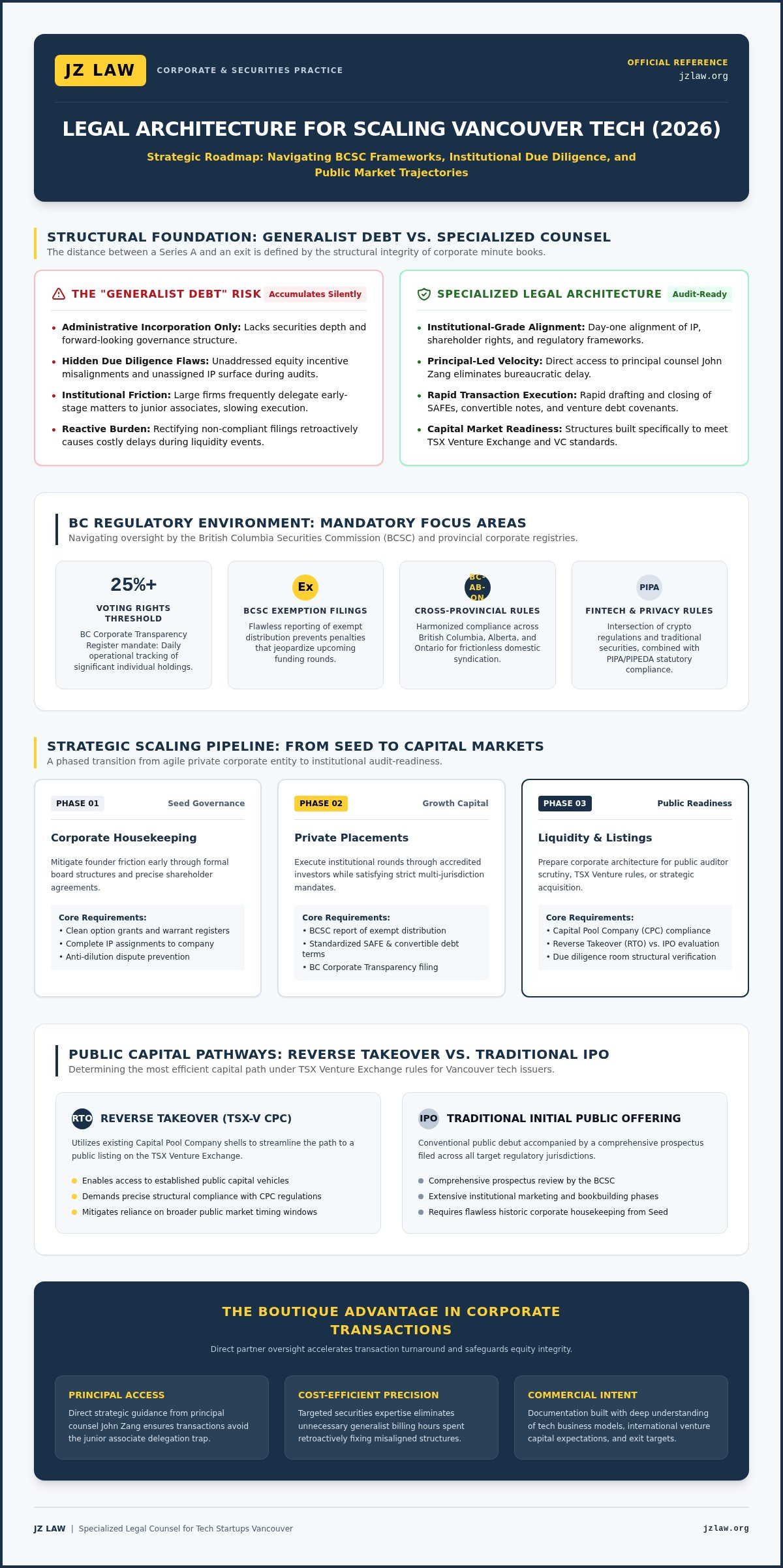
For a Vancouver founder, the legal framework isn't just a hurdle to clear; it's the structural support for every subsequent funding round. Selecting specialized legal counsel for tech startups Vancouver extends far beyond the administrative act of incorporation. It involves the meticulous alignment of intellectual property, shareholder rights, and regulatory compliance with the eventual requirements of a TSX Venture Exchange listing. While generalist firms often handle basic corporate tasks, they frequently overlook the specific tax structuring and securities nuances that define the technology sector. This "generalist debt" accumulates silently, often surfacing only during a due diligence process when a potential acquirer identifies misaligned equity incentives or incomplete IP assignments.
The Evolving Regulatory Landscape in BC
The British Columbia Securities Commission (BCSC) maintains a rigorous oversight environment that demands more than reactive filing. In 2026, the shift toward stricter fintech regulations and the complexities of data privacy under PIPA and PIPEDA require a proactive legal stance. Proactive compliance is the difference between a seamless audit and a catastrophic deal failure in a high-stakes environment. High-growth firms must also navigate cross-provincial requirements, especially when raising capital in Alberta or Ontario, making localized knowledge of the BCSC's harmonized rules essential for efficient scaling. These local regulations directly impact your ability to attract global venture capital, as international investors prioritize entities with transparent regulatory histories.
Boutique Agility vs. Big Law Resources
Securing specialized legal counsel for tech startups Vancouver allows founders to bypass the institutional friction often found in national "Big Law" firms. Large organizations frequently delegate early-stage matters to junior associates, leading to a lack of strategic oversight and slower response times. In contrast, a boutique firm provides direct access to a principal lawyer like John Zang, ensuring that every corporate transaction is viewed through a lens of high-stakes expertise. This principal-led model improves deal speed by eliminating layers of bureaucracy, allowing for the rapid execution of SAFEs, convertible notes, or venture debt covenants. Targeted expertise also proves more cost-efficient than generalist billing, as specialists identify and mitigate risks before they require expensive, retroactive corrections. By prioritizing boutique agility, founders gain a strategic partner who understands the business intent behind the legal documentation.
Core Legal Pillars for Scaling Tech Companies: From Seed to Securities
Scaling a technology firm in Vancouver demands a transition from casual founder agreements to institutional-grade governance. Venture capital firms don't just invest in innovative code; they invest in the management structures that protect that code. Establishing a balanced board of directors and a transparent shareholder structure early prevents the "founder friction" that often derails mid-stage funding. Specialized legal counsel for tech startups Vancouver ensures that your corporate foundation is built to withstand the rigorous due diligence of institutional investors.
Securities and Corporate Finance Fundamentals
Raising capital from accredited investors in British Columbia requires a precise application of BCSC prospectus exemptions. Failing to file the correct reports of exempt distribution can lead to significant regulatory penalties that jeopardize future rounds. Maintaining a clean cap table is equally critical; every option grant and warrant must be documented with precision to avoid dilution disputes. Mastering the complexities of securities regulation allows founders to focus on growth while their legal partner manages the intricate filings required for private placements. Under the current BC Corporate Transparency Register mandate, companies must also maintain accurate records of any individual holding 25% or more of voting rights, making meticulous record-keeping a daily operational necessity.
Specialized Tech Law: Crypto and Emerging Regs
Vancouver remains a significant hub for decentralized innovation, yet the regulatory environment for blockchain tech has reached a new level of maturity. Navigating cryptocurrency law in 2026 involves balancing rapid development with strict FINTRAC compliance and anti-money laundering standards. BC courts are increasingly being called upon to interpret smart contract disputes, treating code-based agreements with the same level of scrutiny as traditional commercial contracts. For startups building in the Web3 or fintech space, proactive risk mitigation is the only way to prevent regulatory intervention from stalling a product launch. Protecting your core value also requires a sophisticated intellectual property strategy that ensures all IP assignments are ironclad from the first line of code. If you're currently preparing for a financing round, engaging a strategic corporate partner can help you identify these regulatory gaps before they become deal-breakers.
Evaluating Legal Counsel: Why Regulatory Depth Beats Generalist Advice
Selecting legal counsel for tech startups Vancouver isn't merely an administrative box to check; it's a strategic investment in the firm's eventual exit potential. Many founders fall into the trap of "generalist debt," where they hire a lawyer with a broad practice but little experience in the high-stakes world of securities or technology law. While a generalist might handle a standard incorporation with ease, they often lack the foresight to structure equity incentives or IP assignments in a way that satisfies the rigorous standards of a future acquirer or public auditor. This lack of depth results in expensive, retroactive corrections that can delay or even derail a Series B or an IPO. The cost of hiring a specialist early is always lower than the cost of fixing a generalist's mistakes later.
True regulatory depth means your counsel acts as a strategic partner who understands the business intent behind every clause. They don't just review documents; they anticipate how a specific board structure will look to a venture capital firm in 24 months. The "sweet spot" for a Vancouver-based startup is a firm that combines a deep local presence with a sophisticated understanding of global regulatory shifts. This ensures that your local filings are harmonized with international standards, making the company more attractive to cross-border investors.
Key Questions Every Tech Founder Should Ask
Founders must look beyond a lawyer's general reputation and probe their specific experience with the capital markets. Ask about their track record with the specific exchange you target, whether that's the TSX Venture Exchange or a US-based listing. Inquire about their direct history with regulatory bodies like the BCSC or the SEC, as these relationships often dictate the speed and success of a filing. A lawyer's approach to corporate transactions and M&A should be proactive, focusing on clearing regulatory hurdles before they become deal-stoppers. If they can't cite specific instances of navigating complex securities filings, they likely lack the depth your scaling firm requires.
The Value of Specialized Industry Knowledge
In sectors like fintech or cannabis tech, industry-specific knowledge is the primary driver of deal speed. Specialized counsel understands the technical requirements of cannabis licensing and how those regulations intersect with traditional corporate finance. This expertise allows for more efficient tax structuring, ensuring that the company's fiscal architecture is optimized for a future exit. When your legal partner understands the underlying technology, they can draft agreements that accurately reflect the operational reality of the business, reducing the likelihood of future disputes. There's a powerful synergy between precise tax structuring and successful tech exits that only a specialist can leverage.
Legal Readiness for IPOs and M&A in Vancouver
The transition to the public markets or a major acquisition doesn't happen overnight; it requires a disciplined, 24-month countdown. During this period, specialized legal counsel for tech startups Vancouver must meticulously organize corporate records, intellectual property assignments, and employment agreements to withstand the scrutiny of institutional buyers or regulators. Clean data rooms are the foundation of deal confidence. If your minute books are incomplete or your IP chain of title is fractured, you'll likely face valuation haircuts or deal delays during the due diligence phase. Proactive housekeeping ensures that when a term sheet arrives, the legal infrastructure is ready to support the transaction rather than hinder it.
Vancouver tech firms often weigh the merits of a traditional IPO against a Reverse Takeover (RTO). Under the current TSX Venture Exchange Policy 2.4, the Capital Pool Company (CPC) program remains a popular alternative, allowing startups to raise up to $10,000,000 CAD in seed capital while adhering to a structured 18-month escrow release schedule for founder shares. Choosing the right path depends on your capital needs and the maturity of your internal compliance systems. An RTO can often provide a faster route to liquidity, but it requires a sophisticated legal partner to manage the complexities of the qualifying transaction.
Taking Companies Public: The Regulatory Roadmap
Transitioning to a public entity involves a complex coordination of legal, financial, and regulatory workstreams. Engaging an expert in taking companies public is essential for navigating the prospectus requirements mandated by the BCSC. Your legal counsel serves as the central hub, coordinating with underwriters to structure the offering and ensuring auditors have the necessary corporate documentation to verify financial standing. This proactive management prevents the regulatory friction that often stalls mid-market listings, ensuring that all securities filings are accurate and timely.
M&A and Strategic Divestitures
Exit strategies often involve choosing between an asset purchase and a share purchase, each carrying distinct tax and liability implications. While share purchases allow founders to utilize the Lifetime Capital Gains Exemption, which is indexed to $1,275,000 in 2026, asset purchases might be preferred by buyers looking to avoid legacy liabilities. Even in the tech sector, real estate law plays a role when firms hold physical assets or long-term commercial leases that require assignment. Strategic tax structuring is vital to maximizing liquidity, especially as the capital gains inclusion rate remains at 50% for 2026. To ensure your firm is structured for a high-value exit, consult with John Zang to begin your readiness audit and secure your corporate future.
JZ Law: Boutique Agility with Public-Market Legal Expertise
The transition from a high-growth startup to a public-market ready enterprise requires a lawyer who understands that legal compliance is merely the baseline. JZ Law bridges the gap between traditional legal oversight and strategic business advisory, offering high-stakes expertise with a level of agility that larger institutions cannot replicate. As legal counsel for tech startups Vancouver, the firm prioritizes direct partner access, ensuring that every strategic decision is guided by John Zang's extensive experience in securities and corporate finance. This principal-led model eliminates the friction caused by multiple layers of junior associates. It allows for a more responsive and precise legal strategy that aligns with the rapid pace of the technology sector. By focusing on your long-term business objectives, the firm transforms legal requirements into a framework for sustainable growth.
A Strategic Approach to Professional Legal Services
The firm's commitment to excellence is reflected in the specialized nature of John Zang Services. By strictly excluding practice areas like criminal and family law, the firm remains 100% focused on the complex needs of the business community. This dedication ensures that every resource is directed toward mastering corporate transactions, tax structuring, and the evolving nuances of cryptocurrency law. From its Vancouver base, JZ Law maintains a global reach, representing clients in high-stakes regulatory environments across North America and beyond. This focus on business law allows the firm to act not just as a legal provider, but as a strategic partner capable of creating value. They don't just review documents; they build structural integrity. Every amalgamation or restructuring is handled with the precision required for future public scrutiny.
Contact JZ Law for a Strategic Consultation
For Vancouver tech founders, the path to a successful exit or a public listing requires a legal partner who understands the intricacies of the BCSC and the capital markets. Engaging with JZ Law starts with a strategic consultation designed to identify regulatory gaps and optimize corporate structures before they become liabilities. Whether you're navigating an early-stage private placement or preparing for a qualifying transaction on the TSX Venture Exchange, the firm provides the sophisticated guidance necessary for public-market readiness. Founders seeking a partner who balances conservative reliability with a modern, innovative mindset will find JZ Law to be the preferred choice for Vancouver’s tech elite. Visit the JZ Law website to learn more about how targeted expertise can secure your firm's future. It's time to scale with confidence and precision.
Securing the Future of Vancouver’s Technological Innovation
The evolution of a technology startup from a private venture to a public enterprise requires a legal foundation that is both resilient and strategically aligned with future exit goals. By prioritizing regulatory depth over generalist advice, founders can effectively mitigate the structural risks that often stall high-stakes transactions. We've examined how meticulous corporate governance, a deep understanding of BCSC prospectus exemptions, and proactive IP management serve as the essential pillars for scaling in the 2026 landscape.
Choosing the right legal counsel for tech startups Vancouver ensures that your corporate architecture is optimized for the scrutiny of institutional investors and public market auditors. John Zang provides principal-led expertise and a specialized track record in taking companies public, offering the sophisticated guidance necessary for navigating emerging tech and complex securities regulation. Secure Strategic Legal Counsel for Your Tech Startup at JZ Law and ensure your organization is structured for long-term success. With the right strategic partner, the path to a public listing or a major acquisition becomes a clear roadmap rather than a regulatory maze. Your innovation deserves a legal framework that's as ambitious as your vision.
Frequently Asked Questions
What are the main legal challenges for tech startups in Vancouver in 2026?
Founders currently face a complex regulatory environment centered on the BC Corporate Transparency Register mandate and evolving data privacy standards. Companies must now file beneficial ownership details directly with the BC Corporate Registry for any individual controlling 25% or more of voting rights. Navigating the 50% capital gains inclusion rate while ensuring compliance with BC PIPA and Quebec's Law 25 remains a primary hurdle for scaling firms. Proactive management of these requirements prevents structural issues during future audits.
When should a Vancouver tech startup hire a securities lawyer?
Engaging a securities specialist is essential before raising capital through private placements or crowdfunding exemptions. Retaining specialized legal counsel for tech startups Vancouver early ensures that your cap table remains clean and attractive to institutional investors. You'll need this expertise when navigating National Instrument 45-110 or preparing for the TSX Venture Exchange Capital Pool Company program. Professional oversight at this stage prevents the "generalist debt" that often complicates mid-stage funding rounds or public listings.
How does JZ Law help companies with the IPO process in Canada?
JZ Law facilitates the transition to public markets by coordinating the entire regulatory roadmap with underwriters and auditors. The firm manages the complexities of TSXV Policy 2.4, including the 18-month escrow release schedule for founder seed shares. John Zang provides principal-led guidance on prospectus filings and BCSC requirements, ensuring your corporate records withstand intense public scrutiny. This strategic oversight focuses on maintaining deal speed while minimizing the friction often associated with high-stakes capital market transactions.
What is the difference between a generalist corporate lawyer and a tech-focused legal counsel?
Generalist lawyers typically focus on routine administrative tasks and lack the regulatory depth required for high-growth innovation. Tech-focused legal counsel for tech startups Vancouver understands the technical nuances of blockchain, fintech, and specialized tax structuring. These specialists anticipate the specific requirements of venture capital firms and public auditors, preventing the retroactive corrections that generalists often miss regarding IP assignments. A specialist acts as a strategic partner who aligns legal frameworks with your long-term business intent.
Does JZ Law assist with cryptocurrency and blockchain regulatory compliance?
The firm provides comprehensive expertise in cryptocurrency law and the evolving standards for decentralized technology. JZ Law assists Vancouver-based crypto exchanges with FINTRAC registration and mandatory anti-money laundering (AML) compliance. John Zang navigates the intersection of smart contract interpretation and traditional securities regulation, ensuring that Web3 projects remain compliant with Canadian law. This proactive risk mitigation protects your tech stack's core value while allowing for rapid innovation within a secure, legally sound framework.
Can JZ Law help with cross-border tax structuring for tech acquisitions?
JZ Law specializes in complex tax structuring for corporate transactions across global hubs. The firm manages the legal mechanics of share and asset purchases to maximize founder liquidity during an exit. This includes navigating the Lifetime Capital Gains Exemption, which is indexed to $1,275,000 in 2026. By aligning BC provincial laws with international regulatory standards, the firm ensures that cross-border acquisitions remain tax-efficient and compliant with both local and foreign securities requirements.
What legal documents are essential for a Series A funding round in BC?
Startups require ironclad founders' agreements, comprehensive IP assignment contracts, and institutional-grade minute books. You must also maintain an updated transparency register under BC Registry Services mandates to satisfy institutional due diligence. Round-specific documents like SAFEs or subscription agreements must be meticulously aligned with BCSC prospectus exemptions. Having these documents prepared by specialized counsel ensures your cap table is dispute-free, which is a fundamental requirement for attracting significant venture capital in the 2026 market.
How does specialized cannabis legal expertise benefit tech startups in that sector?
Deep knowledge of cannabis licensing accelerates the regulatory approval process for technology firms building in this niche. Understanding the intersection of Health Canada regulations and BC provincial laws allows for more precise product development and compliance strategies. JZ Law leverages this expertise to help fintech or SaaS companies navigate the unique hurdles of the cannabis industry. This specialized focus ensures your business model is legally resilient before you pursue venture debt or a public listing.


Comments