


AGLC Inspection Checklist for Retailers: A 2026 Legal Compliance Guide
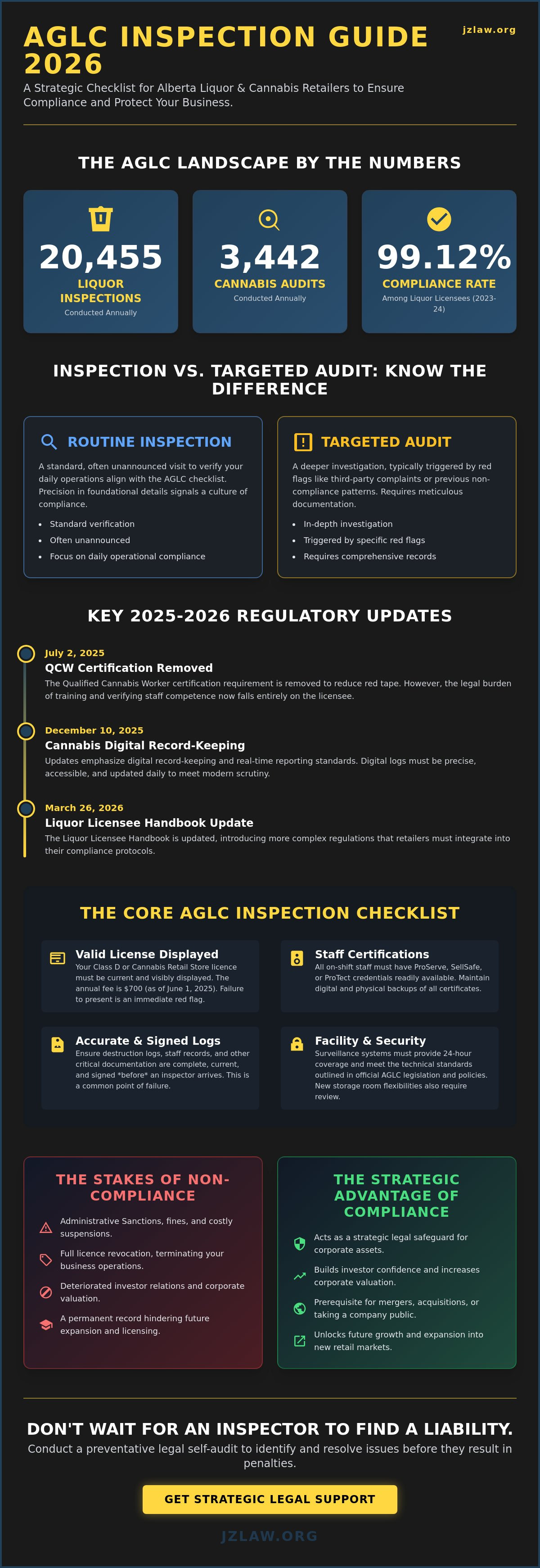
With 20,455 liquor inspections and 3,442 cannabis audits conducted annually, the AGLC maintains a standard of precision that leaves no room for administrative oversight. You've likely felt the weight of the March 26, 2026 Liquor Licensee Handbook or the 100 plus pages of cannabis regulations, and it's natural to worry that a minor clerical error could jeopardize your $700 annual licence or lead to a costly suspension. We understand that for a modern retailer, compliance isn't just a clerical task; it's a strategic legal safeguard that protects your corporation’s most valuable intangible asset.
By utilizing this comprehensive aglc inspection checklist for retailers, you'll master the complexities of the 2026 regulatory landscape with confidence. We'll provide you with a clear, actionable roadmap that covers everything from the July 2, 2025 certification changes to new storage room flexibilities. This article offers a strategic breakdown of exactly what inspectors look for, ensuring you have total peace of mind and a preventative legal posture before an official arrives at your door.
Key Takeaways
Learn how to adapt to the 2026 regulatory environment where high compliance standards meet new flexibilities in cannabis storage and liquor licensing.
Access a structured aglc inspection checklist for retailers that prioritizes valid licensing and the meticulous maintenance of staff certification records.
Discover how to avoid common administrative traps by ensuring destruction logs and staff records are signed and current before an inspector arrives.
Master a professional mock inspection framework to conduct a thorough self-audit that identifies legal liabilities before they result in penalties.
Understand the strategic link between daily regulatory compliance and high-level business goals like mergers, acquisitions, or taking your company public.
Table of Contents Understanding the AGLC Inspection Landscape in 2026 The Core AGLC Inspection Checklist for Retailers Common Pitfalls: Where Retailers Fail During Inspections How to Conduct a Legal Self-Audit Before the Inspector Arrives Strategic Legal Support for Alberta Regulatory Compliance
Understanding the AGLC Inspection Landscape in 2026
The Alberta Gaming, Liquor and Cannabis Commission (AGLC) operates as the primary regulatory body ensuring that the sale of controlled substances aligns with provincial legislation and public safety mandates. In 2026, the commission has shifted toward a data-driven approach to enforcement, prioritizing transparency and modernization. While 99.12% of liquor licensees maintained compliance in the 2023-2024 reporting period, the volume of inspections remains high, with over 20,455 checks conducted at liquor-licensed premises annually. For retailers in high-density markets like Calgary and Edmonton, the frequency of these visits has increased as the AGLC seeks to reduce red tape while maintaining a visible field presence. Precision is mandatory.
Distinguishing between a routine inspection and a targeted audit is vital for your legal strategy. A routine inspection is a standard, often unannounced visit to verify that your daily operations align with the aglc inspection checklist for retailers. In contrast, a targeted audit is a deeper investigation, usually triggered by specific red flags, third-party complaints, or patterns of non-compliance identified through previous reporting. Failure to prepare for either can lead to severe repercussions. Consequences range from minor administrative warnings to full licence revocation, which effectively terminates your business's ability to operate legally in Alberta.
The Legal Stakes of Non-Compliance
Beyond immediate fines, a failed inspection creates a permanent record that can deteriorate investor relations and corporate valuation. Maintaining a clean regulatory standing is a prerequisite for pursuing future cannabis licensing opportunities or expanding into new retail markets. It's not just about today's audit; it's about your firm's long-term viability. An Administrative Sanction is a formal legal mechanism for enforcement that allows the commission to impose penalties, suspensions, or specific conditions without initiating criminal proceedings.
New 2026 Regulatory Updates
The regulatory environment became more complex following the March 26, 2026 update to the Liquor Licensee Handbook. These changes, alongside the December 10, 2025 cannabis updates, emphasize digital record-keeping and real-time reporting standards. Federal oversight has also tightened, meaning provincial inspectors now look for alignment with national health and safety standards during their rounds. Retailers must adapt their internal aglc inspection checklist for retailers to account for the removal of the qualified cannabis worker certification requirement that took effect on July 2, 2025. This means that while barriers to hiring are lower, the legal burden of training and verifying staff competence falls more heavily on the licensee's shoulders. Digital logs must be precise, accessible, and updated daily to survive modern scrutiny.
The Core AGLC Inspection Checklist for Retailers
The AGLC inspector’s primary objective is to verify that your operation mirrors the precise commitments made during your application process. While the handbooks are dense, an effective aglc inspection checklist for retailers focuses on the high-risk areas where most sanctions occur. It begins with the physical display of your Class D or Cannabis Retail Store licence; as of June 1, 2025, the annual fee for these licences stands at $700, and failure to present a valid, current document is an immediate red flag. Accuracy in these foundational details signals a culture of compliance to the visiting official.
Staff certification remains a cornerstone of regulatory safety. Although the AGLC removed the requirement for Qualified Cannabis Worker (QCW) certification on July 2, 2025, to reduce administrative red tape, this change does not exempt staff from ProServe, SellSafe, or ProTect requirements. Inspectors will cross-reference your staff roster against these certification logs. Every employee on shift must have their credentials readily available for verification. We recommend maintaining a digital and physical backup of these certificates to ensure no lapse in documentation occurs during a high-pressure audit.
Facility and Security Requirements
Security is not merely about deterrents; it's about the technical standards outlined in the official AGLC legislation and policies. Your surveillance system must provide 24 hour coverage of all point-of-sale areas and product storage rooms. Current standards typically require high-definition footage to be stored for a minimum of 60 days, though you should verify specific handbook updates from December 10, 2025, regarding cannabis storage room flexibilities. Signage is equally critical. You must display age-verification posters at every entrance and point of sale. If your "Retail Destruction Record" isn't accessible or shows gaps in signatures, the inspector may flag your inventory management as high-risk.
Record-Keeping and Administrative Compliance
The "paper trail" is your primary legal defense during any regulatory inquiry. You must maintain an on-site binder containing your AGLC-approved floor plans, as any unauthorized structural changes to the premises can lead to immediate sanctions. Since the January 13, 2026, policy amendments regarding retail sportsbooks and gaming venues, the intersection of liquor and entertainment has become more scrutinized. Ensure your purchase records match your current inventory exactly. Tracking returns and transfers according to the 2026 User Guide is essential for demonstrating that every product in your store was legally acquired. If you find the administrative burden overwhelming, seeking a strategic legal review of your records can identify gaps before they become liabilities.
Common Pitfalls: Where Retailers Fail During Inspections
Identifying vulnerabilities in your operational workflow is as critical as the initial licensing process itself. Even retailers with a high commitment to excellence often succumb to the "Administrative Trap," where the failure isn't a lack of action, but a lack of documentation. For instance, while a store might properly dispose of unsellable product, a missing signature on the Retail Destruction Record constitutes a breach of policy. In the 2023-2024 period, the AGLC issued 68 penalties to liquor licensees despite high overall compliance rates, proving that inspectors prioritize the precision of your paper trail over verbal assurances.
Staffing errors represent another frequent point of failure. While you may have verified a ProServe or SellSafe certificate during the hiring phase, these credentials expire. An aglc inspection checklist for retailers must include a recurring audit of staff certification dates to prevent an inspector from finding an employee on the floor with lapsed qualifications. Similarly, inventory discrepancies between your physical stock and the point-of-sale (POS) system can trigger a targeted audit. If your digital records don't mirror your shelf counts, it suggests a loss of control over regulated substances, which is a significant legal liability.
The Danger of "Inducements" and Promotions
The legal definition of an "inducement" remains a complex area of regulatory theory. In 2026, any benefit provided by a supplier to a retailer that might "induce" them to carry a specific product is strictly scrutinized. While the November 28, 2024 updates provided some flexibility regarding cannabis product promotion, the line between legal marketing and illegal inducements is thin. Loyalty programs must be structured with extreme care; they cannot offer cannabis or liquor as a reward, nor can they be funded by suppliers in a way that violates the Gaming, Liquor and Cannabis Act. We've seen red flags raised simply because a supplier provided branded barware or display cases that exceeded "nominal value" thresholds.
Security Footage Failures
Technical oversights in surveillance are often the easiest infractions for an inspector to document. A common error is the failure to maintain "unobstructed views" of high-risk areas, such as the immediate space around the cash desk or the entrance to the storage room. If a new display rack blocks a camera’s line of sight, you're in immediate non-compliance. When an inspector requests data, you must provide it without over-disclosing unrelated corporate information. Having a clear protocol for handling these requests ensures you meet your legal obligations without compromising your broader business privacy or digital security standards.
How to Conduct a Legal Self-Audit Before the Inspector Arrives
Prevention is the highest form of legal protection. While the AGLC provides the regulatory framework, the burden of proof regarding your store’s compliance rests entirely on your shoulders. Integrating an aglc inspection checklist for retailers into your monthly operational cycle transforms compliance from a source of anxiety into a routine business process. A methodical self-audit allows you to identify and rectify administrative gaps before they're documented by a provincial official, effectively neutralizing potential liabilities.
To ensure your retail operation remains resilient, we recommend a five step approach based on the JZ Law framework:
Step 1: Perform a "Mock Inspection" using the JZ Law framework to simulate the exact path an inspector takes through your premises.
Step 2: Review all corporate records for corporate transactions that require disclosure, such as changes in directors, share transfers, or new financing arrangements.
Step 3: Audit staff files for certification gaps, ensuring every team member’s ProServe or SellSafe status is documented with a clear expiration date and a record of their last background check.
Step 4: Verify the physical premises against the last AGLC-approved site plan; even minor alterations to product displays or storage areas can trigger a violation if not pre-approved.
Step 5: Consult with legal counsel to address known vulnerabilities or to interpret complex 2026 handbook updates that may impact your specific licence class.
The Role of Internal Compliance Officers
Empowering your managers to act as internal compliance officers creates a culture of "inspection-readiness" that persists even when ownership is off-site. Weekly spot checks should focus on the immediate visibility of age-verification signage and the accuracy of the daily sales logs. Documenting these internal audits is vital. Showing an inspector a history of proactive, self-identified fixes demonstrates a good-faith effort to comply with the law, which can often influence the severity of any administrative feedback you receive.
Addressing Discrepancies Before the Audit
Discovering an error in your records, such as an unsigned destruction log or an inventory mismatch, requires a calculated response. While some issues warrant immediate self-reporting to the AGLC to maintain your standing, others are best handled through internal correction and legal consultation. Correcting record-keeping errors must be done transparently; never backdate a document or attempt to obscure a past mistake, as this can be interpreted as fraudulent activity. The legal principle of due diligence serves as a primary defense, demonstrating that the licensee took all reasonable steps to prevent a regulatory breach. If you've identified a significant compliance gap, contact our legal team to develop a strategic disclosure plan that protects your licence.
Strategic Legal Support for Alberta Regulatory Compliance
Operational excellence requires more than just following a manual; it demands a sophisticated understanding of how regulatory theory intersects with the daily pressures of the retail market. JZ Law bridges this gap by transforming the aglc inspection checklist for retailers from a static list of rules into a dynamic corporate asset. We recognize that for sophisticated operators in Calgary and Edmonton, a clean inspection record is a prerequisite for high level growth. Whether you are scaling a local boutique or managing a multi-jurisdictional chain, our firm provides the precision needed to ensure your retail licence remains an unshakeable foundation for your business goals.
Compliance is a critical factor in business valuation, particularly when taking your cannabis company public or preparing for a significant merger. Investors and underwriters perform deep-dive due diligence into your regulatory history; any pattern of administrative sanctions or failed audits can lead to decreased valuation or the total collapse of a deal. Beyond preventative measures, we provide robust advocacy during AGLC hearings and administrative sanction appeals. If your business faces a potential suspension or fine, our team acts as your strategic representative, challenging overreaches and negotiating resolutions that protect your operational continuity.
Beyond the Checklist: Long-Term Risk Management
A resilient business is built on a structure that can withstand evolving scrutiny. Long term risk management involves more than just passing today's audit; it requires a proactive approach to corporate governance. This includes sophisticated tax structuring and corporate setups that isolate liabilities and protect your licensing interests during complex transactions. JZ Law provides a "Strategic Shield" for your operations, ensuring that your internal policies don't just meet the minimum standards of the March 26, 2026 handbook updates but set a benchmark for industry best practices. We help you build a culture where compliance is integrated into every corporate transaction.
Contacting John Zang for a Compliance Review
Maintaining your standing with the AGLC is an ongoing commitment that requires professional oversight. Scheduling a comprehensive audit of your retail licensing framework with John Zang allows you to identify hidden vulnerabilities before they're exposed by a provincial inspector. As you prepare for expansion into new product categories or geographic jurisdictions, having a seasoned legal partner ensures your growth is both rapid and compliant. Your licence is the lifeblood of your retail enterprise; protect it with the same rigor you apply to your financial bottom line. Secure your retail future with JZ Law and ensure your business is ready for the challenges of the 2026 regulatory environment.
Securing Your Retail Legacy through Proactive Compliance
Maintaining a valid retail licence requires more than just passive adherence to the March 26, 2026 Liquor Licensee Handbook or the December 10, 2025 cannabis updates. It's about building a robust corporate culture where administrative precision and physical security standards are verified through a consistent aglc inspection checklist for retailers. By identifying common pitfalls like inducement violations or surveillance gaps before an official audit, you protect your business's valuation and its future in the Alberta market. This preventative approach ensures that a routine visit from an inspector remains a minor formality rather than a threat to your operations.
JZ Law offers a sophisticated blend of regulatory expertise and strategic business insight to help you navigate these complexities. With a strong presence in Calgary, Edmonton, and major Canadian hubs, our firm specializes in bridging the gap between high stakes corporate transactions and strict provincial oversight. We don't just help you pass an inspection; we help you mitigate long term risk and prepare for scalable growth. Consult with JZ Law on Your AGLC Compliance Strategy to ensure your operations remain a resilient asset. Your commitment to excellence today is the strongest safeguard for your retail success tomorrow.
Frequently Asked Questions
How often does the AGLC conduct inspections for retailers?
AGLC inspectors don't follow a fixed public schedule; however, they conducted 23,897 total inspections across Alberta in the 2023-2024 fiscal year. Retailers in high-traffic urban centers or those with a history of minor infractions can expect more frequent visits. Maintaining a current aglc inspection checklist for retailers helps ensure your team is prepared for these unannounced audits at any time.
What happens if an AGLC inspector finds a violation at my store?
Enforcement actions depend on the severity of the infraction and your store's compliance history. In the 2023-2024 reporting period, the AGLC issued 82 total penalties across both the liquor and cannabis sectors. Consequences range from a formal administrative warning or a financial penalty to the suspension or permanent revocation of your retail licence.
Do I need to be present during an AGLC inspection?
The licensee doesn't need to be physically present, but an authorized representative must be on-site during all operating hours. This individual must have full access to all regulated areas and the administrative binder containing your approved floor plans and staff certifications. Failure to provide immediate access to these records can result in a violation for obstructing an inspector.
Can an AGLC inspector look at my personal financial records?
Inspectors primarily focus on corporate and operational records that impact your licensing eligibility. While they don't typically audit personal finances, they have broad authority to review any documentation related to the purchase, sale, or promotion of regulated products. This includes corporate transaction records and supplier agreements that could signal illegal inducements.
How long do I need to keep security camera footage for AGLC compliance?
You must maintain high-definition surveillance footage for a minimum of 60 days. This footage must clearly show all point-of-sale transactions and the entrance to any product storage rooms. Ensuring your system meets these technical standards is a vital component of any aglc inspection checklist for retailers to avoid immediate technical non-compliance.
What is the difference between a SellSafe and ProServe certification?
ProServe and SellSafe are distinct certifications tailored to specific regulated industries. ProServe is the mandatory training program for the responsible sale and service of liquor in Alberta. SellSafe is the equivalent requirement for the cannabis retail sector, focusing on age verification and the legal limits of cannabis possession and sales.
Can I appeal an AGLC administrative sanction or fine?
You have the legal right to appeal administrative sanctions or fines through the AGLC’s formal review process. This involves presenting your case to the AGLC Board to contest the findings or the severity of the penalty. Professional legal representation is often necessary to navigate these hearings and protect your business interests effectively.
What is a "Retail Destruction Record" and why is it mandatory?
The Retail Destruction Record is a mandatory log used to document the disposal of unsellable or expired regulated products. This document prevents the illegal diversion of inventory and must include the date, reason for destruction, and the signature of the witness. Gaps in this record are one of the most common administrative traps identified during routine audits.



Comments