


Business Asset Purchase vs Share Purchase: A Strategic Legal Guide for 2026
- jzanglaw
- 1 day ago
- 13 min read
The most straightforward path to an acquisition in 2026 is often the one that conceals the deepest legal traps. While a stock transfer seems efficient, it forces you to step into the shoes of the previous owner, along with every undisclosed liability they've accumulated. We recognize that choosing between a business asset purchase vs share purchase feels like a high-stakes gamble where your capital and reputation are both on the line. You're likely concerned about the complexities of transferring regulatory licenses or whether you'll actually secure the tax "step-up" benefits you've been promised. The right structure changes everything.
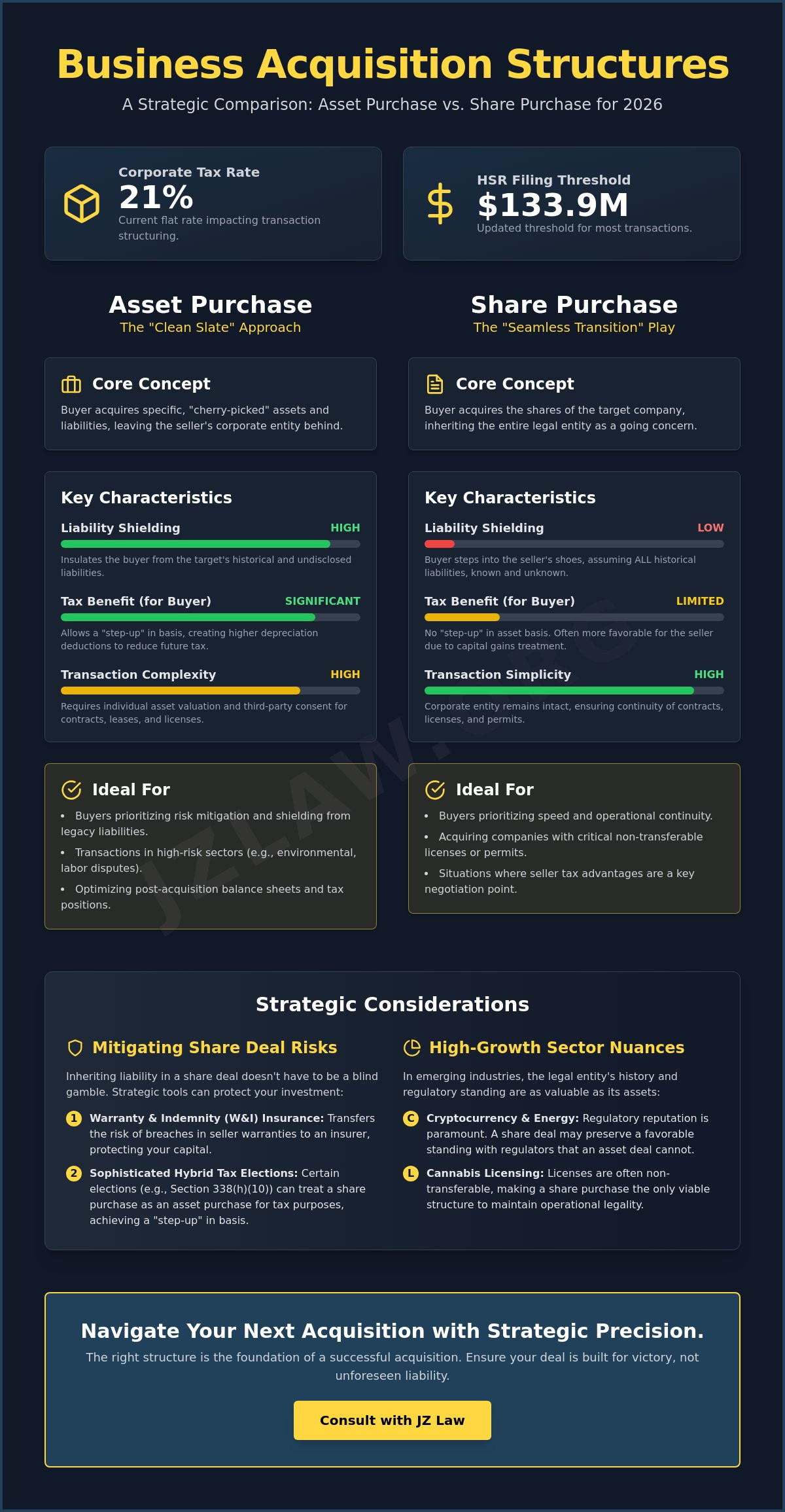
This guide will provide the clarity you need to master these nuances and minimize successor liability effectively. We'll explore how to leverage the current 21% flat corporate tax rate and navigate the updated HSR filing thresholds, which now stand at $133.9 million for most transactions. You'll gain a clear decision-making framework to ensure your next acquisition is a strategic victory rather than a legal burden.
Table of Contents
The Fundamental Choice: Entity vs. Elements in 2026
The decision-making process for Mergers and acquisitions in 2026 has shifted from simple tax calculations to a complex evaluation of regulatory and digital legacies. When evaluating a business asset purchase vs share purchase, you're choosing between acquiring a set of functional tools or inheriting a living legal entity. This distinction is critical because modern businesses carry extensive digital footprints and regulatory track records that don't simply disappear after a closing date. If a target company has a history of data breaches or non-compliance with evolving AI regulations, those "skeletons" remain tied to the corporate identity.
Preliminary due diligence must identify "deal-breaker" liabilities, such as pending environmental litigation or unresolved labor disputes, before you commit to a specific structure. In high-growth sectors like cryptocurrency or energy, the "entity" often carries a reputation with regulators that can either accelerate your growth or anchor you to past mistakes. You can't separate a company from its history in a share deal, so understanding the weight of that history is your first priority. Strategic buyers often find that the most valuable part of a target isn't just its equipment, but its standing in the market.
Asset Purchase: The 'Clean Slate' Approach
An asset purchase is a selective acquisition of a business's operational components rather than its legal identity. This structure allows you to "cherry-pick" specific equipment, intellectual property, and goodwill while leaving the corporate shell behind. By defining the scope of "excluded assets" and "assumed liabilities" with precision, you effectively insulate your capital from the target's historical litigation risks. It's a clean slate. You don't take on the skeletons in the closet because you aren't buying the closet; you're only buying the clothes that still have value. This is particularly advantageous when the target company has complex debt structures or unresolved employee claims that would otherwise jeopardize your financial stability.
Share Purchase: The 'Seamless Transition' Play
In contrast, a share purchase maintains the continuity of the corporation's legal personhood. You buy the entire entity, which means contracts, leases, and vendor relationships typically remain undisturbed. Sellers usually prefer this route because it often qualifies for significant Capital Gains exemptions, particularly under current 2026 tax regulations. However, this seamlessness comes with the burden of history. JZ Law plays a vital role here, evaluating the integrity of the share structure and ensuring that the "seamless transition" doesn't inadvertently include undisclosed debts or regulatory sanctions. We focus on the precision of the transfer to protect your strategic interests from day one. By conducting a forensic review of the corporate minute books and capitalization tables, we ensure that the entity you're buying is exactly what it claims to be.
Asset Purchase Strategy: Maximizing Tax Basises and Shielding Risk
An asset purchase is often the preferred route for buyers seeking to optimize their balance sheets from the moment of closing. One of the primary drivers in the business asset purchase vs share purchase debate is the "step-up" in basis. This mechanism allows you to revalue the acquired assets to their current fair market value, creating higher depreciation and amortization deductions that directly reduce your future tax liabilities. While this provides a clear financial advantage, it frequently initiates a tug-of-war during negotiations. Sellers typically prefer to allocate the purchase price toward assets that trigger capital gains, while buyers push for classifications like equipment or software that offer more immediate tax relief through depreciation.
The strategic isolation of risk is equally vital, particularly in sectors like Calgary's oil and gas industry. By structuring the deal as an asset purchase, you can leave behind historical environmental liabilities or legacy labor disputes that might otherwise jeopardize your new venture. This protection isn't automatic; it requires meticulous drafting to ensure the separation is legally robust. You must also account for the complexity of third-party consents. Since you aren't acquiring the legal entity itself, almost every existing contract, from office leases to specialized software licenses, usually requires a new signature or a formal assignment. This can slow the transaction, but it ensures you aren't tethered to unfavorable terms from the past.
Risk Mitigation for High-Stakes Industries
In high-friction sectors like cryptocurrency, avoiding successor liability is a cornerstone of our strategy. We ensure that employee transfers are handled with precision to prevent mass wrongful dismissal claims, a process that is also essential in real estate law acquisitions involving large property management teams. If you're managing a complex portfolio, our Corporate Transactions expertise can help align these operational shifts with your long-term financial goals. We focus on creating a clean break between the old entity's obligations and your new operational structure.
Valuation of Intangible Assets
Assigning value to goodwill, trademarks, and proprietary technology in 2026 requires a sophisticated understanding of market trends and legal protections. The nuances of intellectual property transfer in an asset-only deal are strict; rights don't simply "flow" to the buyer without explicit documentation. JZ Law evaluates a target's regulatory "good standing" as a tangible value driver. We don't just look at the physical assets. We analyze how the target's reputation and compliance history can be leveraged under your new brand identity to ensure the goodwill you're paying for is actually transferable.
Share Purchase Strategy: Continuity, Licenses, and Speed
While the asset route provides a surgical approach to acquisitions, the share purchase preserves the corporate organism in its entirety. This structure is often the only practical path when a target business relies on complex operational webs that would be too costly or time-consuming to re-establish. By acquiring the shares, you maintain the continuity of the legal personhood, ensuring that leases, vendor contracts, and established client relationships remain undisturbed. However, this convenience shifts the strategic weight heavily toward the investigation phase. In a business asset purchase vs share purchase, the latter requires at least three times the due diligence effort to uncover the "historical baggage" that stays with the entity.
JZ Law employs a rigorous methodology to protect your capital from hidden securities or tax liabilities that don't appear on standard balance sheets. We look beyond the surface to identify unrecorded debts, pending regulatory inquiries, or "poison pill" clauses in existing agreements. Because you're stepping into the seller's shoes, any past mistake becomes your present problem. Our team focuses on the structural integrity of the target's history, ensuring that the speed of a share deal doesn't lead to a long-term legal burden. We provide the forensic oversight necessary to transform a risky inheritance into a calculated strategic move.
Regulatory Continuity and Permitting
The "Change of Control" clause is a frequent trap in share deals; even if the entity remains the same, a change in ownership can trigger termination rights in critical contracts. Navigating notifications for FINTRAC or the SEC requires precise timing to avoid post-closing sanctions. Share purchases are often the only viable path for acquisitions where the target's primary value resides in government-issued licenses that are legally prohibited from being assigned to a third party. This is particularly relevant in cannabis licensing, where the permit is tied to the specific corporate shell and cannot be "cherry-picked" in an asset deal.
Seller Motivations and Negotiation Leverage
Sellers are almost always incentivized to push for a share deal to utilize the Lifetime Capital Gains Exemption (LCGE) in Canada, which remains a cornerstone of exit planning in 2026. This preference creates significant negotiation leverage for the buyer. If you agree to a share structure to facilitate the seller's tax benefits, you're in a position to demand a lower purchase price or more favorable indemnification terms. JZ Law specializes in drafting robust escrow and indemnification clauses that bridge the gap between the seller's desire for a tax-efficient exit and your need for protection. We ensure that a portion of the purchase price is held back to cover any "skeletons" that might emerge after the transition is complete.
Strategic Tax Structuring and Regulatory Objections
Sophisticated acquisitions in 2026 often transcend the binary choice of a business asset purchase vs share purchase by utilizing hybrid structures. For transactions involving U.S. entities, a Section 338(h)(10) election allows parties to treat a stock purchase as an asset purchase for federal income tax purposes, providing the buyer with a beneficial "step-up" in basis while maintaining the operational simplicity of a share transfer. In the Canadian context, similar results are achieved through meticulously planned "bump" strategies under the Income Tax Act. These structures are essential for managing the current 21% flat corporate tax rate and optimizing long-term capital gains, which in 2026 remain tiered at 0%, 15%, or 20% based on income thresholds. We don't just follow standard templates; we engineer the tax architecture to suit the specific liquidity needs of the parties involved.
The most frequent objection to equity deals is the fear of inheriting undisclosed liabilities. JZ Law addresses this concern by integrating Warranty and Indemnity (W&I) insurance as a strategic bridge, shifting the risk of "unknown" historical breaches from the buyer to a third-party insurer. This is particularly vital in corporate transactions that involve volatile digital assets or extensive cryptocurrency holdings, where the regulatory trail can be difficult to audit. Our firm provides the technical and legal oversight required to value these assets accurately while ensuring the transaction remains compliant with the latest securities regulations. If you're planning a complex acquisition, our Tax Structuring experts can help you isolate value while neutralizing historical risk.
Mitigating the Risk of Inherited Liability
Representations and warranties serve as the legal backbone of a secure share purchase, but they're only as effective as the enforcement mechanisms behind them. We utilize holdbacks and earn-outs to align the seller's interests with your long-term success, ensuring that a portion of the purchase price is contingent on the accuracy of the target's financial disclosures. JZ Law's "Deep Dive" audit process examines years of regulatory compliance history to identify potential sanctions or environmental claims before they become your responsibility. We focus on proactivity rather than reaction, ensuring every potential liability is quantified and addressed in the purchase agreement.
Cross-Border Transaction Nuances
Navigating a cross-border acquisition, such as a move from Toronto to NYC or an expansion into Germany, requires an understanding of divergent legal traditions. While North American deals often favor the flexibility of asset transfers, acquisitions in German hubs like Berlin or Hamburg may face strict withholding tax requirements and different treatments of goodwill. Managing these international tax obligations is critical to preventing capital erosion during the transfer. For enterprises managing oil and gas law assets across multiple jurisdictions, we ensure that the choice of structure accounts for local royalty regimes and environmental bonding requirements, providing a unified strategy for global energy hubs.
For those looking toward the Australian market, KPA Lawyers provides the same level of outcome-oriented legal advice, helping businesses navigate the specific regulatory requirements of the Melbourne bayside region.
Executing the Transaction with JZ Law
Executing a transaction is the culmination of months of strategic planning and forensic investigation. At JZ Law, we don't view the closing as merely a signing ceremony; it's the moment your capital is finally deployed into a new growth phase. Our role is to provide unwavering counsel from the initial Letter of Intent to the final exchange of funds. Whether your transaction follows a business asset purchase vs share purchase model, we ensure the legal architecture is built to withstand future regulatory shifts. Our multi-city presence in Calgary, Toronto, Vancouver, and NYC allows us to manage cross-border complexities with local precision, ensuring that a deal structured in Manhattan complies with the specificities of Canadian provincial law.
The "John Zang" approach is defined by a conscious blend of classic professional dignity and a modern, business-minded strategy. We don't just deliver dry legal facts. We act as a strategic partner who understands that the regulatory environment must be navigated in a way that serves your market interests. By merging legal precision with a deep understanding of market dynamics, we help you avoid the common pitfalls that stall transactions. We treat every deal with the systematic thoroughness it deserves, avoiding the haste that leads to ungrounded decisions and long-term liabilities.
Our Process for Corporate Acquisitions
Our methodology is designed to create security at every stage of the deal lifecycle. We begin with a structural analysis and feasibility study to determine which acquisition path aligns with your risk tolerance and tax goals. From there, we move into the following phases:
Definitive Agreements: Drafting and negotiating the Purchase Agreement to include industry-specific protections and robust indemnification clauses.
Regulatory Navigation: Managing the filings and notifications required for sectors with high oversight, such as energy or securities.
Post-Closing Integration: Providing ongoing support for regulatory compliance monitoring to ensure the transition doesn't trigger unforeseen sanctions.
Why JZ Law is the Choice for Complex Deals
We specialize in the high-growth, high-regulation sectors that generalist firms often avoid. Our team understands the unique pressures of the crypto, cannabis, and energy markets, where a single regulatory change can shift the value of a target overnight. Our expertise in taking companies public and pre-IPO restructuring makes us uniquely qualified to handle acquisitions that are part of a larger, long-term exit strategy. We focus on proactivity, identifying the risks of a business asset purchase vs share purchase before they impact your balance sheet. Contact JZ Law today for a strategic consultation on your next acquisition and ensure your capital is protected by a partner who understands the modern business landscape.
Securing Strategic Advantage in Your Next Acquisition
The landscape of corporate transactions in 2026 demands a sophisticated approach that balances immediate tax benefits with long-term regulatory stability. Success requires more than just selecting a structure; it’s about the precise alignment of your financial goals with the specific legal requirements of your industry. Whether you prioritize the tax-optimizing "step-up" in basis or the operational continuity of a share deal, the decision between a business asset purchase vs share purchase will fundamentally shape your future liability profile. Meticulous oversight during the due diligence phase remains the most effective tool for protecting your capital and ensuring a seamless transition.
JZ Law, led by principal lawyer John Zang, specializes in navigating these complex corporate transactions across high-regulation sectors like cryptocurrency and cannabis. With a multi-jurisdictional presence spanning Calgary, Toronto, Vancouver, NYC, and Berlin, we provide the global perspective and local expertise necessary to execute even the most intricate deals. Our firm’s focus on proactivity ensures that potential risks are neutralized before they impact your balance sheet. Secure your next corporate acquisition with JZ Law's strategic counsel. We look forward to helping you transform your business vision into a legally robust reality.
Frequently Asked Questions
What is the main difference between an asset purchase and a share purchase?
The fundamental distinction lies in whether you acquire the individual operational components of a company or the legal entity itself. In an asset purchase, you select specific items like equipment and intellectual property while leaving the corporate shell behind. A share purchase involves acquiring the entire corporation, which means you inherit its full legal history, including all past contracts and potential liabilities. This choice dictates your level of exposure to the target's historical mistakes.
Why do buyers typically prefer asset purchases in 2026?
Buyers often favor an asset structure to isolate themselves from the target's historical risks, such as undisclosed litigation or environmental debts. With the federal corporate tax rate at a flat 21% in 2026, maximizing depreciation through a revaluation of assets is a high priority for capital preservation. This "clean slate" approach is vital in high-regulation sectors where past non-compliance could lead to heavy fines that would otherwise stay with the corporate entity.
Can I transfer a cannabis or liquor license through an asset sale?
Government-issued permits like cannabis or liquor licenses are typically non-transferable and tied strictly to the specific corporate entity that holds them. In an asset sale, these licenses often expire or require an entirely new application process, which can lead to significant operational delays. For this reason, businesses whose value is anchored to such permits often require a share purchase to ensure regulatory continuity and avoid a total cessation of sales during the transition.
How does a share purchase affect the employees of the target company?
Employees generally remain with the company under their existing contracts because the legal identity of the employer hasn't changed. This maintains business continuity and avoids the need to issue new offers of employment or navigate the complexities of mass termination. However, the buyer must carefully audit the target's past labor practices to ensure there are no lurking wrongful dismissal claims or unpaid benefit obligations that could impact the company's valuation after the closing.
What is a 'step-up' in basis and why is it important for buyers?
A "step-up" in basis occurs when a buyer revalues the acquired assets from their historical book value to their current fair market value. This is a critical advantage in a business asset purchase vs share purchase because it allows for higher depreciation and amortization deductions. These deductions directly lower your taxable income, effectively increasing the cash flow available to the business in the years following the acquisition. It's a powerful tool for recovering your initial investment faster.
Are there hybrid options that combine the benefits of asset and share deals?
Hybrid structures allow parties to treat a stock sale as an asset sale for tax purposes, providing the best of both worlds. For example, a Section 338(h)(10) election in the United States enables a buyer to gain the tax "step-up" while maintaining the operational simplicity of a share transfer. These elections require precise legal drafting and mutual agreement between the buyer and seller to ensure the tax burden is allocated fairly. Canadian law offers similar mechanisms to achieve these strategic goals.
How do I protect myself from hidden liabilities in a share purchase?
Protection comes from a combination of forensic due diligence, robust representations and warranties, and the use of Warranty and Indemnity (W&I) insurance. We also recommend utilizing holdbacks or escrow accounts, where a portion of the purchase price is retained for a set period to cover any undisclosed debts that emerge. These mechanisms provide the security needed to proceed with an equity deal without fear of inherited mistakes. It's about building a legal safety net around your investment.
Does JZ Law handle cross-border transactions between Canada and the US?
JZ Law provides comprehensive counsel for cross-border acquisitions, leveraging our multi-city presence in New York City, Toronto, Calgary, and Vancouver. We manage the complexities of international tax structuring, withholding requirements, and divergent regulatory frameworks to ensure your transaction is compliant in both jurisdictions. Our team focuses on merging North American legal standards with your specific business objectives to facilitate a smooth international transition. We bridge the gap between the SEC and provincial regulators effectively.


Comments