


Alberta Securities Commission (ASC) Compliance: A Strategic Guide for 2026
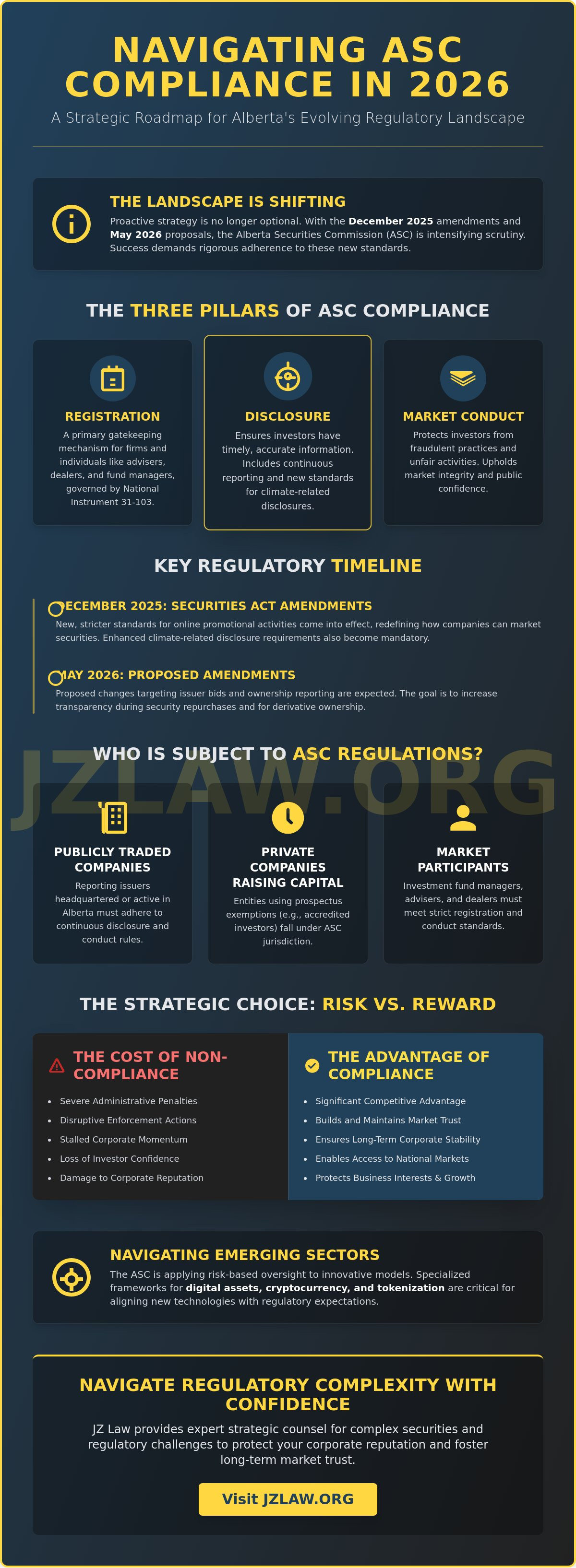
The most successful capital raises in Alberta aren't just built on strong balance sheets; they're built on the invisible foundation of a proactive regulatory strategy. In an era where the December 2025 amendments to the Securities Act have introduced strict scrutiny over online promotional activities, achieving alberta securities commission (asc) compliance has become a sophisticated balancing act. You might feel that every new filing requirement or fee update, such as the May 2026 proposals regarding ownership reporting, is a hurdle that threatens to stall your momentum.
It's natural to worry about the high cost of regulatory errors or the complexity of registration in emerging sectors like cryptocurrency. We agree that the landscape feels increasingly dense, yet we believe that rigorous adherence is actually your greatest competitive advantage for building market trust. This guide provides a clear roadmap to help you navigate these changes while protecting your business interests. You'll gain expert insights into the latest CSA blanket orders and a strategic preview of how to maintain long-term corporate stability during your next phase of growth.
Key Takeaways
Understand how the December 2025 amendments to the Securities Act redefine the standards for online promotional activities and climate-related disclosure.
Master the registration requirements under National Instrument 31-103 to maintain seamless alberta securities commission (asc) compliance while managing firm and individual fee structures.
Prepare for the May 2026 proposed amendments regarding issuer bids and ownership reporting to ensure transparency during security repurchases.
Navigate the specialized regulatory frameworks for digital assets and tokenization to align innovative business models with the ASC's risk-based oversight.
Implement a proactive mitigation strategy that addresses current enforcement priorities to protect your corporate reputation and foster long-term market trust.
Table of Contents
Navigating the Alberta Securities Commission (ASC) Compliance Landscape in 2026
Core Pillars of ASC Regulatory Compliance: Registration, Disclosure, and Market Conduct
The High Cost of Non-Compliance: Enforcement Trends and Mitigation
Compliance Strategies for Emerging Sectors: Cryptocurrency and Cannabis
JZ Law: Strategic Counsel for Complex Securities and Regulatory Challenges
Navigating the Alberta Securities Commission (ASC) Compliance Landscape in 2026
The regulatory environment in Alberta has matured into a complex ecosystem where precision is a strategic necessity. The Alberta Securities Commission (ASC) acts as the primary regulatory body responsible for administering the Securities Act (Alberta). This legislation serves as the bedrock for all capital market activity in the province. As we move through 2026, the focus has pivoted toward addressing modern market challenges, specifically the rise of digital assets and the influence of social media on investment decisions. Achieving consistent alberta securities commission (asc) compliance requires an understanding that these rules aren't static. They evolve alongside technology and market sentiment.
The ASC doesn't operate in a vacuum. It works in concert with the Canadian Securities Administrators (CSA) to harmonize regulations across the country. While Alberta maintains its unique provincial jurisdiction, the collaborative nature of the CSA ensures that local businesses can access national markets without facing a fragmented patchwork of rules. This partnership is evident in recent initiatives like the May 14, 2026, proposals aimed at increasing transparency in derivative ownership. For businesses, this means that local compliance often translates to national readiness. Maintaining a proactive stance is the only way to ensure that regulatory shifts don't disrupt your growth trajectory.
The Mandate of the Alberta Securities Commission
The ASC’s primary objective is to foster a fair and efficient capital market where participants can raise capital with confidence. This mandate is built on protecting investors from fraudulent practices and ensuring that all market participants have access to timely, accurate information. By maintaining public confidence in the financial system, the ASC ensures that Alberta remains a competitive destination for global investment. Their risk-based approach to oversight means they focus resources on areas with the highest potential for market disruption, making specialized legal counsel indispensable.
Who Must Comply with ASC Regulations?
Compliance is not limited to large, publicly traded corporations. The scope of the ASC’s authority covers a broad spectrum of entities:
Publicly traded companies, known as reporting issuers, that are headquartered or active in Alberta.
Private companies that utilize prospectus exemptions to raise capital from accredited investors or through the friends, family, and business associates exemption.
Market participants, including investment fund managers, advisers, and dealers, who must adhere to strict registration and conduct standards.
Maintaining alberta securities commission (asc) compliance is essential for any entity seeking to navigate the Alberta market without the disruption of enforcement actions or administrative penalties. Whether you're a startup in Calgary or an established firm in Edmonton, the rules apply the moment you begin engaging with investors.
Core Pillars of ASC Regulatory Compliance: Registration, Disclosure, and Market Conduct
Maintaining institutional integrity in Alberta’s capital markets requires more than a passive understanding of the law. It demands a rigorous, proactive approach to the three functional pillars of the Alberta Securities Commission (ASC): registration, continuous disclosure, and market conduct. While the foundational rules are set by the Securities Act, the operational reality is defined by National Instruments that harmonize local requirements with broader Canadian standards. For firms operating in Calgary or Edmonton, alberta securities commission (asc) compliance serves as a vital bridge between provincial operations and global capital access. This alignment ensures that an Alberta-based issuer remains attractive to sophisticated international investors who prioritize transparency and regulatory stability.
Registration and Licensing for Market Participants
Registration is the primary gatekeeping mechanism used to ensure that only qualified individuals and firms interact with the public. Under National Instrument 31-103, firms must identify the correct category of registration, whether as a dealer, adviser, or investment fund manager. As of May 2026, the annual registration fee for a firm stands at $1,400, while individuals acting on behalf of these firms incur a $400 annual fee. All applications and updates are managed through the National Registration Database (NRD), which serves as a centralized ledger for the CSA. Recent shifts in the landscape include Coordinated Blanket Order 33-930, effective May 1, 2026, which provides temporary exemptions regarding the submission of certain personal information. This reflects a modern, risk-based approach to data privacy within the registration process. Proficiency is not a one-time achievement; it requires ongoing conduct reviews and adherence to strict ethical standards to maintain standing.
Continuous and Event-Based Disclosure
Reporting issuers must adhere to a strict schedule of transparency defined by National Instrument 51-102. This includes the filing of annual and interim financial statements, which must be accompanied by a Management’s Discussion and Analysis (MD&A). For non-venture issuers with a fiscal year ending December 31, 2025, the annual filing deadline was March 31, 2026. Venture issuers were granted until April 30, 2026. Beyond these calendar milestones, companies must provide immediate disclosure of material changes that could reasonably be expected to affect the market price of their securities. This becomes particularly critical when executing strategic corporate transactions, where the timing of a press release can have significant legal implications. The MD&A should not be viewed as a repetitive clerical task. It is a strategic compliance tool that allows management to explain financial results through the lens of their long-term business strategy. Firms that fail to prioritize audit quality or narrative clarity often face increased scrutiny during the ASC’s risk-based compliance reviews. If you are preparing for a complex filing, seeking specialized securities regulation counsel can help mitigate the risk of administrative delays or enforcement inquiries.
The High Cost of Non-Compliance: Enforcement Trends and Mitigation
Regulatory enforcement in Alberta has entered a phase of heightened technological sophistication. While the Commission prioritizes market efficiency, the cost of failing to maintain alberta securities commission (asc) compliance has never been higher, particularly following the December 2025 amendments targeting misleading online promotional activities. The ASC’s enforcement division now utilizes advanced data analytics to monitor social media and investment forums for potential market manipulation. This shift means that even unintentional errors in public communication can trigger an inquiry that disrupts your business operations for months. We believe that the best defense isn't a reactive response but a proactive, documented commitment to transparency.
The Office of the Whistleblower remains a central pillar of regulatory discovery in 2026. By incentivizing individuals to report internal misconduct, the ASC has created an environment where corporate opacity is a significant liability. For management, the distinction between administrative penalties and quasi-criminal proceedings is vital. Administrative penalties often involve monetary fines or bans from the capital markets. Conversely, quasi-criminal proceedings, pursued through the provincial court system, can lead to imprisonment for serious violations of the Securities Act. Protecting your organization requires a strategic approach that treats compliance as a primary business function rather than a secondary administrative task.
Common Triggers for ASC Investigations
Investigations often stem from inconsistencies in executive compensation disclosure or undisclosed related party transactions. These areas are high-priority targets because they directly impact investor trust. Additionally, the ASC continues to crack down on unregistered trading and the illegal distribution of securities. If a firm raises capital without a valid prospectus or a verified exemption, the resulting enforcement action can freeze current assets and jeopardize future raises. Vigilance in these areas is the only way to ensure that your corporate reputation remains untarnished.
Developing a Robust Compliance Culture
A culture of compliance starts with rigorous internal controls and clear reporting structures. It's not enough to have a policy; you must demonstrate its active enforcement. This is why expert legal counsel is indispensable during the due diligence process. When an inquiry does arrive, management’s first step should be to preserve all relevant data and engage a specialist in securities regulation. A calm, methodical response often determines whether a matter is resolved through a settlement or escalates into a public hearing. Maintaining alberta securities commission (asc) compliance through regular internal audits serves as your first line of defense against these risks.
Compliance Strategies for Emerging Sectors: Cryptocurrency and Cannabis
Innovation in Alberta's economy is increasingly driven by sectors that didn't exist in their current form a decade ago. For pioneers in these spaces, achieving alberta securities commission (asc) compliance requires a departure from traditional regulatory assumptions. The Commission has adopted a technology-neutral approach. This means the underlying substance of a transaction matters far more than the digital or biological nature of the asset. Whether you're tokenizing real estate or scaling a licensed cannabis production facility, the expectation of transparency remains absolute. We've seen that the most resilient companies are those that integrate regulatory foresight into their initial business model.
Crypto Assets as Securities in Alberta
The ASC utilizes a dual-layered analysis, applying both the Howey Test and the Pacific Coast Coin Exchange test to determine if a digital asset functions as a security. This determination isn't a mere academic exercise. It dictates whether an issuer must file a prospectus or find a valid exemption. Crypto-asset trading platforms operating in Alberta are now required to register as dealers, often under a restricted framework that eventually matures into full registration. Stablecoins have also come under increased scrutiny. The ASC follows the CSA's lead in requiring enhanced collateral disclosure for these assets. We believe that understanding the nuances of cryptocurrency law is essential for any platform looking to maintain long-term corporate stability.
Capital Raising for Cannabis and Energy Startups
Startups in the cannabis and energy sectors frequently utilize the Accredited Investor and Offering Memorandum exemptions to fuel early-stage growth. These exemptions don't waive the requirement for accurate disclosure. In the cannabis industry, the alignment of cannabis licensing status with securities filings is a frequent point of regulatory friction. If a license is pending or under review, failing to disclose this as a material risk can lead to severe enforcement actions. For those considering taking companies public, the complexities of cross-border regulatory differences between Canadian and U.S. markets must be managed with extreme precision. The ASC's fee structure, updated as of November 28, 2025, reflects this complexity. Participation fees for reporting issuers scale based on market capitalization. For instance, an issuer with a capitalization under $10 million pays a $400 fee. Those in the $100 million to $250 million range pay $6,500. If your business is scaling in these innovative sectors, our cryptocurrency law specialists provide the strategic counsel necessary to navigate these high-stakes environments.
JZ Law: Strategic Counsel for Complex Securities and Regulatory Challenges
Regulatory mandates don't have to be roadblocks. While the previous sections of this guide detailed the technical requirements of the 2026 landscape, the execution of these rules requires a partner who understands the pulse of the Alberta market. JZ Law operates on the principle that alberta securities commission (asc) compliance should serve the business, not the other way around. We offer a boutique advantage that larger firms often struggle to replicate: principal-led attention. When you engage our services, you aren't handed off to a junior associate. You receive the direct, strategic oversight of John Zang, whose approach to high-stakes corporate and securities matters is defined by precision and a deep understanding of market dynamics.
We bridge the gap between rigid regulatory requirements and your specific business objectives. Founders, directors, and institutional participants face unique pressures when raising capital or executing a pivot. Our role is to protect your interests by anticipating risks before they manifest as enforcement actions or administrative delays. By integrating legal foresight with commercial strategy, we transform compliance from a burdensome obligation into a robust framework for institutional trust and long-term corporate stability.
Comprehensive Securities Advocacy
The energy sector remains the heartbeat of the Alberta economy, yet it faces some of the most rigorous disclosure standards in the country. Our expertise in oil and gas law allows us to guide issuers through the intersection of resource reporting and securities regulation. We don't stop at filings; we provide strategic tax structuring to ensure that your regulatory posture complements your financial efficiency. If a dispute arises, we represent our clients during ASC hearings and settlement negotiations with a focus on achieving a resolution that preserves your market standing and minimizes disruption to your operations.
A Strategic Partner for Growth
Successful growth requires moving beyond reactive legal services. We position ourselves as proactive partners who help you build a culture of compliance from the ground up. This is especially critical for firms managing complex assets or navigating real estate law within a securities framework. We help you implement the internal controls discussed earlier in this guide, ensuring that your firm meets the alberta securities commission (asc) compliance standards required for successful capital raises. Whether you're a startup preparing for an initial offering or an established entity managing a take-over bid, our goal is to ensure your long-term viability through rigorous, tailored legal solutions.
Securing Your Corporate Future through Regulatory Excellence
The regulatory landscape of 2026 demands more than just filing papers on time. It requires a deep understanding of how the ASC and CSA are evolving to meet the challenges of a digital economy. From managing the nuances of cryptocurrency law to ensuring your cannabis license aligns with your securities disclosure, every detail matters. Achieving alberta securities commission (asc) compliance is a continuous commitment that safeguards your reputation and opens doors to global capital markets. By prioritizing transparency and proactive internal audits, you transform a complex legal obligation into a powerful tool for institutional trust.
As a principal-led boutique firm, JZ Law provides the specialized attention necessary to navigate these high-stakes regulatory sectors. We don't just help you follow the rules; we help you leverage them for strategic corporate growth. Our team is dedicated to bridging the gap between complex legal mandates and your long-term business objectives. Consult with JZ Law for Strategic ASC Compliance Counsel to ensure your organization remains resilient in a shifting market. With the right strategy, your regulatory standing becomes your strongest asset for future expansion.
Common Questions Regarding Alberta Securities Regulation
What is the primary role of the Alberta Securities Commission?
The primary role of the ASC is to act as the regulatory agency responsible for administering the Securities Act (Alberta) to ensure a fair and efficient capital market. They protect investors from unfair or fraudulent practices while maintaining the integrity of the provincial financial system. This oversight extends to all market participants, including issuers, dealers, and advisers who operate within Alberta's jurisdiction.
How does the ASC define a reporting issuer in Alberta?
A reporting issuer is generally defined as an entity that has issued securities through a prospectus or has securities listed on a recognized stock exchange. Once a company attains this status, it's subject to continuous disclosure requirements, such as filing annual financial statements and interim reports. This designation remains in effect until the entity successfully applies to cease being a reporting issuer under specific regulatory conditions.
Are all cryptocurrency offerings in Alberta considered securities?
Not all cryptocurrency offerings are automatically classified as securities, though the ASC applies the Howey and Pacific Coast Coin Exchange tests to evaluate the substance of each transaction. If a digital asset involves an investment of money in a common enterprise with an expectation of profit from the efforts of others, it's likely a security. Maintaining alberta securities commission (asc) compliance requires a case by case analysis of each token's specific utility and marketing strategy.
What are the consequences of failing to meet ASC disclosure deadlines?
Failing to meet ASC disclosure deadlines typically results in a "Failure-to-File" Cease Trade Order (CTO) being issued against the company's securities. This order prohibits any trading of the issuer's securities until the missing documents are filed and the applicable late fees are paid. Prolonged non-compliance can lead to more severe administrative penalties or a permanent loss of access to Alberta's capital markets.
Can a private company raise capital in Alberta without a prospectus?
Yes, private companies can raise capital without a prospectus by utilizing specific exemptions such as the Accredited Investor, Offering Memorandum, or Friends, Family, and Business Associates exemptions. Each exemption carries its own set of conditions and filing requirements that must be met to ensure alberta securities commission (asc) compliance. Companies must often file a report of exempt distribution and pay a fee within a specific timeframe after the closing of the raise.
How has ASC compliance changed for energy companies in 2026?
In 2026, energy companies face new requirements following the December 11, 2025, amendments that allow the ASC to adapt safe harbour provisions for climate-related disclosure. These changes aim to standardize how issuers report environmental impact and transition risks. Additionally, the May 2026 proposals regarding derivative ownership transparency directly impact how energy firms manage take-over bids and beneficial ownership reporting.
Does the ASC have the power to recover lost funds for investors?
The ASC focuses on enforcement and market integrity rather than acting as a personal collection agency for individual investors. While they can order disgorgement of ill-gotten gains or impose administrative penalties, these funds are generally not distributed back to investors through the Commission’s own processes. Investors often need to pursue private civil litigation to recover specific financial losses resulting from securities fraud or misconduct.
When should a Calgary business hire a securities lawyer for ASC matters?
A Calgary business should engage a securities lawyer well before launching a capital raise or executing a significant corporate transaction. Early involvement ensures that all offering documents and exemptions are legally sound, preventing costly delays. It's also essential to seek counsel immediately if the ASC initiates a compliance review or an enforcement inquiry to manage the response and protect the firm's market standing.


Comments