


Alberta Securities Law: 2026 Crypto Token Compliance Guide
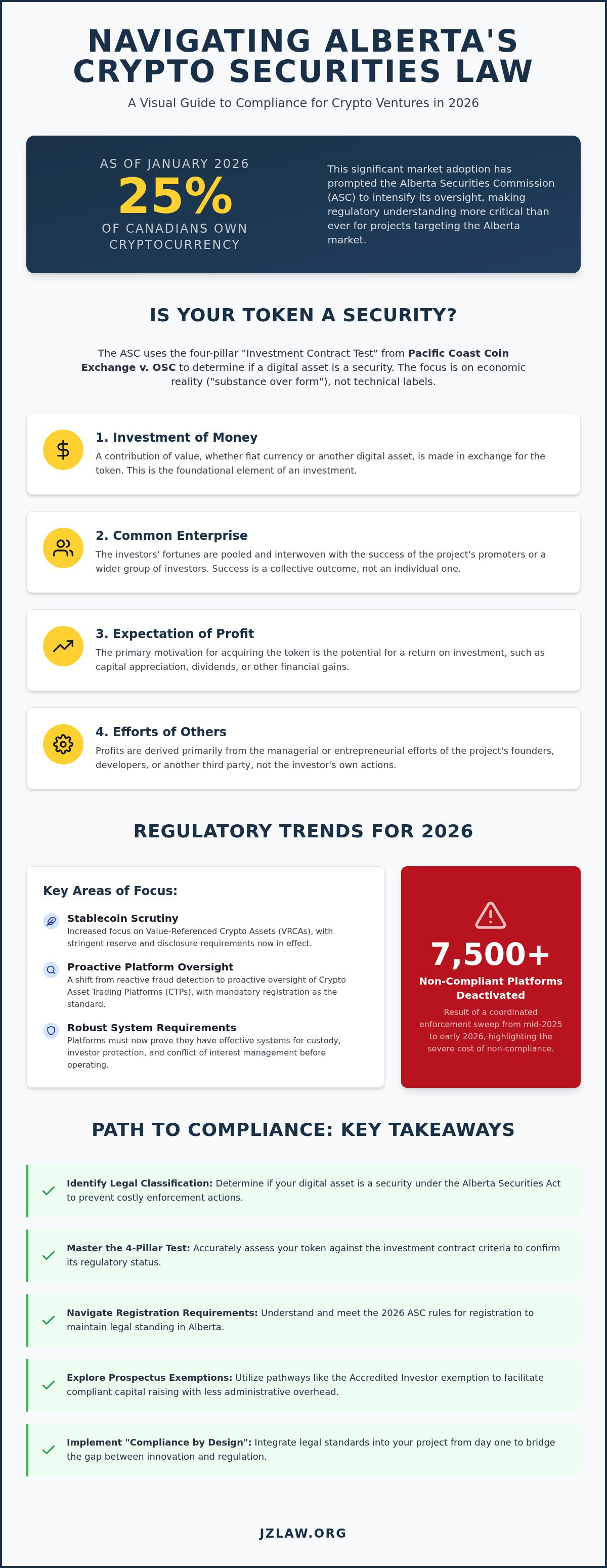
As of January 2026, 25% of Canadians own cryptocurrency, representing a significant shift in the economic environment that has prompted the Alberta Securities Commission to intensify its oversight of alberta securities law for crypto tokens. You've likely found that the line between a utility token and a security remains frustratingly thin, leading to a climate of regulatory uncertainty that can stall even the most innovative projects. The risk of an ASC enforcement action is a constant concern, especially since the costs of non-compliance often exceed the initial capital raised.
This guide serves as a strategic resource to help you maintain regulatory standing while pursuing growth. We'll analyze the current application of the four-prong investment contract test, examine the recent 2026 exemption orders for platforms like Satstreet and Coinbase, and outline the proactive measures required to transform compliance from a burden into a competitive advantage. By aligning your project with the latest provincial standards, you can secure your venture's future and build the long-term trust essential for market success.
Table of Contents
Understanding the ASC Jurisdiction Over Digital Assets in 2026
The Alberta Securities Commission (ASC) functions as the primary regulatory authority ensuring market integrity for digital assets within the province. In 2026, the application of alberta securities law for crypto tokens has matured to address the increasing complexity of decentralized finance and tokenized real-world assets. While the ASC operates with provincial autonomy, it maintains a critical partnership with the Canadian Securities Administrators (CSA) to harmonize national standards. This collaborative approach to Canadian securities regulation ensures that local enforcement remains consistent with broader federal trends while respecting Alberta's unique economic landscape. For 2026, Alberta regulators define a "crypto asset" as any digital representation of value or contractual rights that relies on cryptography and distributed ledger technology, provided it functions as a security or derivative in economic reality.
The Scope of the Securities Act (Alberta)
Legal classification doesn't depend on what you call your token; it depends on what the token actually does. The ASC applies a "substance over form" principle to determine if a digital asset constitutes an investment contract. If you're marketing a token to Alberta residents, provincial law applies regardless of where your development team is based. You must distinguish between "trading" and "distributing" tokens. Trading involves the business of facilitating transactions, while distributing refers to the initial issuance of tokens to the public. Each activity triggers distinct registration and disclosure obligations that are essential for maintaining your project's legal standing. With 25% of Canadians now owning cryptocurrency as of early 2026, the ASC's territorial reach has never been more relevant for global projects seeking access to the Alberta market.
Regulatory Trends for 2026
The current year has brought a sharpened focus on Value-Referenced Crypto Assets (VRCAs) following the Royal Assent of the Stablecoin Act (Bill C-15) in March 2026. Regulators no longer view stablecoins as mere utility tools; they're now subject to stringent reserve and disclosure requirements. Enforcement priorities have shifted significantly from the reactive fraud detection of previous years to proactive oversight of Crypto Asset Trading Platforms (CTPs). Mandatory registration is now the standard for any platform "in the business" of trading. This shift is evidenced by the coordinated sweep between mid-2025 and early 2026 that deactivated over 7,500 non-compliant platforms. Today, platforms must prove they have robust systems for custody and conflict management before they can legally serve Albertans. Compliance is no longer a hurdle to clear but a strategic necessity for long-term viability.
The Investment Contract Test: Is Your Token a Security?
The determination of whether a digital asset falls under alberta securities law for crypto tokens relies on the "investment contract" test. Established by the Supreme Court of Canada in Pacific Coast Coin Exchange v. Ontario Securities Commission, this framework functions as the Canadian equivalent of the American Howey Test. The ASC examines the economic reality of a transaction rather than the technical labels assigned by developers. If your token offering meets specific criteria, it'll be regulated as a security regardless of its intended utility. The ASC provides detailed guidance through Staff Notices 46-307 and 46-308, which clarify that the following four pillars must be analyzed:
Investment of money: This includes the contribution of fiat currency or other digital assets in exchange for the token.
Common enterprise: The fortunes of the investor are often interwoven with those of the issuer or other investors.
Expectation of profit: Investors are motivated by the potential for capital appreciation or a return on their investment.
Efforts of others: The anticipated profits are derived primarily from the managerial or entrepreneurial efforts of the project's founders or a centralized team.
Founders often view the "Utility Token" label as a shield against regulation, but the ASC considers this a legal misnomer. If a token is marketed as an investment or if the proceeds are used to build the platform, the commission will likely deem it a security. Historical enforcement actions show that even tokens with active software functionality can be classified as securities if they satisfy the Pacific Coast test.
Contractual Rights vs. Software Functions
Analyzing the legal nature of a token requires distinguishing between its software code and the contractual rights it represents. A token might function perfectly as a key to a decentralized application, yet the ASC may still view the right to receive that token as a security. This is particularly relevant when the platform isn't fully functional at the time of sale. If investors rely on your team's expertise to deliver the promised ecosystem, you're likely distributing an investment contract. Marketing and promotion play a decisive role here; if your social media channels highlight "moon" potential or price growth, you're actively building an expectation of profit.
Utility Tokens and the ASC’s Stance
To qualify as a true utility token that avoids securities classification, the asset must generally be used for immediate consumption within a functional ecosystem. The ASC is skeptical of tokens sold during an ICO or IDO that promise future functionality. Risk factors increase when you offer tokens at a discount to early participants or implement "tokenomics" designed to induce scarcity. Proactive cryptocurrency law counsel can help you structure your token's economy to minimize these risks before you reach the market.
Regulatory Frameworks for Crypto Asset Trading Platforms (CTPs)
The regulatory landscape for Crypto Asset Trading Platforms (CTPs) in Alberta has transitioned from voluntary guidelines to a mandatory registration regime. If a platform holds custody of user assets or facilitates trades where the underlying asset isn't immediately delivered, it's likely trading in crypto contracts. These contracts fall under the jurisdiction of alberta securities law for crypto tokens as securities or derivatives. To operate legally, platforms must register as investment dealers or exempt market dealers. Many CTPs currently operate under Pre-Registration Undertakings (PRUs), which are binding commitments to comply with investor protection standards while their full registration applications are processed. This structured approach provides a bridge for innovation while maintaining the high level of oversight expected in Cryptocurrency Law 2026.
Dealer vs. Marketplace Registration
Determining the correct registration category depends on the platform's specific functionality. A platform acts as a marketplace under National Instrument 21-101 if it brings together multiple buyers and sellers to trade digital assets using non-discretionary methods. In contrast, dealers facilitate trades for their clients. By 2026, a hybrid Dealer-Marketplace model has become the industry standard for major platforms. This model requires a sophisticated compliance infrastructure that can handle both the execution of trades and the fiduciary duties of a dealer. Platforms like Coinbase Canada and Satstreet secured specific exemption orders in early 2026, illustrating the ASC's willingness to grant tailored relief to firms that demonstrate institutional-grade operational rigor.
Investor Protection and KYC/AML
ASC compliance in 2026 is inseparable from federal Anti-Money Laundering (AML) and Know Your Client (KYC) obligations. The implementation of the Crypto-Asset Reporting Framework (CARF) on January 1, 2026, has added a new layer of transparency, requiring platforms to prepare for comprehensive reporting of asset transfers. Platforms must integrate FINTRAC reporting requirements with provincial securities disclosure rules. This includes providing retail investors with clear, balanced risk statements before they can open an account. The ASC has also implemented strict limits on leverage and margin trading for crypto assets to mitigate systemic risk. Current standards for custody require that at least 80% of client assets be held in cold storage with a qualified custodian. This segregation of client funds from platform operations is a non-negotiable requirement designed to prevent the catastrophic losses seen in earlier, unregulated market cycles.
Compliance Pathways: Prospectus Exemptions and Registration
Under the Alberta Securities Act, the distribution of any digital asset classified as a security is prohibited unless the issuer files a comprehensive prospectus or qualifies for a specific exemption. For most startups, the prospectus route is prohibitively expensive and administratively exhausting. Consequently, mastering the nuances of alberta securities law for crypto tokens involves identifying the most efficient exemption for your specific capital requirements. The Accredited Investor exemption remains the most frequent pathway for private placements. It allows issuers to raise unlimited funds from sophisticated investors without the burden of a full prospectus. If you're looking to engage a broader retail base, the Offering Memorandum (OM) exemption provides a structured alternative, provided you deliver a disclosure document that meets the rigorous standards of National Instrument 45-106.
The Friends, Family, and Business Associates exemption is often tempting for early-stage ventures in Calgary's tech sector. While it removes many administrative hurdles, it carries significant legal risks. The ASC strictly interprets the definitions of these relationships; a "friend" must be more than a social media contact or a casual acquaintance. Misapplying this exemption can lead to rescission rights for investors and severe administrative penalties that could jeopardize your project's future.
Step-by-Step Exemption Filing
Utilizing these pathways requires following a precise administrative sequence. You must first verify the eligibility of every participant to ensure they meet the specific criteria of the chosen exemption. Within 10 days of the distribution, you're required to file a Report of Exempt Distribution via Form 45-106F1 through the ASC's electronic system. This filing must include the required fees and detailed information about the purchasers. Precision is non-negotiable. Late filings or inaccuracies often trigger audits or enforcement scrutiny. If you require assistance with these filings, our team at JZ Law provides the professional legal services necessary to ensure your distribution remains beyond reproach.
The Sandbox Approach: Innovation Hubs
For highly innovative token models that don't fit neatly into existing categories, the CSA Regulatory Sandbox offers a unique opportunity. This environment allows you to test your project under time-limited exemptive relief while working closely with regulators. It's a proactive way to demonstrate "Compliance by Design" before transitioning to a permanent registration category. Successfully navigating the sandbox can position your project as a leader in the Alberta market. It shows both investors and the ASC that you prioritize legal integrity alongside technical development. Transitioning from the sandbox to full registration requires a clear track record of operational stability and adherence to the terms of your initial relief order.
Strategic Legal Counsel for Alberta Crypto Ventures
Bridging the gap between decentralized innovation and established legal frameworks requires more than a surface-level understanding of blockchain technology. At JZ Law, we approach alberta securities law for crypto tokens as a strategic asset rather than a regulatory hurdle. By implementing a "Compliance by Design" methodology, founders can engineer tokenomics that satisfy the Alberta Securities Commission’s rigorous standards from the initial concept phase. This proactive stance is essential for managing ASC inquiries and building a transparent relationship with regulators. When crypto projects are built on a sound legal foundation, they become significantly more attractive for Strategic Corporate Transactions 2026, ensuring that compliance directly supports your long-term business valuation and potential for acquisition.
John Zang’s Approach to Crypto Law
John Zang leverages extensive experience in securities regulation to address the unique challenges of the emerging tech sector. Whether you're a Calgary-based startup or an international founder entering the Canadian market, our firm provides tailored legal solutions that align with your specific growth trajectory. We don't just focus on immediate compliance; we position your venture for future liquidity events, including Taking Your Company Public. This forward-looking perspective ensures that your corporate structure remains robust enough to withstand the scrutiny of public markets and institutional investors, regardless of the complexity of your underlying technology.
Mitigating Enforcement Risks
The shift in enforcement priorities seen throughout 2026 demands a rigorous approach to risk management and internal oversight. Conducting a comprehensive internal legal audit before your token launch is no longer optional; it's a critical safeguard against future litigation and administrative penalties. Your whitepaper must transcend its role as a marketing document to become a legally sound disclosure tool that accurately reflects the risks and functionalities of your ecosystem. If you're developing a digital asset project and want to ensure your venture remains compliant with the evolving landscape of alberta securities law for crypto tokens, contact JZ Law for a strategic consultation.
Securing Your Project’s Future in Alberta’s Digital Economy
Navigating alberta securities law for crypto tokens requires a shift from reactive problem-solving to proactive strategic planning. As the Alberta Securities Commission continues to refine its oversight in 2026, the distinction between a failed project and a market leader often rests on the integrity of its legal framework. By integrating compliance into your token engineering and capital-raising efforts, you protect your venture from enforcement actions while simultaneously increasing its appeal to institutional partners and acquisition targets. Compliance is not merely a box to check; it's a foundation for building long-term trust in a maturing asset class.
JZ Law offers a unique combination of decades of experience in securities regulation and specialized expertise in blockchain and emerging tech. We provide the strategic counsel necessary to manage complex corporate transactions and ensure your digital asset project meets the highest standards of provincial and national law. Whether you're refining your tokenomics or preparing for a significant distribution, our team is ready to support your professional objectives. Consult with JZ Law on your Alberta crypto compliance strategy to build a venture that's both innovative and legally sound. Your project deserves a foundation that can withstand the scrutiny of a dynamic regulatory environment.
Frequently Asked Questions
Is a crypto token always considered a security in Alberta?
A crypto token isn't automatically a security, but the ASC's interpretation of alberta securities law for crypto tokens is expansive. The commission applies the Pacific Coast test to determine if an investment contract exists. If the token provides a right to a future asset or relies on a centralized team to create value, it'll likely be classified as a security. Tokens used solely for immediate consumption within a functional ecosystem might avoid this classification.
What happens if I launch a token in Alberta without ASC approval?
Launching without approval exposes your venture to severe enforcement actions, including permanent cease-trade orders and substantial administrative penalties. The ASC's coordinated sweep between 2025 and early 2026 demonstrated their willingness to deactivate non-compliant platforms. Beyond regulatory fines, you risk civil litigation from investors who gain a statutory right of rescission. This means they can demand their full investment back if the distribution didn't follow proper prospectus requirements or exemptions.
How do I know if I need to register as a dealer with the ASC?
You must register as a dealer if your activities suggest you're "in the business" of trading. This includes soliciting investors, providing investment advice, or handling client funds and digital assets. The ASC analyzes whether your platform facilitates trades in crypto contracts, which are often treated as derivatives. If your project maintains custody of user tokens or offers leverage, registration as an investment dealer or exempt market dealer is a non-negotiable requirement.
What are the main prospectus exemptions used by Alberta crypto startups?
Alberta startups typically rely on the Accredited Investor exemption for private placements to sophisticated individuals or institutions. The Offering Memorandum (OM) exemption is another viable pathway for reaching a broader retail audience, though it requires extensive disclosure. Some early-stage projects use the Friends, Family, and Business Associates exemption. However, this carries high risk because the ASC strictly defines these relationships to prevent the misuse of the exemption during broader public distributions.
Does the ASC regulate stablecoins and DeFi protocols?
The ASC actively regulates Value-Referenced Crypto Assets (VRCAs), commonly known as stablecoins, following the 2026 implementation of the Stablecoin Act. DeFi protocols are evaluated based on their actual level of decentralization. If a protocol's development or governance is centralized within the province, the ASC may assert jurisdiction. Regulators focus on whether the protocol facilitates trading in securities or derivatives, regardless of its underlying decentralized architecture or the technical claims made by its developers.
Can I sell tokens to international investors from an Alberta-based company?
You can distribute tokens to international participants, but the distribution is still subject to alberta securities law for crypto tokens because the issuer is based in Alberta. This means you must find an applicable prospectus exemption for the entire distribution. Additionally, you're responsible for complying with the securities regulations of every foreign jurisdiction where your investors are located. Failing to meet these multi-jurisdictional standards can lead to global enforcement complications and complex legal challenges.
What is the cost of securities compliance for a new token project?
Compliance costs depend on your chosen distribution pathway and the complexity of your token's utility. You'll need to account for ASC filing fees, which vary based on the amount of capital raised. Other expenses include the costs of securing a qualified custodian and conducting mandatory KYC/AML checks. Investing in professional legal audits and robust whitepaper drafting early on is a strategic choice that helps prevent much higher costs associated with future enforcement actions.
How long does the ASC registration process take for a CTP?
The registration process for a Crypto Asset Trading Platform (CTP) is rigorous and usually spans several months. The ASC meticulously reviews your platform's custody arrangements, internal controls, and conflict-of-interest policies. Many platforms utilize Pre-Registration Undertakings (PRUs) to operate under specific conditions while their full application is pending. This allows for a structured transition into the regulated market but requires full transparency and cooperation with provincial and national regulators throughout the review period.


Comments