


Anti-Money Laundering for Crypto Businesses: A Strategic Legal Guide for 2026
- jzanglaw
- 2 hours ago
- 13 min read
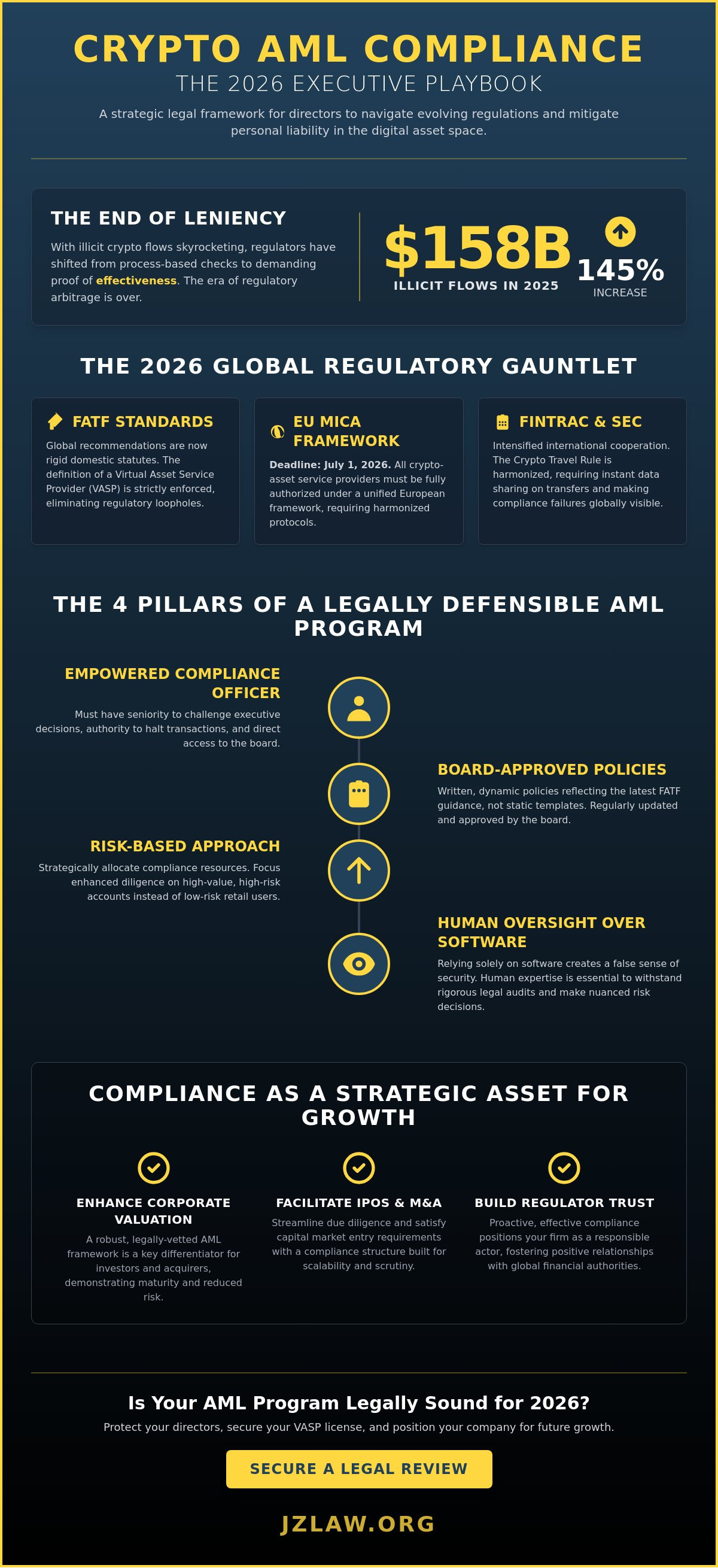
With illicit crypto flows reaching a staggering 158 billion dollars in 2025, representing a 145 percent increase from the previous year, the era of regulatory leniency has officially concluded. For executives in the digital asset space, implementing robust anti-money laundering for crypto businesses is no longer a peripheral technical requirement; it is a foundational pillar of corporate survival. As we move through 2026, the transition from process-based compliance to effectiveness-based standards, particularly under recent FinCEN reforms, demands a level of legal precision that many firms have yet to master.
You likely recognize that the complexity of cross-border jurisdictional overlaps, from the European Union's MiCA transition ending this July to the United Kingdom's amended 2026 money laundering regulations, poses an existential threat to your personal and corporate liability. This guide provides a strategic legal framework designed to protect your directors and ensure your compliance structure remains scalable for future capital market entries. We will examine the specific thresholds for customer due diligence, the impact of the GENIUS Act for stablecoins, and the proactive measures required to satisfy global regulators such as FINTRAC, the SEC, and BaFin.
Key Takeaways
Understand how evolving FATF standards and local implementations in 2026 redefine the requirements for anti-money laundering for crypto businesses, ensuring your VASP status remains compliant across borders.
Learn how to structure a board-approved AML program that empowers a designated Compliance Officer with the necessary legal authority to mitigate corporate risk effectively.
Master the technicalities of the Crypto Travel Rule to manage the "Sunrise Issue" when dealing with jurisdictions that haven't yet harmonized their data exchange standards.
Discover why relying solely on compliance software creates a dangerous false sense of security and how to implement the human oversight necessary to withstand rigorous legal audits.
Position your compliance framework as a strategic asset that enhances corporate valuation and facilitates seamless transitions during IPOs or high-stakes M&A transactions.
Table of Contents
The 2026 Regulatory Landscape for Crypto VASPs
The year 2026 represents a definitive maturation of the global oversight framework for digital assets. The Financial Action Task Force (FATF) has moved beyond advisory recommendations, as member nations have now fully integrated these standards into rigid domestic statutes. A Virtual Asset Service Provider (VASP) is now strictly defined as any entity facilitating the exchange, transfer, or custody of virtual assets for or on behalf of another person. This precise legal classification effectively eliminates the regulatory arbitrage that once allowed firms to operate with minimal oversight. Implementing comprehensive anti-money laundering for crypto businesses is no longer a discretionary choice but a statutory mandate for corporate survival.
Regulators have moved away from a "wait and see" posture in favor of proactive enforcement. In jurisdictions like Canada and the United States, the focus has shifted toward an "effectiveness-based" standard, where the mere existence of a compliance manual is insufficient. Authorities now demand proof that these programs actually identify and mitigate risks associated with Cryptocurrency and crime. Your physical and legal presence in financial hubs like Calgary, New York, or Berlin dictates your specific obligations. For instance, the EU’s MiCA transition period ends on July 1, 2026, requiring all service providers to be fully authorized under a unified European framework. This means that a firm operating across these regions must harmonize its protocols to meet the highest common denominator of regulation.
The Role of FINTRAC and International Cooperation
Canadian crypto entities must now navigate the most stringent reporting requirements in the history of the sector. As of June 2026, FINTRAC has intensified its collaboration with international counterparts, ensuring that the "Travel Rule" is harmonized across North American borders. This protocol requires that originator and beneficiary data be shared instantly during transfers between regulated entities. This level of information sharing ensures that a compliance failure in one jurisdiction is immediately visible to regulators globally. It's a system designed to close the gaps that previously allowed illicit actors to exploit jurisdictional delays.
Distinguishing Between Regulated Entities and DeFi
The legal boundary between decentralized protocols and centralized obligations has become increasingly porous. If a protocol maintains a centralized interface or if a core group of developers retains administrative control, it often triggers centralized obligations for anti-money laundering for crypto businesses under 2026 standards. Legal precedents regarding unhosted wallets now require VASPs to perform enhanced verification when interacting with peer-to-peer transactions. Protocols seeking a "safe harbor" must proactively design their governance structures to align with these evolving expectations. Failure to do so risks categorizing the protocol as a non-compliant financial institution, which carries severe personal liability for those involved in its operation.
Essential Pillars of a Legal Crypto AML Program
A robust framework for anti-money laundering for crypto businesses begins with human accountability, not just digital tools. While software identifies patterns, legal responsibility rests with a designated Compliance Officer. This individual must possess the seniority to challenge executive decisions and the authority to halt transactions that jeopardize the firm's license. Without this level of institutional independence, a compliance program is merely a set of suggestions rather than a legally binding defense. Regulators look for evidence that the Compliance Officer has direct access to the board and sufficient resources to implement the necessary controls.
Written policies must be more than stagnant templates. They require board approval and regular updates to reflect the FATF's Updated Guidance for VASPs. A risk-based approach ensures that your resources aren't wasted on low-risk retail users while high-value institutional accounts receive the scrutiny they deserve. This strategic allocation of compliance capital is what separates sustainable businesses from those destined for regulatory intervention. If you're unsure how these pillars apply to your specific model, seeking specialized cryptocurrency law counsel can help insulate your board from personal liability.
Customer Due Diligence (CDD) and KYC
Verification in 2026 has evolved. It's no longer enough to collect a passport photo. You must verify the source of wealth and the source of funds for high-risk transactions. Enhanced Due Diligence (EDD) is mandatory for Politically Exposed Persons (PEPs) and users from jurisdictions identified as high-risk by the FATF. Maintaining a "living" KYC profile means your system must flag changes in behavior, not just verify a user once during onboarding. Continuous monitoring is the only way to ensure that a low-risk client hasn't transformed into a high-risk liability through their transaction history.
Suspicious Transaction Reporting (STR)
Reporting thresholds vary significantly by jurisdiction. In Canada, FINTRAC requires reporting for transactions over 10,000 dollars, while the U.S. FinCEN threshold for money services businesses remains 2,000 dollars as of mid-2026. Drafting a Suspicious Transaction Report (STR) requires precision; it must provide actionable intelligence that helps law enforcement trace illicit flows. You must also strictly adhere to the "Tipping Off" rule. Informing a user that they're under investigation is a criminal offense in many jurisdictions. Your internal procedures must clearly outline how to handle these investigations without alerting the subject. This protects both the integrity of the legal process and the corporate longevity of your firm. Implementing effective anti-money laundering for crypto businesses requires this level of meticulous legal adherence.
The Crypto Travel Rule: Legal Implementation and Risks
The Travel Rule represents the most significant operational shift in anti-money laundering for crypto businesses since the inception of the FATF standards. It's often discussed as a technical hurdle, yet it's fundamentally a legal liability framework. This mandate requires Virtual Asset Service Providers (VASPs) to exchange identifying information for both originators and beneficiaries during every transaction. In 2026, a "silent" transaction, which is one where the data handshake fails or is ignored, is viewed by regulators as a willful bypass of compliance. This creates a precarious environment for firms that haven't established rigid counterparty due diligence protocols.
The "Sunrise Issue" remains a primary source of legal friction. It occurs when a compliant VASP in a strictly regulated hub like Calgary attempts to transact with an entity in a jurisdiction that hasn't yet implemented FATF Recommendation 16. You can't simply hope for the best. If your counterparty can't or won't provide the required data, the transaction must be blocked or subjected to extreme scrutiny. Failure to do so exposes your directors to claims of negligence. This isn't just about technical compatibility; it's about the legal risk of interacting with non-compliant liquidity providers who may be facilitating illicit flows.
Navigating the conflict between the Travel Rule and data privacy laws like GDPR in Berlin or PIPEDA in Calgary requires a sophisticated legal strategy. You're required to share sensitive PII (Personally Identifiable Information) to satisfy AML rules, yet you're also liable for how that data is handled by the receiving party. Your service level agreements with other VASPs must include strict data protection clauses to ensure you don't solve an AML problem only to create a massive privacy litigation risk.
Cross-Border Jurisdictional Challenges
Operating between Calgary, New York, and Berlin means you must adopt a "highest common denominator" approach. While New York's DFS requirements are notoriously stringent, Berlin's implementation of MiCA adds another layer of complexity regarding the reporting of self-hosted wallet interactions. If you're moving assets between these regions, the most restrictive rule usually takes precedence. Using non-compliant liquidity providers in an attempt to save on operational costs is a short-sighted strategy that often leads to regulatory "de-risking" by your banking partners.
Privacy-Preserving Technologies and Compliance
Zero-Knowledge Proofs (ZKPs) are frequently touted as the solution to the privacy-compliance paradox. While they can prove a user is not on a sanctions list without revealing their identity, regulators in 2026 still largely demand full transparency for audit purposes. Privacy coins and mixers remain under intense scrutiny; most regulated VASPs have already delisted these assets to maintain their safe harbor status. For projects focused on privacy, the path to legitimacy involves building "view keys" or similar mechanisms that allow for selective disclosure during a legal audit. Implementing anti-money laundering for crypto businesses in this niche requires a proactive, transparent dialogue with regulators to avoid being categorized as a high-risk entity.
Why Software is Not a Legal Defense
The allure of automated compliance is undeniable, yet it often creates a dangerous legal vacuum. Many executives operate under the fallacy that "set it and forget it" software satisfies their regulatory obligations. This is a profound misunderstanding of how enforcement works in 2026. While blockchain analytics tools are excellent at flagging known illicit addresses, they frequently fail to detect sophisticated, multi-layered money laundering schemes that don't match pre-defined patterns. Relying solely on automation is not a defense; it's a vulnerability. Regulators view an over-reliance on third-party vendors as a failure of corporate governance rather than a proactive effort to comply.
Director and Officer (D&O) liability is a critical consideration here. When a regulatory body initiates an enforcement action, the software provider's terms of service will inevitably shield the vendor from liability. This leaves the board of directors to face the consequences alone. Criminal liability and heavy fines cannot be outsourced. Building a "Good Faith" legal defense requires more than a software subscription. It necessitates documented professional counsel and a clear record of human intervention in the compliance process. If your board hasn't reviewed its personal liability in the context of your compliance stack, you should consult with an experienced legal team to ensure your corporate shield remains intact.
The Human Element in AML Decision-Making
Software cannot interpret legal intent or navigate the "grey areas" of international finance. Your AML manual must be a bespoke legal document tailored to your specific risk profile, not a generic template provided by a tech firm. Effective anti-money laundering for crypto businesses requires a constant dialogue between the compliance team and legal counsel. This partnership ensures that when a transaction is flagged, the decision to report or block is based on sound legal interpretation rather than a binary algorithm. This human-led approach is what regulators mean when they demand "effectiveness-based" compliance.
Responding to Regulatory Audits and Inquiries
A FINTRAC or SEC audit is not a software demonstration; it's a test of your internal culture and decision-making logic. Representing your program during an inquiry requires a deep understanding of the legal principles behind your controls. Utilizing legal privilege during internal compliance reviews can protect your firm while you identify and remediate weaknesses. Proactive disclosure of a found error, backed by a clear remediation plan, often mitigates fines more effectively than a perfect software record. Ultimately, comprehensive anti-money laundering for crypto businesses relies on the ability to explain the "why" behind every compliance decision to a skeptical regulator.
Strategic Compliance: AML as a Bridge to IPO and Growth
In the high-stakes environment of 2026, a robust framework for anti-money laundering for crypto businesses serves as more than a regulatory shield; it's a primary driver of corporate valuation. During high-level negotiations, sophisticated investors and acquirers prioritize compliance history as a core asset. A clean audit trail and a proactive legal posture significantly reduce the risk premium associated with digital asset firms. This is particularly true in the context of corporate transactions, where the buyer must be protected from the seller's historical compliance lapses. A failure to perform due diligence on past AML failures can result in the buyer inheriting criminal liability and crippling fines.
For founders eyeing the TSX or NYSE, the threshold for entry is "Institutional Grade" compliance. These exchanges don't tolerate the "move fast and break things" ethos of the previous decade. Integrating cryptocurrency law with broader securities regulation ensures that your firm is prepared for the intense scrutiny of a public offering. A well-documented compliance history demonstrates to underwriters and institutional investors that the business is built on a foundation of long-term stability. This legal maturity is what allows a crypto startup to transition into a globally recognized financial entity.
Securities Law and AML Intersection
The question of whether your tokens are categorized as securities is central to your AML obligations. If a token triggers securities laws, the compliance requirements often expand to include broker-dealer regulations and more stringent reporting. Managing AML for Security Token Offerings (STOs) requires a multidisciplinary approach that bridges the gap between traditional finance and decentralized technology. JZ Law provides the strategic oversight needed to navigate these regulatory silos, ensuring that your tokenomics and compliance frameworks are aligned with current legal precedents. We help you determine if your asset falls under the jurisdiction of the SEC or provincial regulators, which dictates your specific reporting path.
The JZ Law Advantage for Crypto Founders
Success in the digital asset space requires more than technical innovation; it demands a partner who understands the intricacies of taking companies public. Our firm provides customized compliance frameworks designed for high-stakes environments where the margin for error is non-existent. Clients gain direct access to John Zang’s expertise, benefiting from a proactive mindset that anticipates regulatory shifts before they impact your operations. Whether you're navigating a complex merger or preparing for an IPO, our counsel ensures that your anti-money laundering for crypto businesses is a bridge to growth rather than a bottleneck. We don't just provide a service; we act as a strategic partner in your corporate longevity.
Future-Proofing Your Digital Asset Enterprise
The shift toward effectiveness-based enforcement in 2026 marks a turning point where only the most legally disciplined crypto firms will thrive. You've seen that institutional-grade anti-money laundering for crypto businesses is no longer a peripheral concern but a prerequisite for accessing capital markets and facilitating corporate transactions. By moving beyond a reliance on automated software and establishing a board-approved, human-led compliance framework, you protect your directors from personal liability while positioning your company for a successful IPO. This strategic maturity transforms a regulatory burden into a competitive advantage during high-stakes mergers and acquisitions.
Navigating these cross-border jurisdictional overlaps requires a partner who understands the nuances of securities regulation and the complexities of taking companies public across North American exchanges. With strategic offices in Calgary, Toronto, Vancouver, New York, and Berlin, JZ Law offers specialized expertise in high-stakes sectors like crypto and cannabis. Secure your crypto business with strategic legal counsel from JZ Law and ensure your innovation is supported by a foundation of professional legal dignity. Your journey toward a public listing or a major exit starts with a commitment to regulatory excellence today.
Frequently Asked Questions
What are the penalties for crypto AML non-compliance in 2026?
Penalties for non-compliance in 2026 range from administrative monetary penalties in the millions to the permanent revocation of operational licenses. Individual directors face heightened exposure to criminal prosecution if systemic failures are discovered during an audit. Regulatory bodies like FINTRAC and the SEC increasingly utilize enforcement actions that include public censures, which can irreparably damage a firm's reputation and its ability to secure future institutional funding.
Does my crypto startup need a full-time AML compliance officer?
A crypto startup doesn't always require a full-time officer in its earliest stages, but it must designate a qualified individual with the seniority to oversee compliance. This person must have the legal authority to halt transactions and direct access to the board. As the firm scales toward an IPO or significant corporate transaction, the role typically transitions into a full-time executive position to manage the increasing complexity of international standards.
How does the Travel Rule affect transactions with private wallets?
The Travel Rule requires additional verification for transfers to or from self-hosted wallets when certain thresholds are met. For example, the European Union's Transfer of Funds Regulation mandates verification for transactions exceeding 1,000 euros. VASPs must collect and store data on the originator and beneficiary even when one party is using a private wallet, ensuring that the transaction doesn't facilitate illicit financial flows through unhosted addresses.
Can a crypto business be compliant without using third-party KYC software?
It's technically possible to maintain anti-money laundering for crypto businesses without third-party software, but it's practically impossible to scale. Manual verification is prone to human error and cannot keep pace with the real-time monitoring requirements of modern regulators. While software doesn't replace legal judgment, it provides the data necessary for your compliance team to make informed, defensible decisions during a regulatory inquiry or independent audit.
What is the difference between AML and KYC in the crypto industry?
KYC (Know Your Customer) is the process of verifying a user's identity, whereas AML (Anti-Money Laundering) is the broader framework of policies and controls. KYC is a critical component of an AML program, but AML also includes transaction monitoring, suspicious activity reporting, and independent auditing. A firm can have perfect KYC data yet still fail its AML obligations if it doesn't monitor how those verified users actually move funds.
How often should a crypto business conduct an independent AML audit?
Most jurisdictions require an independent AML audit every twelve to twenty-four months to verify program effectiveness. High-growth firms or those operating in multiple high-risk jurisdictions should consider annual reviews to catch potential weaknesses before they're identified by regulators. Documenting these audits is essential for building a good faith defense, demonstrating that the board is proactively managing its regulatory risks and corporate longevity.
Does JZ Law provide AML representation for businesses in Berlin and New York?
Yes, JZ Law provides comprehensive legal representation and strategic counsel for businesses operating in Berlin, New York, and other global hubs. Our presence in these jurisdictions allows us to bridge the gap between local requirements and international standards. We assist founders in navigating the specific nuances of MiCA in Germany and the stringent DFS regulations in New York, ensuring a harmonized approach to global compliance.
Is a DeFi protocol legally required to implement AML controls?
A DeFi protocol is legally required to implement AML controls if it maintains centralized elements, such as a managed front-end or administrative keys. Regulators in 2026 look past the decentralized label to determine who actually controls the flow of funds. If your protocol facilitates exchanges or provides custody, it likely falls under the VASP definition, necessitating a formal anti-money laundering for crypto businesses strategy to avoid enforcement actions.


Comments