


NFT Marketplace Terms of Service Lawyer: Navigating Web3 Compliance in 2026
- jzanglaw
- 2 days ago
- 12 min read
What if the smart contracts powering your platform are technically flawless, yet your entire business remains vulnerable to a single regulatory inquiry? You likely recognize that in 2026, relying on generic legal templates is no longer a viable strategy for serious risk management. The recent joint guidance from the SEC and CFTC, specifically Interpretive Release No. 33-11412, has established a strict taxonomy for digital assets that demands precise documentation. Engaging a specialized nft marketplace terms of service lawyer ensures your platform isn't just operational; it's legally resilient against evolving global mandates and the rising threat of costly user disputes.
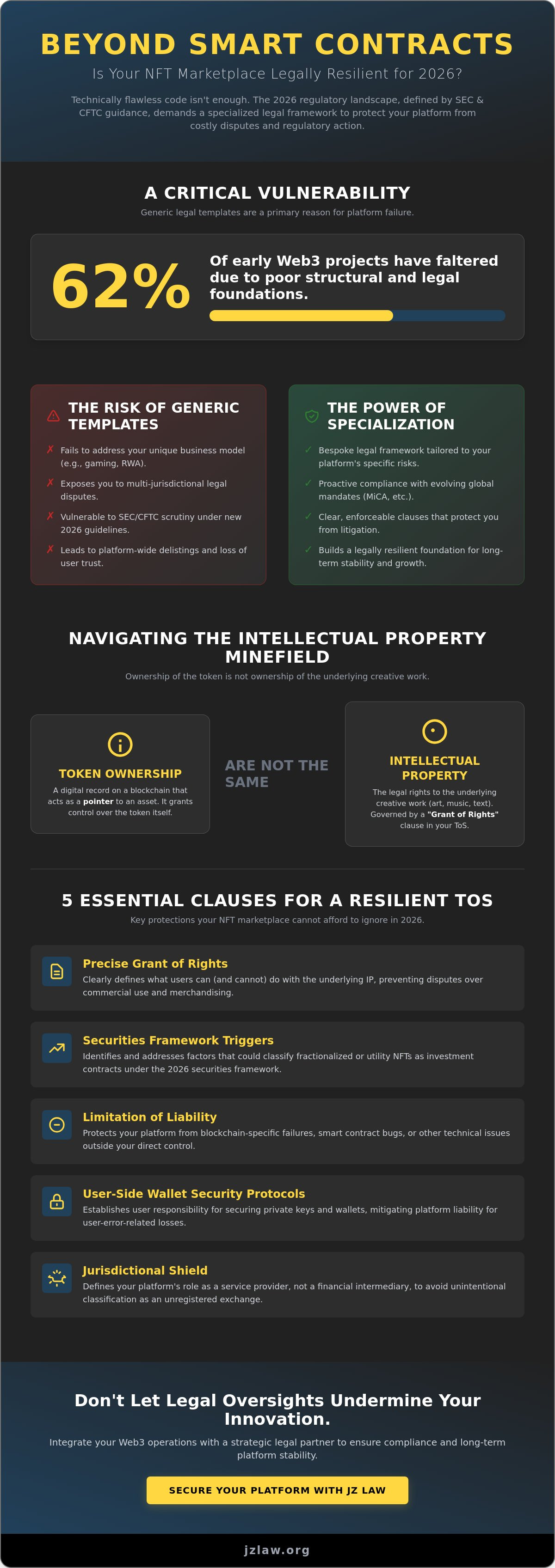
The complexity of distinguishing intellectual property rights from digital ownership often creates significant exposure, especially when data shows that 62% of early projects have already faltered due to poor structural foundations. We'll show you how to secure your platform with a legally enforceable framework that addresses multi-jurisdictional compliance and clear IP licensing. This guide previews the essential clauses your terms must include to bridge the gap between innovative code and established securities law, providing the strategic certainty your stakeholders demand.
Key Takeaways
Understand why a specialized nft marketplace terms of service lawyer is essential to bridge the gap between technical smart contracts and the rigorous regulatory standards of 2026.
Learn to draft precise Grant of Rights clauses that clearly distinguish between the ownership of a digital token and the underlying intellectual property.
Identify the specific triggers that classify fractionalized NFTs as investment contracts under the updated 2026 securities framework.
Protect your platform from blockchain-specific failures by implementing robust limitation of liability and user-side wallet security protocols.
Integrate your Web3 operations into a broader corporate strategy to proactively mitigate litigation risks and ensure long-term platform stability.
Table of Contents
Why NFT Marketplaces Require Specialized Legal Counsel in 2026
In 2026, the digital asset environment has transitioned from speculative experimentation to a highly regulated economic sector. A specialized nft marketplace terms of service lawyer serves as a strategic architect who bridges the gap between immutable smart contracts and global legal frameworks. They don't just draft documents; they build the regulatory infrastructure that allows a Non-fungible token (NFT) platform to scale without the constant threat of administrative freezes. Relying on "boilerplate" text from the early 2020s is a recipe for failure. Those legacy documents were written for a market that didn't yet face the scrutiny of the SEC’s 2026 joint interpretive guidance or the full weight of international enforcement actions.
Copying terms from industry giants like OpenSea or Blur might seem efficient, but it ignores the specific risk profile of your unique business model. If your platform facilitates the trade of gaming assets, loyalty rewards, or tokenized real estate, your legal requirements are fundamentally different from a standard digital art gallery. A dedicated nft marketplace terms of service lawyer identifies these nuances early. They ensure your platform remains operational even when regulators decide to audit specific asset classes or cross-border payment flows, preventing platform-wide delistings that can destroy user trust overnight.
The Evolution of Web3 Legal Requirements
Global regulatory standards have finally reached a point of convergence. With the full implementation of MiCA in Europe and harmonized provincial rules in North America, the distinction between "centralized" and "decentralized" is being tested in real time. Your Terms of Service is no longer just a user agreement; it's a jurisdictional shield. It must clearly define the platform's role as a service provider rather than a financial intermediary to avoid unintentional classification as an unregistered exchange. This precision is vital for maintaining the professional dignity of your brand while ensuring total compliance with the New Frontiers in Technology Act.
Beyond Templates: Bespoke Risk Assessment
Every digital asset platform carries a unique signature of risk. Whether you're dealing with digital collectibles, utility tokens, or complex real-world assets, a one-size-fits-all approach leaves you exposed to multi-jurisdictional disputes. JZ Law approaches these challenges with a proactive, megelőző mindset. We analyze your specific business model and user flow before a single word of your terms is drafted. This ensures that arbitration clauses and liability limitations are actually enforceable, protecting your capital from the high costs of international litigation and the unpredictability of provincial regulator crackdowns.
Navigating the Intellectual Property and Licensing Minefield
Ownership of a digital asset on the blockchain is frequently conflated with the ownership of the underlying creative work. This misunderstanding remains one of the primary drivers of litigation within the Web3 space. As an nft marketplace terms of service lawyer will emphasize, the token is merely a pointer; the legal rights associated with the asset must be explicitly defined in your platform's documentation. The U.S. Copyright Office NFT Study highlights that without a clear transfer of copyright, the purchaser generally acquires only a non-exclusive license for personal display. A robust agreement must bridge the gap between smart contract metadata and the enforceable Terms of Service to ensure that what is promised on-chain is legally substantiated off-chain.
Managing commercial use rights requires a nuanced approach. If a buyer decides to monetize their NFT through merchandise or media, your platform's "Grant of Rights" clause must specify the limitations and any potential revenue-sharing obligations. Failure to synchronize these terms with the technical metadata can lead to irreconcilable disputes between creators and secondary buyers. For platforms looking to scale safely, consulting with a specialized legal partner is the most effective way to align your technical architecture with global intellectual property standards.
Creator Rights and Royalty Enforcement
In 2026, the legal enforceability of on-chain royalties has become a central pillar of platform reputation. Your terms must protect creators from unauthorized derivative works while clearly outlining the mechanics of secondary sale fees. With gaming NFTs growing by 140% year-over-year on specialized networks, the need to prevent unauthorized modifications or "vandalism" of digital assets is paramount. We help you draft terms that ensure creators retain their moral rights while providing buyers with the utility they expect from high-value assets.
User-Generated Content (UGC) and Liability
Marketplaces hosting user-uploaded content must navigate strict safe harbor provisions to avoid direct liability for copyright infringement. Implementing DMCA-compliant take-down procedures, or their international equivalents, is a mandatory requirement for operational security. Your Terms of Service should include rigorous indemnification clauses that shift the legal and financial risk of IP infringement back to the uploader. This proactive structure ensures that your platform remains a neutral venue for commerce rather than a target for institutional litigation.
The Convergence of NFT Marketplaces and Securities Regulation
While intellectual property concerns are frequent, the classification of digital assets as securities represents a catastrophic risk for platform operators. The joint interpretive guidance issued on March 17, 2026 (Release No. 33-11412) provides a taxonomy that clarifies when a digital collectible transitions into an investment contract. If your platform facilitates fractionalized NFTs (fNFTs) or offers yield-bearing staking mechanisms, you've likely crossed the threshold of the Howey Test. An experienced nft marketplace terms of service lawyer ensures your agreement doesn't inadvertently signal that you are operating as an unregistered exchange, which could lead to immediate regulatory freezes.
Fractionalization is particularly sensitive in the current market. By breaking a single high-value asset into tradable shards, platforms often satisfy the "expectation of profit from the efforts of others" prong of securities law. Staking programs that promise passive returns similarly invite scrutiny from the SEC and provincial regulators. A strategic nft marketplace terms of service lawyer will structure your platform's operational flow and documentation to emphasize utility over investment, shielding the business from the aggressive enforcement actions that have become common in 2026.
Compliance with North American and European Standards
Navigating provincial regulations in Calgary, Toronto, and Vancouver requires a granular understanding of how Canadian securities administrators view crypto-asset trading platforms. Simultaneously, marketplaces serving New York clients must balance SEC and CFTC jurisdictional overlaps. Integrating a comprehensive cryptocurrency law 2026 framework into your strategy is essential for maintaining cross-border compliance. This ensures that your Terms of Service remain valid across multiple jurisdictions without conflicting with local consumer protection or financial oversight laws.
AML and KYC Integration in Terms of Service
Drafting terms that mandate identity verification is a delicate balance. You must satisfy FINTRAC and FinCEN reporting requirements for high-value transactions without alienating your user base through excessive friction. According to Cornell Law School's Legal Information Institute, money laundering remains a primary concern for regulators in the digital asset space. Your Terms of Service must explicitly allow for account freezes in cases of suspected illicit activity, providing your platform with the legal authority to act before regulators intervene. This proactive approach prevents your marketplace from being used as a conduit for financial crime, preserving both your license and your reputation.
Essential Clauses for a Robust NFT Marketplace Terms of Service
A robust agreement serves as the operational blueprint for your platform, translating complex technical processes into enforceable legal protections. While regulatory taxonomy provides the framework for compliance, the specific clauses within your document mitigate the daily risks associated with decentralized technology. An nft marketplace terms of service lawyer ensures that your platform is shielded from the inherent unpredictability of blockchain networks. We focus on creating a precise barrier between your company's liability and the failures of underlying protocols, such as network congestion or smart contract exploits that are beyond your direct control.
User responsibility is a cornerstone of any resilient Web3 platform. Your terms must explicitly define the user’s duty regarding private key management and wallet security. In 2026, courts increasingly look to the Terms of Service to determine if a platform acted as a custodian or a mere facilitator. By clearly stating that the user maintains sole control over their digital assets, you reduce the risk of being held liable for unauthorized access or phishing attacks. Additionally, your documentation should address the finality of transactions and the non-refundable nature of gas fees, even in instances where a mint fails or a transaction is dropped by the network.
To ensure your platform operates on a foundation of total legal clarity, it's vital to consult with a strategic legal partner who understands the intersection of code and commerce.
Technical and Operational Disclaimers
Your terms must account for the technical reality of blockchain immutability. This often conflicts with modern privacy mandates like the "Right to be Forgotten." A sophisticated nft marketplace terms of service lawyer drafts disclaimers that explain these technical limitations to users, thereby managing expectations and legal exposure. We also include specific language regarding the extreme volatility of digital assets, ensuring that users acknowledge the financial risks before engaging with the marketplace. This includes disclaiming liability for sudden network fork events that could result in the duplication or loss of asset utility.
Governing Law and Jurisdiction Selection
Selecting the right jurisdiction is a strategic decision that fundamentally alters your risk profile. Mandating arbitration in established legal hubs like Calgary or New York provides access to judges and arbitrators who possess a deep understanding of digital asset precedents. It's essential that these choices align with your broader corporate structure, including your real estate law 2026 strategies if your platform involves tokenized physical assets. We ensure that your jurisdiction selection is not only favorable but also enforceable under international treaties, providing a predictable path for dispute resolution in a global market.
Strategic Legal Risk Mitigation with JZ Law
In 2026, the margin for error in digital asset regulation has effectively vanished. A specialized nft marketplace terms of service lawyer doesn't simply react to litigation; they construct the preventative barriers that stop disputes before they manifest. John Zang provides this level of high-stakes counsel by aligning your platform's Terms of Service with the specific operational realities of your business model. This proactive approach is particularly critical for marketplaces operating across the regulatory friction points between North America and Europe, where a single oversight in jurisdictional language can lead to multi-million dollar exposure.
By integrating corporate transactions into your broader Web3 strategy, we ensure that your legal foundation supports long-term growth rather than just temporary compliance. JZ Law offers localized expertise in key financial and tech hubs, including Berlin, Hamburg, Calgary, and Denver. This multi-jurisdictional reach allows us to navigate the specific nuances of provincial regulators in Canada while simultaneously addressing the stringent requirements of the EU’s MiCA framework. Our boutique structure ensures that you have direct access to principal counsel for complex regulatory filings, providing a level of precision that larger, generalized firms often struggle to maintain.
Beyond Drafting: Ongoing Compliance Monitoring
The crypto space moves at a velocity that renders static documents obsolete within months. We recommend quarterly reviews of your marketplace documentation to account for new joint interpretive guidance or shifts in enforcement priorities. For platforms aiming for institutional maturity, our experience in Taking Companies Public ensures your marketplace is structured correctly for future exit events or venture capital rounds. This strategic positioning is what separates a transient project from a permanent market leader in the evolving digital economy.
Contact JZ Law for a Web3 Consultation
Securing your platform's future requires more than just legal text; it requires a comprehensive regulatory map tailored for global expansion. We invite you to schedule a professional review of your current marketplace documentation to identify and close hidden liability gaps before they are exploited. Contact JZ Law today to engage an experienced nft marketplace terms of service lawyer who understands the strategic intersection of technology, law, and business interests.
Securing Your Platform’s Legacy in the 2026 Digital Economy
The transition from speculative experimentation to a mature, regulated marketplace requires more than just functional code; it demands a sophisticated legal architecture. By clearly defining the boundaries between intellectual property rights and digital ownership while proactively addressing 2026 securities taxonomies, you protect your business from the volatility of shifting global mandates. Engaging an experienced nft marketplace terms of service lawyer is the most effective way to transform your compliance requirements into a competitive advantage that builds institutional trust.
John Zang has provided strategic counsel in cryptocurrency law since 2016, offering specialized expertise in securities regulation and corporate finance. With a localized presence in NYC, Calgary, and Berlin, we provide the global perspective necessary for multi-jurisdictional success. It's time to move beyond boilerplate templates and secure your platform with a bespoke legal framework. Consult with JZ Law on your NFT Marketplace Terms of Service to ensure your digital asset strategy remains resilient and scaleable. Your platform's stability is our primary objective.
Frequently Asked Questions
Do I really need a lawyer for my NFT marketplace Terms of Service?
You absolutely require professional counsel because smart contracts are technically self-executing but legally insufficient on their own. While code handles the automated transfer of tokens, it doesn't address consumer protection mandates, tax obligations, or the limitation of liability for platform-wide technical failures. Engaging a specialized nft marketplace terms of service lawyer ensures your platform is protected by a legally enforceable framework that smart contracts simply cannot provide.
How do NFT licensing terms differ from traditional software licenses?
NFT licensing is fundamentally different because it usually governs the display and commercial use of a specific digital asset rather than the right to use an executable program. Traditional software licenses focus on end-user permissions for code, whereas NFT terms must explicitly define whether the buyer receives copyright ownership, a non-exclusive license, or merely a right to personal display. These terms must be perfectly synchronized with on-chain metadata to prevent conflicting claims of ownership.
Can my NFT marketplace be classified as a securities exchange?
Your marketplace could be classified as an unregistered securities exchange if the assets traded involve an expectation of profit derived from the efforts of others. Features such as fractionalized ownership or yield-bearing staking mechanisms are immediate triggers for regulatory scrutiny under the updated 2026 frameworks. Precise drafting by an nft marketplace terms of service lawyer is necessary to categorize your offerings as utility-based collectibles rather than investment contracts.
What are the risks of using a generic Terms of Service template for Web3?
Using a generic template creates significant liability gaps because boilerplate language often fails to address blockchain-specific risks like gas fee failures, network forks, or wallet security. Generic terms frequently include arbitration clauses that are unenforceable in specific jurisdictions like Alberta or New York. This lack of precision leaves your platform vulnerable to class-action lawsuits and regulatory crackdowns that a customized agreement would have mitigated.
How do I handle international users in my NFT marketplace terms?
You must implement a clear governing law clause that specifies which jurisdiction's rules apply to disputes regardless of the user's physical location. It's also vital to include language that complies with international data protection standards and anti-money laundering requirements. A strategic approach to jurisdictional selection ensures that you aren't forced to defend your platform in multiple foreign courts simultaneously.
What happens if a user mints copyrighted material on my marketplace?
If a user mints infringing material, your platform's liability depends on having robust safe harbor provisions and a clear, legally compliant takedown procedure. Your Terms of Service must include an indemnification clause that shifts the legal and financial responsibility for copyright infringement directly to the uploader. Without these specific protections, your marketplace could be held directly liable for the intellectual property violations of its users.
Are smart contracts legally binding without a written Terms of Service?
Smart contracts are technically binding in the sense that they execute code automatically, but they don't constitute a comprehensive legal agreement in the eyes of a court. A written Terms of Service is necessary to define the rights and obligations that exist outside the code, such as dispute resolution and liability for external technical errors. The written agreement serves as the authoritative legal layer that governs the relationship between the platform and its users.
How does the 2026 regulatory landscape affect NFT marketplaces in Canada and the US?
The 2026 landscape is defined by a convergence of international standards that demand higher levels of transparency and user verification. In Canada, provincial regulators have increased their oversight of digital asset trading platforms, while the US has moved toward a stricter taxonomy for what constitutes a security. These changes mean that marketplaces must now integrate comprehensive AML and KYC protocols into their terms to maintain their operational licenses and avoid administrative penalties.


Comments