


Avoiding Director Liability in Canada: A Strategic Legal Guide for 2026
- jzanglaw
- Jul 11
- 13 min read
Updated: Jul 20
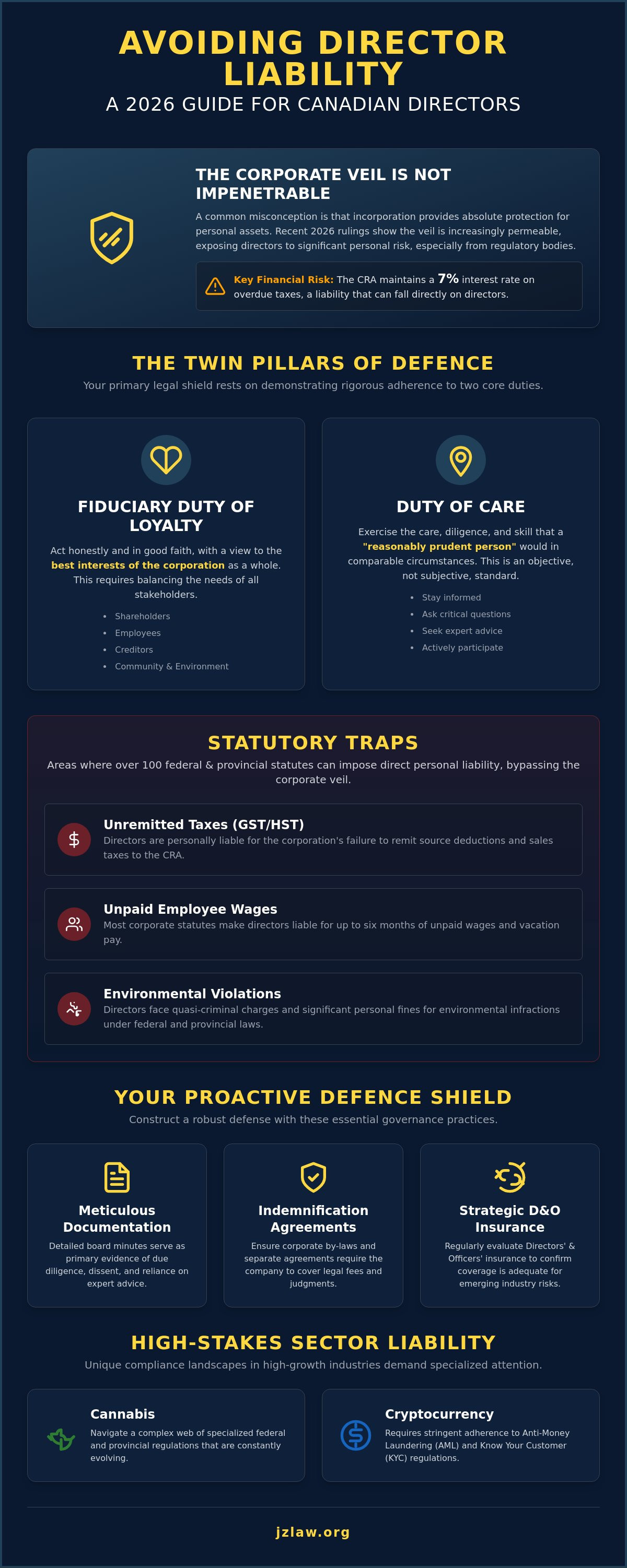
Most Canadian directors believe the corporate veil is an impenetrable shield, yet recent 2026 rulings prove that personal assets are often just one regulatory misstep away from seizure. If you're concerned about avoiding director liability in Canada, you aren't alone; the pressure of navigating diverging provincial and federal statutes while the CRA maintains a 7% interest rate on overdue taxes is immense. It's natural to feel uncertain about whether your current D&O insurance and internal protocols provide a sufficient buffer against personal bankruptcy or reputational damage.
This article provides the strategic clarity you need to transform these risks into manageable variables. You'll learn how to protect your personal assets and professional reputation by navigating the complex statutory and fiduciary duties of Canadian corporate leadership. We'll provide a clear framework for evaluating your indemnity agreements, actionable steps to document your due diligence, and a breakdown of the latest 2026 judicial precedents that every board member must understand to remain secure. By the end of this guide, you'll possess a structured approach to governance that prioritizes both corporate growth and personal protection.
Table of Contents
The Landscape of Personal Liability for Canadian Directors in 2026
The notion that incorporation provides an absolute barrier between corporate failure and personal assets is a dangerous misconception. In 2026, the "corporate veil" is increasingly treated as a permeable membrane rather than an iron wall. Regulatory bodies and courts now place individual accountability at the forefront of their enforcement strategies, making it clear that a director's chair is a position of both prestige and significant personal risk. For those focused on avoiding director liability in Canada, understanding this shift is the first step toward effective risk mitigation.
Corporate Veil vs. Personal Exposure
While the legal principle of separate corporate personality remains the foundation of Canadian law, it's not a universal grant of immunity. Courts will "pierce the veil" when they find that a director used the corporation for fraudulent purposes or when specific statutory provisions mandate personal accountability. There's a critical distinction between civil liability, where a director might be sued for damages, and quasi-criminal regulatory penalties. In the latter, such as environmental or workplace safety violations, the intent to shield oneself through a corporation often fails to prevent significant personal fines.
To better understand the nuances of personal injury advocacy, one might explore Car Accident Legal Representation to see how expert counsel protects individual interests.
A director's legal obligations are rooted in their fiduciary duty and duty of care, which require acting in the company's best interest with the diligence of a reasonably prudent person. Failure to meet these standards doesn't just harm the company; it creates a direct path for creditors or regulators to pursue the director personally. This exposure is particularly acute in 2026, as judicial interpretations of "reasonable diligence" continue to expand in response to complex market conditions.
The Scope of Statutory Liability
The regulatory landscape is divided between the Canada Business Corporations Act (CBCA) and provincial counterparts like the Ontario Business Corporations Act (OBCA) or the Alberta Business Corporations Act (ABCA). While these frameworks share many similarities, they diverge in significant ways regarding residency requirements and specific reporting obligations. Directors must know which jurisdiction governs their entity to ensure compliance, as a failure under one act may not be excused by compliance with another.
Beyond the basic corporate acts, the 2026 environment places heightened importance on the Securities Act, even for directors of private companies. If you're involved in capital raising or preparing for an IPO, your personal exposure increases. Avoiding director liability in Canada now requires a strategic understanding of over 100 federal and provincial statutes that can bypass corporate protections, particularly regarding unpaid wages, unremitted taxes, and environmental degradation. This complex web of legislation demands a proactive, preventative legal strategy rather than a reactive one.
The Twin Pillars of Defence: Duty of Care and Fiduciary Loyalty
Protecting yourself from personal exposure requires more than just a comprehensive insurance policy. It demands a rigorous, daily adherence to the two core principles that define Canadian corporate governance. While the previous section outlined the expanding landscape of risks, these pillars serve as your primary legal shield. Successfully avoiding director liability in Canada relies on demonstrating that you've fulfilled your fiduciary duty of loyalty and your duty of care.
The fiduciary duty of loyalty is often misunderstood as a simple obligation to the shareholders. In reality, Canadian law requires directors to act honestly and in good faith with a view to the best interests of the corporation as a distinct legal entity. This involves balancing the interests of various stakeholders, including employees, creditors, and the environment, to ensure the long-term viability of the firm. Understanding these Key responsibilities and liabilities is essential for anyone sitting on a modern board, as courts look for evidence of a holistic decision-making process.
Parallel to loyalty is the duty of care. This is an objective standard rather than a subjective one. It asks whether a director exercised the care, diligence, and skill that a reasonably prudent person would have exercised in comparable circumstances. It's not a standard of perfection. It's a standard of competence and active engagement. You can't claim ignorance of a company's financial health if the information was available for review.
Invoking the Business Judgment Rule
Canadian courts are generally reluctant to second-guess the business decisions of directors. This restraint is codified in the Business Judgment Rule (BJR), which serves as a shield against judicial interference. For the BJR to apply, a decision must be "informed," meaning the board actively sought expert advice, reviewed all relevant data, and engaged in a deliberate debate before acting. The BJR is the primary protection for directors who follow a rigorous process and act in good faith.
Navigating Conflicts of Interest
Transparency is the only effective antidote to allegations of self-dealing. Directors must disclose any "material interest" in a contract or transaction involving the corporation, whether that interest is direct or indirect. This disclosure must be recorded in the board minutes, and the interested director must recuse themselves from any vote on the matter. Failure to follow this statutory process can lead to the contract being voided and the director being forced to disgorge any personal profits. Maintaining this level of precision in governance is particularly vital when preparing for corporate transactions, where the scrutiny from regulators and minority shareholders is at its highest. Proactive disclosure remains the most effective strategy for avoiding director liability in Canada when personal interests intersect with corporate goals.
Statutory Traps: Taxes, Wages, and Environmental Liability
While fiduciary duties form the backbone of corporate governance, statutory liabilities represent the most immediate threat to a director's personal assets. These traps are often strict. This means the law focuses less on your intent and more on the objective fact that a payment was missed or a regulation was breached. In the current 2026 regulatory climate, the Canada Revenue Agency (CRA) and provincial bodies have intensified their focus on individual directors to satisfy corporate debts when the entity itself lacks the liquidity to pay.
The CRA Target: Unremitted Taxes
The CRA remains the most aggressive pursuer of personal assets in Canada. Under the Income Tax Act and the Excise Tax Act, directors are jointly and severally liable for unremitted source deductions and GST/HST. This isn't just a corporate debt; it's a personal obligation that carries a 7% interest rate for the third quarter of 2026. If the company fails to remit these funds, the CRA doesn't need to pierce the corporate veil to look directly to you for payment.
A common mistake is assuming that resignation provides an immediate shield. In reality, the CRA has a two-year window after you formally resign to assess you for liabilities that occurred during your tenure. Successfully avoiding director liability in Canada regarding taxes requires a robust "due diligence defense." You must prove you took proactive, documented steps to ensure remittances were made, rather than simply relying on management's verbal assurances during board meetings.
Wages and Workplace Safety
Provincial employment standards acts create another layer of significant exposure. In Ontario, for example, directors are personally liable for up to six months of unpaid wages and 12 months of accrued vacation pay. A March 2026 Ontario Labour Relations Board decision recently affirmed this reality by holding a director personally responsible for over $5,400 in unpaid wages following a corporate insolvency.
Occupational Health and Safety (OHS) and environmental laws carry even heavier penalties. Under the Canadian Environmental Protection Act, personal fines for directors can range from $15,000 to $1,000,000, and may even include imprisonment. The February 2026 decision in R. v. Mossman confirmed that directors can be held liable for environmental offenses even without specific knowledge of the violation. This makes thorough oversight during strategic corporate transactions essential, as you may inherit liabilities from past actions or poorly vetted acquisitions.
Securities Law and Misrepresentation
For those involved in taking companies public or managing continuous disclosure, the Securities Act creates heightened risk. Misrepresentations in a prospectus or financial statement can lead to personal liability for damages suffered by investors. The burden of proof is high, and the financial stakes often reach into the millions, making preventative legal structuring a necessity for any board member. Avoiding director liability in Canada in these high-stakes scenarios requires a commitment to transparency and the constant verification of all public-facing data.
Proactive Shielding: Resignation, Indemnity, and D&O Insurance
Defensive governance is not merely about reacting to crises. It's about constructing a multi layered architecture of protection before a dispute ever arises. While previous sections detailed the statutory traps that can catch even the most diligent leaders, this section focuses on the structural tools available for avoiding director liability in Canada. In 2026, the complexity of the regulatory environment means that a passive reliance on corporate bylaws is no longer a viable strategy for personal asset protection.
Structuring Effective Indemnity
Most directors assume they're protected by the indemnification clauses found in their company’s bylaws. This is a risky assumption. Bylaws are often "permissive," meaning the corporation *may* indemnify you, but isn't strictly required to do so. You need a standalone, bilateral Indemnity Agreement that makes protection mandatory. This contract should remain enforceable even if you leave the board or if the company undergoes a change in control. Crucially, ensure your agreement includes the "advancement of costs." Without this provision, you might have to fund a multi year legal defense out of your own pocket before being reimbursed at the conclusion of the trial. If you're concerned about the strength of your current protections, you should Consult with JZ Law to review your board's indemnity framework.
The 2026 D&O insurance market is currently in a "soft" cycle, with premiums having seen an average reduction of 5% at the close of 2025. While capacity is high, you shouldn't let lower costs lead to complacency. Standard policies often contain "insured vs. insured" exclusions or specific carve outs for regulatory investigations in sectors like crypto or cannabis. High level protection requires a policy tailored to your specific industry risks, ensuring that the "Entity Coverage" doesn't dilute the limits available for individual directors.
Resignation is often viewed as a final shield, but it can also act as a trigger for regulatory scrutiny. If you resign because you've discovered financial impropriety that the board refuses to address, a silent exit might be viewed as a breach of your fiduciary duty. You must document your dissent clearly in the board minutes before departing. This creates a contemporaneous record that you fulfilled your duty of care, which is vital given that the CRA maintains a two year window to pursue former directors for unremitted taxes.
The Due Diligence Audit Checklist
A proactive defense is built on a foundation of documented evidence. You can't simply claim you were diligent; you must prove it through the corporate record. Implementing a recurring audit process is the most effective way to demonstrate "reasonable care" in 2026. Your checklist should include:
Remittance Verification: Monthly confirmation that all source deductions, GST/HST, and provincial health taxes have been paid in full.
Minute Precision: Ensuring all board minutes reflect active debate, the review of expert reports, and any formal dissents.
Expert Consultation: Engaging with securities lawyers or tax specialists before approving financial statements or major corporate transactions.
Insurance Review: Annual assessment of D&O policy limits to ensure they align with the company’s current valuation and risk profile.
Establishing these protocols doesn't just protect your reputation. It provides the "due diligence defense" necessary for avoiding director liability in Canada when faced with statutory claims. Strategic documentation is your strongest ally in maintaining professional dignity and financial security.
Liability in High-Stakes Sectors: Crypto, Cannabis, and IPOs
The transition from a privately held company to a reporting issuer, or the entry into highly regulated markets like digital assets and legal cannabis, fundamentally alters a director’s risk profile. In these frontier sectors, the standard of care is often interpreted through the lens of specific federal mandates that bypass general corporate protections. For leaders focused on avoiding director liability in Canada, success requires a shift from general oversight to sector-specific compliance mastery. The complexity of these industries means that a "one size fits all" approach to governance is a liability in itself.
Cannabis and Crypto Regulatory Risks
Directors in the cannabis sector operate under the shadow of the Cannabis Act, where licensing infractions can lead to personal liability for corporate non-compliance. While a May 2025 Alberta court decision in the matter of Freedom Cannabis Inc. provided a rare instance where directors were released from $4.7 million in excise tax liability during a restructuring, such outcomes are the exception. Most directors face strict personal accountability for regulatory breaches. You should review our cannabis licensing guide to understand the compliance frameworks necessary to protect your board during federal audits.
In the cryptocurrency space, the regulatory focus has shifted toward Anti-Money Laundering (AML) and Know Your Customer (KYC) failures. FINTRAC now holds directors personally accountable for systemic failures in a firm’s compliance program. If a digital asset exchange fails to implement robust reporting structures, the directors can't simply blame the compliance officer. They must demonstrate that they actively monitored the program’s effectiveness to maintain their due diligence defense. This proactive oversight is the only reliable method for preventing standalone liability for regulatory fraud.
Going Public: Protecting the Board
The IPO journey introduces prospectus liability, a high-stakes arena where even a single misrepresentation can trigger significant class action litigation. Although securities class action filings saw an 11% decrease in 2025, the financial impact of settlements is rising, with the median settlement reaching $17 million that same year. This data highlights why the "due diligence" defense is the most critical asset for any founder or director during a public offering. You can't afford to be passive when your personal reputation is tied to the accuracy of a several hundred page document.
Protecting the board during this transition involves more than just verifying historical data. You must also manage the risks associated with "forward-looking information," ensuring that any projections are supported by reasonable assumptions and accompanied by specific cautionary language. Our guide on taking companies public details how we structure boards for IPO readiness, ensuring that governance protocols meet the heightened standards of provincial securities commissions. By positioning JZ Law as a partner in preventative law, we help you build a corporate structure that survives the scrutiny of the public markets while avoiding director liability in Canada.
Securing Your Legacy Through Proactive Governance
The transition from the traditional myth of the corporate veil to the reality of individual accountability marks a new era for Canadian leadership. Successfully avoiding director liability in Canada now requires a synthesis of rigorous documentation, sector-specific compliance, and a deep understanding of your fiduciary obligations. Whether you're managing a private firm or steering a reporting issuer through the IPO process, a robust due diligence defense is your most reliable asset against statutory traps. True security isn't found in passive reliance on insurance, but in the implementation of a proactive, preventative legal strategy.
JZ Law acts as a strategic partner for boards navigating these high-stakes environments. Our firm offers specialized knowledge in crypto and cannabis law alongside decades of experience in complex corporate transactions. We provide the precision needed to protect your personal assets and professional reputation through expert securities regulation and IPO readiness. Secure your board’s future with strategic counsel from JZ Law. You can lead with absolute confidence when your financial security is anchored by a sophisticated and resilient legal framework.
Frequently Asked Questions
Can I be held liable for corporate debts if I resign as a director?
Resignation doesn't provide a clean slate for liabilities that occurred while you were in office. You remain personally responsible for unremitted taxes and unpaid wages that accrued during your tenure. Effective strategies for avoiding director liability in Canada involve documenting your dissent in the board minutes before leaving. This creates a contemporaneous record that you fulfilled your duty of care, which is vital if the company fails shortly after your departure.
What is the "due diligence defence" for Canadian directors?
The due diligence defence is your primary protection against statutory liabilities like environmental fines or unremitted GST. To succeed, you must demonstrate that you took all reasonable steps to prevent the specific breach. This isn't a passive standard. You must prove you established robust compliance systems and actively monitored their effectiveness. Courts evaluate whether a reasonably prudent person in your position would've acted differently under similar circumstances.
Does D&O insurance cover all types of legal liabilities?
D&O insurance provides a critical buffer, but it doesn't offer universal immunity. Most policies exclude intentional fraud, criminal acts, and illegal personal profits. In 2026, many standard policies also include specific carve-outs for high-stakes sectors like cryptocurrency or cannabis. You should verify that your coverage includes the "advancement of costs." This ensures your legal fees are paid during an investigation rather than just reimbursed after a trial concludes.
How long after I resign can the CRA come after me for unpaid taxes?
The Canada Revenue Agency (CRA) has a strict two-year window to assess you for corporate tax debts after your formal resignation. This includes unremitted payroll deductions and GST/HST. With the interest rate on overdue taxes reaching 7% in the third quarter of 2026, the financial stakes are high. You should maintain records of your formal resignation notice and corporate registry updates to prove exactly when your legal tenure ended.
Are "de facto" directors liable even if they are not officially on the board?
Individuals who perform the functions of a director without a formal appointment are classified as "de facto" directors and carry the same legal liabilities. Courts prioritize your actual influence and decision-making power over your official title. If you're directing corporate policy or managing high-level operations, you're subject to the same fiduciary duties and statutory risks as any official board member. Strategic legal structuring is essential for anyone in a "shadow" leadership role.
What is the difference between a director’s duty of care and duty of loyalty?
The duty of loyalty requires you to act honestly and in the best interests of the corporation as a distinct entity. In contrast, the duty of care focuses on the level of skill and diligence you apply to your decisions. Loyalty prevents conflicts of interest and self-dealing; care ensures you aren't negligent in your oversight. Both pillars are essential for avoiding director liability in Canada and maintaining your professional reputation during a crisis.
Can a director be liable for environmental damage caused by the company?
Directors face significant personal exposure for environmental damage under the "polluter pays" principle. The February 2026 British Columbia Court of Appeal decision in R. v. Mossman confirmed that you can be held liable even without specific knowledge of the violation. Fines for such offenses can reach $1,000,000. You must ensure the corporation has robust environmental auditing and compliance protocols to mitigate this strict statutory risk effectively.
How can I protect my personal assets when my company is facing insolvency?
Protecting your assets during insolvency requires prioritizing statutory remittances over other corporate debts. Ensure that all employee wages, vacation pay, and CRA source deductions are paid first, as these carry the highest risk of personal liability. You should also verify that your standalone Indemnity Agreement is enforceable and that your D&O insurance remains active. Proactive documentation of your efforts to resolve the crisis is your best defense against future claims by creditors.


Comments