


Blockchain Legal Issues in California: Your 2026 Guide
- jzanglaw
- Aug 1
- 15 min read
What if the smart contract you've been relying on to automate your business agreements isn't actually enforceable under California law? For developers, founders, and legal teams operating in the blockchain space, this isn't a hypothetical concern. Blockchain legal issues in California have grown considerably more complex in the post-2025 regulatory environment, and the gap between what code executes and what courts will recognize as a binding obligation remains one of the most consequential risks in the sector.
You're right to be cautious. The ambiguity surrounding smart contract intent, the immutability that makes traditional amendments nearly impossible, and the lingering uncertainty about regulatory posture following recent executive action are real pressures that businesses face daily. These aren't problems that resolve themselves through technical elegance alone.
This guide is designed to give you a clear, practical framework for understanding your legal exposure and building structures that hold up under California's Uniform Electronic Transactions Act, minimize liability when oracle failures occur, and position your agreements for genuine enforceability. We'll walk through the core compliance considerations, the hybrid contract approach that leading practitioners are adopting, and how strategic legal counsel can serve as the bridge between your technology and the regulatory requirements that govern it.
Table of Contents
Navigating the California Blockchain Landscape in 2026
The regulatory ground shifted decisively in January 2025 when Executive Order 14178 established a formal federal posture of digital asset promotion, signaling that blockchain technology would no longer occupy a legal grey zone at the national level. For tech founders and enterprise teams operating in California, that shift created both opportunity and obligation: the federal government's pro-innovation stance does not preempt state-level compliance requirements, and understanding where those two frameworks intersect is now a foundational business concern.
California remains the primary jurisdiction for blockchain-based enterprises not simply because of its concentration of capital and technical talent, but because its courts have produced a body of technology case law that no other state can match. When a dispute arises involving smart contract interpretation or token classification, California's established precedents offer a more predictable litigation environment than jurisdictions that are still developing their baseline frameworks.
The Impact of Federal Digital Asset Leadership on Local Law
EO 14178 directed federal agencies to promote the development of digital assets and blockchain infrastructure, but it did not rewrite California's commercial statutes or alter how state courts assess contract formation. What it did do is accelerate institutional adoption, which in turn is generating new categories of blockchain legal issues in California that courts have not yet fully addressed. The practical implication for founders is direct: federal fintech promotion creates market momentum, but state-level compliance determines whether your agreements are enforceable and your operations are structured correctly. Staying ahead of SEC guidance and monitoring how California's Department of Financial Protection and Innovation responds to federal signals is no longer optional for serious market participants.
Why California Jurisdiction Matters for Global Blockchain Ventures
For ventures headquartered in Toronto, Berlin, or New York, California jurisdiction offers a strategic anchor. The state's technology case law provides interpretive depth that newer blockchain jurisdictions simply don't have yet, and its courts are experienced with cross-border commercial disputes involving digital assets. Managing multi-jurisdictional exposure from a single, well-structured California legal base is a practical approach that many global protocols are now adopting deliberately rather than by default.
This is precisely where firms like JZ Law serve a distinct function. With expertise spanning cryptocurrency law, securities regulation, and corporate transactions, the firm positions itself as the strategic bridge between developers building on-chain systems and the regulatory frameworks that govern them, whether a client's operations touch California, Canada, or multiple international markets simultaneously. The complexity of that intersection demands counsel that understands both the technology and the compliance architecture it operates within, not one or the other in isolation.
Blockchain legal issues in California are no longer the exclusive concern of early-stage startups testing experimental protocols. Institutional adoption has brought institutional scrutiny, and the legal structures that served the sector's experimental phase are increasingly inadequate for the scale and stakes involved in 2026.
Are Smart Contracts Legally Enforceable in California?
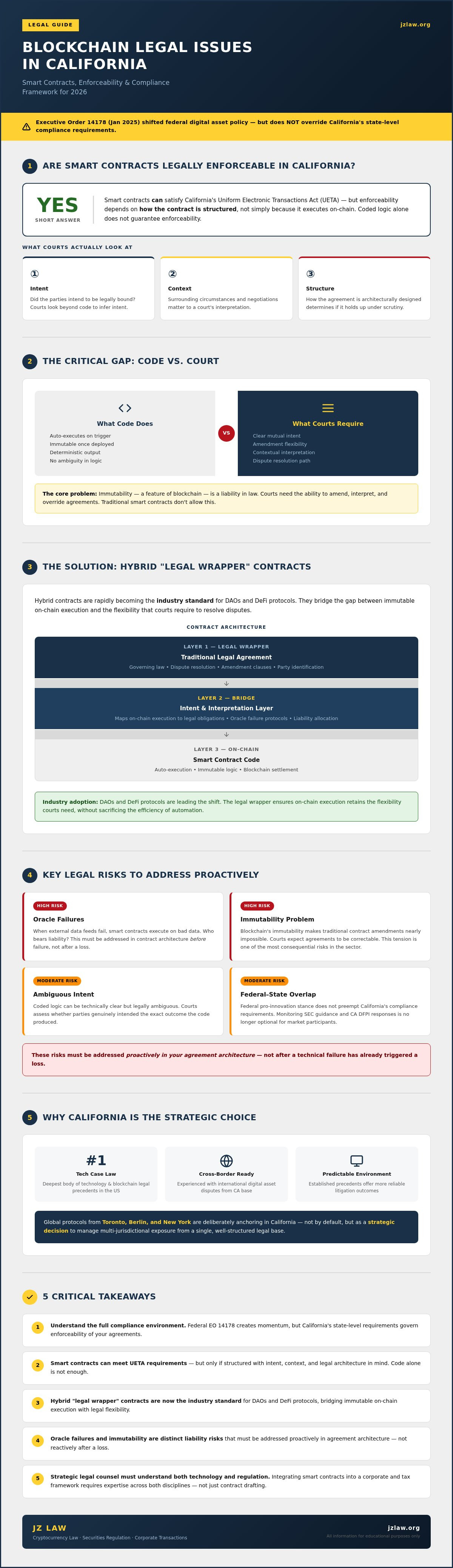
The short answer is yes, but with meaningful conditions attached. California's Uniform Electronic Transactions Act provides the foundational legal framework for recognizing electronically executed agreements, and smart contracts can satisfy its requirements. The critical distinction is that satisfying those requirements depends on how the contract is structured, not simply on the fact that it executes on-chain. Understanding where coded logic holds up and where it falls short is one of the most consequential blockchain legal issues California-based enterprises need to resolve before deploying production agreements.
Applying UETA to Coded Logic
Under California's UETA, codified at Cal. Civ. Code § 1633.1 et seq., an "electronic record" is any record created, generated, sent, communicated, received, or stored by electronic means. A smart contract deployed to a public blockchain satisfies this definition: the contract's bytecode constitutes an electronic record, and the on-chain transaction that triggers its execution functions as an electronic signature, provided it can be attributed to a specific party. The practical challenge isn't definitional. It's evidentiary. When a contract is written in Solidity or Rust, proving mutual intent requires demonstrating that both parties understood the coded conditions as the operative terms of their agreement, not merely as a technical implementation layer sitting beneath a separate written document.
A smart contract under California UETA standards can be defined as: a self-executing electronic record in which the terms of an agreement are expressed as programmable logic, deployed to a distributed ledger, and triggered automatically upon the satisfaction of predefined conditions, provided the parties have affirmatively assented to those terms and the agreement is otherwise lawful.
The federal E-SIGN Act reinforces this framework at the national level, confirming that electronic signatures and records can't be denied legal effect solely because they're in electronic form. For blockchain-based agreements, E-SIGN and UETA together create a permissive but conditional environment: the technology is recognized, but the legal substance still has to be there.
The Essential Elements of a Binding Coded Agreement
Offer, acceptance, and consideration don't disappear simply because an agreement is automated. They manifest differently. In a decentralized exchange protocol, for instance, a liquidity provider's wallet interaction constitutes both acceptance and consideration simultaneously. Courts will look for evidence that each element was present at the moment of execution, even if no human consciously articulated them in sequence.
The "meeting of the minds" requirement presents a more complex challenge in anonymous or pseudonymous transactions. California courts assess mutual assent objectively, meaning the question isn't what each party privately believed, but what a reasonable person would have understood from the conduct and context. Pseudonymity doesn't automatically defeat this analysis, but it does complicate the evidentiary record if a dispute arises.
Statute of Frauds considerations become particularly important for high-value smart contract transactions. California's Statute of Frauds, under Cal. Civ. Code § 1624, requires certain agreements to be in writing, including contracts for the sale of goods exceeding C$500 in value and real property transactions. A purely on-chain execution may not satisfy the "writing" requirement without supplementary documentation establishing the parties' identities and the agreed terms in accessible language.
Offer: The coded conditions define the terms; the deployed contract constitutes the standing offer.
Acceptance: A wallet interaction or transaction signature serves as acceptance, provided the party had reasonable notice of the terms.
Consideration: Token transfers, service execution, or data delivery typically satisfy this element, but the exchange must be genuine and lawful.
Writing requirement: For transactions subject to the Statute of Frauds, on-chain execution alone is likely insufficient without a legal wrapper or off-chain documentation.
Structuring agreements that satisfy all of these elements simultaneously, in an environment where the counterparty may be anonymous and the code is immutable, requires deliberate legal architecture from the outset. Working with counsel experienced in cryptocurrency law before deployment is considerably more efficient than attempting to reconstruct intent after a dispute has already materialized.
The Obtuse Code Dilemma: Why Hybrid Contracts are Essential
The phrase "code is law" carries a certain elegance in developer circles. In a courtroom, it carries almost no weight at all. A California judge assessing a disputed DeFi protocol interaction isn't equipped to read Solidity bytecode, and more critically, isn't required to. What courts interpret is intent, expressed in terms that a reasonable person can understand. When the only record of an agreement is a deployed smart contract, that interpretive gap becomes one of the most consequential blockchain legal issues California practitioners currently face.
Immutability compounds the problem. The same property that makes smart contracts operationally reliable makes them legally brittle. Traditional contracts can be amended, rescinded, or supplemented by course of dealing. Code that has been deployed to a public blockchain cannot be unilaterally revised, and a disputed execution that produces an unintended outcome leaves affected parties with limited remedies unless a parallel legal framework was established in advance.
Natural Language vs. Self-Executing Code
The gap between technical execution and legal obligation isn't merely a translation problem. It's a structural one. Coded logic expresses conditions and outcomes; it doesn't express purpose, context, or the parties' underlying commercial intentions. A Ricardian Contract model addresses this directly by creating a document that is simultaneously human-readable and machine-parseable, with each clause in natural language cryptographically linked to its corresponding executable logic. For complex business arrangements involving multi-party governance, revenue distribution, or conditional licensing, this model provides courts with the interpretive anchor they require without sacrificing the automation that makes the system valuable.
When approaching corporate transactions involving automation, JZ Law's methodology reflects this dual-layer architecture: the on-chain execution layer handles settlement and enforcement logic, while a companion legal instrument defines the parties' identities, governing law, dispute resolution mechanisms, and the commercial intent behind each automated condition. Neither layer is subordinate to the other; they operate in deliberate coordination.
Strategic Benefits of Legal Wrappers for DAOs
Decentralized autonomous organizations present a particular liability problem under California law. Without a recognized legal structure, DAO members can face exposure to general partnership liability, meaning personal assets may be reachable for the organization's obligations. A legal wrapper, typically structured as a California LLC or a Wyoming DAO LLC registered to do business in California, resolves this by establishing a defined legal entity that holds the protocol's assets, enters contracts, and absorbs liability at the organizational level rather than the individual member level.
Beyond liability protection, wrappers define governance rights in terms California courts recognize. Token-based voting mechanisms are operationally functional but legally ambiguous without documentation establishing what those votes actually authorize. A properly drafted operating agreement translates on-chain governance into enforceable membership rights, including the right to distributions, the right to participate in material decisions, and the conditions under which a member's interest can be transferred or redeemed.
Integrating these structures into a broader cryptocurrency law framework matters particularly for protocols with Canadian participants or cross-border token distributions, where C$-denominated obligations and securities law considerations under provincial regulators add further complexity. The hybrid contract approach isn't a workaround; it's the architecture that makes decentralized systems legally durable.
Managing Technical and Legal Risks in Automated Agreements
Automated execution is both the primary advantage of smart contracts and their most significant legal vulnerability. When code runs without human intervention, the legal consequences of a technical failure land immediately and often irreversibly. Two categories of risk dominate the landscape of blockchain legal issues California practitioners are currently managing: the liability exposure created by corrupted external data feeds, and the structural problem of correcting a legal error in code that cannot be unilaterally changed after deployment.
The Oracle Problem and Data Liability
Smart contracts don't have independent access to real-world information. They rely on oracles, third-party services that supply external data such as asset prices, interest rates, or event outcomes to trigger on-chain execution. An oracle, in its legal character, functions as a third-party service provider whose data delivery obligations exist independently of the smart contract it serves, meaning that when corrupted or manipulated price feeds cause a contract to execute incorrectly, the question of who bears the resulting loss is a contractual and tort law problem, not merely a technical one.
California courts analyzing such disputes will look first at what the parties agreed about data reliability. If the smart contract's companion legal instrument is silent on oracle failure, affected parties are left arguing negligence or breach of implied warranty, neither of which produces a predictable outcome. The more defensible architecture includes explicit indemnification clauses that:
Identify the specific oracle provider and the data feed being consumed
Define what constitutes a "failure event," including price deviation thresholds and downtime windows
Allocate liability between the protocol deployer, the oracle provider, and the end user for losses attributable to corrupted data
Establish a notice and cure mechanism before litigation rights are triggered
Flash loan exploits compound this exposure directly. When an attacker manipulates an oracle's price data within a single transaction block to drain protocol funds, the harm is simultaneous with the technical event. Without pre-drafted liability allocation, recovery attempts are expensive and uncertain.
Jurisdictional clauses deserve equal attention. Decentralized networks have no inherent domicile, but California courts will assert jurisdiction when a party is resident here or when the agreement designates California law. Including a governing law clause and a California-specific choice-of-forum provision in your legal wrapper is a foundational step, not an afterthought.
Dispute Resolution in an Immutable World
Immutability doesn't mean disputes are impossible to resolve. It means the resolution mechanisms have to be built in before they're needed. Incorporating administrative pause functions or circuit breakers into the contract's technical architecture, paired with a corresponding clause in the legal wrapper authorizing their use under defined conditions, gives affected parties a window to pursue arbitration or injunctive relief without the underlying harm compounding in real time.
Private arbitration under JAMS or AAA rules is increasingly the preferred resolution pathway for California-based blockchain disputes, precisely because arbitrators can be selected for technical literacy and proceedings remain confidential. Your agreement should specify the arbitral body, the seat of arbitration, and whether the arbitrator's award is binding and judicially enforceable under California's Code of Civil Procedure, which it can be, provided the clause is properly drafted.
Courts retain the authority to grant equitable relief even where arbitration is the primary mechanism. Ensuring your smart contract structure doesn't inadvertently waive judicial remedies for fraud, gross negligence, or regulatory violations is a drafting precision issue that experienced cryptocurrency law counsel should address before your protocol goes live.
Strategic Legal Counsel for Blockchain Ventures at JZ Law
A smart contract doesn't exist in isolation. It sits inside a corporate structure, generates revenue that attracts tax obligations, and may distribute tokens that regulators classify as securities. Treating the contract as a standalone technical instrument, separate from the corporate and fiscal architecture surrounding it, is one of the most consequential errors blockchain ventures make. It's also one of the most common blockchain legal issues California-based enterprises bring to counsel only after the consequences have already materialized.
Smart Contracts in Corporate Tax and Securities
Automated revenue streams create immediate tax characterization questions. When a protocol distributes tokens to liquidity providers or stakers, the timing, form, and classification of that distribution determine whether it's treated as ordinary income, capital gain, or something else entirely under Canadian and cross-border tax frameworks. The logic embedded in your smart contract can inadvertently trigger these events at scale, across thousands of wallet addresses, before your tax counsel has had the opportunity to structure the distribution mechanism correctly.
Securities exposure presents an equally urgent consideration. Under both Canadian provincial securities law and U.S. frameworks that reach California-based participants, a token that grants holders economic rights tied to the efforts of others can satisfy the definition of a security regardless of what the issuer calls it. The automated execution of token distributions doesn't insulate the issuing entity from that classification; it simply means the potentially non-compliant event has already occurred by the time the question is raised. JZ Law's experience in taking companies public and navigating securities regulation provides a directly applicable framework for blockchain firms evaluating whether their token architecture requires registration, exemption reliance, or structural redesign before launch.
Tax structuring: Aligning token distribution mechanics with your corporate entity structure to control the timing and character of taxable events.
Securities analysis: Assessing whether automated distributions, governance rights, or yield-bearing instruments meet the threshold for securities classification under applicable law.
Entity architecture: Selecting and establishing the corporate vehicle that appropriately contains protocol liability while supporting compliant token issuance.
Securing Your Professional Legal Strategy
Boutique firms operating at the intersection of cryptocurrency law, securities regulation, and corporate transactions offer something that generalist practices structurally cannot: a practice built around the specific complexity your venture actually faces. Every engagement at JZ Law is approached as a strategic partnership rather than a transactional file, with counsel that understands both the regulatory environment and the commercial logic driving your decisions.
Addressing blockchain legal issues in California proactively, before deployment rather than in response to a dispute or regulatory inquiry, is the methodology that produces durable outcomes. Precision in drafting, foresight in structuring, and genuine fluency in the technology and the law that governs it are the standards that complex blockchain ventures require. To discuss your specific compliance architecture or token structure with John Zang, reach out directly for a consultation tailored to the regulatory and commercial realities your venture is navigating.
Build Your Blockchain Venture on a Legal Foundation That Holds
The landscape of blockchain legal issues in California has never been more consequential for founders, developers, and institutional participants. Smart contract enforceability under UETA, the structural necessity of hybrid legal wrappers, and the liability exposure created by oracle failures and immutability aren't abstract concerns; they're operational risks that compound quickly without deliberate legal architecture in place.
Three principles carry through everything covered here: proactive structuring outperforms reactive remediation, coded logic alone cannot substitute for legal intent, and the corporate, tax, and securities frameworks surrounding your protocol matter as much as the protocol itself.
JZ Law brings specialized expertise in cryptocurrency law, securities regulation, and strategic corporate transactions to ventures navigating precisely this complexity. Whether you're structuring a DAO, evaluating token classification risk, or preparing for cross-border compliance across Canadian and U.S. markets, the right counsel makes the difference between a durable structure and an expensive correction.
Don't wait for a dispute to reveal the gaps. Consult with JZ Law on your smart contract strategy and build with the confidence that your legal foundation is as solid as your technology.
Frequently Asked Questions About Blockchain Legal Issues in California
Is a smart contract legally binding in California?
Yes, a smart contract can be legally binding in California, but enforceability depends on structure, not simply on deployment. The agreement must satisfy the same foundational elements as any contract: offer, acceptance, consideration, and mutual assent. California's Uniform Electronic Transactions Act provides the statutory recognition, but coded logic alone doesn't guarantee a court will uphold the agreement if intent and identity can't be established from the available record.
How does California UETA affect blockchain-based agreements?
California's UETA, codified at Cal. Civ. Code § 1633.1 et seq., recognizes electronic records and signatures as legally valid, which means a deployed smart contract and its triggering transaction can satisfy the statute's requirements. The practical challenge is evidentiary: parties must demonstrate that both sides understood the coded conditions as the operative terms of their agreement. UETA creates a permissive framework, but it doesn't lower the substantive bar for what constitutes a binding obligation.
What is a "legal wrapper" for a smart contract?
A legal wrapper is a companion legal instrument drafted in natural language that operates alongside a deployed smart contract, defining the parties' identities, governing law, dispute resolution mechanisms, and the commercial intent behind each automated condition. It doesn't replace the on-chain execution layer; it coordinates with it. For DAOs and DeFi protocols, a wrapper is typically structured as a California LLC or Wyoming DAO LLC, converting token-based governance rights into enforceable membership interests that California courts can recognize and adjudicate.
Can a smart contract be used for California real estate transactions?
Smart contracts can support components of a real estate transaction, such as escrow logic or conditional payment release, but California's Statute of Frauds under Cal. Civ. Code § 1624 requires real property agreements to be in writing with identifiable parties. A purely on-chain execution is unlikely to satisfy that requirement without supplementary documentation. Any blockchain-assisted real estate structure needs a carefully drafted off-chain legal instrument to remain compliant with California's property law requirements.
What happens if a smart contract executes incorrectly due to a bug?
When a bug triggers an unintended execution, affected parties face a difficult recovery path if no legal framework was established in advance. California courts will examine what the parties agreed about technical failures, and if the companion agreement is silent on the issue, claimants are left arguing negligence or breach of implied warranty, both of which produce uncertain outcomes. Building administrative pause functions into the contract's architecture, paired with a legal clause authorizing their use under defined conditions, is the most defensible pre-deployment approach.
Does California law recognize DAOs as legal entities?
California doesn't have a dedicated DAO statute, which means an unincorporated DAO may be treated as a general partnership under state law, exposing individual members to personal liability for the organization's obligations. The most common solution is registering a legal entity, typically a California LLC or a Wyoming DAO LLC qualified to do business in California, that holds the protocol's assets and enters contracts on behalf of the organization. Without that structure, blockchain legal issues in California for DAO participants carry substantially higher personal risk than most founders anticipate.
How do I include a choice-of-law clause in a smart contract?
A choice-of-law clause belongs in the legal wrapper document rather than embedded in the smart contract's code, since Solidity and similar languages have no native mechanism for expressing jurisdictional intent in a form courts can interpret. The wrapper should specify the governing law, the chosen forum for dispute resolution, and whether California's Code of Civil Procedure governs the enforcement of any arbitral award. Without this clause, a court will apply its own conflict-of-laws analysis, which may produce an outcome neither party anticipated or preferred.
Are smart contracts subject to California securities regulations?
They can be, and the classification question turns on the economic substance of what the contract does rather than what it's called. If a smart contract automatically distributes tokens that grant holders economic returns tied to the efforts of a third party, that instrument may satisfy the definition of a security under both California law and applicable federal frameworks. The automated nature of the distribution doesn't insulate the issuer from that classification; it simply means the potentially non-compliant event has already occurred by the time the question reaches a regulator. Securities analysis should precede deployment, not follow it.


Comments