


Preventing Shareholder Disputes in Alberta: A Strategic Guide for 2026
- jzanglaw
- 2 days ago
- 12 min read
Your most valuable corporate asset isn't your intellectual property or your market share; it's the underlying stability of your ownership structure. Many founders mistakenly believe a standard template provides sufficient protection, yet generic agreements often trigger the very litigation they're meant to avoid. Preventing shareholder disputes in Alberta demands a more sophisticated, proactive approach than simply filing standard incorporation paperwork. We recognize the genuine anxiety surrounding minority shareholder oppression claims and the fear that a shotgun clause might be used as a predatory weapon rather than a fair exit mechanism.
This guide provides the strategic clarity you need to safeguard your Alberta corporation through robust legal frameworks and industry-specific governance. You'll learn how to construct a bulletproof Unanimous Shareholder Agreement (USA) that remains compliant with current Alberta Business Corporations Act standards while maximizing tax efficiency under 2026 rates. We'll examine how to establish clear exit strategies for partners and align your internal governance with your long-term commercial goals. By the end of this article, you'll have a roadmap to ensure your corporate structure serves as a shield for your legacy, not a source of future conflict.
Key Takeaways
Understand how the Alberta Business Corporations Act and the "Reasonable Expectations" test define the legal boundaries of shareholder rights and corporate conduct.
Implement a tailored Unanimous Shareholder Agreement (USA) as the definitive instrument for preventing shareholder disputes in Alberta by establishing clear exit strategies and governance protocols.
Mitigate operational and regulatory risks specific to Alberta's cannabis, cryptocurrency, and energy sectors through industry-aligned corporate structures.
Utilize strategic tax structuring and holding companies to harmonize shareholder interests regarding cash flow, dividend distributions, and long-term asset protection.
Adopt a proactive governance model that integrates high-stakes securities expertise to ensure your corporation remains resilient during complex transitions and market shifts.
Table of Contents
The Legal Framework of Shareholder Rights in Alberta
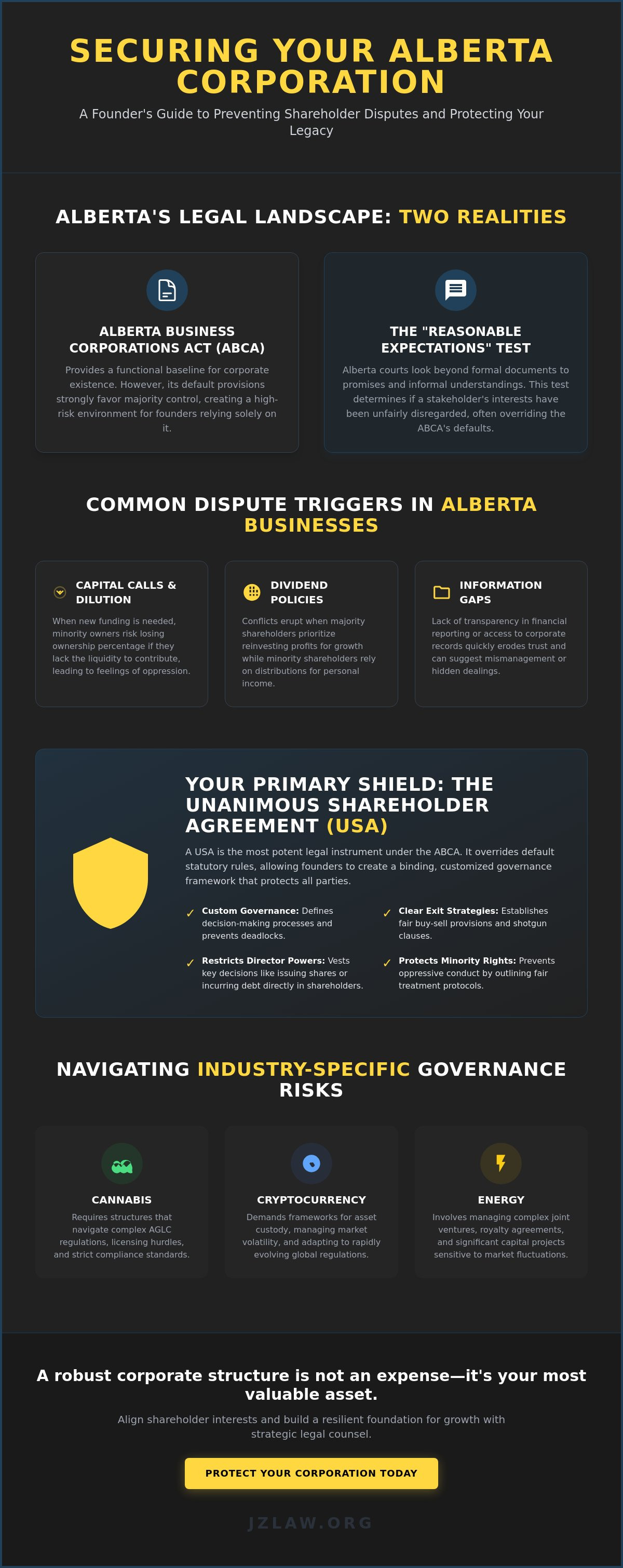
The Alberta Business Corporations Act (ABCA) serves as the primary governing statute for all provincial entities. While it provides a functional baseline for corporate existence, relying solely on its default provisions is a high-risk strategy for founders. These statutory defaults favor majority control and often fail to address the nuanced operational realities of a growing venture. The Legal Framework of Shareholder Rights in Alberta is heavily influenced by the "Reasonable Expectations" test. This means courts don't just look at the letter of the law; they examine the specific promises, informal agreements, and understandings between partners to determine if a stakeholder's interests have been unfairly disregarded.
The friction between minority rights and majority control is where most corporate conflicts begin. Majority shareholders often believe they have an absolute mandate to steer the company as they see fit, but the ABCA provides significant protections for the minority that can halt operations if triggered. Preventing shareholder disputes in Alberta effectively requires moving beyond the basic statute. If you haven't explicitly defined how decisions are made or how deadlocks are broken, you're essentially inviting a judge to interpret your intentions years after the fact, which is both costly and unpredictable.
The Oppression Remedy and Fiduciary Duties
Oppressive conduct occurs when the corporation's affairs are conducted in a way that's unfairly prejudicial to a shareholder. Under 2026 legal standards, the oppression remedy is a broad, equitable power granted to Alberta courts to rectify conduct that undermines the reasonable expectations of a stakeholder. A common point of confusion for Calgary business owners is the role of directors. Their fiduciary duty is strictly to the corporation itself, not to any individual shareholder. This distinction often leads to bitter disputes when a director's decision benefits the company's long-term health but harms a specific shareholder's immediate financial interests or dividend expectations.
Common Triggers for Disputes in Calgary Businesses
In the local business environment, certain patterns of conflict emerge more frequently than others. These triggers often include:
Capital calls and dilution: When the company requires additional funding and minority owners face a reduction in their ownership percentage because they lack the liquidity to contribute.
Dividend policies: Conflicts arise when the majority wants to reinvest all profits for aggressive growth while the minority relies on distributions for personal income.
Information gaps: A lack of transparency regarding financial reporting or corporate records quickly erodes trust and suggests mismanagement.
These issues aren't just administrative hurdles; they're fundamental threats to the stability of your enterprise. Without a clear framework that exceeds the ABCA's minimum requirements, these common triggers often escalate into litigation that can paralyze a corporation for years.
The Unanimous Shareholder Agreement (USA): Your Primary Shield
A Unanimous Shareholder Agreement (USA) is the most potent legal instrument available under the Alberta Business Corporations Act. While bylaws provide a generic administrative framework, a USA allows shareholders to fundamentally alter the governance of the corporation. It effectively overrides the default statutory rules, providing a level of customization that standard articles of incorporation simply cannot match. For founders, this is the cornerstone of preventing shareholder disputes in Alberta, as it creates a binding set of rules that all parties must follow, regardless of their percentage of ownership. Without this document, you're left at the mercy of broad judicial interpretations of what's "fair" or "reasonable" under the ABCA.
One of the USA's most critical functions is its ability to restrict the powers of directors. In many Alberta private companies, the shareholders and directors are the same individuals, but their legal roles differ significantly. A USA can strip directors of specific decision-making powers, such as the ability to issue new shares or incur significant debt, and vest those powers directly in the shareholders. This prevents a board from taking actions that might technically fulfill their fiduciary duty to the company while undermining the specific intent of the founders. In a 50/50 ownership structure, these restrictions are vital for managing deadlocks, as they can mandate specific mediation or arbitration paths before a stalemate paralyzes the business.
Critical Exit and Transfer Clauses
The "Shotgun Clause" remains a controversial but effective "nuclear option" for 50/50 deadlocks in 2026. It forces one partner to buy out the other at a price the offering party sets, ensuring a clean break but often favoring the partner with superior liquidity. To balance this, many Alberta firms utilize a Right of First Refusal (ROFR), which lets existing shareholders match a third-party offer, or a Right of First Offer (ROFO), requiring a departing shareholder to offer their stake to existing partners first. Additionally, drag-along rights ensure a majority can force a full sale of the company to a third party, while tag-along rights protect minority owners by allowing them to join that sale on identical terms.
Valuation Methods to Prevent Price Disputes
Disagreements over share value are a primary driver of corporate litigation. Relying on "book value" is often a mistake for high-growth sectors like tech or cannabis, where intellectual property and future cash flows far outweigh physical assets. Financial and Tax Structuring to Pre-empt Conflicts often highlights that pre-set valuation formulas or mandatory third-party appraisals are superior for maintaining peace. Establishing a clear timeline for annual valuation updates ensures that all parties are aligned on the company's worth before a conflict arises. If your current agreement lacks these specific mechanics, seeking a comprehensive corporate review can identify and close these dangerous governance gaps before they escalate into costly legal battles.
Industry-Specific Governance: Cannabis, Crypto, and Energy
The complexity of corporate governance increases significantly when a business operates within highly regulated sectors. In Alberta, sectors like energy, cannabis, and emerging technologies face unique pressures where a single regulatory oversight can lead to catastrophic value loss. Preventing shareholder disputes in Alberta often hinges on whether the corporate bylaws and shareholder agreements account for these industry-specific landmines. A failure to maintain compliance with FINTRAC or securities regulations doesn't just invite government fines; it creates a breach of trust that often triggers minority shareholder oppression claims. When the stakes involve the potential loss of an operating license, the margin for error in governance disappears.
In technical oil and gas ventures or blockchain startups, "Key Person" risk is a tangible threat to equity value. If a lead engineer or a geologist with proprietary knowledge departs or becomes incapacitated, the resulting vacuum often leads to internal power struggles. Strategic agreements must include specific clauses for IP transfer and succession planning to ensure the corporation remains viable. This level of foresight is essential when preparing for a transition to public markets like the TSX or NASDAQ. Institutional investors demand rigorous governance standards that many private founders find restrictive, making it vital to align internal agreements with public market expectations early in the company's lifecycle.
Governance in the Alberta Cannabis Sector
The Alberta Gaming, Liquor and Cannabis (AGLC) commission enforces strict suitability requirements for anyone holding a significant interest in a licensed entity. If a shareholder fails a background check or becomes a "prohibited person" due to legal issues, the entire corporation's license is at risk. Your shareholder agreement must include mandatory buyout provisions that trigger automatically if a stakeholder's status threatens the company's regulatory standing. This prevents a single individual's personal legal troubles from sinking the entire enterprise. For a deeper analysis of these requirements, consult the JZ Law Cannabis Licensing Guide 2026 to understand how provincial frameworks impact your ownership structure.
Cryptocurrency and Emerging Tech Considerations
Blockchain ventures face unique challenges regarding intellectual property ownership and tokenomics. Disputes often arise when founders disagree on whether digital assets or tokens constitute equity or separate compensation. Clear documentation must define how token distributions affect shareholder equity to prevent dilution conflicts that can stall development. Preventing shareholder disputes in Alberta within the tech sector requires a precise definition of what constitutes a corporate asset versus personal IP. Understanding these jurisdictional nuances is critical, as detailed in the JZ Law Cryptocurrency Law 2026 report, which explores the intersection of local law and global digital asset trends.
Financial and Tax Structuring to Pre-empt Conflicts
Most corporate friction isn't born from personal animosity; it's a byproduct of financial misalignment. Preventing shareholder disputes in Alberta often requires a forensic look at how the corporation distributes wealth and manages its tax liabilities. When a corporate structure is tax-inefficient, it creates a zero-sum game where one shareholder's liquidity comes at the expense of another's tax bill. For instance, if a corporation lacks a holding company structure, individual shareholders may find their personal assets unnecessarily exposed to corporate creditors, or they might miss out on the benefits of tax-deferred inter-corporate dividends.
Liquidity is another common flashpoint that founders frequently overlook until a crisis hits. A buy-sell agreement is only as effective as the funding mechanism behind it. In 2026, sophisticated Alberta corporations increasingly use life insurance policies to fund these agreements, ensuring that if a partner passes away or must be bought out, the corporation has the immediate cash on hand. This prevents the remaining partners from having to liquidate operational assets or take on predatory debt to fulfill their contractual obligations. It's also vital to consider the tax implications of a "shotgun" exit; without prior planning, a forced sale can trigger massive capital gains taxes that strip the departing party of their expected payout and lead to secondary litigation over the net value received.
Strategic Tax Structuring for Founders
Founders should utilize multiple share classes to maximize the Lifetime Capital Gains Exemption (LCGE) across family members or holding entities. While Alberta's small-business tax rate remains at 2.00% in 2026, income splitting regulations demand precise documentation to avoid punitive consequences. Implementing tax-aligned governance reduces financial litigation risk by ensuring that every distribution is defensible and optimized for the unique tax positions of all stakeholders.
Capital Structure and Future Financing
As a company moves toward Series A or B funding, the tension between original founders and new investors can escalate quickly. Convertible debt often seems like an easy solution for short-term capital, yet it carries significant legal pitfalls if the conversion terms aren't perfectly aligned with existing shareholder rights. Our guide on Strategic Corporate Transactions 2026 details how to manage these transitions without diluting the control of original stakeholders. If you're concerned your current financial setup is creating future liabilities, it's time for a professional tax structuring consultation to fortify your corporate foundation.
JZ Law: Strategic Counsel for Alberta Shareholder Matters
John Zang’s approach to corporate governance is rooted in the conviction that a precisely drafted agreement is the most effective insurance policy a business can possess. Preventing shareholder disputes in Alberta requires a fundamental transition from reactive legal fixes to a proactive, growth-oriented framework that anticipates corporate evolution. For companies operating within Calgary's technical energy or emerging tech sectors, this involves preparing for high-stakes securities environments long before a liquidity event appears on the horizon. The dynamics of ownership change significantly when a board begins the process of taking a company public on the TSX or NASDAQ. Founder control must eventually yield to institutional transparency, a transition that often reveals structural flaws in early-stage agreements. JZ Law provides the sophisticated oversight required to manage these shifts, ensuring your corporate architecture remains a strategic asset during intense regulatory scrutiny.
Moving from a dispute-prone structure to one designed for scale demands an understanding of both local statutes and global market expectations. We don't just provide documents; we deliver a strategic roadmap that aligns your internal governance with your commercial trajectory. By integrating tax structuring with corporate transactions, we ensure that every shareholder's interests are protected against the common triggers of litigation. This level of comprehensive counsel is essential for Alberta firms that aim to compete in international markets while maintaining a stable domestic foundation.
Beyond Litigation: A Strategic Partnership
Effective governance isn't merely about statutory compliance; it's about the meticulous drafting of instruments that reflect your specific business objectives. We often serve as external general counsel for private Alberta boards, offering an objective perspective that internal stakeholders may lack. This partnership allows us to identify friction points in capital calls or dividend policies before they escalate into formal conflicts. You can explore the full scope of John Zang Services to understand how we harmonize securities regulation and corporate law into a unified strategy for your enterprise.
Navigating Complexity in 2026
The 2026 market landscape in Calgary and other global hubs necessitates a higher degree of legal agility. With heightened market volatility and the rapid evolution of cross-border regulations, Alberta companies with US interests face unique compliance hurdles that require specialized knowledge. Our firm offers the cross-border expertise needed to align Alberta corporate governance with international standards. Whether you're restructuring for a Series B round or preparing for an IPO, we ensure your legal foundation is resilient enough to withstand global economic shifts. To begin fortifying your corporate structure and preventing shareholder disputes in Alberta, contact JZ Law for a strategic consultation.
Building a Resilient Corporate Legacy for 2026 and Beyond
The stability of your Alberta corporation depends on your willingness to move beyond the basic protections of the provincial statute. By implementing a robust Unanimous Shareholder Agreement and aligning your internal governance with industry-specific regulatory requirements, you transform a potential source of conflict into a foundation for growth. Preventing shareholder disputes in Alberta isn't merely a legal checkbox; it's a strategic necessity that requires integrating tax efficiency with precise corporate structuring to ensure all stakeholders remain aligned.
Whether you're navigating the complexities of the cannabis sector, managing digital assets, or preparing for high-stakes oil and gas transactions, your legal framework must be as dynamic as the markets you serve. Led by John Zang, an expert in complex corporate transactions, our firm focuses on proactive risk mitigation and sophisticated tax structuring. We invite you to secure your business’s future with strategic legal counsel from JZ Law. Our specialized knowledge in the cannabis, crypto, and energy sectors ensures your enterprise is prepared for the challenges of 2026. Your corporate legacy deserves a partner who prioritizes precision and long-term security.
Frequently Asked Questions
What is the most common cause of shareholder disputes in Alberta?
The most frequent triggers for conflict include disagreements over dividend policies and the necessity of capital calls. These disputes often arise when one group of shareholders seeks to reinvest profits for aggressive growth while another group requires immediate liquidity for personal income. Misalignment regarding the long-term strategic direction of the company frequently leads to trust erosion and subsequent litigation.
Can a minority shareholder stop a majority sale in an Alberta corporation?
A minority shareholder generally cannot veto a sale of the company unless specific protections are outlined in a Unanimous Shareholder Agreement. Under the Alberta Business Corporations Act, a majority can often force a sale, though minority owners may exercise "dissent rights" to receive fair value for their shares. Without a USA, the minority's primary recourse is often the oppression remedy if they believe the sale price is unfairly prejudicial.
What is a "Shotgun Clause" and is it legal in Alberta?
A shotgun clause is a mandatory buy-sell provision that is entirely legal and common in Alberta corporate law. It allows one shareholder to offer to buy out another at a specific price, forcing the recipient to either accept the offer or buy out the proposer at that same price. While effective for preventing shareholder disputes in Alberta by breaking deadlocks, it can be predatory if one partner has significantly more liquidity than the other.
How does the Alberta Business Corporations Act protect shareholders?
The ABCA protects shareholders primarily through the oppression remedy and the right to initiate derivative actions against directors. It also mandates that shareholders have access to corporate records and financial statements to ensure transparency. These statutory protections provide a baseline of fairness, though they're often less effective than the customized safeguards found in a professionally drafted shareholder agreement.
Do I need a lawyer to draft a Unanimous Shareholder Agreement (USA)?
Engaging a lawyer is essential because generic templates fail to account for the unique regulatory and tax environments of 2026. A strategic advisor ensures that your USA includes industry-specific clauses for sectors like cannabis or crypto, which are vital for preventing shareholder disputes in Alberta. Meticulous drafting by a professional minimizes the risk of ambiguous language that could lead to future court intervention.
What happens if a shareholder wants to exit but there is no agreement?
Exiting a private corporation without a shareholder agreement is complex and often requires finding a third-party buyer who's willing to accept the existing corporate terms. If no buyer is found, the departing shareholder may be forced to remain in the company unless they can prove oppressive conduct that justifies a court-ordered buyout. This lack of a clear exit strategy is a primary driver of partnership dissolution and legal conflict.
How are shareholder disputes resolved without going to court in Calgary?
Disputes are frequently resolved through Alternative Dispute Resolution (ADR) methods such as mediation or binding arbitration. These processes are typically faster, more cost-effective, and more private than public litigation in Alberta courts. Many modern shareholder agreements include mandatory ADR clauses that require partners to attempt these non-adversarial paths before filing a formal lawsuit.
Does the oppression remedy apply to large public companies in Alberta?
The oppression remedy applies to both private and public corporations governed by the ABCA. While it's more commonly invoked in closely held private companies where "reasonable expectations" are easier to define, shareholders of public companies can also seek relief if the directors act in a way that's unfairly prejudicial. The remedy is a powerful tool for ensuring that corporate actions don't disregard the interests of any stakeholder group.


Comments