


Public Company Compliance in Calgary: A 2026 Strategic Legal Framework
In the 2026 capital markets, public company compliance in Calgary has evolved from a back-office administrative task into a critical strategic lever for market valuation and investor confidence. You likely recognize that the transition to the integrated SEDAR+ platform and the increasing rigor of Alberta Securities Commission (ASC) audits have introduced unprecedented layers of complexity to your daily operations. The financial and reputational costs of non-compliance penalties are simply too high to ignore in a competitive environment. This guide provides the expert clarity you need to master the intricacies of Alberta securities law and continuous disclosure requirements with precision. We'll explore a comprehensive strategic framework specifically designed to help Calgary-based public entities maintain an impeccable standing with the ASC while ensuring seamless reporting cycles. By the end of this analysis, you'll understand how to transform regulatory obligations into a streamlined process that reduces risk and secures your corporate future through proactive planning and sophisticated legal oversight.
Table of Contents
The Regulatory Landscape for Calgary Public Companies
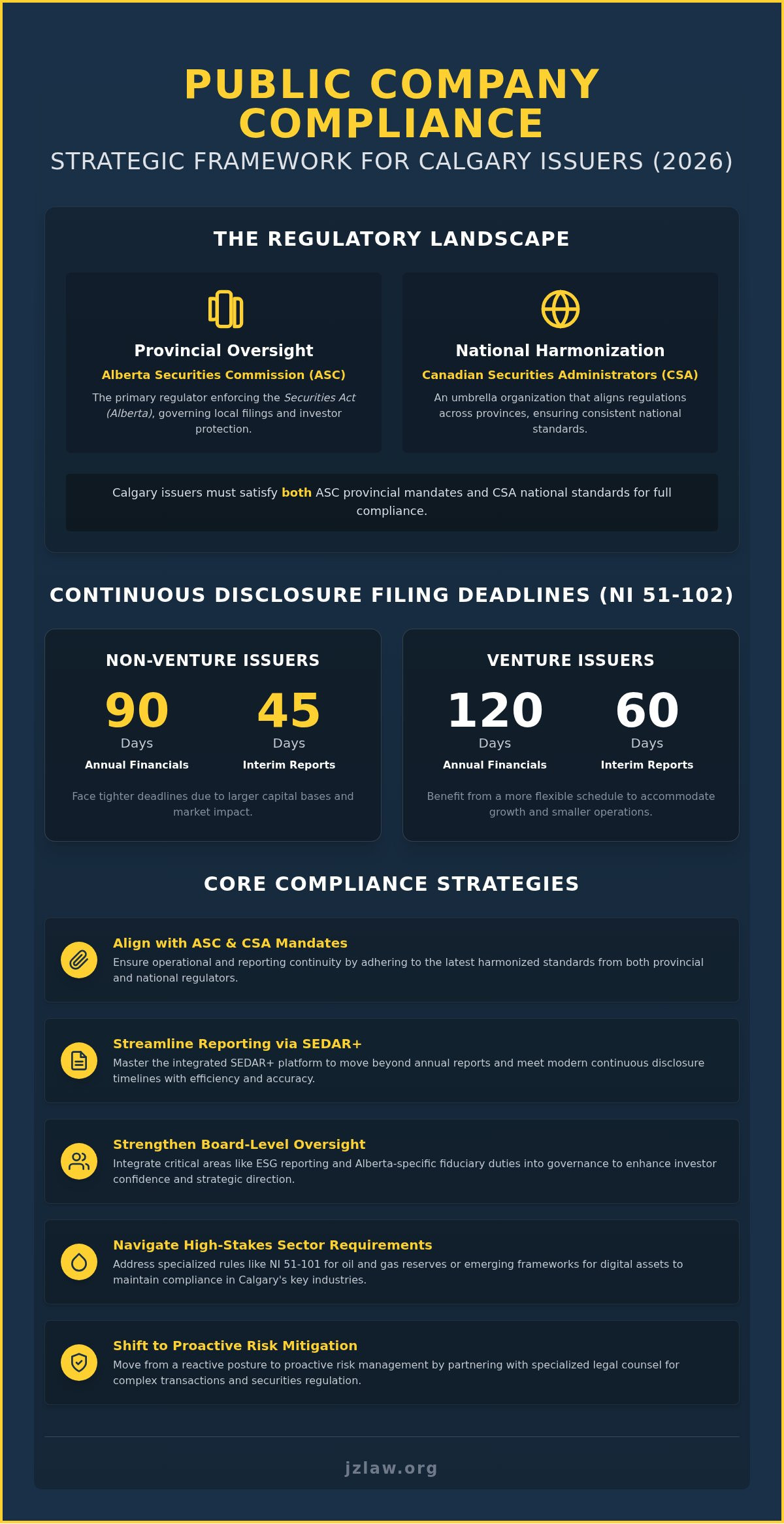
The foundation of public company compliance calgary rests upon a dual-layered regulatory architecture that demands absolute precision from executives and legal teams. At the provincial level, the Alberta Securities Commission (ASC) serves as the primary regulatory body, operating under the authority of the Securities Act (Alberta). While the ASC maintains local jurisdiction, it functions as a critical member of the Canadian Securities Administrators (CSA), a national umbrella organization that harmonizes regulations across provinces to ensure a consistent experience for issuers and investors alike. Understanding this interplay is vital because while your primary filings are governed by Alberta statutes, they must simultaneously meet national standards to remain in good standing across the country.
A reporting issuer in the Alberta context is an entity that has either filed a prospectus with the ASC or has otherwise become subject to continuous disclosure requirements through a stock exchange listing or a corporate reorganization.
The Role of the ASC in 2026
The ASC's mandate focuses on fostering a fair and efficient capital market while protecting investors from unfair or fraudulent practices. In 2026, we see an intensified focus on proactive enforcement, particularly regarding the accuracy of digital disclosures and the integrity of climate-related reporting. The commission doesn't operate in a vacuum; it maintains a symbiotic relationship with the TSX and TSX Venture Exchange. While the exchanges set listing standards and oversee trading activity, the ASC enforces the underlying statutory law. This means a Calgary entity must satisfy both the contractual requirements of their chosen exchange and the legal mandates of the commission. This dual oversight ensures that market integrity isn't sacrificed for growth.
National Instrument 51-102: The Compliance Gold Standard
National Instrument 51-102 (NI 51-102) represents the core framework for continuous disclosure in Canada. It dictates how and when a company must communicate with the public. Calgary firms must distinguish between venture issuers and non-venture issuers, as the regulatory burden differs significantly. Non-venture issuers typically face tighter filing deadlines for annual and interim financial statements, whereas venture issuers benefit from a more flexible reporting schedule designed to accommodate smaller capital bases. Prioritizing these standards is not merely a legal obligation but a strategic necessity. High-quality disclosure under NI 51-102 builds the transparency required to attract institutional capital and maintain a stable market valuation for public company compliance calgary.
Continuous Disclosure: Beyond the Annual Report
The evolution of public company compliance calgary has reached a critical juncture with the mandatory adoption of SEDAR+. This centralized portal facilitates all corporate filings, demanding a higher level of technological proficiency and data accuracy than its predecessor. For leadership teams, this means the compliance cycle never truly closes. While the annual report remains a cornerstone, the real weight of regulatory scrutiny often falls on the consistency of interim filings and the strategic narrative within the Management Discussion and Analysis (MD&A). In 2026, a high-quality MD&A must do more than recite financial figures. It needs to provide a forward-looking perspective on risks and opportunities, particularly regarding capital expenditures and market volatility. Precision here is non-negotiable.
Financial Reporting Milestones
Adhering to strict timelines is the most visible aspect of maintaining good standing. For non-venture issuers, audited annual financial statements must be filed within 90 days of year-end, while interim reports are due within 45 days. Venture issuers typically operate on a 120-day and 60-day cycle, respectively. Beyond the numbers, National Instrument 52-109 requires CEO and CFO certifications, which attest to the effectiveness of disclosure controls and procedures. Calgary energy firms often struggle with the presentation of decommissioning liabilities or asset impairment tests. These areas require rigorous internal review to prevent ASC inquiries. If you are preparing for a reporting cycle, engaging specialized securities counsel can help ensure these complex disclosures meet the highest standards.
Managing Material Change Disclosure
A material change occurs when an event is reasonably expected to have a significant effect on the market price or value of a company's securities. When such a change occurs, the law is clear: a press release must be issued immediately, followed by a formal material change report filed on SEDAR+ within 10 days. Determining what constitutes "materiality" is one of the most difficult exercises in public company compliance calgary, especially during complex corporate transactions.
Materiality Thresholds: Whether it's a major acquisition or a sudden shift in executive leadership, the determination requires a strategic lens that considers both quantitative and qualitative impacts.
Avoid Selective Disclosure: Sharing sensitive information with a small group of investors before a public announcement, known as "tipping," carries heavy legal penalties and destroys market trust.
Drafting for Regulators: Press releases should be factual, balanced, and devoid of promotional language that might mislead the market or trigger a regulatory audit.
Maintaining this level of transparency is essential for reducing regulatory risk and fostering long-term investor trust. It transforms compliance from a burden into a competitive advantage.
Corporate Governance and Board Responsibilities
Effective governance serves as the strategic anchor for any organization seeking long-term stability in the capital markets. Under the Business Corporations Act (Alberta), directors are bound by a fiduciary duty to act honestly and in good faith with a view to the best interests of the corporation. This standard isn't just a legal formality; it's the benchmark by which every board-level decision is measured during regulatory reviews. In 2026, this duty increasingly encompasses Environmental, Social, and Governance (ESG) reporting. Investors now demand transparency regarding carbon footprints and social impact, making ESG a core component of public company compliance calgary. A board that fails to integrate these metrics risks not only regulatory friction but also a significant discount in market valuation.
Effective Board Oversight in 2026
Structuring committees correctly is essential for maintaining regulatory integrity and operational transparency. The audit committee, for instance, must consist of independent directors who are financially literate, ensuring an objective review of all financial disclosures before they reach the public. Meanwhile, the Corporate Secretary plays a pivotal role in maintaining the minute books, which serve as the official record of corporate diligence. These records are often the first line of defense during an Alberta Securities Commission (ASC) audit. For boards managing complex growth or structural changes, our guide on Strategic Corporate Transactions 2026 offers deeper insights into the legal nuances of high-stakes mergers and acquisitions.
Insider Reporting and SEDI Compliance
Maintaining public trust requires rigorous control over sensitive corporate information and the trading activities of those who hold it. An "insider" generally includes directors, senior officers, and any person or company that owns or controls more than 10% of the voting shares. These individuals must report any change in their holdings through the System for Electronic Disclosure by Insiders (SEDI). Under current Canadian standards, initial reports are due within 10 days of becoming an insider, while subsequent trades must be reported within a strict 5-day window.
Failing to meet these deadlines can lead to significant late filing fees and can trigger a broader investigation into the company’s internal controls. To prevent these issues, boards should implement strict black-out periods around financial reporting dates. This proactive approach ensures that public company compliance calgary remains a shield against legal liability rather than a source of vulnerability. Clear policies and consistent enforcement demonstrate to both the ASC and the market that the organization prioritizes integrity over expediency.
Specialized Compliance for Calgary’s Niche Sectors
Calgary's economic identity is built on specialized industries that demand more than a one-size-fits-all approach to regulatory oversight. While general continuous disclosure is the baseline, sectors like energy, digital assets, and cannabis face additional statutory mandates that complicate the landscape for public company compliance calgary. Success in these fields requires an interdisciplinary strategy that aligns securities law with technical industry standards. JZ Law bridges this gap by providing high-level representation that accounts for both your business objectives and the unique regulatory hurdles of these niche markets.
Energy Sector Disclosure (NI 51-101)
For oil and gas issuers, National Instrument 51-101 (NI 51-101) represents the primary framework for reserve reporting. This standard requires rigorous disclosure of reserves and resources, often involving independent qualified reserves evaluators to verify data accuracy. Unlike general corporate reporting, energy compliance involves a complex interaction with the Alberta Energy Regulator (AER) regarding environmental liabilities and operational permits. Precision in these filings is critical because discrepancies can lead to immediate market volatility and ASC enforcement actions. You can find a deeper analysis of these requirements in our guide on Oil and Gas Law: Strategic Legal Frameworks.
Emerging Tech: Crypto and Cannabis Compliance
The regulatory environment for innovative sectors remains in a state of constant refinement. In 2026, cryptocurrency issuers must navigate specific securities law implications regarding tokenized assets and decentralized finance (DeFi) platforms. The ASC has intensified its focus on whether certain digital assets qualify as investment contracts, necessitating a proactive legal review before any public offering. Our detailed look at Cryptocurrency Law 2026 explores these jurisdictional nuances across global hubs.
Similarly, public cannabis entities in Alberta face a dual-layered compliance burden. They must satisfy Health Canada’s strict licensing and operational mandates while simultaneously meeting the ASC's disclosure expectations for reporting issuers. This includes managing the risks associated with cross-border operations and complex tax structuring. Managing these conflicting priorities requires a partner who understands the operational realities of the sector. If your organization operates within these high-stakes environments, contact JZ Law to ensure your compliance framework is both robust and strategically aligned with your growth objectives.
Strategic Compliance Partnering with JZ Law
Maintaining public company compliance calgary requires more than a standard checklist; it demands a strategic partner who understands the specific rhythm of the Alberta capital markets. While large, multi-disciplinary firms often treat compliance as a routine administrative task, a boutique practice like JZ Law offers the specialized focus necessary for high-stakes securities matters. John Zang’s approach is rooted in the belief that legal counsel should act as a strategic asset rather than a reactive expense. By integrating deep expertise in securities regulation with a modern business perspective, the firm helps entities transition from private operations to public reporting issuer status with minimal disruption. This high-level representation ensures that your corporate goals aren't sidelined by regulatory friction.
Proactive risk mitigation is the most effective way to protect your market valuation. The cost of an Alberta Securities Commission (ASC) investigation, both in terms of financial penalties and reputational damage, far outweighs the investment in a robust compliance framework. We focus on identifying potential vulnerabilities before they escalate into enforcement actions, providing the composure and professional precision required to navigate complex audits. Our solutions are specifically tailored to Calgary’s unique corporate environment, where energy and tech sectors face distinct challenges that generalist firms often overlook.
Customized Compliance Programs
Effective compliance is built on a foundation of robust internal controls that do more than just satisfy regulators. We design programs that specifically meet NI 52-109 standards, ensuring that CEO and CFO certifications are backed by verifiable processes and clear documentation. Beyond mere disclosure, our advisory services encompass strategic tax structuring and corporate transactions, allowing your organization to scale while remaining within the bounds of provincial and federal laws. This comprehensive oversight allows management to focus on growth, knowing that the underlying legal architecture is sound and pro-actively managed.
Getting Started with JZ Law
The journey to becoming a public entity involves a rigorous series of legal milestones, from the initial filing of a prospectus to the establishment of continuous disclosure protocols. For newly public companies, we conduct comprehensive compliance audits to identify potential vulnerabilities before they attract regulatory attention. This methodical approach ensures that your governance framework is ready for the scrutiny of the TSX or TSX Venture Exchange from day one. If you're ready to elevate your regulatory strategy and secure your standing in the market, contact JZ Law for a strategic compliance consultation. Our team is prepared to provide the tailored legal solutions required to navigate public company compliance calgary with absolute confidence.
Securing Your Corporate Future through Proactive Compliance
Mastering public company compliance calgary requires more than technical adherence to Alberta Securities Commission mandates; it demands a forward-looking strategy that integrates regulatory precision with your broader business objectives. We've explored how the transition to SEDAR+ and the rising importance of ESG reporting have reshaped the responsibilities of modern boards. Whether you're navigating the technical reserve reporting of the energy sector or the emerging frameworks of the digital asset market, success depends on proactive risk mitigation rather than reactive crisis management. JZ Law brings extensive expertise in securities regulation and strategic corporate transaction experience to ensure your entity remains in good standing while pursuing growth. By partnering with a firm that possesses specialized industry knowledge, you transform compliance from a back-office burden into a competitive market advantage. We provide the higgadtság and professional oversight necessary to secure your corporate future in an increasingly complex regulatory landscape. Consult with John Zang on your public company compliance strategy to build a framework that protects your valuation and inspires investor confidence. Your path to sustainable market success starts with a commitment to excellence and strategic integrity.
Frequently Asked Questions
What is the primary regulator for public companies in Calgary?
The Alberta Securities Commission (ASC) serves as the primary regulatory authority for public entities operating within Calgary. It's responsible for administering the Securities Act (Alberta), ensuring that capital markets remain fair and transparent for all participants. While the ASC focuses on provincial oversight, it collaborates closely with the Canadian Securities Administrators (CSA) to maintain a harmonized national regulatory framework. This dual-layered oversight ensures that local issuers meet both provincial and national standards.
How has the transition to SEDAR+ changed compliance for Alberta firms?
The transition to SEDAR+ has streamlined the reporting process by consolidating several legacy systems into a single, web-based portal. For Calgary firms, this means that all continuous disclosure filings, including financial statements and material change reports, are now managed through an integrated interface. This shift requires corporate secretaries and legal teams to maintain high levels of digital proficiency to ensure that deadlines are met without technical delays, ultimately improving the transparency and accessibility of public records.
What are the penalties for late continuous disclosure filings in Alberta?
Late continuous disclosure filings in Alberta trigger immediate financial penalties and significant regulatory risks. The ASC imposes daily late filing fees that can accumulate quickly, potentially reaching thousands of dollars depending on the specific document type. Beyond the monetary cost, a company may be placed on the "defaulting issuers" list or face a Cease Trade Order (CTO). These actions severely damage investor confidence and can lead to a suspension of trading on the TSX or TSX Venture Exchange.
Does a Calgary public company need a local securities lawyer?
Engaging a local securities lawyer is a strategic necessity for managing public company compliance calgary effectively. While a firm could technically use out-of-province counsel, a local expert possesses deep familiarity with ASC enforcement trends and Calgary-specific sector requirements like NI 51-101. JZ Law provides this specialized oversight, ensuring that your compliance framework accounts for the unique operational realities of the Alberta market. This proximity allows for more responsive advisory services during high-stakes regulatory audits or complex transactions.
What is the difference between a venture issuer and a non-venture issuer?
The primary difference lies in the reporting burden and the deadlines for financial disclosures. Venture issuers, typically listed on the TSX Venture Exchange, benefit from longer filing windows, such as 120 days for annual audited financials. Non-venture issuers, listed on the TSX, must meet a stricter 90-day deadline and are subject to more rigorous internal control certifications under NI 52-109. These distinctions ensure that regulatory requirements remain proportional to the size and complexity of the reporting entity.
How often must a public company update its material change reports?
A public company must update its material change reports whenever an event occurs that is reasonably expected to significantly affect the market price of its securities. The process involves two critical steps. First, the company must issue a press release immediately to inform the public. Second, a formal material change report must be filed on SEDAR+ within 10 days of the event. This dual-step process ensures that all market participants have equal access to price-sensitive information.
Are ESG disclosures mandatory for Calgary public companies in 2026?
By 2026, ESG disclosures have become a de facto requirement for public entities seeking institutional capital in Calgary. While specific mandates vary based on an issuer's size and exchange listing, the ASC and CSA have introduced enhanced requirements for climate-related risks and board diversity. Investors now view ESG metrics as essential indicators of long-term corporate resilience. Failing to provide transparent ESG data can lead to a lower market valuation and increased scrutiny from sustainability-focused investment funds.
How can a boutique law firm like JZ Law assist with an IPO?
JZ Law acts as a strategic partner throughout the entire process of taking a company public. We provide comprehensive guidance on prospectus drafting, corporate reorganization, and tax structuring to ensure a successful Initial Public Offering (IPO). Beyond the listing date, our firm establishes the necessary internal controls and governance frameworks required for ongoing public company compliance calgary. This boutique approach ensures that management receives personalized, high-level counsel that addresses both regulatory mandates and specific business objectives.


Comments