


Cannabis Delivery License Alberta: Legal Requirements & Compliance Checklist 2026
Obtaining a commercial cannabis delivery license Alberta storefronts need to scale isn't simply a matter of deploying courier software; under provincial law, a standalone delivery permit doesn't even exist. Commercial delivery is an operational privilege strictly anchored to an active physical retail licence, meaning every dispatched order directly stakes your storefront's operating authority. You likely already recognize that delivery is vital to protect market share, yet reconciling overlapping AGLC directives, municipal commercial transport bylaws, and rigorous digital age-gating standards can expose your business to severe administrative penalties.
Treating delivery logistics as enterprise risk architecture rather than routine shipping is what separates enduring businesses from those hit with licence suspensions. This guide provides the complete legal framework and operational compliance checklist you need to secure your AGLC delivery endorsement, execute airtight courier contracts, and insulate your enterprise from regulatory scrutiny. You'll explore verified requirements for digital platform approvals, fleet structuring options, SellSafe training mandates, and mandatory doorstep verification protocols.
Table of Contents
Alberta Cannabis Delivery Regulatory Framework: AGLC Mandates and Licensing Overview
Core Statutory Requirements: The Compliance Checklist for Alberta Delivery
Delivery Models Compared: In-House Courier Fleets vs. Third-Party Carriers
Critical Compliance Pitfalls: ID Verification, Municipal Bylaws, and Audit Risks
Securing Your Alberta Cannabis Delivery License: Structured Legal Advisory with JZ Law
Alberta Cannabis Delivery Regulatory Framework: AGLC Mandates and Licensing Overview
Commercial cannabis distribution in Alberta operates under a rigorous statutory mandate established by the Gaming, Liquor and Cannabis Act (GLCA) and administered by Alberta Gaming, Liquor and Cannabis (AGLC). When provincial authorities decentralized distribution, they replaced the state-run e-commerce monopoly with a regulated, private-sector model. This statutory evolution was designed to displace illicit operators while enforcing strict public health safeguards, primarily the absolute prevention of minor access. For commercial operators, pursuing what is commonly termed a cannabis delivery license alberta requires understanding that delivery rights are directly contingent upon storefront regulatory compliance.
The Legislative Framework: From Government Monopoly to Private Delivery
Private delivery became possible through statutory modernization under the Red Tape Reduction Implementation Act (Bill 80). Prior to this legislative pivot, online sales remained an exclusive provincial monopoly operated via AlbertaCannabis.org. The restructuring established within the broader cannabis legalization framework in Alberta empowered licensed private operators to launch proprietary e-commerce platforms and dispatch product directly to consumers. However, commercial expansion remains heavily counterbalanced by statutory liability. The regulatory framework treats every digital transaction as a direct extension of the physical premises, meaning operational errors off-site carry identical corporate consequences to violations committed behind the sales counter.
Retail Cannabis Store (RCS) Licensing vs. Direct Delivery Authorizations
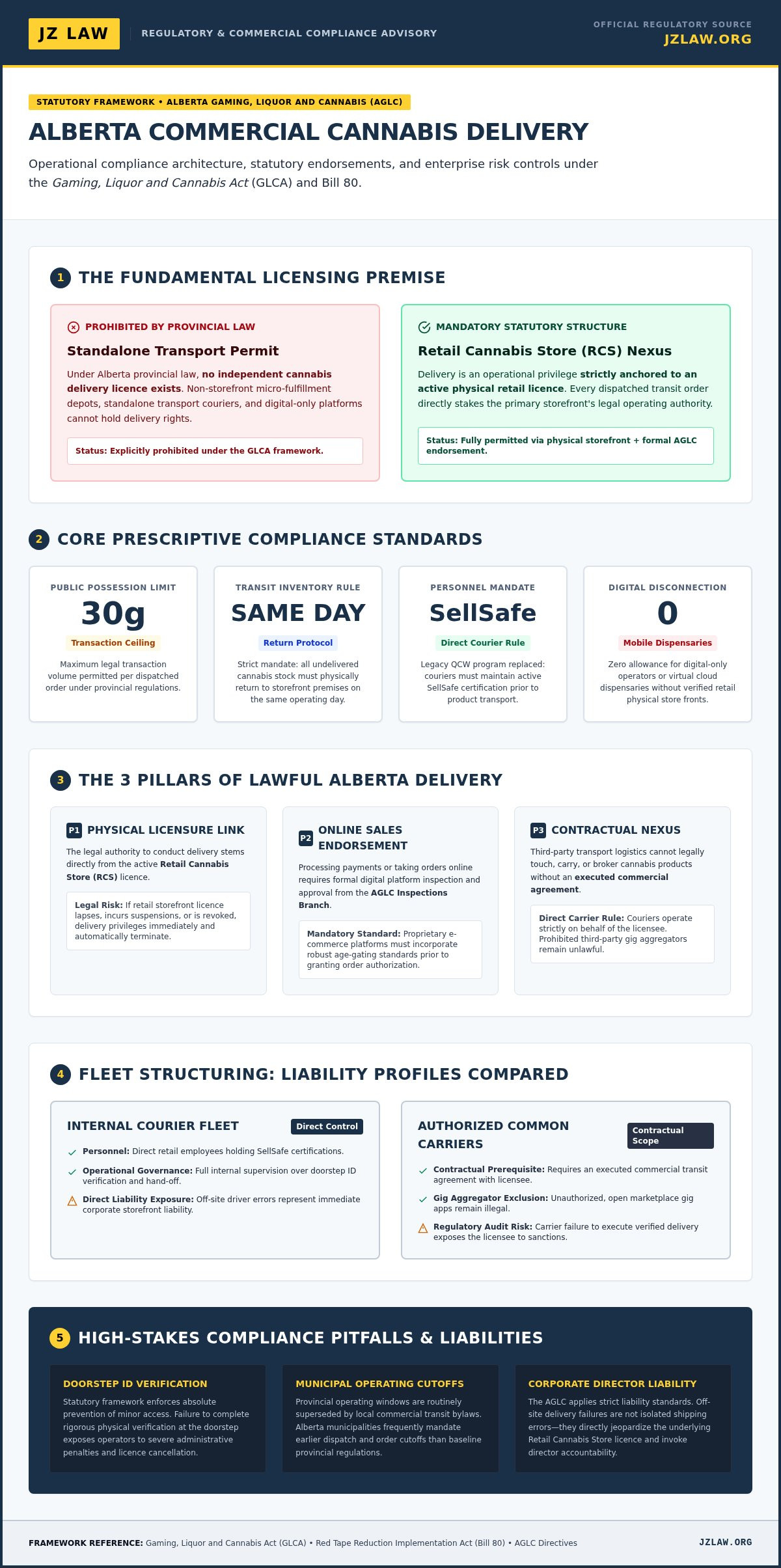
A frequent legal misconception among emerging logistics providers is that Alberta permits standalone transport permits for commercial fulfillment. AGLC does not issue an independent cannabis delivery license in Alberta. Instead, delivery is an operational endorsement tied exclusively to an active, physical Retail Cannabis Store (RCS) licence. Non-storefront micro-fulfillment centers, mobile dispensaries, and digital-only platforms remain explicitly prohibited under the GLCA.
To establish lawful commercial transit, licensees must structure their operations according to clear provincial parameters:
Primary Licensure Dependency: Delivery privileges automatically terminate if the underlying retail storefront licence lapses, incurs a suspension, or faces regulatory revocation.
Mandatory Digital Endorsements: While in-person delivery authorization stems from the RCS licence, processing payments or orders online requires formal platform inspection and an Online Sales Endorsement from the AGLC Inspections Branch.
Contractual Nexus: Third-party logistics providers cannot independently touch, transport, or broker cannabis sales without an executed commercial agreement with an active retail licensee.
Failing to preserve this strict nexus between logistics and licensed premises exposes operators to significant statutory penalties, including licence cancellation and corporate director liability.
Core Statutory Requirements: The Compliance Checklist for Alberta Delivery
Maintaining regulatory standing under a commercial cannabis delivery framework requires adherence to prescriptive operational mandates. The Alberta Gaming, Liquor and Cannabis Act enforces strict liability for non-compliance, meaning administrative sanctions apply regardless of operational intent. Because a delivery endorsement remains permanently anchored to your primary retail status, systemic delivery errors directly jeopardize your physical storefront. Operators must treat internal transport standards as core governance obligations rather than discretionary logistical workflows.
Mandatory Personnel Qualifications and SellSafe Certification
AGLC eliminated the legacy Qualified Cannabis Worker (QCW) registration protocol, streamlining retail onboarding significantly. In its place, direct couriers must complete the mandatory SellSafe Cannabis Staff Training program within 30 days of their start date. Internal drivers must be at least 18 years of age and carry physical or digital proof of their SellSafe credential alongside a valid copy of the Retail Cannabis Store licence during every transit run. Because retail operators face statutory vicarious liability for driver misconduct, establishing internal compliance verification protocols before dispatching delivery personnel remains mandatory.
Secure Vehicle Transit, Chain of Custody, and Manifest Requirements
Product transit demands continuous physical chain-of-custody protocols from storefront departure to customer receipt. Commercial operators must design transit systems around clear provincial limits:
Transaction Caps: Deliveries cannot exceed 30 grams of dried cannabis equivalent per transaction, though couriers may transport multiple orders in aggregate on an authorized run.
Transit Storage: Consignments must be kept in locked, secure storage compartments inside the vehicle, shielded from external visibility.
Same-Day Return Mandate: Deliveries must depart within 30 minutes of store closing. Undelivered product cannot remain in vehicles overnight; drivers must return inventory to the physical premises before closing on that calendar day.
Digital Ordering Platforms and Provincial Data Privacy Standards
Digital ordering interfaces require strict platform hygiene before commercial deployment. Under AGLC Retail Cannabis Store Handbook directives, websites must display the physical store address, retail licence number, and mandatory CannabisSense public education materials. Simple age-attestation checkboxes do not meet regulatory scrutiny; platforms must implement verified digital age verification before customers access transactional checkouts.
Every commercial checkout captures personally identifiable transaction data. Retailers must manage this pipeline in strict compliance with the Alberta Personal Information Protection Act (PIPA), preventing illicit retention, unauthorized third-party marketing integration, or commercial data transfers. Operators structuring omnichannel compliance across Canadian provinces can review our Cannabis Licensing Guide to benchmark their data and retail governance models. For operators scaling physical distribution networks, engaging JZ Law provides clear corporate advisory to insulate valuable retail assets from avoidable compliance investigations.
Delivery Models Compared: In-House Courier Fleets vs. Third-Party Carriers
Selecting a fulfillment structure under an Alberta cannabis delivery license framework requires balancing operational agility against corporate risk. Retail licensees must decide whether to deploy a proprietary fleet or retain commercial logistics partners. While logistics software providers often portray delivery as a simple plug-and-play revenue stream, regulators view the arrangement through a strict lens of licensee responsibility. The corporate structure you choose determines whether operational defaults remain isolated within a vendor entity or jeopardize your primary retail operating authority.
Proprietary In-House Courier Fleets: Operational Control vs. Direct Liability
Directly employing delivery personnel grants comprehensive control over customer brand touchpoints, transit schedules, and inventory tracking. However, direct managerial oversight creates unbroken vicarious liability. If an employed driver fails to verify age or incurs an infraction, provincial enforcement actions land directly on the corporate licensee.
Operating an internal delivery division introduces significant corporate overhead, including:
Commercial Fleet Underwriting: Standard commercial auto policies rarely cover retail cannabis transit, requiring bespoke commercial insurance endorsements.
Direct Regulatory Exposure: The corporate licensee remains immediately answerable to inspectors for roadside documentation lapses, manifest discrepancies, or missing transit logs.
Workers' Compensation Administration: Internal fleets expand operational payroll liabilities under provincial occupational health and safety standards.
Third-Party Delivery Service Contracting: Compliance and Indemnification
Retailers may contract authorized common carriers, such as postal services or independent commercial couriers serving the general public. While third-party gig-economy platforms like Uber Eats or DoorDash remain strictly prohibited under AGLC cannabis retail policies, legitimate common carriers offer an effective mechanism for expanding geographical fulfillment. Crucially, outsourcing physical transit does not automatically absolve the retailer of regulatory exposure under provincial scrutiny.
A standard transport contract is insufficient to insulate a cannabis business. Retaining an independent logistics partner demands tailored commercial agreements containing explicit regulatory covenants. Contracts must legally mandate that courier personnel execute mandatory doorstep ID verifications, maintain physical manifests, and return undelivered consignments before the storefront's daily closing hour. Most importantly, agreements must incorporate comprehensive indemnification clauses that hold the logistics provider financially and legally accountable for damages, fines, or regulatory actions triggered by driver misconduct.
Corporate operators structuring complex logistics agreements should review our insights on Strategic Corporate Transactions to evaluate multi-party operational structures. Aligning logistics contracts with statutory standards prevents operational defaults from compromising your underlying retail cannabis store license.
Critical Compliance Pitfalls: ID Verification, Municipal Bylaws, and Audit Risks
Operating an authorized fulfillment network involves legal exposure that software dashboards can't resolve on their own. While digital compliance begins at online checkout, the most acute vulnerabilities materialize at the customer's doorstep. Alberta Gaming, Liquor and Cannabis routinely deploys mystery-shopper inspections targeting residential hand-offs. For operators leveraging a cannabis delivery license alberta endorsement, a single operational lapse during product transfer can trigger formal administrative proceedings, substantial financial penalties, or immediate licence suspension.
Mandatory Age Verification (18+) and Physical Hand-off Protocols
Provincial directives enforce zero tolerance for age-verification failures. Delivery personnel must physically examine valid, government-issued photo identification for any recipient appearing under 25 years of age, confirming they meet Alberta's statutory minimum age of 18. Packages can't be left unattended on porches, handed to unauthorized third parties, or released to visibly intoxicated individuals. Dispatch systems must also programmatically geofence and reject delivery addresses situated on secondary school properties, daycares, or public spaces where distribution remains strictly unlawful.
Navigating Municipal Delivery Restrictions in Calgary, Edmonton, and Regional Hubs
While AGLC sets a provincial operational ceiling allowing retail activities between 9:00 AM and 2:00 AM, local governments wield independent authority over commercial business practices. Municipalities across Alberta enforce local land-use and business licensing bylaws that frequently mandate earlier commercial closing times, often restricting retail operations and courier departures to 10:00 PM or 11:00 PM in Calgary and Edmonton. Dispatching orders past local operating hours breaches municipal business bylaws, creating an immediate regulatory issue that jeopardizes provincial standing.
Municipal zoning rules also regulate storefront vehicle dispatch areas, curb access, and dedicated retail loading docks. Before launching an on-demand transit fleet, commercial operators must audit their lease agreements against municipal development permits. Aligning your physical facilities with local ordinances using principles from Commercial Real Estate Law ensures logistics infrastructure remains legally insulated.
Provincial regulatory audits routinely compare roadside transit manifests against physical store inventory records in real time. Any divergence between digital fulfillment logs and vault counts invites immediate investigative scrutiny. Documenting airtight standard operating procedures shields your enterprise during targeted provincial reviews. To insulate your retail license against administrative penalties, retain JZ Law for comprehensive regulatory defense.
Securing Your Alberta Cannabis Delivery License: Structured Legal Advisory with JZ Law
Deploying an on-demand fulfillment model demands integrated legal governance that software platforms simply cannot deliver. While technical vendors focus on order management, retail executives require sophisticated legal counsel to coordinate municipal land-use approvals, e-commerce data governance, and provincial operating standards. Establishing your operational framework under the cannabis delivery license alberta regulatory model means anchoring every transport process to an airtight legal foundation. JZ Law provides strategic corporate and regulatory counsel, structured to protect commercial retail assets from enforcement actions and maintain ongoing operational standing.
Comprehensive Application Preparation and AGLC Disclosure Filings
Securing provincial authorizations requires meticulous corporate transparency. Our practice guides retail operators through complex AGLC regulatory filings, ensuring corporate ownership disclosures, officer documentation, and background records satisfy exhaustive provincial scrutiny. We draft audit-proof standard operating procedures covering secure vehicular storage, mandatory customer verification workflows, and strict chain-of-custody tracking. When provincial inquiries arise, we represent operators during formal suitability assessments to resolve administrative inquiries before they escalate into licensing delays.
Commercial Contracting, Courier Risk Mitigation, and Corporate Defense
Protecting the primary retail permit requires robust contractual boundaries between the operating company and its fulfillment personnel. JZ Law drafts specialized third-party logistics agreements equipped with comprehensive indemnification provisions, strict statutory adherence covenants, and explicit breach remedies. For businesses managing in-house fleets, we construct corporate transport policies and fleet governance manuals designed to shield parent organizations from vicarious operational exposure. When regulatory friction occurs, we provide seasoned legal defense against alleged provincial non-compliance, license suspensions, and administrative monetary penalties.
Our regulatory practice works closely with retail operators, corporate fleets, and expanding enterprises seeking durable, compliant growth across Canadian markets. High-growth operators planning institutional capitalization or capital markets listings can explore essential corporate milestones in Taking Your Cannabis Company Public to align their expansion roadmaps with public market expectations.
Proactive legal architecture remains the single most effective defense against regulatory disruption. By addressing corporate exposure, courier liability, and local compliance prior to dispatching your first vehicle, JZ Law helps you deploy a legally insulated, profitable delivery enterprise that endures.
Building a Defensible Commercial Delivery Fleet in Alberta
Commercial delivery offers significant market reach across Alberta, yet sustainable growth demands treating transit as an enterprise risk discipline rather than simple transport logistics. Securing and maintaining the operational endorsement tied to your cannabis delivery license alberta framework requires strict adherence to physical handoff verification, absolute alignment with municipal closing bylaws, and legally defensible courier contracts. Software alone won't insulate your operation when provincial inspectors conduct doorstep audits.
JZ Law brings more than a decade of experience advising commercial operators in high-stakes regulated markets. Through specialized knowledge of AGLC compliance and corporate structuring, we provide proactive risk mitigation designed to protect your physical retail assets from administrative sanctions or regulatory forfeiture. If you're preparing to launch or scale commercial fulfillment, consult JZ Law for strategic cannabis licensing counsel to secure your operations and build long-term commercial value with complete confidence.
Frequently Asked Questions
Can any business in Alberta apply for a cannabis delivery license without a retail store?
No, Alberta does not grant standalone delivery authorizations to independent delivery companies or delivery-only dark warehouses. Operating under a legal cannabis delivery license alberta framework requires holding an active, physical Retail Cannabis Store (RCS) licence issued by AGLC. Delivery remains an operational privilege extended exclusively to licensed brick-and-mortar storefronts, meaning digital sales and fulfillment rights permanently depend on maintaining an active, approved physical retail establishment.
What are the mandatory qualifications for cannabis delivery drivers under AGLC policy?
Direct delivery drivers employed or contracted by a licensee must be at least 18 years of age and hold active SellSafe Cannabis Staff Training certification. AGLC eliminated the legacy Qualified Cannabis Worker registration, allowing staff to complete SellSafe within 30 days of hiring. Drivers must carry their SellSafe verification and a valid physical or digital copy of the retail store licence whenever transporting customer orders.
What is the maximum quantity of cannabis that can be delivered in a single transaction in Alberta?
Alberta law limits single delivery transactions to a maximum of 30 grams of dried cannabis equivalent. While individual customer orders cannot exceed this statutory threshold, commercial couriers may transport multiple fulfilled orders simultaneously in one transit vehicle. Retailers must track each consignment using distinct manifests and customer profiles to maintain compliant documentation during commercial roadside inspections by provincial enforcement officers.
Can cannabis deliveries be completed through third-party platforms like Uber Eats or DoorDash in Alberta?
No, third-party gig-economy delivery apps and external marketplaces are strictly prohibited from listing, brokering, or fulfilling cannabis orders across Alberta. Retail licensees must process all digital purchases and electronic payments through their own proprietary e-commerce storefronts. Physical transport may only be handled directly by internal retail staff or contracted common carriers serving the general public, such as commercial parcel courier networks.
What technical requirements apply to cannabis delivery vehicles operating across Alberta?
Vehicles transporting commercial cannabis must contain secure, locked storage compartments or lockboxes that conceal inventory from external view. Consignments cannot be stored in delivery vehicles overnight. Undelivered packages must return to the primary licensed premises before store closing on the same calendar day. Additionally, delivery runs must depart the storefront during authorized retail hours or within 30 minutes of store closing.
What happens if a delivery driver delivers cannabis to an underage individual in Alberta?
Delivering cannabis to an individual under 18 triggers immediate administrative penalties from AGLC, potentially resulting in substantial corporate fines or retail licence suspension. Because licensees absorb statutory vicarious liability for driver actions, regulatory enforcement targets the physical storefront's operating authority. Regulators enforce zero tolerance, mandating physical verification of government photo identification for anyone who appears under 25 years old at the doorstep.
How do municipal delivery bylaws differ between Calgary, Edmonton, and smaller Alberta municipalities?
Municipal bylaws frequently impose operating conditions that override provincial permissions. While AGLC permits provincial retail fulfillment until 2:00 AM, local bylaws across Calgary and Edmonton often mandate commercial closing and delivery cutoff hours at 10:00 PM or 11:00 PM. Municipalities also enforce specific commercial vehicle licensing rules, zoning requirements for dispatch locations, and distinct curbside loading restrictions that operators must actively reconcile.


Comments