


Crypto Exchange Compliance in Alberta: The 2026 Operator Legal Guide
Registering as a federal money services business is often treated as the finish line, but for digital asset platforms, federal standing addresses only half the equation. Establishing defensible crypto exchange compliance alberta regulators demand requires aligning two separate legal regimes at once. If your platform maintains custody of Canadian client assets, even momentarily, the Alberta Securities Commission views those contractual commitments as securities, pulling your operations directly into provincial jurisdiction alongside your federal obligations.
We recognize that reconciling FINTRAC requirements with provincial Pre-Registration Undertakings and evolving CIRO custody rules creates genuine operational anxiety. The risk of public warning lists, asset freezes, or sudden platform takedowns represents an existential threat to any growing fintech enterprise. This guide delivers a definitive roadmap to establish regulatory alignment, protect your business from enforcement actions, and build institutional-grade credibility. Ahead, you will discover the essential legal mechanisms governing qualified custodians, operational capital reserves, and the strategic advantages of Alberta's regulatory sandbox framework.
Table of Contents
Alberta Crypto Exchange Regulations: The Legal Landscape in 2026
Operating a digital asset trading desk in Western Canada requires moving past common industry misconceptions regarding asset classifications. While many founders assume that handling unbacked digital tokens involves purely personal property or straightforward commodity sales, provincial authorities take a fundamentally different view. The Alberta Securities Commission (ASC) regulates platforms based on practical market mechanisms rather than promotional technical labels. If your business model facilitates digital token transactions without immediate, unencumbered settlement to client-controlled private keys, provincial securities law governs your operations directly.
Under the Alberta Securities Act, achieving sustained crypto exchange compliance alberta operators need demands understanding the legal character of client deposits. When a user deposits fiat or digital tokens onto an exchange, the platform credits the user's ledger account. That ledger balance does not represent immediate title to the underlying tokens on-chain; instead, it establishes an ongoing contractual right against the exchange for future delivery. This contractual right constitutes a security or derivative under Alberta law, placing the entire custodial trading infrastructure under ASC supervision.
The Legal Definition of a Crypto Asset Trading Platform
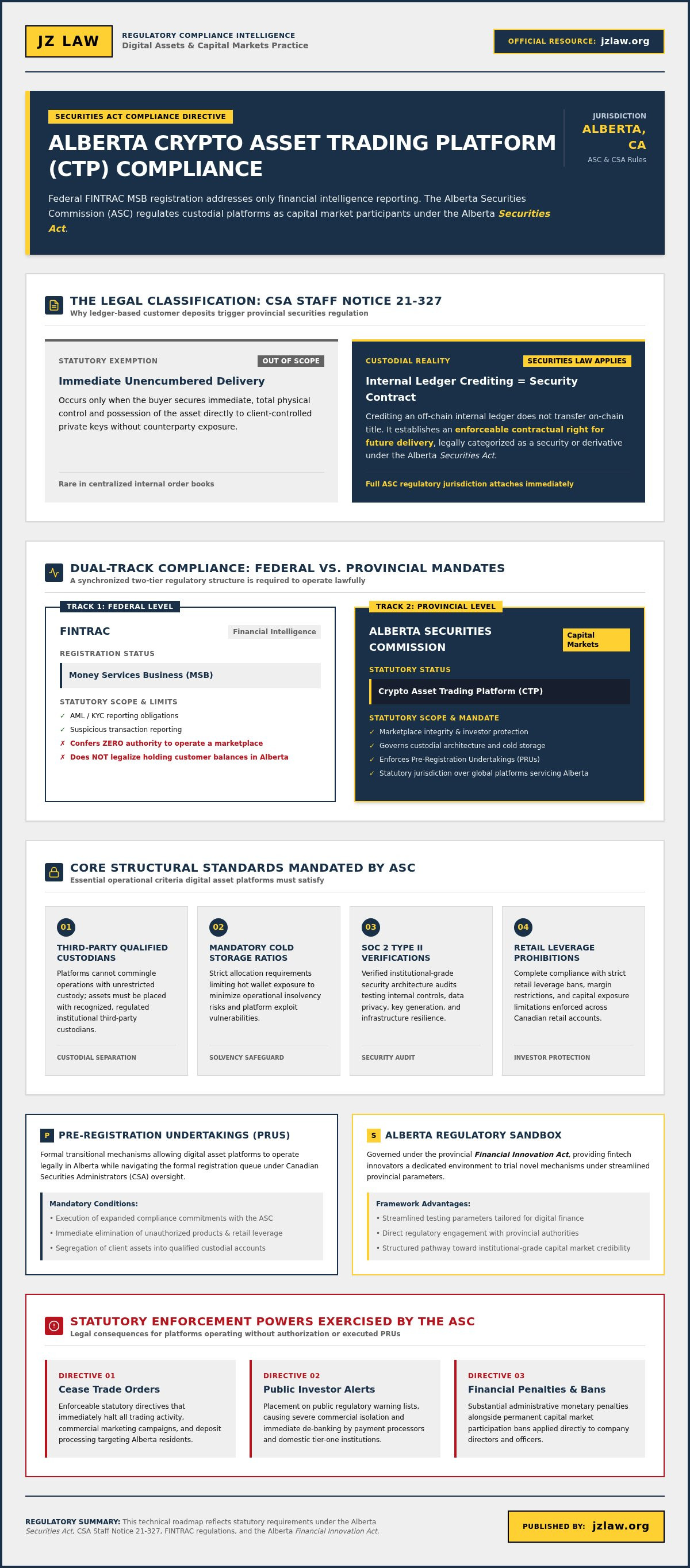
Canadian securities regulators formalised this interpretation through Canadian Securities Administrators (CSA) Staff Notice 21-327, which classifies custodial exchanges as Crypto Asset Trading Platforms (CTPs). An exemption exists only if a transaction produces immediate delivery, meaning the buyer secures total control and possession of the asset immediately, leaving no ongoing counterparty exposure. In modern centralized exchanges featuring internal order matching, off-chain settlement, and pooled hot wallets, instantaneous delivery does not occur. As reflected in broader analyses of the legality of cryptocurrency in Canada, platforms operating this way fall squarely under capital markets rules rather than basic retail commerce frameworks.
The Role of the Alberta Securities Commission (ASC)
The ASC holds a clear statutory mandate: foster fair, efficient capital markets while safeguarding retail investors from insolvency risks, operational fraud, and market manipulation. Operating without proper authorization triggers aggressive enforcement measures under provincial authority. The commission exercises extensive administrative powers to protect the market, routinely deploying several legal tools:
Cease Trade Orders: Enforceable statutory directives immediately halting all trading activities, commercial marketing, and deposit processing directed at Alberta residents.
Public Investor Alerts: Inclusion on published warning directories, which systematically isolates businesses from tier-one payment processors and domestic banking partners.
Financial Penalties and Market Bans: Substantial administrative monetary penalties alongside permanent bans that prohibit directors and officers from accessing Alberta capital markets.
ASC oversight extends globally. International platforms that service Alberta retail accounts without an approved registration or an executed Pre-Registration Undertaking (PRU) routinely face jurisdictional enforcement. To achieve durable crypto exchange compliance alberta entities must deliberately align their custody architecture, user onboarding workflows, and internal risk controls with statutory requirements from their initial day of operations.
Dual-Track Compliance: ASC Securities Mandates vs. FINTRAC AML Rules
One of the costliest assumptions a platform founder can make is equating federal registration with provincial authorization. Securing status as a federal Money Services Business (MSB) satisfies financial intelligence reporting requirements, but it confers zero legal authority to operate a digital marketplace or hold investor balances in Alberta. A sound framework for crypto exchange compliance alberta operators must deploy demands running a synchronized dual-track strategy. This structure separates federal anti-money laundering controls from provincial investor protection and market integrity mandates.
Provincial regulators and federal agencies police completely different institutional risks under separate statutes:
Federal Track (FINTRAC): Administers the Proceeds of Crime (Money Laundering) and Terrorist Financing Act (PCMLTFA), focusing entirely on transaction transparency, tracing financial flows, and detecting illicit capital.
Provincial Track (ASC & CIRO): Administers the Alberta Securities Act and national instruments, focusing on counterparty solvency, custodial segregation, fair market pricing, and investor protection.
Operating solely under an MSB registration while matching client orders creates an immediate enforcement target for the ASC. Platforms must run these operational pipelines side by side without allowing gaps between them.
Federal Anti-Money Laundering (AML) and MSB Registration
Virtual currency dealers operating in Alberta must maintain active MSB registration with the Financial Transactions and Reports Analysis Centre of Canada (FINTRAC). Under the PCMLTFA, platforms must establish an operational compliance program managed by an appointed compliance officer. This mandates robust Know-Your-Customer (KYC) onboarding protocols, explicit record-keeping systems, and automated monitoring capable of detecting structured deposits. Platforms must systematically submit Suspicious Transaction Reports (STRs) and strictly enforce the statutory 24-hour rule for any digital currency transfers exceeding C$10,000.
Provincial Securities Oversight Under Canadian Securities Administrators
Provincial securities oversight operates under CSA Staff Notice 21-329, which details regulatory expectations for platforms facilitating trades in crypto contracts. In Alberta, the ASC and the Canadian Investment Regulatory Organization (CIRO) coordinate oversight of trading systems and order-matching engines. Retail end-user agreements must accurately articulate these legal mechanics, documenting that the user holds a contractual entitlement against the platform rather than direct possession of unencumbered on-chain assets. Navigating this overlap requires precision; founders often retain experienced cryptocurrency law counsel in Calgary to harmonize corporate governance with these simultaneous oversight tracks.
Federal and provincial authorities maintain active information-sharing conduits. FINTRAC filings, bank notifications, and ASC inquiries regularly cross-reference one another. Achieving lasting crypto exchange compliance alberta ventures require depends on treating both tracks not as alternating phases, but as interconnected pillars of a single operational architecture.
Custody, Capital, and Pre-Registration Undertakings (PRUs)
Achieving sustained crypto exchange compliance alberta authorities mandate requires navigating the Pre-Registration Undertaking (PRU) framework. Far from being a routine administrative filing, a PRU is an enforceable, publicly disclosed legal pact executed with the ASC and CSA. This mechanism allows a platform to continue operating in Alberta while its formal investment dealer application and Canadian Investment Regulatory Organization (CIRO) membership undergo exhaustive assessment. Failing to execute a PRU while holding user deposits places an exchange in immediate breach of provincial capital market rules.
Pre-Registration Undertakings (PRUs) Explained
A PRU imposes rigorous operational boundaries designed to eliminate insolvency exposure and protect retail capital. Platforms operating under an undertaking must commit to clear market restrictions:
Leverage and Margin Prohibitions: Exchanges cannot extend margin, credit, or leveraged derivative contracts to Canadian retail market participants under any circumstance.
Asset Listing Restrictions: Platforms must exclude proprietary exchange tokens and unapproved value-referenced crypto assets, ensuring retail clients cannot trade algorithmic stablecoins lacking audited reserve structures.
Executive Accountability: Senior leadership and designated compliance officers must sign undertakings personally, creating direct liability for procedural non-compliance or reporting failures.
Custody and Asset Segregation Requirements
Custody architecture forms the core focus of current ASC and CIRO regulatory reviews. Platforms can no longer rely on unverified internal wallets or commingled operational omnibus structures. Under 2026 standards, digital asset platforms must deposit client holdings with an accredited, third-party Qualified Custodian. This infrastructure must satisfy several technical and financial conditions:
System and Organization Controls: Custodians must present verified SOC 2 Type II audit certifications covering key-generation protocols, multisig transaction authorizations, and server environments.
Cold Storage Mandates: The vast majority of digital assets must remain in segregated, offline cold storage vaults protected by institutional-grade insurance tiers against theft, breach, or internal collusion.
Bankruptcy-Remote Structuring: Client assets must sit within explicit custodial trust accounts. These contractual vehicles ensure client balances cannot be liquidated to satisfy general platform debts if corporate insolvency occurs.
Complementing these custodial protocols, operators must maintain minimum regulatory capital buffers held in segregated accounts at approved Canadian financial institutions. These reserves ensure continuous operations during periods of extreme market volatility without jeopardizing client access to their funds.
Five-Step Compliance Roadmap for Launching a Crypto Platform in Alberta
Transitioning from an architectural concept to an active trading marketplace requires a disciplined, sequential execution model. Regulators scrutinize not just your code, but your operational maturity and corporate leadership. Establishing full crypto exchange compliance alberta authorities recognize requires executing five distinct legal and operational stages.
Corporate Structuring and Governance in Calgary
Your launch begins with entity formation under the Alberta Business Corporations Act or registering an extra-provincial corporation in the province. Regulators examine corporate leadership closely. Platform directors and designated officers must satisfy rigorous "fit and proper" standards, proving both sector competence and clean regulatory backgrounds. Your internal governance documents must clearly define reporting lines, risk management matrices, and enforceable conflict-of-interest policies that segregate proprietary operations from client services.
Following entity formation, operators must execute four additional milestones:
Phase 2: AML and Sanctions Program Implementation: Appoint an experienced Canadian compliance officer, draft tailored PCMLTFA policies, register with FINTRAC, and configure automated screening tools for politically exposed persons (PEPs) and sanctioned addresses.
Phase 3: Custody Integration and Banking Relationships: Contract with a SOC 2 Type II qualified custodian to establish segregated storage vaults, and secure escrow accounts with domestic financial institutions to handle fiat clearance.
Phase 4: Regulatory Submissions and Undertakings: Finalize platform rulebooks, draft client disclosures, and formally file your documentation with the Alberta Securities Commission to secure an interim Pre-Registration Undertaking.
Phase 5: Ongoing Audit and Statutory Reporting: Implement permanent trade surveillance software, prepare for annual third-party financial audits, and align data pipelines with the CRA's Crypto-Asset Reporting Framework (CARF).
Regulatory Submission and Operational Onboarding
The regulatory filing represents the focal point of the onboarding process. Platforms must draft plain-language risk disclosure forms and client acknowledgement agreements before processing retail accounts. Your matching engine must enforce CSA investor caps, limiting non-accredited retail users to prescribed annual net purchase limits for unexempted tokens. Every policy must prove that client orders resolve without internal market manipulation.
Executing this multi-stage sequence prevents procedural delays and shields founders from personal enforcement liabilities. If you are preparing to deploy a trading platform or OTC desk, contact JZ Law for specialized securities regulation counsel in Calgary to structure your corporate governance, engage the ASC, and protect your digital enterprise.
Mitigating Enforcement Risks and Partnering with Specialized Counsel
Operating a digital asset trading system without explicit provincial authorization exposes leadership to severe administrative action. The Alberta Securities Commission aggressively targets unregistered activity through coordinated statutory mechanisms. Once formal enforcement commences, retroactive remediation becomes exceedingly difficult, making proactive defense the only viable path to long-term commercial survival.
Enforcement Realities in Alberta's Capital Markets
The ASC uses sweeping statutory authority under the Securities Act to protect local capital markets. Platforms serving Alberta accounts without an executed Pre-Registration Undertaking face immediate operational disruptions that routinely cripple ongoing commerce:
Interim and Permanent Cease Trade Orders: Statutory rulings that legally freeze Canadian financial rails, ban marketing distribution, and order immediate cessation of platform services.
Financial Administrative Penalties: Substantial financial sanctions levied against both corporate entities and individual executives found to have authorized unexempted trading in securities contracts.
Reputational Blacklisting: Placement on public investor warning rosters, triggering automated de-risking by domestic schedule I banks, international payment processors, and liquidity providers.
Personal Executive Liability: Piercing of corporate protections where directors and officers knowingly participated in non-compliant offerings, leading to personal director bans across Canadian capital markets.
Cross-border platforms frequently misjudge their jurisdictional footprint. Serving a single retail investor in Calgary or Edmonton establishes territorial nexus under Alberta law, regardless of where offshore matching servers reside.
Strategic Regulatory Counsel with JZ Law
Achieving durable crypto exchange compliance alberta regulators respect requires specialized legal architecture designed prior to onboarding domestic volume. JZ Law, led by principal John Zang, provides sophisticated counsel across corporate transactions, securities regulation, and emerging digital asset frameworks. Working with specialized legal counsel provides critical institutional protections:
Jurisdictional and Product Audits: Conducting rigorous legal characterization of listed tokens, staking mechanisms, and liquidity pools to ensure operational designs avoid triggering unexempted derivatives rules.
Corporate Structuring: Establishing robust corporate structures under Alberta legislation, isolating custodial risk, and insulating founding teams from personal exposure.
Institutional Capital Alignment: Structuring internal governance, private placement memorandums, and compliance controls to prepare your enterprise for future corporate transactions, institutional capital raises, or taking companies public.
Proactive ASC Engagement: Negotiating formal Pre-Registration Undertakings and facilitating communications with Canadian Securities Administrators.
If your enterprise plans to operate or expand digital asset services within the province, schedule a confidential consultation with JZ Law for regulatory counsel tailored to your commercial objectives.
Building an Enduring Digital Asset Enterprise in Alberta
Achieving institutional resilience requires moving beyond provisional operational measures. Sustainable crypto exchange compliance alberta regulators mandate rests on synchronizing federal FINTRAC reporting with Alberta Securities Commission Pre-Registration Undertakings. By integrating certified qualified custody, establishing bankruptcy-remote asset segregation, and eliminating unauthorized retail leverage, platforms safeguard client capital while removing existential shutdown risks.
JZ Law delivers strategic representation for digital asset ventures across Calgary and major international hubs. Led by principal lawyer John Zang, our boutique legal practice offers specialized counsel in securities regulation and corporate structuring, translating complex administrative mandates into concrete commercial advantages. When you establish rigorous legal foundations early, regulatory scrutiny transforms from an operational liability into your strongest competitive asset. Schedule a regulatory compliance consultation with JZ Law to position your platform for lasting market leadership.
Frequently Asked Questions
Can a crypto exchange operate in Alberta with only a FINTRAC MSB registration?
No, an MSB registration alone does not permit exchange operations. Federal registration under FINTRAC satisfies financial intelligence reporting requirements, but provincial capital market rules govern client custody and order matching. To achieve full crypto exchange compliance alberta operators must secure formal registration with the Alberta Securities Commission or execute a binding Pre-Registration Undertaking. Platforms operating solely with an MSB registration face swift regulatory shutdowns.
What triggers Alberta Securities Commission jurisdiction over a digital asset trading platform?
Jurisdiction is triggered whenever a platform retains custody of client deposits or controls the private keys to their digital assets. Under Alberta securities law, this custody arrangement creates a contractual entitlement rather than direct physical delivery of property. This ongoing contractual obligation is legally categorized as a security or derivative contract, pulling the exchange directly under the statutory supervision of the ASC.
What is a Pre-Registration Undertaking (PRU) for Canadian crypto exchanges?
A PRU is an interim, publicly disclosed agreement entered into with provincial regulators such as the ASC. It allows platforms to operate legally in Canada while their full investment dealer registrations undergo formal review. Platforms entering into a PRU must agree to strict operational restrictions, including segregating user assets with qualified custodians and halting leveraged retail derivative trading.
Are international crypto platforms legally permitted to serve residents living in Alberta?
Foreign platforms cannot service Alberta residents unless they have registered with Canadian regulators or executed an active PRU. The physical location of matching servers abroad does not insulate foreign entities. If an offshore exchange markets to or onboards Alberta accounts, the ASC asserts territorial jurisdiction over those transactions, routinely issuing extraterritorial cease trade orders against non-compliant operators.
What happens if an unregistered crypto exchange continues operating in Alberta?
The ASC uses sweeping administrative enforcement powers against unauthorized entities. Consequences include immediate cease trade orders, substantial monetary fines, and mandatory blacklisting on provincial investor warning rosters. This public listing leads Canadian schedule I banks to freeze operational funds. Additionally, company directors face personal liability and long-term prohibitions against serving as officers or accessing public capital markets.
How are stablecoins and yield-generating crypto products regulated under Alberta law?
Regulators categorize stablecoins as value-referenced crypto assets, requiring explicit CSA authorization before domestic platforms can list them. Platforms must verify that issuers maintain segregated, fully audited fiat cash reserves. Staking services and yield products fall under strict scrutiny; they often qualify as investment contracts, requiring detailed risk disclosures and formal regulatory exemptions before retail distribution.
Can crypto exchange operators offer margin trading or derivatives to retail Albertans?
No, current regulatory directives explicitly prohibit platforms from extending margin, leverage, or unauthorized crypto derivatives to retail investors in Alberta. Platforms bound by standard Canadian undertakings must eliminate leveraged retail products completely. Any margin facilities or leveraged contracts offered without institutional dealer registration place the entity in breach of provincial crypto exchange compliance alberta rules.


Comments