


Commercial Debt Recovery Strategies in Alberta: A 2026 Legal Guide
Is your outstanding B2B debt an unfortunate cost of doing business, or is it a recoverable asset being shielded by sophisticated restructuring? In a climate where the Alberta Court of Justice handles claims up to $100,000, the line between a total loss and a successful recovery often depends on precision rather than just persistence. Implementing effective commercial debt recovery strategies alberta requires more than just sending standard demand letters; it demands a clinical understanding of the 2026 regulatory environment and the current 2.69% prejudgment interest rate.
It's frustrating to watch cash flow stall while a debtor hides behind corporate maneuvers, especially when you're worried about throwing good money after bad legal fees. You've worked hard to build your enterprise, and you deserve a recovery process that protects your corporate reputation while aggressively pursuing what's owed. This guide provides a clear roadmap to mastering the legal frameworks required to secure your interests and successfully enforce judgments. We'll examine the strict two-year limitation period, pre-litigation maneuvers to minimize friction, and the specific strategic advantages of Alberta's updated enforcement laws.
Table of Contents
Navigating the Commercial Debt Landscape in Alberta’s 2026 Economy
The economic environment in Calgary and Edmonton throughout 2026 has been defined by a dual-track reality: robust growth in energy exports paired with tightening credit conditions in the real estate sector. For enterprises operating in these hubs, unpaid invoices are no longer just accounting nuisances; they represent significant threats to liquidity. Effective commercial debt recovery strategies alberta must account for this volatility. Unlike consumer collections, which are primarily concerned with personal privacy and harassment laws, B2B recovery involves navigating complex corporate structures where debtors often have the resources to delay payment through strategic restructuring.
While the Consumer Protection Act primarily shields individuals, its regulations regarding collection agencies still dictate the boundaries of professional conduct in commercial disputes. Creditors must identify red flags early, particularly in the energy sector where sudden shifts in project financing can lead to stalled payments. If a debtor begins requesting unusual extensions or undergoes a quiet management overhaul, it's often a signal that assets are being repositioned. Recognizing these patterns allows for a pro-active legal stance before the debtor becomes insolvent.
Industry-Specific Challenges: Oil, Gas, and Emerging Tech
Securing payment in the energy sector requires a nuanced approach to oil and gas law, specifically regarding how lien rights attach to specific projects. In 2026, we also see an increase in disputes within the cryptocurrency and blockchain space. These digital assets require specialized recovery techniques that differ from traditional industrial supply chain defaults. When a default occurs, creditors must move quickly to leverage the Civil Enforcement Act to secure property before it's liquidated or moved out of jurisdiction. Strategic counsel ensures that your enforcement actions are both legally sound and tailored to the specific asset class involved.
The Statute of Limitations in Alberta
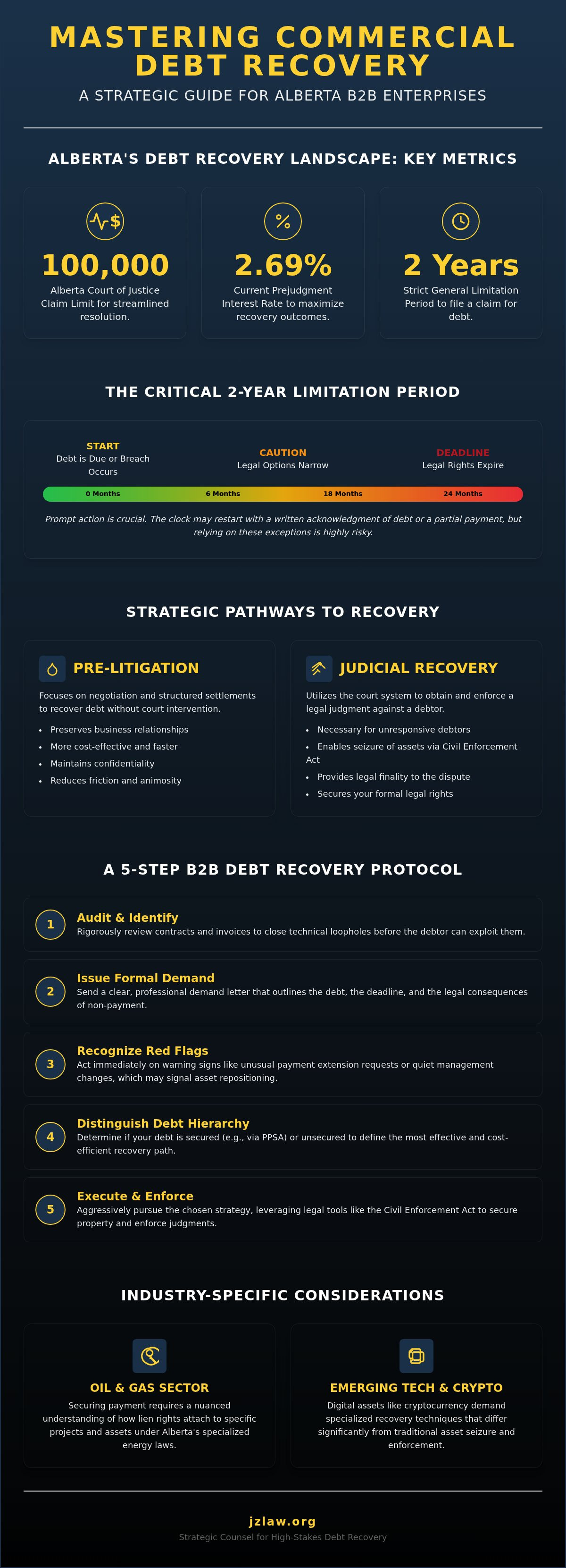
Time is the greatest enemy of recovery. Alberta maintains a strict two-year general limitation period for debt claims. This clock begins ticking from the moment the debt was first due or when the breach occurred. It's possible to restart this period if the debtor provides a written acknowledgment of the debt or makes a partial payment. However, relying on these exceptions is risky. Early intervention remains the most reliable factor for success. Waiting until the eighteen-month mark to seek counsel often leaves too little room for the pre-litigation maneuvers that could have settled the matter without a courtroom. Prompt action preserves your rights and increases the likelihood of a full recovery.
Legal Frameworks and Creditor Rights Under Alberta Law
Under the Collection and Debt Repayment Practices Regulation, a commercial creditor is defined by the nature of the transaction. Specifically, it involves debt arising from business-to-business activities rather than personal, family, or household credit. Understanding this distinction is foundational for developing the commercial debt recovery strategies alberta businesses need to protect their liquidity. The hierarchy of debt in Alberta places secured creditors at the forefront, typically through registrations under the Personal Property Security Act (PPSA). This act allows your business to claim a security interest in a debtor's equipment, inventory, or accounts receivable, providing a significant advantage during insolvency or restructuring. These legislative tools are central to the most effective commercial debt recovery strategies alberta law firms employ for corporate clients.
For claims totaling up to $100,000, the Alberta Court of Justice provides a streamlined venue. This limit, which was increased in 2023, allows for faster resolution than the Court of King’s Bench for many medium-sized commercial disputes. Navigating Alberta's Civil Enforcement Process requires a precise understanding of these jurisdictional boundaries to ensure that enforcement is both legal and effective. Misjudging the court's jurisdiction can lead to unnecessary delays and increased costs, which is why a structured approach to filing is essential.
Pre-Judgment Remedies: Securing Assets Early
Waiting for a final judgment can sometimes mean waiting until the debtor’s accounts are empty. Pre-judgment garnishment orders allow a creditor to freeze funds held by third parties, such as the debtor's bank, before the case is even heard. Similarly, an attachment order can be obtained if there is a reasonable risk that the debtor will dissipate or hide assets to avoid payment. Pre-judgment attachment serves as a critical tool for high-stakes corporate protection in volatile markets. If you're concerned about asset flight, consulting with a strategic legal partner can help you secure these remedies before the debtor's financial position deteriorates further.
Regulatory Compliance for Corporate Creditors
Even in B2B recovery, demand letters must adhere to specific legal standards to avoid claims of professional misconduct or potential liability. When debt recovery intersects with securities regulation, the complexity increases, particularly for companies in the cannabis or tech sectors where public disclosure requirements are stringent. Creditors must also manage FINTRAC and Anti-Money Laundering (AML) considerations when dealing with large-scale commercial payments to ensure the source of funds is legitimate. Maintaining compliance isn't just about following the law; it's about protecting your corporate reputation throughout the recovery process. This disciplined approach ensures that your pursuit of outstanding debt doesn't create new regulatory risks for your own organization.
Strategic Pre-Litigation vs. Judicial Recovery Methods
Choosing the correct path for recovery requires a clinical evaluation of the return on investment. While some creditors reflexively move toward litigation, the most effective commercial debt recovery strategies alberta businesses employ often begin with sophisticated pre-litigation maneuvers. A standard collection agency typically relies on volume-based persistence, which can be insufficient for complex B2B disputes where the debtor is a sophisticated entity. In contrast, a specialized law firm uses asset searches and skip tracing to qualify a debtor's ability to pay before any legal costs are incurred. This ensures you aren't wasting resources pursuing a shell company with no seizable assets.
The "Demand Letter Plus" strategy serves as a bridge between negotiation and litigation. It involves a formal legal demand that is accompanied by a draft Statement of Claim, signaling that your organization is prepared for immediate judicial action. This approach often forces a debtor to the negotiating table, as it demonstrates that the cost of defense will likely exceed the cost of settlement. By combining legal pressure with corporate negotiation, you preserve the possibility of a structured resolution while maintaining a position of strength.
The Art of the Structured Settlement
A successful settlement isn't just about the dollar amount; it's about enforceability. We focus on drafting agreements that include confession of judgment clauses, which allow a creditor to enter a judgment immediately if the debtor misses a single payment. By integrating tax structuring into these agreements, your firm can better manage the impact of bad debt write-offs and potentially recover value through strategic offsets. Securing these future payments with corporate guarantees or additional collateral ensures that the settlement is more than just a promise; it's a secured obligation that provides a clear path to enforcement if the debtor defaults again.
Litigation as a Tactical Tool
When negotiations fail, filing a Statement of Claim in Alberta’s Court of King’s Bench becomes a necessary tactical move, particularly for debts exceeding the $100,000 threshold or those involving complex corporate hierarchies. For clear-cut cases of non-payment, the summary judgment process offers a way to fast-track the recovery without a full trial. This procedure is designed for instances where there's no genuine defense, allowing the court to grant a judgment based on affidavit evidence. Throughout this process, the discovery phase remains a powerful tool for uncovering hidden corporate assets and identifying third parties who may be liable for the debt, ensuring that your commercial debt recovery strategies alberta are backed by the full weight of the judicial system.
A Step-by-Step Protocol for B2B Debt Recovery in Alberta
A disciplined protocol ensures that your organization maintains the upper hand when deploying commercial debt recovery strategies alberta. Systematic recovery isn't just about demanding payment; it's about building a legal record that makes resistance futile for the debtor. This process requires meticulous attention to detail at every stage to prevent technicalities from stalling your progress. When an account becomes delinquent, following a standardized roadmap minimizes the risk of asset dissipation and maximizes the likelihood of a full return.
Step 1: Comprehensive Audit: Examine all contracts, invoices, and correspondence to confirm the debt's validity and identify any clauses related to interest or legal costs.
Step 2: Formal Legal Demand: Issue a demand for payment that carries the weight of legal counsel, clearly stating the deadline and the intent to pursue judicial remedies.
Step 3: Initiating Proceedings: File a Statement of Claim and, if necessary, seek pre-judgment motions to secure assets while the case progresses.
Step 4: Entering Court Judgment: Once the court grants an order, it must be formally entered and registered to become an enforceable Writ of Enforcement.
Step 5: Execution: Engage a civil enforcement agency to act on the writ through seizures, garnishments, or other authorized recovery actions.
Advanced Enforcement Techniques
Once a judgment is secured, the focus shifts to aggressive enforcement. B2B garnishment allows you to intercept funds from the debtor’s bank accounts or their own outstanding accounts receivable. If the debtor holds significant property, registering writs of enforcement against their commercial real estate creates a lien that prevents any sale or refinancing without first addressing your claim. For debtors who remain non-compliant, a civil enforcement bailiff can be instructed to seize and sell corporate equipment, vehicles, or inventory to satisfy the debt. These tools are the most potent components of effective commercial debt recovery strategies alberta professionals use to resolve high-value defaults.
Piercing the Corporate Veil
In cases where a business has been hollowed out to avoid creditors, we explore the possibility of holding individual directors personally liable. This is particularly relevant when dealing with fraudulent preferences, where a debtor pays "friendly" creditors or shareholders while ignoring legitimate business obligations. Director liability in Alberta commercial law is typically established when the corporate structure is used as a shield for fraudulent activities or when directors prioritize their own interests over the company's solvency during a period of financial distress. Identifying these transfers early allows for legal challenges that can reverse the dissipation of assets. If you suspect a debtor is hiding behind a shell entity, consult our strategic legal team to implement these advanced recovery protocols today.
JZ Law: Strategic Counsel for High-Stakes Debt Recovery
John Zang views debt recovery as an extension of a firm’s broader corporate health rather than an isolated administrative task. By integrating commercial debt recovery strategies alberta into the overall business plan, JZ Law ensures that every action taken to recover funds also serves to strengthen the client's market position. This strategic alignment is essential for enterprises in the cannabis, energy, and cryptocurrency sectors, where the intersection of regulatory compliance and financial recovery requires a sophisticated legal touch. We don't just chase payments; we manage corporate risk.
High-value B2B disputes often stem from unresolved corporate transactions where complex unpaid obligations threaten to derail future growth. John Zang’s experience in securities regulation and oil and gas law provides a unique advantage when identifying the assets of a sophisticated debtor. Whether the issue involves a default on a supply chain contract or a failure to honor a crypto-asset transfer, the most effective commercial debt recovery strategies alberta law firms provide must account for the specific regulatory environment of the debtor's industry. Our approach remains focused on precision and the preservation of your professional standing.
A Boutique Approach to Corporate Conflict
JZ Law operates as a boutique practice, meaning clients receive the direct attention of John Zang himself. You won't be passed off to junior associates who lack the context of your business goals. Our focus remains on achieving results through calculated pressure and expert negotiation, often resolving matters without the need for prolonged courtroom drama. It's about efficiency and results. If you're managing a complex commercial debt portfolio, contact JZ Law for a consultation that prioritizes strategic resolution over unnecessary litigation.
Global Reach with Alberta Roots
While our roots are firmly planted in Alberta’s industrial and energy hubs, our reach extends across Calgary, Toronto, Vancouver, and major international business centers. We navigate the jurisdictional challenges of cross-border debt recovery with a modern, tech-forward mindset that reflects the 2026 economic reality. This global perspective allows us to track assets across borders and enforce judgments wherever your debtor attempts to hide. Schedule a strategic consultation with JZ Law to secure your outstanding B2B interests and protect your firm's liquidity.
Securing Your Corporate Liquidity Through Strategic Recovery
The 2026 economic landscape in Alberta demands a shift from reactive collections to proactive asset preservation. Recovering high-value B2B debt requires a clinical understanding of the provincial regulatory environment and a willingness to deploy advanced enforcement protocols before assets are dissipated. By prioritizing early intervention and utilizing the full range of judicial remedies, your organization can effectively mitigate the impact of non-payment on your cash flow. Implementing the right commercial debt recovery strategies alberta isn't just about closing an invoice; it's about protecting the long-term viability of your enterprise.
Success in these complex matters often hinges on precision and a deep familiarity with Alberta's specific corporate statutes. JZ Law provides principal-led legal counsel that integrates recovery into your broader corporate strategy, ensuring your reputation remains intact while your interests are secured. If your current recovery efforts have stalled, it's time to elevate your approach. Consult with JZ Law on your Alberta debt recovery strategy to leverage our expertise in B2B corporate law and the provincial regulatory landscape. You don't have to navigate these jurisdictional challenges alone. Your path to successful recovery starts with a clear, professional plan.
Frequently Asked Questions
How long does the commercial debt recovery process take in Alberta?
The timeline for recovery varies significantly based on the debtor’s cooperation and the chosen legal path. A successful pre-litigation settlement might be reached in as little as thirty days through a formal demand. However, if the matter proceeds to the Alberta Court of Justice or the Court of King’s Bench, the process can take six to eighteen months. Factors like court availability and the complexity of the debtor’s corporate structure will influence the final duration.
What is the minimum debt amount that justifies hiring a lawyer in Alberta?
While there isn't a statutory minimum, hiring a lawyer is typically most cost-effective for debts exceeding $10,000. For amounts below this threshold, the legal fees may consume a disproportionate share of the recovered funds. However, if the debt involves a recurring contract or a strategic business interest, the value of professional counsel often outweighs the immediate cost. We recommend evaluating the debtor's seizable assets before committing to an extensive legal campaign.
Can I recover legal fees and interest on unpaid commercial invoices?
You can recover interest and a portion of your legal fees if your contract contains specific indemnity and interest clauses. In the absence of a written agreement, the Judgment Interest Act allows for a 2.69% prejudgment interest rate for 2026. Courts often award "costs" to the winning party, though these are calculated based on a fixed schedule and rarely cover the full extent of your actual legal expenditures unless the contract specifies otherwise.
What happens if a debtor files for bankruptcy during the recovery process?
A bankruptcy filing triggers an automatic stay of proceedings, which immediately halts all active collection and legal actions against the debtor. You'll need to file a Proof of Claim with the bankruptcy trustee to participate in any eventual distribution of assets. Your priority for payment depends on whether you're a secured creditor under the PPSA. Unsecured creditors often receive only a small percentage of the total debt once secured interests and administrative costs are settled.
How do I find out if a debtor in Calgary has assets worth pursuing?
Identifying seizable assets involves conducting thorough searches of the Personal Property Security Registry and the Alberta Land Titles Office. These records reveal if the debtor owns real estate, vehicles, or industrial equipment that isn't already encumbered by other liens. This due diligence is a vital component of the commercial debt recovery strategies alberta firms use to ensure their clients aren't wasting resources on "judgment proof" debtors who have no reachable equity.
Is a verbal agreement for a business loan enforceable in Alberta courts?
Verbal agreements are legally enforceable in Alberta, but they're notoriously difficult to prove without supporting evidence. To succeed in court, you'll need to provide corroborating documentation such as bank statements showing the transfer of funds, email threads discussing repayment, or witness testimony. Without a written contract, the debtor may dispute the terms or the existence of the loan, making the recovery process significantly more complex and reliant on the credibility of the parties involved.
What is the difference between a collection agency and a law firm for B2B debt?
The difference lies in the scope of authority and the strategic tools available for enforcement. Collection agencies rely on persistence and credit reporting, whereas a law firm can initiate litigation and obtain court orders for seizure and sale. For high-stakes disputes, the commercial debt recovery strategies alberta lawyers provide offer a level of legal weight that agencies cannot match. Law firms are also better equipped to handle complex corporate maneuvers like fraudulent asset transfers.
Can I garnish a debtor’s bank account before I have a court judgment?
You can garnish a bank account before a judgment by obtaining a pre-judgment attachment order from the court. This is considered an extraordinary remedy, so you must prove there's a high probability of success and a genuine risk that the debtor will hide or dissipate their funds before the trial concludes. If granted, the bank will freeze the disputed amount, ensuring that the funds remain available to satisfy a future judgment once the litigation is resolved.


Comments