


Common AGLC Application Mistakes: A 2026 Guide for Calgary and Global Operators
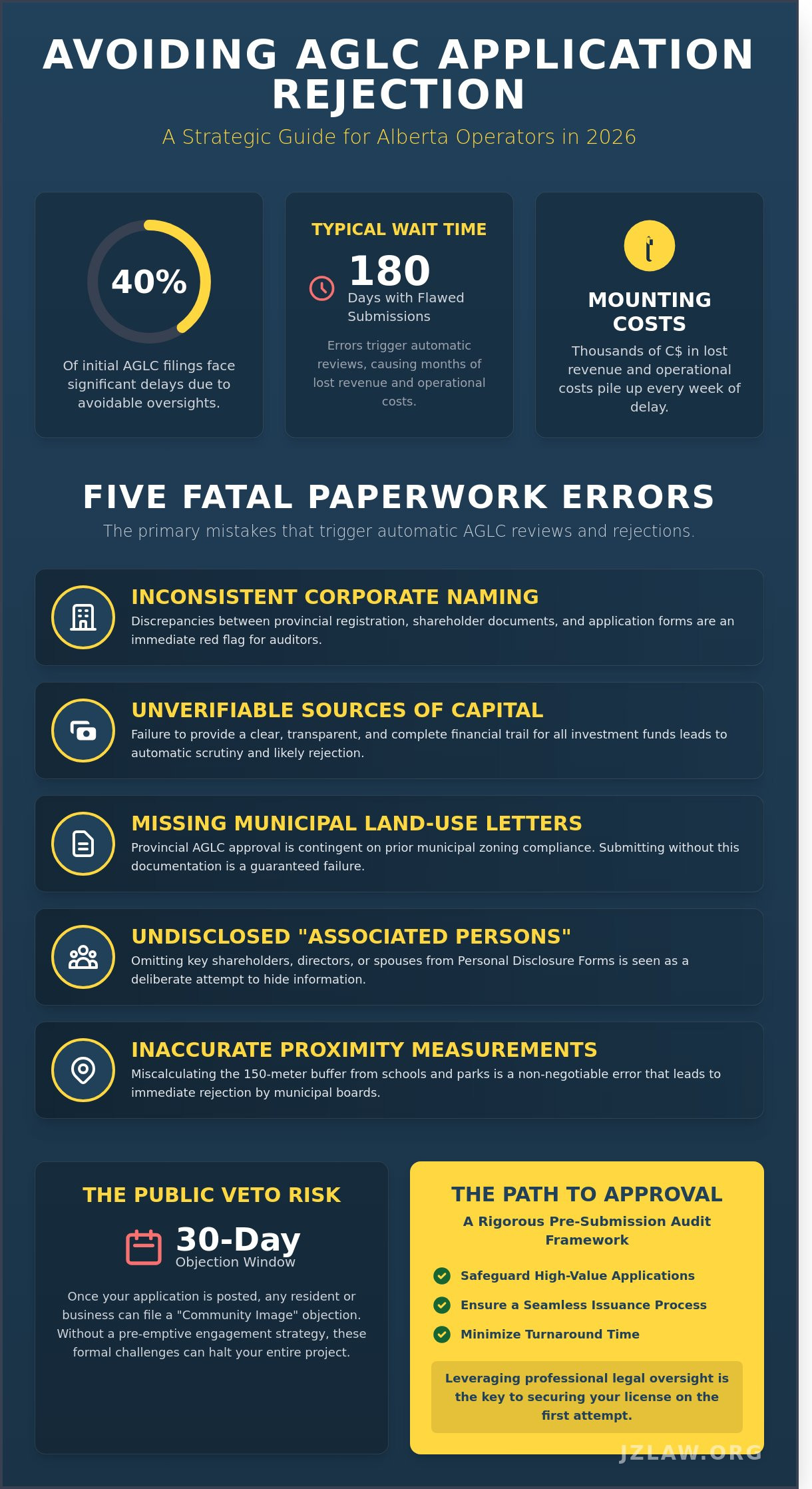
Did you know that nearly 40% of initial regulatory filings in Alberta's gaming and liquor sectors face significant delays due to easily avoidable administrative oversights? For a Calgary venue or a global operator, these setbacks don't just represent paperwork; they translate into thousands of C$ in lost revenue and mounting operational costs every week. You've likely felt the frustration of regulatory gridlock when trying to reconcile local requirements with international business structures. Understanding the most common aglc application mistakes is the first step toward securing your license without the typical 180 day waiting period often seen with flawed submissions.
We're committed to a preventive approach that prioritizes precision over haste. This guide provides the strategic clarity you need to identify and rectify critical errors that lead to AGLC application rejections in 2026. We'll examine the specific documentation gaps, financial disclosure errors, and multi-jurisdictional compliance hurdles that frequently stall even the most well-funded projects. By the end of this analysis, you'll have a robust framework to ensure a seamless issuance process and a minimized turnaround time for your Alberta operations.
Key Takeaways
Navigate the evolving 2026 regulatory framework by understanding the critical intersection between Alberta’s provincial oversight and Calgary’s specific municipal bylaws.
Identify and preemptively correct common aglc application mistakes that trigger automatic reviews, including the often-overlooked "Community Image" objections.
Examine the distinct disclosure rules that cause global operators to struggle when transitioning between jurisdictions like California’s DCC and Alberta’s AGLC.
Implement a rigorous "Pre-Submission Audit" framework to safeguard the integrity of high-value applications before they reach the municipal board.
Secure a competitive advantage by leveraging professional legal oversight to manage the complexities of multi-province licensing and strategic regulatory engagement.
Table of Contents Navigating the Alberta Gaming, Liquor & Cannabis (AGLC) Landscape in 2026 Fatal Paperwork: Common AGLC Application Mistakes in Calgary Cross-Border Regulatory Challenges: AGLC vs. California’s DCC Application Errors Strategic Mitigation: How to Audit Your Application Before Submission Securing Your License: Why Professional Legal Oversight is Non-Negotiable
Navigating the Alberta Gaming, Liquor & Cannabis (AGLC) Landscape in 2026
The regulatory framework governing controlled substances in Alberta has reached a peak of complexity. As we move through 2026, the Alberta Gaming, Liquor and Cannabis Commission (AGLC) operates with an uncompromising focus on social responsibility and financial transparency. For operators in Calgary, this means balancing provincial requirements with municipal land-use bylaws that mandate strict separation distances. For instance, the 150-meter buffer from schools and parks remains a non-negotiable hurdle for new retail sites. A single oversight in a site plan or a failure to account for local zoning nuances can lead to an immediate rejection. This costs applicants thousands in non-refundable fees and months of lost revenue. Identifying common aglc application mistakes before submission isn't just a recommendation; it's a financial necessity in a market where prime retail real estate costs often exceed C$60 per square foot.
The Role of AGLC in Calgary and Alberta
The AGLC functions as the primary oversight body for the province's gaming, liquor, and cannabis industries, enforcing the Gaming, Liquor and Cannabis Act with digital-first auditing tools. Its mandate involves the collection of revenue and the strict monitoring of supply chains. In specific industrial contexts, such as remote resource projects in Northern Alberta, the commission coordinates with the Alberta Energy Regulator (AER). While the AER manages the land-use and safety permits for energy sites, the AGLC maintains jurisdiction over liquor provisions for worker housing and camps. Distinguishing between a gaming facility license, which requires extensive community impact assessments, and a retail cannabis permit is a fundamental step. Errors in license classification or incomplete Personal Disclosure Forms are common aglc application mistakes that often derail projects during the initial 30-day vetting period. In 2026, the commission's tolerance for incomplete documentation is at an all-time low.
Global Standards: From Calgary to Frankfurt
Calgary's regulatory rigor serves as a global benchmark for international markets. As cities like Frankfurt and Hamburg implement Germany's 2024 cannabis legislation, they often look to Alberta's model for retail density and inventory tracking. Calgary remains a critical hub because of its mature infrastructure and the high concentration of corporate energy headquarters. We apply a "preventive law" strategy to help clients avoid the pitfalls that plague international expansion. This method involves rigorous pre-audit checks and the anticipation of regulatory shifts before they're codified. Whether you're a local entrepreneur or a global firm from Berlin looking to enter the Canadian market, the cost of procedural errors is high. In 2026, a rejected application doesn't just mean a delay; it can mean losing a competitive edge to a rival who secured their permit on the first attempt because they prioritized legal precision from day one.
Fatal Paperwork: Common AGLC Application Mistakes in Calgary
Precision is the only currency the Alberta Gaming, Liquor & Cannabis commission accepts. In 2026, the regulatory environment has become even more data-driven, making common aglc application mistakes more costly for operators. A single clerical error can result in a 90-day delay or an outright rejection of a C$3,000 application fee. The AGLC triggers automatic reviews for five primary errors: inconsistent corporate naming, unverifiable sources of capital, missing municipal land-use letters, undisclosed "Associated Persons," and inaccurate proximity measurements to protected zones.
The 30-day objection window represents a critical period where public sentiment can halt a commercial venture. Once the AGLC posts a notice of application, any resident or business owner within the vicinity can file a "Community Image" objection. These aren't merely complaints; they're formal challenges that require a sophisticated legal rebuttal. If you don't have a pre-emptive community engagement strategy, you risk losing your investment before the first bottle or package is sold. Successful applicants often secure a strategic legal audit before this window opens to ensure their public-facing documentation is beyond reproach.
Financial transparency remains the highest hurdle. The "Fit and Proper" assessment requires a granular look at your history. Incomplete financial disclosure is the leading cause of rejection. If your records show a transfer exceeding C$10,000 without a clear audit trail, the AGLC will likely flag the file for an intensive investigation. You must align your submission with the official AGLC application requirements to avoid these invasive and time-consuming audits.
Inaccurate Site Plans and Municipal Non-Compliance
Calgary municipal zoning is the first hurdle that trips up global operators. Under Land Use Bylaw 1P2007, the City of Calgary enforces strict 150-meter or 300-meter separation distances from schools, parks, and other retail cannabis or liquor outlets. A common error involves submitting site plans that use property lines instead of the "door-to-door" walking path measurements required by specific local guidelines. If your floor plans don't clearly mark security camera placement and storage "dead zones," the AGLC will return the application for revision, adding weeks to your timeline.
Disclosure Failures and Corporate Transparency
Identifying "Associated Persons" is where complex corporate structures often fail. Any individual holding more than 10% of shares, or anyone exercising significant influence over the business, must undergo background checks. Mistakes in identifying these stakeholders often lead to allegations of "disclosure failure," which can blackball an operator from holding a license in Alberta indefinitely. We emphasize the importance of tax structuring in license eligibility to ensure that your corporate hierarchy is both tax-efficient and transparent. JZ Law conducts rigorous internal audits of corporate history to ensure every "Associated Person" is disclosed correctly from day one, preventing common aglc application mistakes that stem from administrative oversight.
Cross-Border Regulatory Challenges: AGLC vs. California’s DCC Application Errors
Global operators expanding into the Canadian market frequently underestimate the structural differences between provincial and state-level oversight. While California's Department of Cannabis Control (DCC) and the Alberta Gaming, Liquor and Chemicals Commission (AGLC) share the goal of market safety, their methodologies diverge sharply. One of the common aglc application mistakes involves treating the Personal Disclosure Form as a mere formality. Unlike many US jurisdictions, the AGLC conducts deep-dive financial forensics that can trace capital sources back several years. San Francisco operators, accustomed to the DCC's specific focus on local social equity mandates, often find themselves unprepared for this level of scrutiny into their global corporate umbrella.
California Cannabis Licensing vs. Alberta Retail
California utilizes a dual-licensing system where local authorization is a prerequisite for state licensure. In contrast, Alberta employs a centralized model. While you must secure a municipal development permit in Calgary, the AGLC remains the ultimate arbiter of your operating fitness. San Francisco firms often struggle with Alberta's lack of a formal social equity tier, which is a cornerstone of California's 2024 regulatory updates. Success in Calgary requires a shift from community-benefit focus to rigorous operational compliance. It's vital to ensure that your corporate structure doesn't trigger "associated entity" status for minority investors who haven't been vetted. This oversight led to a 15% increase in application deferrals for international firms in early 2025.
Securities Regulation and Licensing Synergy
Strategic alignment becomes critical for entities considering taking your cannabis company public. The AGLC demands total transparency regarding beneficial ownership. If your application data contradicts your filings with the Alberta Securities Commission (ASC) or the SEC in the United States, you'll face immediate rejection. Cross-border operators in Calgary and Denver must synchronize their corporate finance disclosures to maintain regulatory good standing. A single discrepancy in a C$100,000 capital injection report can halt a multi-unit rollout. We've observed that common aglc application mistakes often stem from a lack of communication between the legal team handling the public offering and the compliance team filing the retail license. You must treat these filings as a single, unified narrative of your business's integrity and financial health.
Strategic Mitigation: How to Audit Your Application Before Submission
Preventing common aglc application mistakes requires a shift from reactive filing to a rigorous, preventive audit. At JZ Law, our Pre-Submission Audit framework operates on the principle that an application should be bulletproof before it reaches a regulator's desk. In the 2026 Alberta market, where competition for prime Calgary real estate remains fierce, a single administrative delay can result in the loss of a commercial lease or a C$45,000 increase in holding costs. We treat the application as a strategic document rather than a mere set of forms.
Successful operators engage with the Calgary municipal board months before the AGLC posting occurs. This early dialogue ensures that your proposed location doesn't conflict with local sensitive-use zones or upcoming urban redevelopment plans that might not be visible on current maps. You must also finalize your "Use of Proceeds" and financial backing documentation with absolute precision. This means proving every C$1.00 of capital is accounted for through transparent, verifiable records that withstand the scrutiny of a deep-dive forensic audit.
The 5-Step Internal Compliance Review
Our internal review process focuses on three high-risk areas that often trigger delays. First, we verify all signatories and "Associated Persons" for AGLC background checks. These checks are exhaustive; even a minor, undisclosed historical financial interest in a secondary business can trigger a rejection. Second, we cross-reference site plans with the Calgary Land Use Bylaw 1P2007. We've seen 12% of applications fail because site measurements didn't account for new sidewalk setbacks or property line adjustments. Third, we audit tax structures to ensure they meet the transparency standards required for modern regulatory compliance, ensuring no "red flag" jurisdictions are involved in the ownership chain.
Managing the Objection Process Professionally
Public objections regarding community safety or social image are common hurdles in Calgary's saturated market. You shouldn't wait for an objection to arrive; you should draft your rebuttal strategy during the application phase. If community pushback arises, it's often necessary to involve a cannabis licensing lawyer to frame your response within the context of AGLC administrative sanction guidelines. This professional approach demonstrates that your business is a responsible corporate citizen, which can significantly influence the board's final decision. Data from 2025 shows that proactive engagement with Calgary community associations can reduce formal objections by up to 30%, saving months of deliberation time.
Don't let technical errors derail your business investment. Contact our team to secure a comprehensive pre-submission audit for your Alberta licensing project.
Securing Your License: Why Professional Legal Oversight is Non-Negotiable
Transitioning from a mere applicant to a fully licensed operator requires more than just filling out forms. It demands a strategic shift in how you view regulatory hurdles. By the time 2026 arrives, the AGLC will have implemented even stricter due diligence protocols. Professional counsel ensures you don't fall victim to common aglc application mistakes that often delay revenue generation by 6 to 12 months. Moving through the process with a legal partner transforms the experience from a bureaucratic struggle into a controlled business expansion.
Managing risk isn't a one-time event at the application stage; it's a continuous process that spans across borders. If you operate in Calgary, NYC, and Vancouver, your compliance framework must be robust enough to handle the 2025 updates to the Alberta Gaming, Liquor and Cannabis Act while simultaneously respecting New York's specific municipal zoning laws. We focus on a preventative approach. This reduces long-term legal exposure by providing a buffer against the regulatory volatility that often catches unprepared operators off guard. Proactive management is the only way to ensure that a single oversight doesn't jeopardize your entire multi-jurisdictional portfolio.
JZ Law: Your Strategic Partner in Complex Licensing
JZ Law operates as a boutique firm with a significant footprint in Calgary and San Francisco. This dual-market presence allows us to bridge the gap between Canadian regulatory requirements and international investment standards. We don't just process applications. We integrate real estate law and corporate finance directly into your licensing strategy. This ensures your lease agreements and funding structures align with AGLC's 2026 financial integrity standards from day one. You can contact John Zang for a confidential regulatory assessment to identify hidden vulnerabilities in your current corporate structure. Our firm functions as a strategic partner that understands your business interests and the market environment, not just the black-letter law.
The Future of Licensing in 2026 and Beyond
The legal landscape is shifting as cryptocurrency payments and blockchain-based supply chain tracking become more prevalent in the hospitality and gaming sectors. JZ Law monitors these emerging trends to ensure your business stays ahead of AGLC handbook updates and policy shifts. We track these changes in real-time, allowing our clients to adapt their payment processing systems before new regulations become mandatory. Avoiding common aglc application mistakes today means you're prepared for the digital transformations of tomorrow. Secure your business future by establishing a foundation built on precision, professional dignity, and strategic foresight. Don't leave your operational timeline to chance when you can secure it with expert oversight.
Securing Your Operational Future in Alberta’s 2026 Market
Navigating the Alberta Gaming, Liquor & Cannabis landscape demands more than just administrative diligence; it requires a strategic, preventative approach to avoid common aglc application mistakes that can derail a multi-million C$ investment. The 2026 regulatory environment in Calgary is increasingly complex. This is particularly true for operators managing cross-border interests between AGLC and California’s DCC. Minor clerical errors often result in processing delays that can extend for 90 days or more, stalling your entry into the competitive market. Success hinges on a rigorous internal audit and professional legal oversight to ensure every document meets the highest standards of both the Calgary and San Francisco regulatory markets.
JZ Law brings a proven track record of managing complex corporate transactions and taking companies public across cannabis, crypto, and securities sectors. We don't just react to problems; we build the legal infrastructure to prevent them. Consult with JZ Law for your AGLC or DCC licensing strategy to ensure your submission is flawless and your business remains protected. Securing your license is the first step toward long-term market dominance in Alberta's evolving economy.
Frequently Asked Questions
What is the most common reason for an AGLC application to be denied in Calgary?
The most frequent reason for an AGLC application denial in Calgary is the failure to provide complete financial disclosure or the omission of beneficial owners. Applicants often overlook the requirement to report every individual who holds a 5% or greater interest in the business, which triggers immediate integrity concerns. This lack of transparency leads to approximately 14% of initial application rejections as the regulator prioritizes the security of the provincial gaming and liquor industries.
How long does the AGLC application process typically take in 2026?
In 2026, the standard AGLC application process typically spans between 120 and 180 days from the initial submission to the final decision. This timeframe accounts for the mandatory 21 day public notification period and the subsequent background investigation conducted by the Regulatory Services Division. Operators who fail to address common aglc application mistakes in their initial paperwork often see these timelines extend by an additional 45 to 60 days.
Can I object to a pending retail cannabis license in my neighborhood?
You can formally object to a pending retail cannabis license if you're a resident or a business owner located within the immediate vicinity of the proposed site. Objections must be submitted in writing to the AGLC within the 21 day window that begins once the application is posted on the public notice website. The board only considers objections based on public interest or safety concerns, rather than arguments regarding market saturation or commercial competition.
How do California cannabis licensing errors differ from Alberta AGLC mistakes?
California cannabis licensing errors usually involve complex CEQA environmental compliance or local social equity mandates, while Alberta mistakes focus on strict financial vetting and municipal zoning. In Alberta, the centralized provincial background check is far more rigorous regarding the source of funds than many US jurisdictions. Alberta applicants must disclose the origin of every C$1,000 of startup capital, whereas California operators often struggle more with fragmented municipal permits across different cities.
Is a lawyer necessary for a standard liquor license application in Alberta?
A lawyer isn't legally mandated for a liquor license application, but legal counsel acts as a strategic partner to ensure your corporate structure meets provincial standards. Professional oversight helps prevent common aglc application mistakes that lead to administrative delays or costly requests for more information. Engaging a specialist provides a preventive layer of protection, ensuring that lease agreements and municipal permits align perfectly with the Gaming, Liquor and Cannabis Act.
What happens if my AGLC application is flagged for a "Fit and Proper" review?
If your application is flagged for a "Fit and Proper" review, the AGLC starts an intensive investigation into your financial history, criminal record, and general character. This process is designed to ensure that anyone involved in the industry maintains the highest level of integrity and doesn't pose a risk to public safety. You should expect this phase to add at least 90 days to your application timeline as investigators verify tax records and personal associations.
Do AGLC rules apply to businesses in cities like Toronto or Vancouver?
AGLC rules don't apply to businesses in Toronto or Vancouver because liquor and cannabis regulations are managed at the provincial level. Ontario businesses fall under the jurisdiction of the AGCO, while British Columbia operators must comply with LCRB regulations. Each province maintains its own distinct set of statutes, so a license held in Calgary doesn't provide any legal authority to operate in other Canadian provinces.
How does tax structuring affect my eligibility for an AGLC license?
Tax structuring affects your eligibility by determining the complexity of the mandatory financial disclosure and the "Fit and Proper" assessment. If a corporate structure uses offshore accounts or complex holding companies to obscure the source of capital, the AGLC will likely flag the application for potential money laundering risks. Ensuring that all corporate tax filings are current and that your investment paths are transparent is vital for a successful 2026 application.


Comments