


Continuous Disclosure in Vancouver: Core Duties and Filings
Continuous disclosure is not a once-a-year filing exercise. For issuers managing continuous disclosure obligations in Vancouver, a material change requires a prompt press release and a material change report within 10 days. The rules also require periodic filings, with deadlines that depend on the issuer’s classification and reporting period.
That framework can feel demanding when a business event, financial reporting deadline or exemption question arises at the same time. This article explains how Canadian requirements under National Instrument 51-102 apply to material changes, annual and interim filings, business acquisition reports, fees and foreign issuer exemptions. It also outlines why materiality depends on the issuer’s circumstances, rather than a single bright-line test.
The sections ahead explain the core duties involved in managing continuous disclosure obligations in Vancouver. You’ll find the filing rules to consider, when deadlines may apply, and how securities-law advice can support a sound compliance process.
Table of Contents
Material change reporting
For a Canadian reporting issuer, a material change triggers timely public disclosure and a filing obligation. Under National Instrument 51-102, materiality turns on the change’s expected effect on the market price or value of securities.
A material change is a change in an issuer’s affairs that significantly affects, or would reasonably be expected to significantly affect, the market price or value of its securities. Canadian securities laws set no bright-line test. The assessment depends on the issuer’s circumstances and the change’s expected effects.
Timely Material Change Disclosure
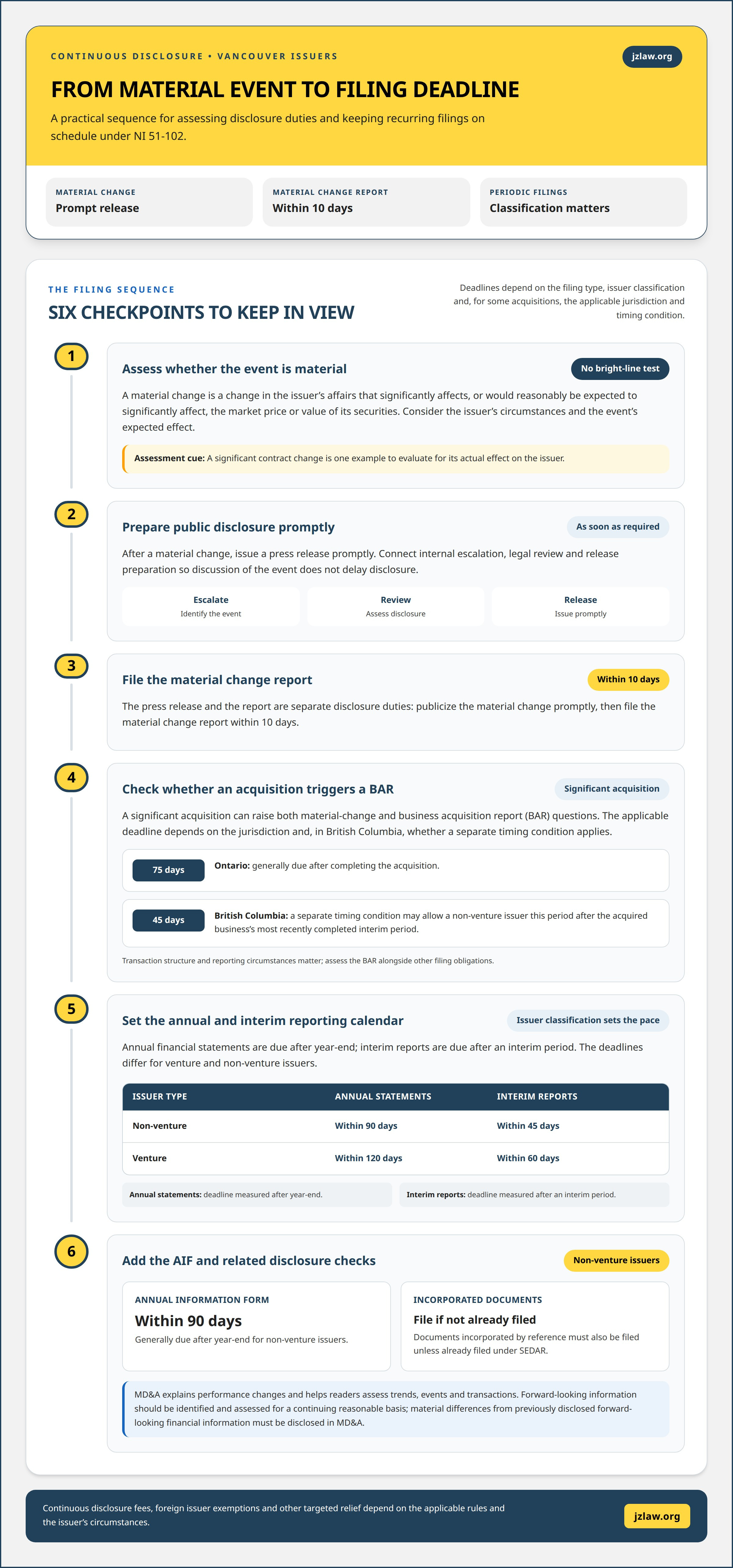
Timely disclosure means issuing a press release promptly after a material change and filing a material change report within 10 days. For Vancouver issuers, the reporting process should connect internal escalation, legal review and release preparation, so discussion of an event does not delay required public disclosure. A significant contract change, for example, should be assessed for its actual effect on the issuer.
Restructuring transactions require careful analysis under NI 51-102. A transaction can include an asset acquisition and securities issuance that leaves new securityholders owning or controlling more than 50% of the issuer’s outstanding voting securities. Disclosure is required for each resulting entity, although information may be incorporated by reference to another document. Amendments to specified constating documents and related agreements need filing when the amendment is material.
A significant acquisition can raise both material-change and business-acquisition-report issues. Under British Columbia’s NI 51-102, a business acquisition report is generally due within 75 days after the acquisition date; a separate timing condition may allow a non-venture issuer 45 days after the acquired business’s most recently completed interim period. The transaction’s structure and reporting circumstances matter.
Confidential Information and Selective Disclosure
Confidentiality controls limit access to material information while an issuer prepares accurate disclosure. Vancouver issuers should restrict internal circulation, coordinate a single release process and avoid selective discussions with investors or analysts about material facts. National Policy 51-201 addresses disclosure standards; if information leaks or confidentiality is lost, reassess promptly whether a public release is needed.
Annual information forms and business acquisition reports
An annual information form (AIF) is a yearly disclosure document describing an issuer’s business and risks. Under National Instrument 51-102, non-venture issuers generally file an AIF within 90 days after year-end; documents incorporated by reference must also be filed unless already filed under SEDAR.
Periodic disclosure means recurring financial statements and related management discussion and analysis (MD&A). Under NI 51-102, non-venture issuers file annual financial statements within 90 days after year-end and interim reports within 45 days after an interim period. Venture issuers have 120 days for annual statements and 60 days for interim reports. MD&A explains performance changes and helps readers assess trends, events and transactions.
A business acquisition report (BAR) is a filing about a significant acquisition. In Ontario, a company generally files it within 75 days after completing the acquisition. British Columbia’s NI 51-102 provides a 45-day deadline after the acquired business’s most recently completed interim period when the stated timing condition applies. Acquisition reporting should be assessed alongside the issuer’s other filing obligations.
For a non-reporting issuer using Ontario’s Offering Memorandum exemption, annual financial statements generally go to the securities commission within 120 days after year-end. That obligation is distinct from reporting-issuer filings.
Forward-looking information (FLI) concerns expected future results or events. Canadian issuers must identify FLI and assess whether it continues to have a reasonable basis. If actual results materially differ from previously disclosed forward-looking financial information, the differences must be disclosed in MD&A. Updates, notices of updates or withdrawal belong in MD&A or a news release.
Insider reporting covers certain directors, officers and other insiders who buy, sell or otherwise deal in issuer securities under National Instrument 55-104. Early-warning analysis is separate; changes in holdings should be assessed alongside issuer disclosure. A securities lawyer can coordinate filing analysis and disclosure review; securities regulation guidance can support that work.
Continuous disclosure fees and foreign issuer exemptions
A continuous disclosure fee is a regulatory charge associated with required issuer filings. Fee rules depend on the jurisdiction: Ontario companies required to file continuous disclosure documents pay an annual participation fee under OSC Rule 13-502, while Vancouver issuers must consider the applicable British Columbia requirements.
National Instrument 71-102 provides certain foreign issuers exemptions from most continuous disclosure requirements and some other requirements. A designated foreign issuer may qualify for certain Ontario exemptions when Canadian residents hold no more than 10% of its outstanding equity securities and it meets the other applicable conditions. Foreign status alone does not establish eligibility.
Exchangeable-share and credit-support issuer exemptions provide targeted relief for particular security or support structures. Whether they apply depends on the issuer’s arrangement and the conditions in the applicable instrument. Assuming a subsidiary, exchangeable security or credit-support arrangement is exempt without analysing its structure can lead to an incorrect filing position.
A venture issuer is a reporting issuer classified under securities rules for disclosure purposes. The amended definition treats issuers with securities listed on AIM or OFEX, now PLUS, as venture issuers. Because classification affects filing requirements, assess the issuer’s status and listing before setting reporting dates.
An executive officer is an officer whose position falls within the applicable securities-law definition. That status can matter when issuer responsibilities or exemptions depend on officers’ roles. Venture and non-venture issuers also have different interim filing deadlines under NI 51-102, making classification a key part of compliance planning.
Vancouver issuers can consult British Columbia Securities Commission materials for provincial regulatory guidance. Securities counsel can analyse how a rule applies to a transaction or exemption. Exchanges explain their own listing requirements, so consider exchange rules alongside securities-law duties.
Canadian continuous disclosure obligations under NI 51-102
National Instrument 51-102 sets continuous disclosure requirements for Canadian reporting issuers other than investment funds. In British Columbia, it is cited as B.C. Regulation 110/2004. Canadian securities regulation is provincial and territorial, so issuers must account for the rules and regulatory authority in each applicable jurisdiction. For issuers managing continuous disclosure obligations in Vancouver, that means assessing both provincial requirements and any other jurisdictions where they report.
NI 51-102 documents include annual and interim financial statements, management discussion and analysis, and, where applicable, an annual information form. Together, these filings should present a consistent account of financial performance, material risks and business developments. MD&A explains performance changes and helps readers understand trends, events, transactions and expenditures.
Related instruments govern financial reporting. NI 52-107 sets accounting principles and auditing standards for filed financial statements, while NI 52-108 concerns auditor oversight. NI 52-112 addresses non-GAAP and other financial measures, and CSA Staff Notice 52-306 concerns non-GAAP financial measures. Consistent explanations across documents support clear disclosure.
Governance duties add another layer. NI 52-109 covers disclosure certifications and internal controls, while NI 52-110 sets audit committee requirements. NI 58-101 and NP 58-201 address corporate governance rules and guidance. Directors need processes for reviewing disclosures, escalating issues and supporting accurate filings.
Some issuers face industry-specific rules. NI 43-101 applies to mineral project disclosure, while NI 51-101 sets standards for oil and gas activities. NI 54-101 addresses communication with beneficial owners. National Instrument 55-104 covers certain insiders’ reporting when they deal in issuer securities. These instruments differ by activity, role and disclosure subject.
A practical approach to managing continuous disclosure obligations in Vancouver is to map each filing to the issuer’s status, industry and jurisdiction, then coordinate financial, governance and transaction review. For tailored securities regulation support, legal guidance can clarify how NI 51-102 and related instruments apply to the issuer’s disclosure framework.
JZ Law
JZ Law provides securities regulation counsel to companies assessing Canadian continuous disclosure requirements. Its advice can help when a material event, periodic filing, acquisition or exemption question requires legal analysis as well as business judgment.
For issuers preparing to go public, JZ Law’s services for taking companies public connect disclosure planning with the wider securities regulatory process. A focused legal review can clarify which reporting obligations apply and how disclosure fits into the transaction.
If your company is assessing continuous disclosure responsibilities or a related securities matter, contact JZ Law to discuss the legal support you need.
Build disclosure into business decisions
Managing continuous disclosure obligations in Vancouver starts before a filing deadline approaches. Build disclosure review into transaction planning, financial reporting and leadership discussions so emerging issues reach decision-makers early. This helps coordinate legal analysis with business priorities and maintain clear accountability as circumstances change.
Map how information moves through the organization: who identifies a potential disclosure issue, who assesses its implications and who coordinates the response. Clear responsibilities help teams handle questions consistently instead of treating each event as a one-off. The process should reflect the issuer’s structure, operations and reporting needs.
Where a current or planned matter raises disclosure concerns, Contact JZ Law about disclosure obligations to discuss the legal support that fits. A thoughtful process can help your organization approach its next reporting decision with greater clarity and confidence.
Frequently Asked Questions
What continuous disclosure obligations apply to publicly listed companies in Canada?
Publicly listed companies that are reporting issuers must meet applicable securities-law disclosure requirements and the rules of their listing exchange. The obligations can also depend on the issuer’s industry, security structure and jurisdiction. For example, a mineral issuer must account for project disclosure requirements under NI 43-101, while oil and gas disclosure is subject to NI 51-101. Identifying all applicable regimes is an important first step.
What are the continuous disclosure filing deadlines under Canadian securities laws?
Deadlines depend on issuer classification, filing type and the event that triggers a report. For example, interim financial statements are generally due within 45 days for non-venture issuers and 60 days for venture issuers. A transaction may create a separate deadline, while a material change report has its own timetable. Build a filing calendar around the issuer’s financial year, interim periods and anticipated corporate events.
Which Canadian securities filings are required annually, quarterly, and on a timely basis?
Common recurring filings include annual and interim financial statements, related management discussion and analysis, and an annual information form where applicable. Canadian reporting is generally annual and interim, not universally quarterly. Depending on the event, timely filings may also include a material change report or a business acquisition report. The issuer’s status and circumstances determine which documents apply.
What events require immediate material change disclosure in British Columbia?
A reportable event is one that constitutes a material change in the issuer’s affairs, assessed by its expected effect on the market price or value of its securities. A major transaction, restructuring or cybersecurity incident may warrant assessment. The event’s label alone does not determine materiality: consider the issuer’s circumstances and reassess as facts develop. Public disclosure must meet the applicable timely-disclosure requirements.
How do TSX and TSX Venture Exchange disclosure requirements differ?
Both exchanges operate alongside Canadian securities laws, but issuer classification and the applicable listing rules can affect reporting expectations. Venture status matters under NI 51-102, including for interim filing deadlines, while exchange-specific requirements may also apply. A company should identify its exchange, reporting-issuer status and any applicable exemptions before setting procedures. This distinction is especially relevant when a listing or issuer classification changes.
What penalties and enforcement risks apply for late or inaccurate continuous disclosure in British Columbia?
Late or deficient disclosure can attract regulatory scrutiny and disrupt an issuer’s ability to access capital markets. In British Columbia, an issuer that fails to meet continuous disclosure obligations may be cease traded without further notice. National Policy 12-203 addresses cease trade orders for continuous disclosure defaults. Inaccurate disclosure can also require corrective filings and careful review of the issuer’s public statements and controls.



Comments