


Defending an ASC Investigation: A Strategic Guide for Executives and Issuers
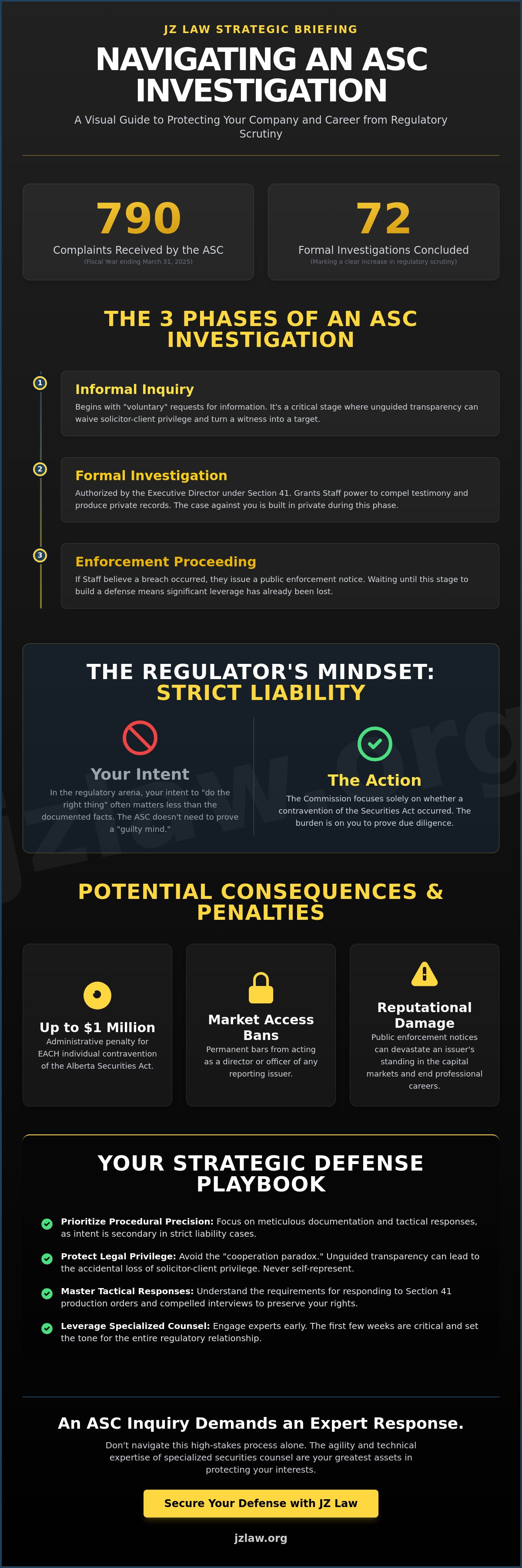
In the fiscal year ending March 31, 2025, the Alberta Securities Commission received 790 complaints and concluded 72 formal investigations, marking a clear increase in regulatory scrutiny. For executives and issuers, receiving a notice of inquiry isn't merely a procedural hurdle; it's a high-stakes event where your professional standing and the company's market reputation are immediately at risk. Successfully defending an asc investigation requires more than just a willingness to cooperate. It demands a sophisticated understanding of procedural precision and the protection of legal privilege from the very first interaction.
You likely understand that even a minor oversight in disclosure or a perceived conflict of interest can trigger severe administrative penalties or a permanent bar from acting as a director. It's natural to feel a sense of urgency to explain your actions, yet in the regulatory arena, your intent often matters less than the documented facts and your tactical response. This guide provides the critical legal frameworks and strategic insights you need to manage the process effectively. We'll examine how to minimize potential penalties, avoid the fallout of a public enforcement notice, and ensure your business remains compliant while vigorously protecting your legal rights.
Key Takeaways
Identify the specific catalysts for an inquiry, from whistleblower reports to routine disclosure reviews, to better understand the regulator's initial focus.
Navigate the complexities of defending an asc investigation by prioritizing procedural precision over arguments regarding intent, as strict liability principles govern most enforcement actions.
Protect your legal standing by understanding the cooperation paradox, where unguided transparency can lead to the accidental loss of solicitor-client privilege.
Master the tactical requirements for responding to Section 41 production orders and compelled interviews to ensure your rights are preserved throughout the process.
Leverage the agility of specialized securities counsel to manage the rapid timelines and technical demands of an active Alberta Securities Commission probe.
Table of Contents
Navigating the Lifecycle of an ASC Investigation in 2026
An investigation by the Alberta Securities Commission (ASC) isn't a casual conversation. It's a formal, statutory inquiry focused on potential breaches of the Alberta Securities Act (ASA). These probes often start quietly, triggered by whistleblower reports, AI-detected market anomalies, or routine disclosure audits. For those tasked with defending an asc investigation, the process can feel overwhelming, but it follows a predictable, three-phase lifecycle: the informal inquiry, the formal investigation, and the eventual enforcement proceeding. The decisions you make during the first few weeks are the most critical, as they set the tone for the entire regulatory relationship.
The early stages are where the narrative of the case is established. If you wait until an enforcement notice is public to build your strategy, you've already lost significant leverage. Proactive management during the inquiry phase can often prevent a matter from ever reaching the formal investigation stage, potentially saving an issuer from devastating reputational damage in the capital markets.
The Informal Inquiry vs. Formal Summons
Staff members often begin with "voluntary" requests for information or documents. It's a common trap to think that total transparency without counsel is the fastest way out. It isn't. Providing unvetted information can lead to a waiver of solicitor-client privilege or inadvertently turn a witness into a target. You must determine your status immediately. Are you a witness providing context, or is the Commission building a case against you? Without this clarity, every document you hand over could be used to widen the scope of the probe.
The Role of the Executive Director
Under Section 41 of the ASA, the Executive Director has the power to authorize a formal investigation. This order grants Staff the authority to compel testimony and produce private records. In the fiscal year ending March 31, 2025, the ASC received 790 complaints, reflecting a high-pressure environment for regulators to show results. These investigations can last several months, during which Staff build their case in private. In the current 2026 regulatory landscape, defending an asc investigation requires a meticulous approach to these timelines, ensuring that document production is handled with precision while protecting your company's strategic interests.
Regulatory Strict Liability: Understanding the ASC Enforcement Powers
The regulatory framework in Alberta operates on a principle that often catches executives off guard: strict liability. Unlike criminal proceedings where the prosecution must prove a "guilty mind," the ASC doesn't need to prove you intended to deceive the market or break the law. If a breach of the Alberta Securities Act occurs, the Commission focuses solely on the fact of the contravention itself. This reality makes defending an asc investigation a technical challenge rather than a debate over character or good intentions. When the regulator identifies a failure in disclosure or a breach of trading rules, the burden shifts to the respondent to prove they exercised due diligence, a high legal bar that requires meticulous documentation.
The financial stakes of these enforcement powers are significant. Administrative penalties can reach $1 million for each individual contravention. In cases involving complex series of trades or multiple misleading filings, these costs can escalate rapidly. Beyond the monetary impact, the Commission frequently seeks "market access" orders, which can permanently bar individuals from acting as directors or officers of any reporting issuer. This isn't just about a fine; it's about the potential end of a professional career in the capital markets.
Materiality and Selective Disclosure
The legal definition of a "material fact" has become increasingly nuanced in 2026. It now encompasses any information that would reasonably be expected to have a significant effect on the market price or value of a security, including climate-related disclosures following the December 2025 amendments to the Securities Act. Executives must be exceptionally careful when managing strategic corporate transactions, as even preliminary discussions or draft news releases can be deemed material. Off-market conversations, even those intended to be private, often trigger tipping investigations if sensitive data is shared before a formal public announcement.
Niche Sector Vulnerabilities: Crypto and Cannabis
Regulators are currently applying intense scrutiny to high-growth sectors. There's a particular focus on cryptocurrency law, where the ASC is aggressively pursuing unregistered platforms and stablecoin offerings that fail to meet strict transparency standards. Similarly, companies taking their cannabis company public must navigate a complex web of multi-jurisdictional compliance requirements. Many emerging tech firms find themselves targeted for "unregistered activity" simply because they didn't realize their digital assets qualified as securities. If your organization operates in these volatile spaces, proactive engagement with experts in securities regulation is the most effective strategy for defending an asc investigation and preserving your market standing.
The Cooperation Paradox: Why Self-Representation Fails in Securities Probes
Many executives approach a regulatory inquiry with a sense of professional transparency, believing that a "nothing to hide" philosophy will resolve the matter quickly. This is often a strategic error. In a strict liability environment, your intent or lack of malice is secondary to the technical facts of a disclosure or trade. When defending an asc investigation, what you perceive as a helpful clarification can easily be characterized by Staff as an admission of a material breach. Staff members are not your advisors; their mandate is to protect the public interest and enforce the Alberta Securities Act, not to provide a safe harbor for your individual reputation. Friendly informal calls aren't casual chats; they're evidence-gathering sessions where every word is recorded and analyzed.
There's a subtle but vital distinction between cooperation and submission to regulatory overreach. While the ASC's enforcement policy recognizes cooperation as a potential mitigating factor, it's never a guarantee of immunity. In fact, providing unvetted voluntary statements can inadvertently provide the Commission with the missing links they need to move from an informal inquiry to a formal Section 41 order. True cooperation involves meeting your statutory obligations while vigorously protecting your legal rights, a balance that is nearly impossible to maintain without experienced securities counsel acting as a buffer.
The Risk of Inadvertent Admissions
Simple interactions can have devastating consequences. A casual explanation about why a news release was delayed might be framed as an admission of selective disclosure or a failure to file a timely material change report. A notable example in Canadian securities law involved a CEO who provided "exemplary cooperation" by handing over internal memos without prior legal review. Those same documents were later used to justify significant administrative penalties, despite the CEO's belief that they were being helpful. Having counsel present ensures that your words aren't stripped of their context or used to build a case against the company's interests.
Protecting Privilege and Confidentiality
Identifying which documents are protected by solicitor-client privilege is a technical task that must occur before a single file is transferred to the Commission. Once privilege is waived, even inadvertently, it's nearly impossible to claw back that protection in future civil or regulatory proceedings. Maintaining corporate confidentiality while satisfying regulatory demands requires a surgical approach to document production. You must distinguish between confidential material information, which may be subject to disclosure under a production order, and privileged legal advice, which remains strictly protected. This distinction is the cornerstone of a successful defense strategy.
Tactical Steps for Responding to ASC Document Demands and Interviews
Receiving a Section 41 production order transforms a regulatory inquiry into a mandatory legal obligation. At this stage, defending an asc investigation shifts from strategic positioning to rigorous execution. Your first priority is the immediate implementation of a litigation hold. You must ensure that all potentially relevant records, including internal messaging and metadata, are preserved to prevent any allegations of evidence tampering. Managing the scope of these demands is a delicate negotiation; providing too little can be seen as non-compliance, while providing too much can lead to unnecessary business disruption or the accidental disclosure of unrelated sensitive data.
Staff often demand massive volumes of data with tight deadlines. It's vital to have a structured process for reviewing every document before it leaves your control. This isn't just about finding relevant files; it's about verifying that no privileged communications are included in the production set. Engaging forensic experts early can help satisfy digital evidence requirements while ensuring that your internal systems remain secure during the extraction process.
Preparing for the Compelled Interview
The mechanics of a compelled interview are significantly different from a standard legal deposition. Under Section 42 of the Alberta Securities Act, the Commission has the power to examine individuals under oath, and the traditional "right to silence" does not apply. You are legally required to answer questions, even if the answers are incriminating. However, this power comes with specific protections. Counsel's role is to ensure that "use immunity" is properly established, preventing your testimony from being used against you in certain subsequent proceedings. We carefully define the bounds of the interview, objecting to improper or speculative questions that exceed the scope of the original Section 41 order.
Document Production Strategy
Modern investigations in 2026 involve highly technical data sets. For energy firms, this often includes proprietary oil and gas law technical data or complex reserve reports. In the fintech space, Staff may demand access to crypto-asset keys or blockchain transaction logs. Handling these requests requires a specialized approach to ensure that your intellectual property and digital assets remain protected while you meet your statutory duties. For issuers facing these complex demands, securing expert representation in securities regulation is the most effective way to ensure a methodical and protected response that preserves your company's operational integrity during the probe.
Strategic Regulatory Defense: How JZ Law Protects Corporate Interests
JZ Law doesn't merely respond to regulatory inquiries; we proactively manage the narrative. We merge deep technical knowledge with a high-level strategic approach to protect both the corporate entity and its leadership. When defending an asc investigation, the initial response often dictates the final outcome. Our boutique structure allows us to provide a level of agility and senior-level attention that larger firms often struggle to match. This focus is essential when dealing with the rapid-fire document demands and tight timelines characteristic of a modern Commission probe.
We prioritize an Early Resolution strategy whenever possible. A public enforcement notice can be as damaging as the penalties themselves, often triggering secondary consequences like credit rating downgrades or the loss of key institutional investors. By engaging Staff early in the process, we work to resolve concerns before they escalate into a formal hearing. Our work involves a rigorous analysis of the facts to determine if a No-Action letter or a confidential settlement is achievable. This methodical approach ensures that your business interests remain the primary focus throughout the negotiation.
Our expertise extends to the complex intersection of real estate law and securities regulation. In 2026, many real estate syndications and development funds are finding themselves under the ASC's microscope as regulators look closer at how investment contracts are structured. We ensure that these complex corporate vehicles meet all disclosure requirements while defending them against claims of unregistered activity or misleading promotional materials. Our goal is to provide clarity and security in an increasingly complex regulatory environment.
John Zang’s Strategic Advocacy
John Zang brings a sophisticated perspective to defending an asc investigation, particularly in high-growth sectors like cannabis and cryptocurrency. He acts as a critical buffer, managing all interactions with Commission Staff to prevent the inadvertent disclosure of sensitive information. By leveraging his experience with No-Action letters and technical settlement negotiations, he focuses on preserving your reputation and ensuring that any regulatory friction is resolved with minimal public exposure. His approach combines traditional professional dignity with a modern understanding of innovative economic sectors.
Contact JZ Law for a Confidential Consultation
The moment you receive an informal request or a Section 41 order is the moment you need professional representation. JZ Law provides high-level counsel for clients in Calgary, Toronto, Vancouver, and New York City, ensuring a consistent defense strategy across different jurisdictions. Waiting for an investigation to become a public crisis is a risk you can't afford. Our team is ready to provide the strategic partnership necessary to navigate these challenges with composure and precision. Protect your business—Contact JZ Law for ASC defense counsel.
Proactive Reputation Management in an Era of Increased Scrutiny
The landscape of securities regulation in Alberta is shifting toward greater transparency and more aggressive enforcement. Successfully defending an asc investigation requires you to move beyond simple cooperation and adopt a rigorous, technical defense strategy that prioritizes the protection of solicitor-client privilege. Precision is your best defense. You must recognize that in a strict liability environment, your professional history and good intentions aren't enough to mitigate significant administrative penalties or market access bars.
Led by John Zang, our firm provides the specialized advocacy needed to navigate complex regulatory defense in the cannabis, cryptocurrency, and oil and gas sectors. We integrate this expertise with a deep understanding of corporate transactions and tax structuring to ensure your long-term business interests remain secure. Whether you're facing an informal inquiry or a formal Section 41 production order, having a strategic partner allows you to focus on your operations while we manage the regulator. Secure your strategic defense—Consult with JZ Law on your ASC investigation. Taking the right steps today ensures your company's standing in the capital markets remains resilient for years to come.
Frequently Asked Questions
Does the ASC have the power to put me in jail?
The Alberta Securities Commission is a regulatory body and does not have the authority to impose prison sentences through its administrative proceedings. Its enforcement powers are limited to administrative penalties, disgorgement orders, and market participation bans. However, if an investigation reveals evidence of serious quasi-criminal or criminal activity, the Commission can refer the matter to the RCMP or specialized prosecution services for trial in the provincial or superior courts.
What is the difference between an ASC investigation and a criminal investigation?
ASC investigations are administrative processes focused on protecting capital markets and ensuring compliance with the Alberta Securities Act, where proof of intent is often unnecessary under strict liability. In contrast, a criminal investigation is conducted by law enforcement to determine if the Criminal Code was violated, requiring proof of a "guilty mind" beyond a reasonable doubt. While the ASC seeks fines and bans, a criminal conviction can result in a permanent record and incarceration.
Do I have a right to remain silent during an ASC interview?
You do not have a traditional right to remain silent when defending an asc investigation during a compelled interview. Section 42 of the Alberta Securities Act mandates that individuals must answer all questions, even if the answers are incriminating. Refusing to testify can result in a court finding of contempt. Your counsel's role is to ensure that "use immunity" protections are properly invoked to prevent your compelled testimony from being used against you in subsequent criminal proceedings.
Can the ASC share my information with the RCMP or the SEC?
The Commission maintains robust information-sharing agreements with other regulatory bodies and law enforcement agencies both domestically and internationally. This cooperation is a standard part of modern securities enforcement, particularly in cases involving cross-border transactions or digital assets. You should assume that any documents produced or testimony given may be shared with the RCMP, the SEC, or other members of the Canadian Securities Administrators to ensure comprehensive market oversight.
What are the possible penalties if the ASC finds a breach?
The ASC can impose significant sanctions designed to deter misconduct and preserve market integrity. These include administrative penalties of up to $1 million per contravention, orders to pay the costs of the investigation, and the disgorgement of any profits obtained through the breach. Furthermore, the Commission frequently issues "prohibitive orders" that can permanently prevent an individual from acting as a director or officer of a reporting issuer or using any exemptions under securities law.
How long does a typical ASC investigation take to resolve?
Timelines for resolution vary significantly based on the complexity of the case and the number of jurisdictions involved. Some inquiries are resolved within several weeks, while more intricate matters involving multiple respondents can span several months. The ASC 2025 Annual Report indicated that 72 investigations were concluded in the fiscal year ending March 31, 2025. Engaging experienced counsel early is the most effective way to manage these timelines when defending an asc investigation.
Can I settle an ASC investigation without admitting any wrongdoing?
It is possible to reach a settlement that does not include a formal admission of liability, although the Commission generally prefers admissions of fact to serve the public interest. These "no-contest" or "no-admission" settlements are highly technical and require strategic negotiation to balance the regulator's desire for deterrence with your need to protect your reputation. Such settlements often focus on the payment of a voluntary settlement amount and the acceptance of specific market conduct restrictions.
Does the ASC investigate private companies or only public ones?
The ASC has full jurisdiction over any individual or entity that trades securities within Alberta, regardless of whether the company is publicly traded or privately held. Private issuers raising capital through prospectus exemptions are subject to the same anti-fraud and filing requirements as large reporting issuers. Many investigations actually target private companies involved in exempt market distributions, real estate syndications, or emerging technology start-ups that fail to comply with the strict requirements of the Alberta Securities Act.



Comments