


Software Licensing Agreement Lawyer Canada: Protecting Tech Assets in 2026
Updated: Jul 22
In 2026, a standard software license is no longer just a contract; it's a strategic shield that must be precision-engineered to withstand Canada's rapidly evolving regulatory landscape. With the recent introduction of Bill C-36 and the Protecting Privacy and Consumer Data Act, the cost of a minor oversight has never been higher for emerging firms. Founders often seek legal advice for tech startups canada to navigate these complexities, yet many still feel vulnerable to the threat of intellectual property theft or the suffocating weight of unlimited liability clauses found in enterprise contracts. You shouldn't have to choose between commercial growth and legal security.
We understand that the ambiguity between Canadian and US legal requirements can be paralyzing, especially when you're trying to scale while protecting your core innovations. This article provides the strategic roadmap you need to secure your intellectual property and mitigate commercial risk through counsel tailored specifically to the Canadian technology sector. We'll examine how to build an enforceable licensing framework, establish clear limitations of liability, and ensure your operations remain compliant with the latest privacy mandates and 2026 SR&ED tax credit enhancements, including the new C$6 million expenditure limit for qualifying corporations.
Table of Contents
The Strategic Role of a Software Licensing Agreement Lawyer in Canada
A sophisticated Software license represents far more than a mere end-user agreement; it functions as a primary instrument of commercialization and a foundational layer of corporate security. For founders seeking legal advice for tech startups canada, the objective is rarely just the acquisition of a document. Instead, it's the cultivation of a partnership with a legal strategist who understands the intricate interplay between technical innovation and the Canadian judicial framework. This relationship ensures that the code, which often represents the company's most significant asset, is protected by an enforceable shield that accounts for domestic nuances that generic, international templates frequently overlook.
Relying on standardized templates downloaded from global repositories often introduces systemic risk into a Canadian tech venture. These documents typically lack the specific language required to address the Canadian Copyright Act, particularly concerning moral rights, or the rigorous data residency requirements mandated by evolving privacy legislation. A lawyer specializing in this field bridges the gap between abstract technical code and the hard realities of enforceable law, translating complex software architecture into clear, defensible rights. In a borderless digital economy, the precision of jurisdictional clauses is paramount. Without them, a Vancouver-based SaaS provider might find themselves litigating a minor dispute in an unfavorable foreign court, incurring costs that could jeopardize their operational stability.
When to Engage Legal Counsel for Your Tech Venture
Strategic engagement should begin long before the first enterprise sale. During the pre-launch phase, establishing a clear foundation for intellectual property ownership is vital to prevent future disputes with co-founders or early contractors. As a startup matures into enterprise negotiations, specialized counsel becomes indispensable for countering aggressive indemnification demands from global buyers who possess significantly more leverage. Finally, when looking toward cross-border expansion, your Canadian licenses must be meticulously adapted to remain enforceable in markets like New York, Berlin, or Denver while maintaining a consistent core of IP protection.
The Distinction Between Legal Drafting and Strategic Advisory
There's a profound difference between drafting for immediate enforceability and drafting for long-term business flexibility. A strategic advisor identifies hidden "landmine" clauses in third-party vendor and API agreements that could restrict your future development or compromise your data integrity. They ensure that every licensing term aligns with the company's ultimate goals, whether that involves scaling operations or preparing for strategic corporate transactions. This proactive, preventative mindset focuses on eliminating risks before they manifest as costly litigation, ensuring that your legal framework supports your valuation rather than detracting from it.
Essential Components of a Robust Canadian Software Licence
Constructing a software licence that withstands judicial scrutiny requires moving beyond academic definitions toward a granular, business-first approach. For founders, obtaining legal advice for tech startups canada is not about filling in blanks on a template; it's about defining the exact parameters of how your innovation is consumed and protected. A robust agreement serves as the definitive record of what the user is permitted to do and, more importantly, what they are strictly prohibited from attempting. Without this precision, you risk losing control over your most valuable commercial assets.
Every effective Canadian software licence must address several non-negotiable components to ensure long-term viability:
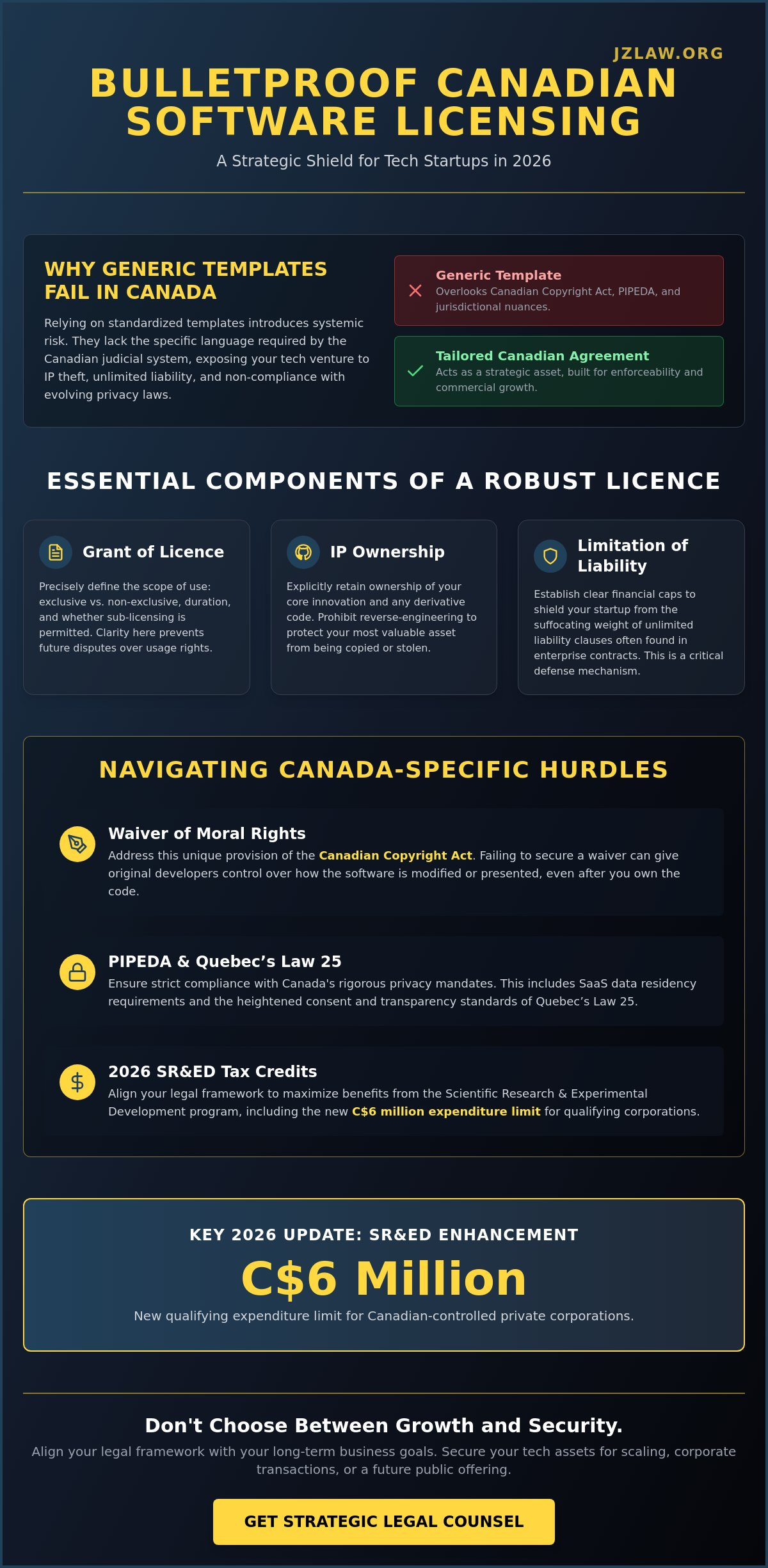
Grant of Licence: This clause must precisely define the scope of use, whether it's exclusive or non-exclusive, and the specific duration of the right to use. It should distinguish between internal business use and any potential for external sub-licensing.
Intellectual Property Ownership: You must explicitly retain title to the underlying code and all derivatives. The Canadian Intellectual Property Office notes that software is protected as a literary work, meaning your contract must reinforce these statutory protections to prevent unauthorized replication.
Payment and Audit Rights: In royalty-based or usage-dependent deals, you need transparent revenue reporting and the right to audit the licensee’s records to ensure you're receiving full value for your technology.
Termination and Wind-down: Clear protocols for termination protect your interests if a commercial relationship sours, outlining how data is returned and when access is revoked.
Warranties and Disclaimers: Manage expectations by defining software uptime and ensuring "as-is" delivery for specific modules to limit your exposure to performance-related claims.
Limitation of Liability: The Most Critical Clause
Canadian courts draw sharp distinctions between direct, indirect, and consequential damages. A well-drafted agreement sets a liability cap that reflects the actual contract value and aligns with your professional insurance coverage. This prevents a single technical failure from resulting in a catastrophic financial judgment that exceeds your company's total valuation. Liability caps typically do not extend to damages resulting from gross negligence or wilful misconduct. Engaging with strategic legal counsel ensures these caps are enforceable and tailored to your specific risk profile.
Indemnification and Third-Party Claims
Indemnification clauses are designed to protect the licensee from intellectual property infringement claims brought by third parties. It's essential to define your "duty to defend" and maintain control over any resulting litigation to manage costs effectively. Canadian startups must be particularly cautious with open-source components, as these can introduce hidden indemnification risks if not properly audited and disclosed within the licence framework. Proactive management of these claims is a cornerstone of high-level legal advice for tech startups canada, allowing founders to focus on growth rather than legal defense.
Navigating SaaS, Enterprise, and Open-Source Frameworks
The architecture of a software agreement is dictated by its deployment model, as the legal obligations for a cloud-based service differ fundamentally from those of locally installed applications. Selecting the appropriate framework requires a deep understanding of how your technology is delivered and maintained. For many founders, obtaining legal advice for tech startups canada is the first step in determining whether a Software-as-a-Service (SaaS) model or a traditional on-premise license better serves their commercial objectives. Each path carries distinct risks regarding data control, intellectual property protection, and service continuity. A Practical Law guide on software agreements emphasizes that the scope of use and risk allocation must be calibrated to the specific delivery method to remain enforceable under Canadian law.
Startups must also remain vigilant regarding open-source compliance. While integrating open-source components can accelerate development, "copyleft" licenses like the GPL can introduce the risk of "viral" licensing, potentially requiring you to disclose your proprietary source code to the public. Beyond internal development, structuring multi-tier distribution through white-labelling and reseller agreements allows for rapid scaling. These arrangements require precise language to ensure that your brand remains protected while your partners possess the necessary rights to market and support the software effectively.
The Shift to SaaS: Legal Implications for Data Control
In a SaaS environment, the focus shifts from physical code security to service availability and data integrity. Uptime guarantees within Service Level Agreements (SLAs) are not merely technical goals; they are binding legal commitments. Significant service outages in tech hubs like Calgary and Toronto can trigger heavy penalties or termination rights for the client. Furthermore, you must distinguish between data ownership and data processing rights. This is especially critical for ventures operating within the specialized parameters of cryptocurrency law, where blockchain-based software must comply with rigorous multi-tenant cloud regulations and decentralized data residency requirements.
Enterprise Software Negotiations
Large-scale enterprise deals often involve high-stakes negotiations where global buyers may demand "Most Favoured Nation" (MFN) clauses. These clauses can severely limit your future pricing flexibility by requiring you to offer the same or better terms to the enterprise client as you do to any other customer. Additionally, sophisticated buyers frequently insist on escrow agreements. These protect the buyer by providing access to the source code if the software provider faces insolvency. You must also be wary of "Work Made for Hire" pitfalls. This concept is a US legal doctrine that does not exist in the same form under the Canadian Copyright Act. Securing legal advice for tech startups canada ensures that your contracts correctly assign ownership of customizations without inadvertently surrendering your core intellectual property rights.
Canada-Specific Legal Hurdles: IP, Privacy, and Tax
Expanding a technology venture within the Canadian market requires an acute awareness of domestic statutes that often diverge significantly from international norms. Many founders assume that a contract enforceable in Silicon Valley will seamlessly apply in Toronto or Montreal, yet this oversight can lead to systemic vulnerabilities. Obtaining specialized legal advice for tech startups canada is essential for addressing the unique intersection of the Canadian Copyright Act, provincial privacy mandates, and complex tax withholding requirements. These factors don't just influence your legal standing; they directly impact your company's valuation and attractiveness to institutional investors.
International licensing also introduces fiscal complexities that require proactive structuring. When a Canadian company licenses software to foreign entities, or vice versa, withholding tax obligations can significantly erode profit margins if not properly managed through applicable tax treaties. Ensuring your licensing framework accounts for these "border-crossing" costs is a hallmark of a mature, scaling enterprise. To ensure your intellectual property and revenue streams remain protected under these specific conditions, engaging with JZ Law provides the strategic oversight necessary to navigate these high-stakes hurdles.
Protecting IP Under the Canadian Copyright Act
Under the Canadian Copyright Act, software is classified as a literary work, but a critical nuance lies in the concept of "moral rights." Unlike economic rights, moral rights remain with the original human author even after the copyright is assigned to a corporation, unless those rights are explicitly waived in writing. Without a robust waiver, an original developer could legally prevent certain modifications to the code, potentially paralyzing your product roadmap. It's also vital to distinguish between the assignment of IP, which transfers ownership, and licensing, which merely grants permission for use. Following recent legislative alignments, software protected by copyright in Canada generally benefits from a term of protection lasting for the life of the author plus 70 years as of 2026.
Privacy and Data Protection in Software Contracts
The regulatory environment is further complicated by the intersection of federal and provincial privacy mandates. While PIPEDA sets the federal standard, Quebec’s Law 25 introduces much more stringent requirements for companies handling data within that province, including mandatory breach notifications and the appointment of a dedicated privacy officer. Your software licenses and Data Processing Agreements (DPAs) must be meticulously drafted to satisfy these varying provincial commissioners. Furthermore, your architecture should support "Privacy by Design" legal standards, ensuring that data residency requirements are met, particularly in sectors where Canadian user data is legally required to be stored on domestic servers.
JZ Law: Strategic Counsel for High-Stakes Tech Ventures
In a commercial environment where technical innovation outpaces traditional regulation, the role of legal counsel must evolve from reactive document preparation to proactive strategic partnership. John Zang’s approach to technology law is defined by a rigorous commitment to precision, ensuring that every contractual detail aligns with the client’s broader business objectives. For founders seeking legal advice for tech startups canada, this means moving beyond basic compliance to build a legal framework that actively enhances corporate valuation. By integrating legal safeguards directly into the commercialization process, JZ Law provides the stability necessary for ventures to navigate the complexities of modern economic sectors.
The firm operates as a specialized boutique, offering high-level representation in highly regulated and innovative industries. Whether navigating the volatile requirements of Cryptocurrency Law, the shifting landscape of Cannabis Licensing, or the capital-intensive demands of the energy sector, the focus remains on long-term resilience. This specialized knowledge allows for the identification of risks that generalist firms might overlook, particularly when dealing with the intricate data residency and intellectual property hurdles discussed in previous sections. Proactive risk management is not merely a defensive measure; it's a strategic tool used to maximize the company’s appeal to institutional investors and potential acquirers. In a similar vein, many elite law firms are utilizing advanced technology to manage their own scaling, and you can discover Nexus Legal Group to see how growth infrastructure is transforming the legal industry.
The JZ Law Advantage in Tech Commercialization
Success in the Canadian tech landscape often requires a sophisticated understanding of cross-border transactions, particularly those involving the US market. JZ Law provides a distinct advantage by maintaining a "big picture" perspective, ensuring that licensing agreements and intellectual property protections are integrated into the company's broader corporate finance goals. Clients receive direct access to principal lawyer John Zang for high-stakes negotiations, ensuring that the firm's deepest expertise is applied to the most critical moments of a company's growth. This level of personalized, senior-level attention is essential for founders who require more than just a template-based approach to their legal needs.
Securing Your Future: IPO and Exit Readiness
Clean, well-structured licensing agreements are the bedrock of a successful exit strategy. During the due diligence process for a merger or acquisition, any ambiguity in the "chain of title" or intellectual property ownership can result in significant valuation haircuts or even the collapse of the deal entirely. As a venture matures, JZ Law assists in taking companies public, ensuring that the legal framework is robust enough to withstand the scrutiny of securities regulators and public market investors. By auditing your existing software contract portfolio for compliance today, you eliminate the legal debt that could hinder your progress tomorrow. Secure your company's future by consulting with a firm that understands the path from early-stage innovation to global market leadership.
Securing Your Intellectual Property for the 2026 Global Economy
The evolution of the Canadian technology landscape in 2026 demands a shift from generic templates to precision-engineered legal frameworks. A robust software license protects your core innovation from unauthorized sub-licensing while ensuring compliance with stringent domestic privacy and tax mandates. By addressing moral rights waivers and data residency requirements today, you eliminate the legal debt that often complicates future corporate transactions. It's about building a foundation that supports rapid scaling and international expansion without compromising your ownership.
Founders who seek specialized legal advice for tech startups canada gain more than a contract; they secure a strategic asset that drives long-term valuation. Principal lawyer John Zang brings deep expertise in complex regulatory sectors across Calgary, Toronto, and Vancouver, bridging the gap between technical code and IPO readiness. Whether your goal is navigating enterprise negotiations or preparing for a major exit, proactive risk management is your most effective tool. Consult with JZ Law for Expert Software Licensing Counsel to ensure your technology is protected by a framework built for the modern economy. Your innovation deserves a defense as sophisticated as the code itself.
Frequently Asked Questions
Do I need a Canadian lawyer if my software is sold globally?
Yes, you require domestic counsel because your corporate entity and primary intellectual property assets are anchored in Canadian law. A lawyer ensures your foundational contracts remain enforceable within your home jurisdiction while managing the complexities of international jurisdictional clauses. This prevents a situation where a foreign dispute inadvertently compromises your Canadian assets or operational stability.
What is the difference between an EULA and a Master Service Agreement (MSA)?
An End User License Agreement (EULA) focuses strictly on the individual's right to use the software, whereas a Master Service Agreement (MSA) governs the comprehensive commercial relationship between two business entities. MSAs typically establish high-level terms for payment, indemnification, and liability. They serve as an umbrella for specific statements of work or individual service orders.
Can I use a US-style "Work Made for Hire" clause in a Canadian contract?
You shouldn't rely on that specific terminology because "Work Made for Hire" is a US legal doctrine that has no direct equivalent under the Canadian Copyright Act. In Canada, you must use explicit language to assign ownership of intellectual property from the creator to the company. You must also obtain written waivers of moral rights to achieve the same level of protection.
How does PIPEDA affect my software licensing terms in 2026?
PIPEDA requires your licensing terms to include precise provisions regarding data collection, informed consent, and robust security protocols. In 2026, following the introduction of Bill C-36, you must also account for new transparency obligations regarding automated decision systems. Seeking legal advice for tech startups canada is the most reliable way to ensure your licenses reflect these updated federal mandates and data residency requirements.
What happens to my software licence if my company is acquired?
The continuity of your licenses depends on the "Assignment" and "Change of Control" clauses within your customer contracts. If these aren't carefully drafted, an acquisition could trigger termination rights for your clients or necessitate costly renegotiations. Ensuring these clauses permit a seamless transfer to an acquirer is a vital step in maintaining your company's valuation during an exit or funding round.
Is a click-wrap agreement legally enforceable in Canada?
Click-wrap agreements are generally enforceable in Canada provided the user has a reasonable opportunity to review the terms before acceptance. Canadian courts require that particularly onerous or unusual clauses be brought to the user's attention through distinct formatting or specific notice. The presentation must demonstrate a clear "meeting of the minds" between the provider and the user.
How do I handle "Moral Rights" in a software development contract?
You must obtain a written waiver of moral rights from every developer because these rights cannot be assigned or transferred under Canadian law. Moral rights allow an author to protect the integrity of their work and their right to be associated with it. Without a waiver, a developer could legally block future modifications or updates to your proprietary code, even if you own the copyright.
What are the risks of using open-source code in my proprietary software?
The primary risk involves "copyleft" or viral licensing, where the use of certain open-source components may legally require you to release your proprietary source code to the public. This can compromise your trade secrets and significantly diminish the commercial value of your technology. Obtaining legal advice for tech startups canada allows you to implement an open-source policy that identifies and mitigates these infringement risks before they affect your corporate valuation.



Comments