


Employee Stock Option Plans (ESOP) for Canadian Startups: A 2026 Legal Guide
- jzanglaw
- 7 hours ago
- 12 min read
A Canadian ESOP in 2026 is far more than a simple recruitment incentive; it has evolved into a sophisticated tax-deferral instrument that requires surgical precision to align with current corporate objectives. While the promise of equity remains the most potent tool for attracting elite talent, the underlying legal framework is fraught with complexities that can inadvertently penalize both the founder and the employee. You likely recognize the necessity of sharing ownership, yet the fear of triggering immediate tax liabilities or miscalculating the $200,000 annual vesting cap often creates significant hesitation during the structuring phase.
This guide offers a definitive roadmap to mastering the employee stock option plan for startups canada by providing the clarity needed to navigate the latest regulatory shifts. You'll learn how to leverage the 50% stock option deduction effectively, manage the two-year holding period for CCPC shares, and ensure your 2026 T4 reporting remains beyond reproach. We will analyze the strategic intersection of tax efficiency and corporate governance, providing you with a clear path toward a compliant, high-growth exit or initial public offering.
Table of Contents
Understanding the Strategic Role of ESOPs for Canadian Startups
The modern employee stock option plan for startups canada is a strategic bridge between current capital constraints and future enterprise value. At its core, an Employee stock option (ESO) provides the holder with the right to acquire shares at a set price after meeting specific performance or tenure milestones. This structure allows founders to preserve their liquid capital while offering a compelling value proposition to high-performing individuals who might otherwise be lured away by the immediate financial rewards of established corporations.
The "Equity Gap" represents the persistent disparity between the liquid capital available to early-stage ventures and the high-six-figure salaries offered by established global technology firms. By 2026, the rise of decentralized workforces has forced Canadian founders to look beyond local borders, meaning equity packages must now be competitive on a global scale. An ESOP effectively transforms an employee from a salaried worker into a stakeholder, aligning their personal financial success with the long-term appreciation of the company's valuation.
Alignment of interests is not merely about motivation; it's about disciplined retention. Through carefully designed vesting schedules, a company ensures that its most critical assets, its people, remain committed through the volatile cycles of early-stage growth. This approach shifts the focus from short-term gains to the collective pursuit of a significant liquidity event or market leadership.
Stock Options vs. Restricted Share Units (RSUs)
Early-stage startups almost exclusively prefer stock options because they offer superior tax deferral opportunities under Canadian law, particularly for Canadian-Controlled Private Corporations (CCPCs). While later-stage companies often transition to RSUs, which function more like a cash bonus paid in shares, options provide a unique cash-flow benefit by allowing the startup to compensate talent without depleting its bank account. The strike price is the predetermined cost at which an employee can purchase a share, which is typically set to match the Fair Market Value (FMV) of the stock at the time the option is granted.
The 'Golden Handcuffs' Effect
Designing a robust employee stock option plan for startups canada involves implementing a "cliff," usually set at one year, to ensure that equity is only earned by those who demonstrate long-term value. This "golden handcuffs" effect is essential for maintaining stability during rapid scaling phases. Properly structured plans ensure that equity holders are protected during strategic corporate transactions, facilitating a cleaner cap table for potential acquirers. Ultimately, the psychology of ownership fosters a culture of accountability and innovation that salary alone cannot replicate.
The Legal Framework: CCPCs and the Income Tax Act
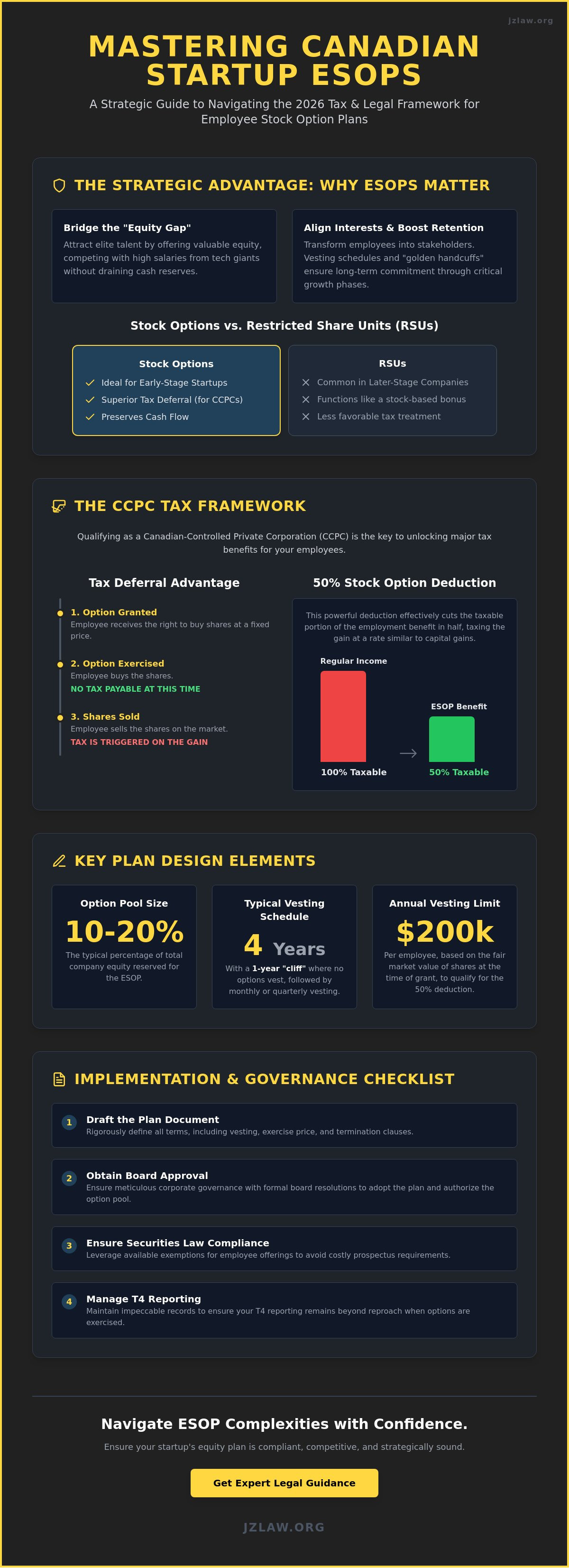
The Canadian-Controlled Private Corporation (CCPC) status isn't just a corporate label; it's the structural foundation for a tax-efficient employee stock option plan for startups canada. For a business to qualify as a CCPC, it must be a private corporation resident in Canada that isn't controlled, directly or indirectly, by non-residents or public corporations. This distinction is vital because the Income Tax Act grants CCPC employees a unique privilege: the deferral of taxation. Unlike employees of public or foreign-controlled firms who may face a tax bill the moment they exercise their options, CCPC employees typically don't pay tax until they actually sell the underlying shares.
Under the Canadian tax rules for employee stock options, specifically Sections 110(1)(d) and (d.1), qualifying individuals can access a 50% deduction on the taxable benefit. This effectively ensures that the gains from stock options are taxed at a rate similar to capital gains rather than ordinary income. Maintaining this status requires vigilant oversight of your cap table. A significant investment from a foreign venture capital firm or a change in board control can inadvertently strip a company of its CCPC status, triggering immediate tax liabilities for employees upon exercise and complicating your long-term equity strategy. Consulting with an expert in tax structuring ensures these nuances are handled before they become liabilities.
Eligibility for the 50% Deduction
To secure the 50% deduction, the strike price of the options must be equal to or greater than the Fair Market Value (FMV) of the shares at the time of the grant. If options are issued "in the money," meaning the strike price is lower than the current value, the tax treatment becomes significantly less favorable. For non-CCPCs, the rules are even more restrictive, often requiring a two-year holding period to qualify for similar deductions. The CRA remains highly active in auditing these arrangements, specifically looking for discrepancies between the granted price and the actual value of the company at that date.
Valuation Requirements in 2026
In 2026, relying on internal "back of the napkin" estimates for share pricing is a recipe for regulatory failure. An independent, professional valuation is essential to establish a defensible FMV, protecting employees from "phantom income" risks where they're taxed on perceived value that doesn't exist. Precision is the only defense against future audits. Backdating an option grant to a period of lower valuation is a serious legal violation that can lead to severe penalties and the loss of deduction eligibility for the entire plan.
Designing Your Plan: Key Terms and Mechanics
Designing a robust employee stock option plan for startups canada requires a methodical approach that balances long-term dilution with the immediate need to secure world-class talent. This process is not merely administrative; it's a foundational exercise in corporate governance. To ensure the plan is defensible and effective, founders should follow a disciplined five-step drafting process: first, authorize the option pool through board resolutions; second, draft the master ESOP document; third, establish the current Fair Market Value; fourth, issue individual grant agreements; and finally, ensure compliance with provincial securities regulators. Understanding How Employee Stock Options Work is fundamental for founders who wish to avoid common pitfalls during these early drafting stages.
Establishing the size of your option pool is a high-stakes decision that impacts every future funding round. Most early-stage Canadian startups reserve between 10% and 20% of their total equity for the initial pool. While a larger pool makes recruitment easier, it also dilutes existing shareholders, so precision in these calculations is paramount. Once the pool is set, the focus shifts to the vesting schedule. The industry standard remains a four-year "1/48th" schedule with a one-year cliff. This means an employee earns nothing until their first anniversary, at which point 25% of their options vest, with the remainder vesting monthly over the following three years.
Exercise periods also require careful consideration, particularly when an employee departs the organization. While the traditional "post-termination exercise window" is 90 days, many modern startups are extending this period to several years to be more employee-friendly. However, founders must weigh this generosity against the complexity of managing a cap table filled with former employees who may no longer be aligned with the company's current trajectory.
Standard vs. Accelerated Vesting
Vesting acceleration is a critical negotiation point for C-suite hires. A "single-trigger" provision allows options to vest immediately upon a change of control, such as an acquisition. Conversely, a "double-trigger" provision requires both an acquisition and the termination of the employee without cause. Most sophisticated boards prefer double-trigger acceleration because it incentivizes key talent to stay through the transition period, protecting the enterprise value for the acquirer.
The Shareholder Agreement (USA) Integration
Every option holder who exercises their right to buy shares must be legally bound by the company's main Shareholder Agreement. This integration is non-negotiable for founders looking toward future taking your cannabis company public or other exit strategies. Drag-along rights are particularly vital, as they prevent minority shareholders from blocking a sale that the majority of the board and shareholders have approved. Similarly, tag-along rights provide employees with the security that they can participate in a sale on the same terms as the founders. Typically, option holders shouldn't be granted voting rights until they've fully exercised their options and become shareholders of record.
The $200,000 Annual Cap and 2021 Tax Reforms
The implementation of the July 1, 2021, tax reforms represented a paradigm shift in how an employee stock option plan for startups canada is structured for high-growth firms. While the 50% deduction remains a cornerstone of Canadian equity compensation, the federal government introduced a $200,000 annual limit on the amount of options that can qualify for this preferential treatment. This cap is calculated based on the Fair Market Value (FMV) of the underlying shares at the time of the grant, not at the time of exercise. It's a critical distinction that requires founders to maintain meticulous records of their valuation history to avoid unforeseen tax burdens for their most senior hires.
Crucially, the "Startup Exemption" ensures that the vast majority of early-stage ventures remain unaffected by these restrictive measures. CCPCs are generally exempt from the $200,000 cap, as are non-CCPC employers with annual gross revenues of $500 million or less. This exemption is designed to preserve the competitive advantage of the Canadian tech ecosystem, allowing startups to continue using aggressive equity incentives without hitting the ceiling intended for mature, large-cap corporations. However, tracking the precise vesting dates is essential, as the cap applies to the year the options become exercisable. If an employee's total vesting in a single calendar year exceeds the $200,000 threshold, the excess is treated as a "non-qualified security," which carries different tax implications.
There's a strategic trade-off involved in these "non-qualified" grants. While the employee loses the 50% deduction on the excess amount, the corporation becomes eligible for a corporate tax deduction equal to the amount of the employment benefit. This shift can be advantageous for the company’s cash flow, provided the plan is documented with extreme precision. For founders managing complex cap tables or preparing for significant growth, engaging with professionals specializing in securities regulation is the only way to ensure these reporting nuances don't derail future investment rounds.
Who is Affected by the Cap?
The legislation targets "specified persons," which generally includes any employee who doesn't meet the startup exemption criteria. It's vital to recognize that the $200,000 limit applies across a group of "associated corporations." You can't bypass the cap by issuing options from multiple subsidiaries or related entities. Strategic planning is required for high-value hires, such as incoming CEOs, where a single grant could easily exceed the threshold over a standard four-year vesting period.
Compliance and Reporting Requirements
Employers have a mandatory obligation to notify the CRA of any "non-qualified" grants in the year the option agreement is entered into. For the 2026 tax year, you must use the specific reporting codes 38, 39, and 41 on T4 slips to ensure accurate benefit reporting. Failure to provide written notice to an employee that their options are non-qualified can result in the loss of the employer's corporate deduction. The employer must notify the CRA of any grants of non-qualified securities in the prescribed form along with the corporate tax return for the year the agreement was made.
Implementation: Securities Law and Board Governance
The successful execution of an employee stock option plan for startups canada requires more than just tax alignment; it demands rigorous adherence to provincial securities laws and internal corporate governance. Issuing options is technically a distribution of securities, which generally requires a prospectus unless a specific exemption applies. Most startups rely on the "Employee, Officer, Director, and Consultant" exemption, which allows the company to issue equity to internal stakeholders without the prohibitive costs of a formal filing. However, this exemption isn't automatic and requires the corporation to maintain precise records of all participants' roles, residency, and relationship to the firm.
Formal board approval is the cornerstone of this process. Every grant must be backed by a board resolution that specifies the number of options, the exercise price, and the vesting schedule. These documents must be meticulously filed in the corporate minute book, as any gap in documentation can create significant due diligence hurdles during future funding rounds or acquisitions. The individual grant letter must serve as a mirror to the Master ESOP document, ensuring that no conflicting terms are introduced that could jeopardize the plan's legal integrity or the employee's tax-deferred status.
Provincial Securities Regulation
While the federal framework provides the tax basis, securities regulation is managed at the provincial level, leading to variations in filing requirements between Ontario, British Columbia, and Alberta. For early-stage grants, founders often utilize the "Close Personal Friend" or "Business Associate" exemptions, though these must be used with extreme caution to avoid regulatory scrutiny. At JZ Law, we specialize in managing these multi-jurisdictional complexities, particularly for cryptocurrency startups that frequently operate across international borders and require specialized compliance strategies to navigate conflicting regional mandates.
The Path to Exit: ESOPs in M&A or IPO
As your startup approaches a liquidity event, the treatment of the employee stock option plan for startups canada becomes a central negotiation point. In a reverse merger or an IPO, unvested options are typically handled through tax-efficient rollovers into the acquiring company's equity plan, preserving the employee's 50% deduction eligibility. Ensuring these transitions are seamless requires a proactive approach that anticipates the needs of future underwriters or acquirers. If you're ready to secure your company's future and align your team's interests with a successful exit, contact John Zang at JZ Law for a strategic consultation on your startup's equity structure and long-term compliance needs.
Securing Your Startup’s Future through Strategic Equity
Implementing a robust employee stock option plan for startups canada is a delicate balance of tax efficiency and corporate foresight. We've explored how maintaining CCPC status provides an unparalleled deferral advantage, while the $200,000 annual vesting cap requires diligent tracking to protect your top-tier talent from unnecessary tax burdens. Success lies in the precision of your board governance and the clarity of your shareholder agreements during the drafting phase.
Navigating these complexities requires a partner who understands the intersection of law and innovation. John Zang brings specialized expertise in securities regulation and strategic tax structuring for global business hubs. Whether you're scaling a high-tech venture or require specialized counsel for cannabis startups, our proactive approach ensures your equity structure remains a powerful asset rather than a liability. Schedule a Strategic Consultation with John Zang today to align your corporate objectives with the latest 2026 regulatory requirements.
Building a legacy of ownership starts with a single, well-structured grant. Let's ensure your path to an exit is clear, compliant, and optimized for growth.
Frequently Asked Questions
What is the difference between a stock option and a grant of shares in Canada?
A stock option provides the right to purchase shares at a fixed price in the future, whereas a grant of shares results in immediate ownership. While direct share grants often trigger an immediate taxable benefit for the recipient, an employee stock option plan for startups canada allows for strategic tax deferral, as the tax event is postponed until the options are exercised or the shares are sold.
How is the exercise price of an option determined for a private company?
The exercise price must be set at or above the Fair Market Value (FMV) of the shares at the time the grant is issued. Since private company shares aren't traded on a public exchange, the board must rely on a formal, independent valuation to establish a defensible price that satisfies CRA requirements and ensures the employee remains eligible for the 50% tax deduction.
Can a Canadian startup grant options to US-based employees?
Yes, Canadian companies can issue options to US residents, but this requires strict adherence to both Canadian and American regulations. You must ensure the plan complies with Section 409A of the US Internal Revenue Code to avoid punitive taxes for the employee, while also managing the necessary filings with provincial and state securities regulators.
What happens to employee stock options if the company is acquired?
The outcome depends on the specific terms of your Master Plan, which typically provides for either acceleration or a rollover. Acceleration allows unvested options to vest immediately upon a change of control, while a rollover replaces the startup’s options with equivalent equity in the acquiring corporation, often preserving the employee's existing tax advantages.
Is the 50% stock option deduction still available in 2026?
The 50% stock option deduction remains fully available in 2026 for qualifying securities under the Income Tax Act. The federal government has maintained this incentive to support the growth of Canadian ventures, provided the options meet the necessary criteria regarding strike price and, for CCPCs, the required two-year holding period after exercise.
Do employees have to pay tax when they are first granted stock options?
No tax is payable at the time of the grant in Canada. The grant itself isn't considered a taxable event; instead, the tax liability is deferred until the employee exercises the options or, in the case of a CCPC, until they eventually sell the shares they acquired through the plan.
How do I calculate the $200,000 annual vesting limit for my employees?
The limit is calculated by multiplying the number of options that vest in a specific calendar year by the FMV of the shares at the time the options were granted. It's important to remember that this cap only applies to large-scale corporations with annual revenues exceeding $500 million, so most early-stage startups remain exempt from this restriction.
Can consultants and contractors participate in a Canadian ESOP?
Consultants and contractors can be included in an employee stock option plan for startups canada, though their tax treatment differs from that of full-time employees. They generally aren't eligible for the 50% stock option deduction under Section 110(1)(d), meaning their gains are typically taxed as business income rather than as a preferential employment benefit.


Comments