


Exempt Market Dealer Requirements Alberta: A 2026 Strategic Legal Guide
Within Alberta's sophisticated private capital markets, regulatory compliance is far more than a bureaucratic hurdle. It is a strategic asset that signals institutional-grade reliability to investors and partners alike. You likely find that the technical intricacies of National Instrument 31-103 and the shifting exempt market dealer requirements alberta present a significant challenge to operational efficiency. The cost of non-compliance is simply too high to ignore, yet the path to registration often feels obscured by dense legal jargon and evolving fee structures.
This guide clarifies the registration process by providing a rigorous roadmap through the current regulatory environment as of May 2026. You'll gain a precise understanding of the $50,000 minimum working capital threshold, the mandatory proficiency exams for dealing representatives, and the nuances of the latest ASC fee coordination policies. We'll also explore how your firm can leverage recent regulatory expansions, such as participation in prospectus offerings, to solidify its market position and ensure long term stability in the Alberta financial sector. By the end of this article, you'll have the clarity needed to align your firm's operations with the highest standards of securities regulation.
Key Takeaways
Identify the strategic role of Exempt Market Dealers within Alberta's energy and technology sectors under the National Instrument 31-103 framework.
Master the exempt market dealer requirements alberta regarding individual proficiency exams and the mandatory $50,000 working capital threshold.
Determine whether an EMD registration or a Portfolio Manager license offers the most efficient regulatory path for your firm's specific capital-raising goals.
Streamline your ASC application by understanding the critical phases of policy development and National Registration Database submissions.
Implement a proactive compliance framework to successfully manage ASC audit cycles and complex FINTRAC reporting obligations.
Table of Contents
Understanding the Exempt Market Dealer (EMD) Category in Alberta
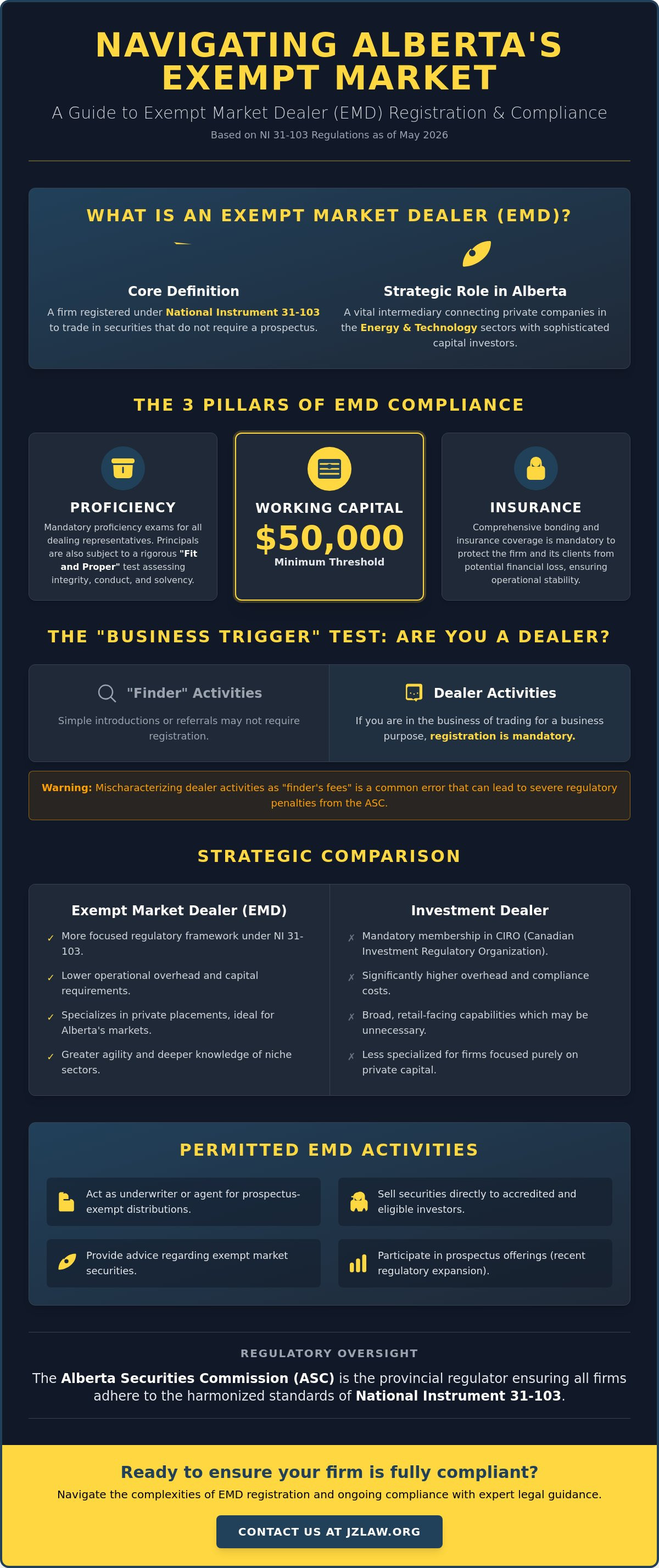
The Exempt Market Dealer (EMD) category represents a critical pillar of Canada's financial infrastructure. Defined under National Instrument 31-103, an EMD is a firm registered to trade in securities that don't require a prospectus. In the context of Alberta's unique economic landscape, these dealers act as vital intermediaries between private companies and sophisticated capital. While full Investment Dealer status requires membership in the Canadian Investment Regulatory Organization (CIRO) and carries significantly higher overhead, the EMD route offers a more focused regulatory framework. Many Alberta-based firms prefer this category because it aligns precisely with the needs of the energy and technology sectors, where private placements are the standard for capital raising.
Permitted activities for an EMD are specifically tailored to the exempt market. These firms can act as underwriters or agents for distributions made under prospectus exemptions, sell securities to accredited investors, and provide advice regarding those specific products. By specializing in this niche, dealers can navigate the exempt market dealer requirements alberta with greater agility than diversified brokerage houses. This focus allows for a deeper understanding of localized market trends, particularly in oil and gas exploration and emerging cryptocurrency ventures. It's a strategic choice for firms that prioritize efficiency and specialized market knowledge over the broad, retail-facing capabilities of a traditional brokerage.
The Legal Framework: NI 31-103 and the ASC
The Alberta Securities Commission (ASC) serves as the provincial regulator, ensuring that all market participants adhere to the standards set out in NI 31-103. This national instrument creates a harmonized hierarchy of regulations across Canada, though the ASC maintains local oversight to protect Alberta's specific market integrity. The Exempt Market serves as the primary engine for Alberta private equity, facilitating the flow of capital from sophisticated investors into high-growth ventures. Understanding this framework is the first step in establishing a compliant and sustainable dealing operation within the province.
When is EMD Registration Mandatory?
Determining whether registration is necessary hinges on the "Business Trigger" test. If an individual or firm is in the business of trading for a business purpose, registration is generally required. This often creates confusion for those who consider themselves finders. In Alberta, the distinction between a simple issuer and a dealer is sharp. Once you begin soliciting investors or receiving compensation for successful trades, you've likely crossed the threshold into dealer territory. Mischaracterizing these activities as finder's fees is a common error that can lead to severe regulatory penalties. Compliance requires a proactive assessment of your operational model to ensure you meet all exempt market dealer requirements alberta before engaging in any capital-raising activities.
The Core Requirements: Proficiency, Capital, and Insurance
Securing a license in Alberta's private markets demands more than a simple application; it requires a demonstrable commitment to professional standards and financial resilience. The Alberta Securities Commission (ASC) evaluates every applicant through a rigorous lens, focusing on three foundational pillars: individual proficiency, capital adequacy, and comprehensive insurance coverage. These exempt market dealer requirements alberta act as a safeguard for the province's investment ecosystem, ensuring that only those with the requisite expertise and fiscal stability can operate. Organizations such as the Private Capital Markets Association of Canada (PCMA) provide essential advocacy and resources for firms attempting to navigate these complex benchmarks in a shifting economic climate.
The Alberta Securities Commission also applies a "Fit and Proper" test to all principals and significant shareholders. This assessment scrutinizes personal integrity, past business conduct, and overall financial solvency to ensure the leadership team is capable of upholding fiduciary duties. It's a holistic review that leaves little room for ambiguity or past regulatory oversights. Maintaining these exempt market dealer requirements alberta is an ongoing obligation that extends far beyond the initial registration date. Seeking professional guidance in securities regulation can help your firm address potential red flags and build a robust compliance culture before the ASC begins its formal review process.
Individual Proficiency for Dealing Representatives
Dealing representatives must meet specific educational benchmarks, typically passing the Canadian Securities Course (CSC) and the Exempt Market Products Exam. For Calgary-based representatives, these qualifications serve as the mandatory baseline for registration. The Chief Compliance Officer (CCO) requires even more substantial industry experience, often involving several years in a regulated management role. While the ASC may grant exemptions based on prior professional history, these aren't guaranteed and require rigorous documentation of equivalent expertise.
Financial Solvency and Reporting
Financial stability is measured by a $50,000 minimum working capital requirement, calculated via Form 31-103F1. Firms must also maintain bonding or insurance of at least $50,000 per employee to mitigate operational risks. The Ultimate Designated Person (UDP) is responsible for this financial oversight, ensuring that audited financial statements reach the ASC by the annual deadline. Failure to maintain these levels can lead to immediate regulatory intervention or the suspension of trading activities.
Strategic Comparison: EMD vs. Investment Dealer and Portfolio Manager
Selecting the appropriate registration category is a pivotal business decision that extends beyond mere legal compliance. For firms entering the Alberta capital markets, the exempt market dealer requirements alberta offer a specialized and cost-effective alternative to the broader Investment Dealer or Portfolio Manager categories. This strategic choice is particularly relevant for entities focusing on private equity, venture capital, or localized energy financing where the primary objective is the distribution of exempt securities rather than broad retail brokerage. Understanding these distinctions allows a firm to align its regulatory overhead with its actual business activities.
The cost-benefit analysis for a venture capital fund often favors the EMD license due to its focused scope. While an Investment Dealer can trade any security, the EMD category is purpose-built for the exempt market. This focus results in more predictable compliance costs and a more streamlined path to market entry. For many Alberta firms, the ability to underwrite and sell prospectus-exempt securities provides all the necessary legal authority to execute their business plan without the unnecessary complexity of a full-service brokerage license.
The CIRO vs. ASC Divide
Exempt Market Dealers operate directly under the oversight of the Alberta Securities Commission without the mandatory requirement to join the Canadian Investment Regulatory Organization (CIRO). This distinction is vital for Calgary-based startups and boutiques because it bypasses the significant membership fees and higher capital thresholds associated with CIRO. For instance, the $50,000 minimum working capital required for an EMD is substantially lower than the requirements for Investment Dealers, making it a more accessible entry point for Strategic Corporate Transactions. By operating under the ASC, firms can maintain a leaner operational structure while still meeting all exempt market dealer requirements alberta.
Portfolio Management Restrictions
It's essential to understand that an EMD license doesn't permit discretionary management of client accounts. If your business model involves making investment decisions on behalf of clients without obtaining their specific consent for every individual trade, a Portfolio Manager (PM) registration is required. EMDs are generally restricted from providing broad retail access, as they must ensure that the products they sell are suitable for the specific investor classes permitted under prospectus exemptions. Detailed guidance on these boundaries can be found in the ASC Policy and Procedures Manual for EMDs. As an Alberta firm scales, it may choose to transition from a pure EMD to a hybrid model that includes PM registration to offer more comprehensive wealth management services.
The Registration Roadmap: Navigating the ASC Process
The transition from conceptual understanding to active registration requires a methodical, four-phase approach. Successfully meeting the exempt market dealer requirements alberta is not merely about submitting forms; it's about demonstrating a functional compliance infrastructure to the Alberta Securities Commission. This process begins with corporate structuring and the development of internal controls, followed by the formal submission through the National Registration Database (NRD). Once the filing is live, the ASC initiates a detailed review period that often involves multiple rounds of information requests before final approval is granted.
A successful application hinges on the quality of the initial submission. While technical filing instructions are available, they don't capture the strategic preparation required to survive the ASC's scrutiny. Each phase of the roadmap must be treated as a building block for institutional trust. From the initial policy drafting to the final post-registration filings, every step requires a high degree of precision to avoid the common pitfalls that lead to multi-month delays or outright denials.
Drafting the Compliance Manual
The compliance manual serves as the operational heart of your firm. The ASC frequently identifies "template" manuals as a significant red flag, as they often fail to reflect the actual business activities of the applicant. Your policies must be meticulously customized to address Know Your Client (KYC) and Know Your Product (KYP) obligations, ensuring that every trade is suitable for the specific investor. For firms operating within innovative sectors, such as digital assets, it is vital to incorporate specific Cryptocurrency Law considerations to satisfy regulatory expectations regarding custody and valuation.
The ASC Review and Interview
During the review phase, the ASC often conducts a "pre-registration" interview, typically at their Calgary offices. This meeting is designed to assess the proficiency and readiness of the Ultimate Designated Person (UDP) and the Chief Compliance Officer (CCO). Common delays in Alberta arise when applicants provide vague responses to "deficiency letters," which are official documents outlining gaps in the initial filing. Responding to these with legal precision is essential to keep the application moving forward. If you require assistance in preparing your firm for this level of scrutiny, our team provides comprehensive support in Securities Regulation to ensure your roadmap remains on track.
Ongoing Compliance: Protecting the License and Mitigating Risk
Compliance functions as the bedrock of a sustainable financial practice in Calgary and beyond. Once you've successfully navigated the initial exempt market dealer requirements alberta, your strategic focus must shift toward preservation and risk mitigation. The Alberta Securities Commission maintains a systematic audit cycle designed to verify that your firm's daily operations align perfectly with your written policies and procedures. These reviews aren't mere formalities; they're rigorous examinations of your transaction history, client files, and due diligence records. A single oversight in documentation or a failure to update a compliance manual can jeopardize your registration, making a proactive approach a necessity rather than a secondary concern.
Conflict of interest management represents another critical area of continuous regulatory scrutiny. EMDs must identify, disclose, and, where possible, avoid conflicts that could compromise their professional judgment or fiduciary responsibilities. This process requires a transparent framework where every potential bias is documented and communicated to the client in a prominent and timely manner. Engaging experienced legal counsel to maintain an institutional-grade compliance program ensures that your firm remains resilient against shifting regulatory expectations. By treating compliance as a dynamic strategy, you protect your license while building a reputation for integrity that attracts sophisticated investors.
KYC, KYP, and Suitability
The integrity of the exempt market rests on three pillars: Know Your Client (KYC), Know Your Product (KYP), and Suitability. These aren't just administrative hurdles; they're your primary defense against litigation and regulatory sanctions. Every investment recommendation must be backed by a thorough analysis of the client's financial position and the specific risks of the security in question. This is particularly vital in complex sectors like Real Estate Law, where private placements often involve long term illiquidity and specific project risks that must be clearly explained to the investor. Documenting these conversations with precision is the only way to safeguard your firm against future claims of unsuitability.
FINTRAC and Anti-Money Laundering (AML)
Anti-Money Laundering (AML) obligations under FINTRAC add a significant layer of operational complexity to the 2026 regulatory landscape. Alberta financial entities are required to report suspicious transactions and maintain detailed records of client identification to prevent illicit funds from entering the capital markets. Failure to implement a robust AML regime can result in substantial administrative monetary penalties and permanent reputational damage. The Compliance Officer plays a central role in AML oversight, acting as the primary point of contact for regulators and ensuring that all staff are trained to recognize red flags in real time. This vigilant approach is essential for maintaining the high standards expected of an EMD operating in Alberta's sophisticated economy.
Securing Your Future in Alberta’s Private Capital Markets
Mastering the exempt market dealer requirements alberta is a continuous commitment to excellence rather than a one-time administrative task. Success in this sophisticated sector demands a precise alignment of your firm's capital structure, professional proficiency, and internal compliance protocols. By prioritizing institutional-grade standards from the outset, you position your organization to capitalize on Alberta's robust energy and technology markets while effectively mitigating the risks of regulatory intervention.
Navigating the ASC's expectations requires a strategic partner who understands the complex intersection of securities regulation and corporate finance. John Zang provides expert counsel specifically tailored for Calgary and global business hubs; he offers specialized knowledge in niche regulatory sectors to ensure your operations remain beyond reproach. Whether you're structuring a new dealer or refining an existing compliance framework, professional guidance is the most effective way to safeguard your market position and build lasting investor trust.
Consult with John Zang for Strategic EMD Registration and Compliance to transform regulatory hurdles into competitive advantages. Your firm's long term stability starts with a foundation of legal precision and proactive risk management.
Frequently Asked Questions
How long does it take to become an Exempt Market Dealer in Alberta?
The registration process generally spans three to six months from the initial filing date. This timeline depends heavily on the complexity of your business model and the precision of your initial documentation. Providing a comprehensive compliance manual and responding promptly to ASC deficiency letters can prevent unnecessary delays during the review phase.
What is the minimum capital required for an EMD in Alberta?
Alberta firms must maintain a minimum working capital of $50,000 at all times to satisfy the regulatory framework. This amount is calculated according to Form 31-103F1 and represents the excess capital available after accounting for all liabilities. It serves as a vital financial buffer to ensure the firm can meet its operational obligations to clients and regulators.
Can an Alberta EMD sell securities to investors in other provinces?
You can sell to investors in other jurisdictions provided you are registered as an EMD in each of those specific provinces. While National Instrument 31-103 harmonizes many rules, you must still pay the relevant provincial fees and adhere to local variations in securities law. This multi-jurisdictional approach is a common strategy for Alberta firms seeking broader capital pools.
Do I need a law degree to be the Chief Compliance Officer of an EMD?
A law degree isn't a mandatory requirement for a Chief Compliance Officer under current ASC regulations. However, the candidate must satisfy specific proficiency benchmarks, such as passing the Canadian Securities Course and the Exempt Market Products Exam. The regulator also requires several years of relevant management or compliance experience within the financial services industry to ensure effective oversight.
What is the difference between an Accredited Investor and a Self-Certified Investor in Alberta?
Accredited investors meet high income or asset thresholds defined under NI 45-106, such as earning $200,000 annually. In contrast, self-certified investors are a category specific to Alberta and Saskatchewan for individuals who don't meet accredited status but possess sufficient financial knowledge. These self-certified participants are subject to annual investment limits to balance market access with investor protection.
Can an EMD also be an issuer of its own securities?
An EMD is permitted to act as the dealer for its own securities or those of a related issuer. This arrangement requires a rigorous disclosure of the conflict of interest to all potential investors before any trade occurs. Your compliance framework must clearly outline how these internal transactions are handled to ensure that suitability assessments remain objective and transparent throughout the process.
How often does the ASC audit Exempt Market Dealers?
The ASC doesn't follow a fixed schedule but instead employs a risk-based approach for compliance reviews. Most firms can expect an audit every three to five years, though new registrants or firms in high-risk sectors may face more frequent scrutiny. Maintaining institutional-grade records of every transaction is the most effective way to prepare for these unannounced examinations and meet the exempt market dealer requirements alberta.
What insurance is mandatory for an Alberta EMD firm?
Every firm must maintain a Financial Institution Bond or equivalent insurance coverage to satisfy provincial standards. The mandatory minimum is $50,000 per employee or $200,000, whichever is less. Additionally, dealers holding or having access to client assets must secure bonding equal to 1% of those assets, up to a maximum of $25,000,000, to mitigate potential operational risks.



Comments