


Founder Dispute Resolution Lawyer NYC: Strategic Counsel for High-Stakes Business Divorce
- jzanglaw
- May 8
- 12 min read
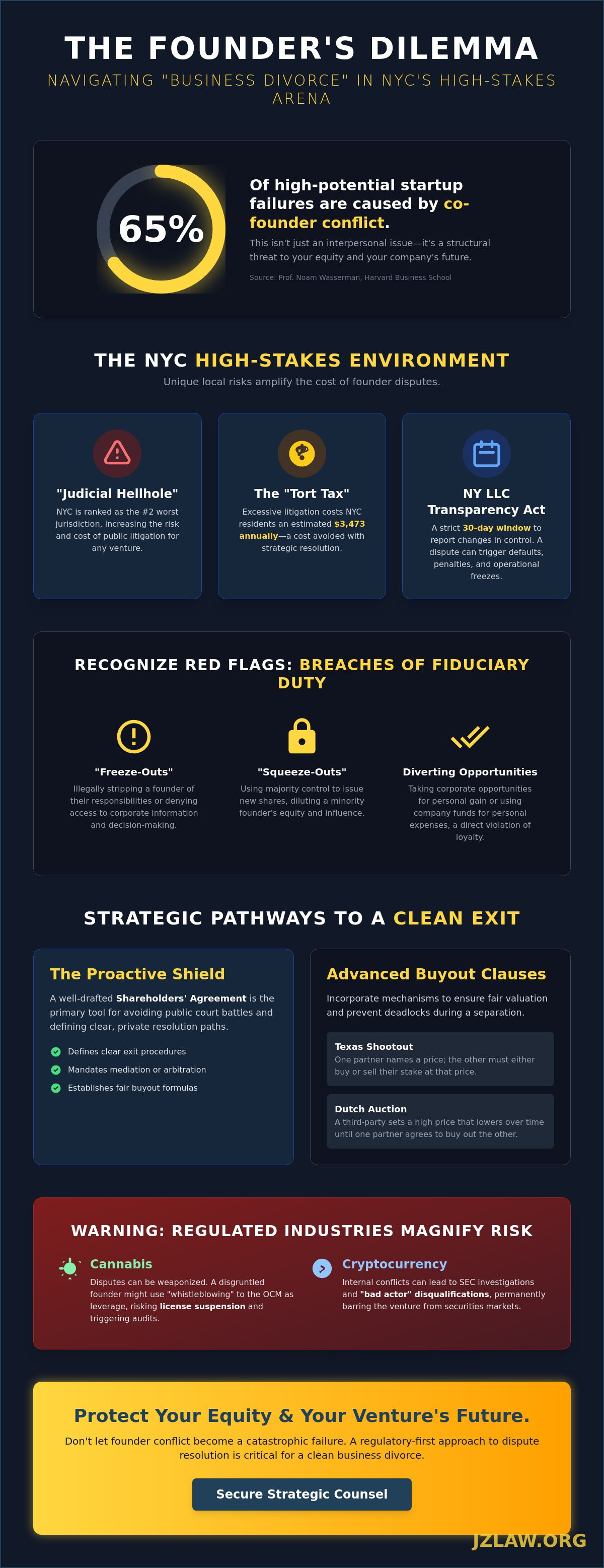
Harvard Business School Professor Noam Wasserman found that co-founder conflict causes 65% of high-potential startup failures. You likely recognize that internal disputes are not merely interpersonal issues; they represent a structural threat to your equity and your company's standing. In a city ranked as the second-worst "Judicial Hellhole" for 2025-2026, the risk of public litigation is a significant burden on any venture. Partnering with a founder dispute resolution lawyer NYC ensures you protect your assets through strategic, "regulatory-first" counsel. This article explains how to achieve a clean business divorce while retaining control of your intellectual property and maintaining operational stability. You'll discover how to manage these high-stakes transitions without triggering regulatory defaults under the New York LLC Transparency Act that took effect January 1, 2026, or jeopardizing standing in cannabis and crypto markets. We'll also address how to avoid the $3,473 annual "tort tax" often associated with excessive litigation costs in local courts.
Key Takeaways
Identify the specific legal mechanisms under the NY Business Corporation Law that govern the dissolution of corporate partnerships and the protection of your equity.
Discover how a founder dispute resolution lawyer NYC can prevent a "business divorce" from triggering catastrophic regulatory defaults in the cannabis or cryptocurrency sectors.
Master the strategic application of "Texas Shootout" and "Dutch Auction" clauses to ensure a fair valuation and a clean exit from failing founder relationships.
Implement immediate protective measures, such as securing corporate records and auditing fiduciary duties, to minimize operational disruption and legal exposure.
Gain insights into the advantages of cross-border legal strategy for founders operating between the NYC, Toronto, and Berlin markets.
Table of Contents
Navigating the "Business Divorce": Founder Disputes in NYC
The term "business divorce" describes the legal termination of a professional partnership, a process that requires a specialized founder dispute resolution lawyer NYC to manage effectively. In the context of New York’s corporate environment, this is not merely a contract dispute; it is a specialized branch of law that balances the New York Business Corporation Law (BCL) with the fast paced demands of the venture capital ecosystem. New York is a unique jurisdiction because the BCL provides specific, rigid frameworks for judicial dissolution, particularly under Sections 1104 and 1104-a. These statutes allow shareholders to petition for the dissolution of a corporation when directors are deadlocked or when those in control have engaged in oppressive conduct. Success in these high stakes environments depends on shifting your mindset from seeing a co-founder as a partner to viewing them as a strategic adversary. This transition must happen early to protect your equity before the conflict goes public.
The Legal Landscape of NYC Business Divorce
The NYC Commercial Division courts are designed for efficiency in corporate matters, yet they remain a rigorous venue for those without a clear paper trail. While many startups in Brooklyn or Manhattan tech hubs begin with handshake deals, these informal arrangements lead to the most complex and expensive litigation. A well drafted Shareholders’ Agreement is the primary tool for avoiding the "tort tax" that costs New York residents approximately C$3,473 annually due to excessive litigation. This document defines the resolution paths, whether through mandatory mediation or specific buyout formulas. Without these pre-defined exits, founders are left to the mercy of statutory defaults, which rarely favor the minority shareholder or the visionary who lacks formal board control.
Fiduciary Duties: The NYC Standard
Under New York law, founders who serve as directors or officers owe a strict duty of loyalty and care to the corporation and its shareholders. This legal standard is the highest known to law, requiring individuals to put the company’s interests above their own. Common tactics like "freeze-outs" or "squeeze-outs," where a founder is stripped of their responsibilities or denied access to corporate information, trigger immediate legal liability. It’s essential to document every breach of these duties as they occur. When a partner begins diverting corporate opportunities or using company funds for personal legal expenses, they provide the leverage needed for a favorable settlement. Strategic representation ensures these breaches are identified and used to secure a fair valuation during the separation process.
Triggers for Conflict in Regulated NYC Industries
In highly regulated sectors, a founder dispute is rarely a private matter. It quickly evolves into a regulatory crisis that can threaten the company's very right to operate. A founder dispute resolution lawyer NYC must evaluate how internal friction impacts standing with authorities like the Office of Cannabis Management (OCM) or the SEC. Many high growth ventures overlook "change of control" provisions in their operating licenses. If a dispute leads to a mandatory buyout or a shift in voting power, it might require immediate notification to state authorities. Failure to report these changes within the 30 day window mandated by the New York LLC Transparency Act, which took effect January 1, 2026, can lead to significant penalties and operational freezes. If you are taking your cannabis company public, an unresolved litigation can halt the entire process, as underwriters demand absolute clarity on ownership structures.
Cannabis and Crypto: The Regulatory Trap
For NYC cannabis businesses, the risks of a public lawsuit are particularly acute. The OCM maintains strict compliance standards regarding beneficial ownership. A disgruntled founder might use the threat of "whistleblowing" to the OCM or FINRA as leverage, alleging minor compliance lapses to trigger an audit. This type of regulatory blackmail can lead to the suspension of retail or cultivation licenses. In the crypto sector, "bad actor" disqualifications can permanently bar a venture from securities markets. Strategic silence during a founder exit is often more valuable than aggressive litigation. Maintaining a clean regulatory record requires a disciplined approach to disclosures, ensuring that a "business divorce" doesn't inadvertently signal instability to oversight bodies. If you face these complexities, seeking strategic legal counsel early can prevent a private disagreement from becoming a public regulatory failure.
IP and Trade Secret Theft in NYC Tech
The "departing founder" scenario often involves the misappropriation of proprietary code or client lists. Protecting these assets in 2026 requires navigating new labor protections, such as the New York "Trapped at Work" Act. Effective December 19, 2025, this act prohibits employers from imposing heavy financial penalties on departing employees, which complicates traditional non-compete enforcement. Founders must rely on robust IP assignments and trade secret protections rather than broad restrictive covenants. When digital assets are involved, we utilize cryptocurrency law frameworks to track and recover misappropriated tokens or private keys. Every breach of duty must be documented with precision to ensure that intellectual property remains with the entity, not the individual.
Strategic Resolution Frameworks: Buyouts vs. Dissolution
Choosing between a negotiated buyout and a court ordered dissolution requires a calculated assessment of the company’s remaining value and current liabilities. A founder dispute resolution lawyer NYC provides the necessary framework to evaluate these paths while minimizing the risk of a public, value destroying legal battle. Most resolutions involve strategic corporate transactions designed to facilitate a clean break. These transactions often employ specific clauses like the "Texas Shootout," where one party sets a price and the other decides whether to buy or sell at that valuation, or a "Dutch Auction" to determine the market clearing price for a founder’s interest. Tax structuring is equally vital; a poorly planned exit can trigger immediate capital gains liabilities that significantly erode the settlement value for both the departing and remaining parties.
The Buyout: Valuation and Terms
Valuation remains the most contentious point in any buyout negotiation. NYC firms typically utilize Discounted Cash Flow (DCF) analyses or market multiples based on recent industry benchmarks. To protect company liquidity, payouts are often structured as a combination of an initial lump sum and subsequent earn-outs tied to performance metrics. This structure ensures the business remains operational while the departing founder receives fair compensation. Every buyout must conclude with a "Global Release" agreement. This document prevents future litigation by discharging all known and unknown claims related to the partnership, providing the finality required for both parties to move forward.
Judicial Dissolution: The Nuclear Option
When negotiations reach an irreconcilable deadlock, judicial dissolution under the NY BCL becomes the nuclear option. This process involves a court ordered wind down and liquidation of assets. However, NY BCL § 1118 provides a "Right of Election," allowing the corporation or other shareholders to buy out the petitioner’s shares at their "fair value" to avoid total liquidation. This is particularly relevant for ventures with significant real estate holdings or long term commercial leases in Manhattan, as a forced sale can lead to suboptimal returns. The filing fee for a Certificate of Dissolution in New York is a modest C$60, but the legal costs of reaching that stage often reflect the local average litigation rate of C$430 per hour. Strategic representation focuses on using the threat of dissolution as leverage to secure a more favorable negotiated settlement before the court intervenes.
Immediate Actions for Founders Facing a Dispute
The initial 48 hours following the breakdown of a founder relationship determine whether you'll settle favorably or face a protracted legal battle in the NYC Commercial Division. You must immediately secure all corporate records, capitalization tables, and financial statements to prevent the "disappearance" of critical evidence. Review your Shareholders’ Agreement and Bylaws specifically for "Notice" requirements; failing to provide formal notice of a dispute as defined in your contract can waive your right to certain remedies. You should also begin a comprehensive audit of communication logs across Slack, email, and WhatsApp. These records often contain the first evidence of a fiduciary breach or the diversion of corporate opportunities. Engaging a founder dispute resolution lawyer NYC who understands the nuances of securities regulation is essential if your venture involves complex equity structures or plans for a public offering. Finally, maintain "business as usual" operations. Any sudden change in your performance or interference with company contracts can be framed as "intentional interference," giving your adversary grounds for a counter-suit.
Evidence Preservation in NYC Litigation
New York law imposes a strict requirement for a "Litigation Hold" once a dispute is reasonably anticipated. You must not delete any messages or documents, even if you believe they are damaging to your position; spoliation of evidence can lead to severe judicial sanctions that jeopardize your entire case. We often utilize forensic accountants to identify "hidden" founder distributions or unauthorized personal expenses charged to the company. Given that the average hourly rate for a civil litigation lawyer in New York is C$430, precision in evidence gathering is the most effective way to control costs. Strategic documentation allows your legal team to build a narrative of fiduciary breach before the first motion is even filed. If you suspect your partner is misappropriating assets, you should consult with a strategic partner to implement protective measures immediately.
Managing External Perception
A founder fight can trigger a mass exodus of talent or cause investors to pull funding during sensitive rounds. You must handle communications with Venture Capitalists and Angel investors with extreme care, providing only the information required by your financing agreements. Avoid public "wars of words" in the NYC tech press, as these rarely benefit the company’s valuation and often lead to "bad actor" labels that haunt future ventures. Retention of key employees is paramount; you must project stability while the legal process unfolds behind the scenes. In a city where the annual "tort tax" per resident exceeds C$3,473, staying out of the public eye and resolving matters through confidential mediation is often the most profitable path for all stakeholders.
Why JZ Law is the Strategic Choice for NYC Founder Resolution
JZ Law operates at the intersection of sophisticated corporate law and high stakes regulatory compliance, providing a level of precision that larger, generalist firms often struggle to replicate. John Zang brings a unique background in navigating the most demanding regulatory environments, ensuring that your "business divorce" is handled with the discretion and strategic foresight required to protect your professional reputation. Our firm’s philosophy centers on "Preventative Litigation," a proactive approach where we resolve disputes through structured negotiation and mediation before they reach the public record. In an era where total litigation spending is projected to reach C$44.8 billion in 2026, avoiding the courtroom is not just a legal preference; it is a vital financial strategy. Engaging a founder dispute resolution lawyer NYC at JZ Law means you gain a partner who understands that your operational licenses and equity are inseparable from your legal standing.
Boutique Focus, Global Reach
Working with JZ Law ensures you receive direct counsel from a principal lawyer rather than being handed off to a junior associate. This boutique focus allows for a deeper understanding of your specific business interests, whether you are managing a tech startup in Manhattan or navigating the complexities of oil and gas law in global energy hubs. We are uniquely positioned to handle cross border disputes involving jurisdictions in NYC, Toronto, and Berlin, providing a seamless legal strategy for founders with international operations. Our commitment to discretion is absolute; we recognize that for 65% of high potential startups, the primary risk of failure is internal conflict, and we work methodically to resolve these issues while preserving the company’s market value and investor confidence.
Contact JZ Law for a Strategic Consultation
The first step in securing your company’s future is a confidential, thorough review of your existing shareholder agreements and corporate bylaws. During your initial consultation, we will audit your current legal exposure and identify the most efficient path toward a resolution that protects your control and intellectual property. To maximize the effectiveness of this meeting, please bring all relevant founding documents, capitalization tables, and a timeline of the recent conflict. With the average hourly rate for New York lawyers reaching C$426 in 2026, early intervention is the most effective way to manage your legal budget while securing a fair valuation. Protect your company’s future-consult with JZ Law today.
Secure Your Professional Legacy and Equity
Resolving a high stakes partnership conflict requires more than just litigation; it demands a strategic partner who understands the intersection of corporate law and industry-specific regulations. You've learned that a regulatory first lens is essential to prevent internal friction from triggering defaults with the Office of Cannabis Management or the SEC. By utilizing structured frameworks like negotiated buyouts or tax-efficient corporate transactions, you can achieve a clean business divorce that preserves both your capital and your reputation. Partnering with a founder dispute resolution lawyer NYC provides the principal led counsel necessary to navigate these complexities across global hubs like Toronto and Berlin. John Zang’s expertise in IPO track companies and digital asset classes ensures that your exit is not only legally sound but also operationally safe. Don't let a temporary deadlock dictate the long term trajectory of your venture. Secure your equity and resolve your dispute-Contact JZ Law NYC to implement a preventative litigation strategy today. Your company’s future stability depends on the decisive actions you take now.
Frequently Asked Questions
Can I fire my co-founder if we both own 50% of the company?
Firing a co-founder in a 50/50 ownership structure is typically impossible without a court order or a specific provision in your Shareholders’ Agreement. In New York, this situation creates a legal deadlock that often leads to a petition for judicial dissolution under NY BCL Section 1104. You'll need a founder dispute resolution lawyer NYC to negotiate a buyout or structure a voluntary exit. Without a tie-breaking mechanism, neither party has the unilateral authority to terminate the other's employment or ownership.
What happens to my unvested equity if I am forced out of my NYC startup?
Unvested equity is typically forfeited upon termination unless your agreement contains specific "Good Leaver" protections. Most NYC startup contracts follow a four year vesting schedule with a one year cliff. If you're forced out before these milestones, you generally lose those shares. However, if the termination constitutes a breach of contract or fiduciary duty, you may have grounds to claim the equity's value during settlement negotiations.
How much does a founder dispute lawyer in NYC cost?
Legal fees for resolving a founder dispute depend on the complexity of the case and the chosen resolution path. As of May 2026, the average hourly rate for a civil litigation lawyer in New York is C$430. A negotiated settlement might cost between C$15,000 and C$50,000, while a full judicial dissolution process in the Commercial Division can exceed C$150,000. Investing in early mediation often reduces these costs significantly compared to protracted court battles.
Will a founder dispute prevent my company from going public (IPO)?
Unresolved founder disputes will almost certainly prevent a company from completing an Initial Public Offering (IPO). Underwriters and the SEC require absolute clarity on ownership and a clean cap table before a company can go public. Any pending litigation regarding equity or control must be disclosed in the S-1 filing, which usually scares off institutional investors. Solving these conflicts through a founder dispute resolution lawyer NYC is a prerequisite for any successful exit strategy.
What is a "freeze-out" and is it legal under New York law?
A "freeze-out" occurs when majority shareholders attempt to force a minority founder out by cutting off dividends, salary, or access to company information. While common in contentious business divorces, these actions are often illegal under New York law as they violate the fiduciary duty of loyalty and fair dealing. Courts in NYC frequently intervene in these cases to protect minority rights or order a buyout of the oppressed shareholder's interest at fair value.
Can we use mediation to resolve a founder dispute instead of going to court?
Mediation is a highly effective, confidential tool for resolving founder disputes without the public exposure of a courtroom. It allows parties to reach a private "business divorce" agreement that addresses equity, IP, and non-compete terms simultaneously. Unlike NYC courts, which are subject to public record requirements, mediation keeps your company’s internal struggles away from competitors and the press. It's often the fastest way to preserve the operational integrity of a venture during a transition.
How long does a typical "business divorce" take in NYC?
The duration of a business divorce in NYC varies from three months to over two years depending on the level of cooperation. A negotiated buyout facilitated by legal counsel typically concludes within 90 to 180 days. In contrast, a contested judicial dissolution in the New York Supreme Court can take 18 to 24 months to reach a final judgment. Early intervention and a focus on "preventative litigation" are the most effective ways to shorten this timeline.
What should I do if my co-founder is stealing company intellectual property?
You must immediately file for a temporary restraining order (TRO) and issue a formal litigation hold if you suspect IP theft. This prevents the co-founder from further using or transferring proprietary code, client lists, or trade secrets. You should also engage forensic technology experts to audit company servers and Slack logs for evidence of unauthorized data exports. Prompt legal action is necessary to maintain the company’s valuation and its standing with investors and regulatory bodies.


Comments