


Fractional General Counsel Cost NYC: 2026 Pricing & ROI Guide
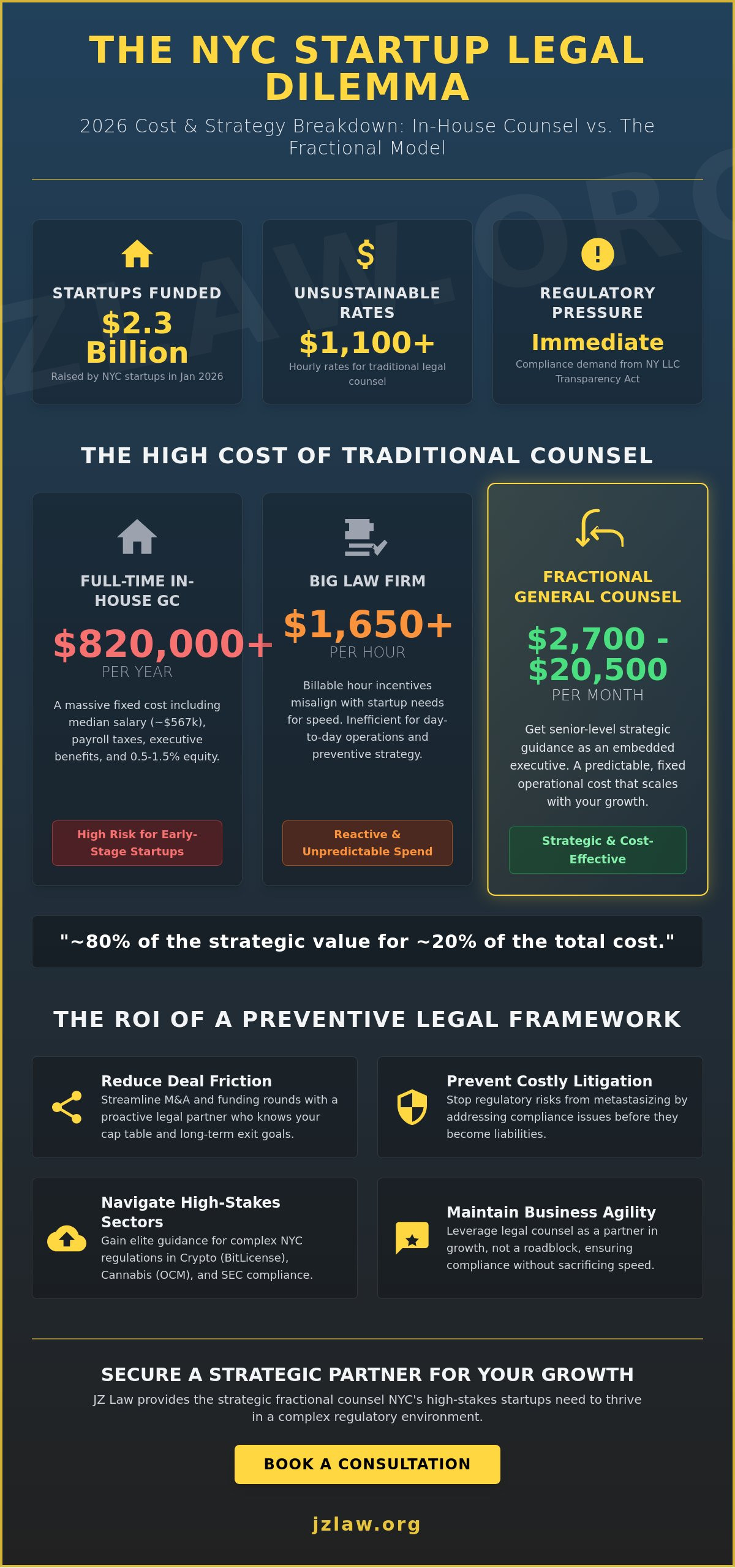
In January 2026, New York City startups raised $2.3 billion in venture capital, yet a staggering number of these firms still struggle to manage the $1,100 hourly rates of traditional legal counsel. You likely recognize that securing a top tier corporate lawyer for startups NYC is no longer just about document review; it's about navigating a regulatory environment where the new New York LLC Transparency Act now demands immediate compliance. The financial burden is significant, as the median compensation for a full-time General Counsel has climbed toward $567,000. This often leaves founders choosing between high-risk neglect or unsustainable legal bills that drain their series funding.
We understand that your business requires the precision of elite legal strategy without the enterprise-level overhead. This guide promises to reveal the exact 2026 cost structures of fractional services, which typically range from $2,700 to $20,500 per month, so you can achieve a predictable spend. You'll learn how to implement a proactive, preventive legal strategy that addresses SEC and crypto regulations before they become liabilities. We'll break down the specific ROI of the fractional model and show you how to secure senior-level guidance that scales alongside your revenue growth.
Key Takeaways
Compare the total cost of ownership for full-time hires against fractional models to eliminate the C$567,000 median salary and associated New York payroll tax burdens.
Understand how a specialized corporate lawyer for startups NYC provides the daily oversight needed to navigate the 2026 LLC Transparency Act and complex BitLicense requirements.
Identify the specific ROI of a preventive legal framework, which reduces deal friction during M&A and prevents regulatory risks from metastasizing into costly litigation.
Discover how tiered retainer structures, typically ranging from C$2,700 to C$20,500, offer the elite legal strategy required for high-stakes sectors like cannabis and cryptocurrency.
Learn to leverage strategic counsel as a partner in growth, ensuring compliance with evolving OCM hurdles and SEC regulations while maintaining modern business agility.
Table of Contents
The Economic Reality: In-House vs. Fractional General Counsel in NYC
The 2026 legal market in New York City has reached a critical inflection point where the cost of internalizing legal expertise often outweighs the benefits for scaling firms. As of May 2026, the median cash compensation for a full-time General Counsel sits at C$567,000. When you factor in the mandatory New York payroll taxes, comprehensive executive benefits, and the typical 0.5% to 1.5% equity grant, the total cost of ownership for a single hire can easily exceed C$820,000. This financial reality forces founders to seek a more agile strategic corporate transactions partner rather than a permanent fixture on the payroll.
The traditional model of hiring a dedicated corporate lawyer for startups NYC is evolving into a fractional approach. This model provides high-level oversight and risk mitigation without the permanent fiscal burden of a C-suite executive. It's a shift driven by the need for precision and the realization that most startups don't require 40 hours of legal work every week, but they do require 100% of the strategic brainpower. With the recent closure of the START-UP NY program on January 1, 2026, startups no longer have the luxury of tax-based cushions to offset bloated administrative costs.
The NYC Salary Gap
A competitive offer for a NYC General Counsel in 2026 includes a base salary of at least C$480,000, a 20% performance bonus, and significant stock options. For a seed-stage or Series A company, committing this much capital to a single non-revenue-generating role is often premature. The fractional model offers approximately 80% of the strategic value for roughly 20% of the total cost; this allows capital to be diverted toward product development and market expansion. The NYC Premium for legal talent in 2026 represents the mandatory surcharge founders pay for counsel who can navigate the specific intersection of New York state transparency laws and federal SEC scrutiny.
Big Law vs. Fractional GC: Efficiency Metrics
Relying on Big Law firms for day-to-day operations has become an unsustainable strategy as hourly rates for senior partners now frequently surpass C$1,650. These firms operate on billable hour incentives, which often creates a misalignment between the lawyer's desire for thoroughness and the startup's need for speed. In contrast, a fractional counsel functions as an embedded executive. They understand the Role of General Counsel as a business enabler who facilitates growth rather than a distant consultant who merely lists risks.
This integration into the executive leadership team ensures that legal considerations are woven into the business strategy from the outset. Instead of reacting to crises with expensive hourly interventions, the fractional model prioritizes a preventive approach. You gain a partner who knows your cap table, your specific sector challenges in cryptocurrency law, and your long-term exit goals. This provides the stability of an in-house hire with the flexibility of an external consultant.
Breakdown of Fractional General Counsel Cost Structures
Transparency in legal billing has become a prerequisite for growth-oriented firms. For a corporate lawyer for startups NYC, the 2026 market has largely moved away from the opaque billable hour toward structured, predictable fee arrangements. Monthly retainers now serve as the baseline for ongoing regulatory and corporate oversight, typically ranging from C$2,700 for early-stage ventures to C$20,500 for companies with complex, multi-state operations. This shift allows founders to treat legal expenses as a fixed operational cost rather than a fluctuating liability that threatens monthly burn rates.
Hybrid models are also gaining traction for mid-market firms. These combine a modest base retainer with success fees tied to specific milestones, such as the closing of a major M&A deal or a Series B funding round. This alignment of interests ensures your counsel is as invested in the transaction's success as you are. If you're evaluating your current legal spend, exploring a strategic fractional arrangement can provide the elite strategy your business deserves without the hidden costs of a traditional firm.
Retainer-Based Pricing: What is Included?
The scope of a standard retainer in 2026 generally encompasses essential daily legal functions. This includes participation in board meetings, routine contract review, and oversight of employment law matters. We've observed a significant move toward value-based retainers over traditional hours-based models. In a value-based system, the fee is determined by the strategic importance of the counsel's availability and their integration into the leadership team. This ensures that response times are guaranteed without the ticking clock of a C$1,200 per hour partner rate.
Project-Specific Costs for High-Growth Firms
While retainers cover the steady state, high-stakes events require specialized project pricing. For instance, the legal complexities involved in taking companies public in the New York market demand a distinct budget that accounts for intensive SEC filings and NYDFS regulatory hurdles. Similarly, managing strategic corporate transactions often involves flat-fee structures that provide certainty during sensitive negotiations. These projects often include multi-jurisdictional compliance checks to ensure that a New York-based startup remains protected as it expands into international markets.
The NYC Premium: Why Local Regulatory Expertise Impacts Pricing
Operating in New York City requires a departure from generalist legal strategies. The city's regulatory environment is notoriously dense, often imposing requirements that exceed federal standards. For a corporate lawyer for startups NYC, pricing reflects the necessity of navigating these local minefields. In 2025, NYC-based startups secured 48.5% of all fintech funding in the United States, a figure that underscores the city's dominance but also highlights the intense scrutiny from the New York Department of Financial Services (NYDFS). If your firm operates in the digital asset space, the BitLicense remains a significant barrier to entry, requiring specialized cryptocurrency law expertise to ensure compliance without stalling innovation.
The NYC Premium also extends to the burgeoning cannabis sector. While federal legality remains a separate conversation, New York's Office of Cannabis Management (OCM) has established a complex web of social equity requirements and local zoning laws. Failing to account for these nuances can lead to catastrophic delays in licensing. Similarly, as tech hubs expand into non-traditional districts, the intricacies of real estate law in NYC, including commercial lease negotiations and tax abatements, demand a counsel who understands the local landscape. A generalist without this specific experience often overlooks the New York LLC Transparency Act requirements, which as of January 1, 2026, mandate strict beneficial ownership reporting for all entities.
Specialized Industry Oversight
The cost of legal oversight is often driven by the specific industry's regulatory friction. For instance, the cannabis licensing guide 2026 highlights how New York operators must manage multi-layered compliance that shifts between state and local jurisdictions. In the financial sector, dealing with FINRA and the SEC from an NYC base adds another layer of complexity. A fractional General Counsel who bridges the gap between US and international standards is particularly valuable for Canadian firms looking to establish a foothold in Manhattan's competitive ecosystem.
NYC Employment and Tax Law Nuances
Labor regulations in the five boroughs are among the most stringent in the world. Managing NYC-specific executive compensation structures requires a deep understanding of local pay transparency laws and specific termination protocols. Beyond payroll, tax structuring for cross-border transactions must account for local NYC corporate taxes that can surprise unprepared founders. We prioritize preventive auditing to identify these risks early. This proactive approach avoids the local regulatory fines that frequently cripple startups before they reach their first major milestone.
Evaluating ROI: How Fractional GC Prevents Metastasizing Legal Costs
Measuring the return on investment for a corporate lawyer for startups NYC requires looking past the monthly invoice to the catastrophic expenses that never occur. A preventive legal framework operates as a strategic shield for your firm's equity. In the 2026 NYC ecosystem, where 121 unicorns currently operate, the cost of regulatory friction is a primary reason for deal failure. Traditional commercial litigation in Manhattan can easily consume C$200,000 in legal fees before it even reaches the discovery phase. By identifying these risks early, a fractional General Counsel ensures that capital remains focused on growth rather than defense.
The efficiency of your legal strategy directly impacts your burn rate. Beyond litigation, a GC streamlines the due diligence process for both M&A and venture financing. When a company's internal documents, cap tables, and intellectual property filings are maintained with executive-level precision, deal friction is significantly reduced. This speed to close is vital in a market where NYC startups raised C$2.3 billion in January 2026 alone. If you're ready to secure your firm's future, consider how partnering with strategic fractional counsel can transform your legal department from a cost center into a competitive advantage.
The Cost of Inaction
The financial consequences of reactive legal management are often severe. A formal SEC inquiry or a deep-dive audit by the NYDFS can cost a startup between C$75,000 and C$350,000 in specialized defense fees. Furthermore, having a dedicated GC often leads to a 10% to 20% reduction in insurance premiums for Directors and Officers (D&O) and Errors and Omissions (E&O) coverage, as insurers recognize the lowered risk profile. Early-stage tax structuring implemented by a sophisticated counsel typically results in a 12% to 18% reduction in total tax liability during a future liquidity event.
Strategic Partnering for Funding Rounds
As you prepare for Series A through C funding, the role of the GC shifts toward investor relations and cap table management. Institutional investors in 2026 are increasingly risk-averse; they prioritize startups that demonstrate professionalized legal oversight. A fractional GC adds immediate credibility to your leadership team, signaling to venture capitalists that the business is built on a foundation of compliance and structured growth. This preparation eliminates the expensive "cleanup" costs that often arise when institutional due diligence reveals neglected filings or poorly drafted employment agreements. By maintaining a clean legal house, you ensure that your valuation remains intact during sensitive negotiations.
JZ Law: Strategic Fractional Counsel for NYC’s High-Stakes Sectors
JZ Law represents a paradigm shift for founders seeking a corporate lawyer for startups NYC. John Zang’s approach consciously merges classical legal dignity with modern business agility, ensuring that every strategic decision is rooted in thoroughness and logic. We don't just provide legal services; we function as a strategic partner capable of overseeing high-stakes sectors where the regulatory burden is heaviest. From navigating the complexities of oil and gas law to the rapid evolution of the digital asset market, our expertise is designed for firms that have outgrown basic counsel but aren't ready for the fiscal commitment of a C-suite hire.
Our firm prioritizes a preventive approach, which implies that the highest form of legal counsel is the one that prevents a crisis before it manifests. We understand that in the NYC ecosystem, a single regulatory oversight can jeopardize millions in venture funding. By integrating into your leadership team, we provide the steady hand and methodical precision necessary to navigate high-stakes corporate transactions. This partnership ensures that your business interests are protected by a counsel who understands the market environment as well as the statutes.
Tailored Legal Frameworks
We offer customized fractional GC packages specifically for securities and cryptocurrency firms that require daily regulatory oversight. These frameworks ensure that your operations align with both NYC local law and global business hub standards, providing a seamless bridge for international expansion. Our firm maintains a hyper-focus on corporate success by intentionally excluding criminal and family law from our practice. This specialization allows us to devote 100% of our intellectual resources to your business interests, tax structuring, and complex regulatory filings.
Next Steps: Securing Your Strategic Counsel
Securing your strategic counsel begins with a methodical assessment of your company’s 2026 legal roadmap. We help you transition from the unpredictability of ad-hoc, hourly counsel to a structured fractional GC relationship that rewards efficiency and long-term stability. During the consultation process, we evaluate your current compliance status and long-term exit goals to ensure your legal framework supports your valuation. We invite founders to schedule a strategic evaluation of their legal spend to identify how a fractional model can drive greater ROI for their 2026 growth initiatives.
Secure Your Global Growth Strategy
The 2026 NYC legal landscape requires more than just reactive advice; it demands a partner who anticipates regulatory shifts before they impact your valuation. By moving away from the unsustainable C$567,000 median salary of a full-time hire, you can leverage a corporate lawyer for startups NYC through a fractional model that scales with your revenue. This approach ensures that your firm remains compliant with the New York LLC Transparency Act while maintaining the agility needed for high-stakes securities and cryptocurrency transactions. It's about protecting your equity.
JZ Law maintains a strategic presence across NYC, Toronto, and Calgary, specializing in the complex nuances of cannabis, crypto, and securities law. We prioritize a preventive framework that maximizes your long-term ROI and prepares your cap table for institutional scrutiny. Our team knows your focus must remain on innovation, not navigating OCM hurdles or SEC inquiries alone. Secure your strategic legal partner; contact JZ Law for fractional GC services today. We're ready to help you build a resilient, compliant, and thriving enterprise in the world's most competitive markets.
Frequently Asked Questions
How much does a fractional general counsel cost per month in NYC?
Monthly retainers in early 2026 typically range from C$2,700 to C$20,500 depending on your firm's complexity. Early-stage startups usually find a baseline of C$2,700 to C$5,500 sufficient for essential oversight. Growth-stage companies with complex regulatory needs or multi-state operations often fall into the C$6,800 to C$10,900 range. This tiered structure provides the predictability founders need to manage their burn rate effectively.
What is the difference between a fractional GC and traditional outside counsel?
A fractional GC functions as an embedded executive member, while traditional outside counsel operates on a transactional, reactive basis. The GC understands your long-term business goals and cap table intimately. Unlike traditional firms that might bill C$1,200 per hour for isolated tasks, a fractional counsel provides proactive, preventive guidance. They're invested in your daily operations rather than just specific legal projects.
Does my NYC startup need a fractional general counsel before Series A?
Securing a corporate lawyer for startups NYC before Series A is a strategic investment that prevents expensive cleanup costs during due diligence. Institutional investors in 2026 prioritize companies with professionalized compliance frameworks and clean corporate records. Addressing these foundational elements early preserves your valuation and signals to venture capitalists that your leadership team is prepared for institutional scale.
How many hours a week does a fractional GC typically work?
Most fractional arrangements involve 5 to 15 hours of dedicated strategic work per week. This volume is generally sufficient to handle board meetings, routine contract reviews, and regulatory monitoring. The model is designed to be flexible; it can scale up to 20 or more hours during high-stakes events like a C$10 million funding round or a complex corporate acquisition.
Can a fractional GC handle complex securities and IPO filings?
Experienced fractional counsel manage complex securities and IPO filings by coordinating the entire legal strategy from inception to completion. They act as the primary liaison for the SEC and NYDFS. While they may leverage specialized boutiques for specific niche filings, the GC ensures that the overall corporate narrative and compliance standards remain consistent throughout the intensive public offering process.
Is a fractional GC responsible for managing other specialized law firms?
A fractional GC acts as your "legal quarterback," managing specialized outside firms to eliminate redundant billing and conflicting advice. They ensure that high-cost specialists are only engaged when absolutely necessary. This central oversight prevents miscommunication between departments and ensures that every piece of legal work aligns perfectly with the company's broader commercial objectives and risk tolerance.
What industries benefit most from the fractional GC model in New York?
Fintech, AI, and Cannabis sectors benefit most due to the dense regulatory environment in New York. In 2025, NYC-based startups raised 48.5% of all US fintech funding, which requires constant compliance with evolving NYDFS standards. AI firms also require a corporate lawyer for startups NYC to navigate new data privacy laws and protect valuable intellectual property as they scale.
How does a fractional GC stay integrated with a remote or hybrid NYC team?
Integration is maintained through active participation in Slack channels, virtual board meetings, and weekly executive syncs. Modern fractional counsel utilize the same project management and communication tools as your internal staff. This ensures they're available for real-time strategic decision-making, providing the same level of accessibility and cultural alignment as a traditional full-time in-house hire.



Comments