


Independent Director Liability in Canada: A 2026 Legal Framework for Risk Mitigation
- jzanglaw
- May 24
- 12 min read
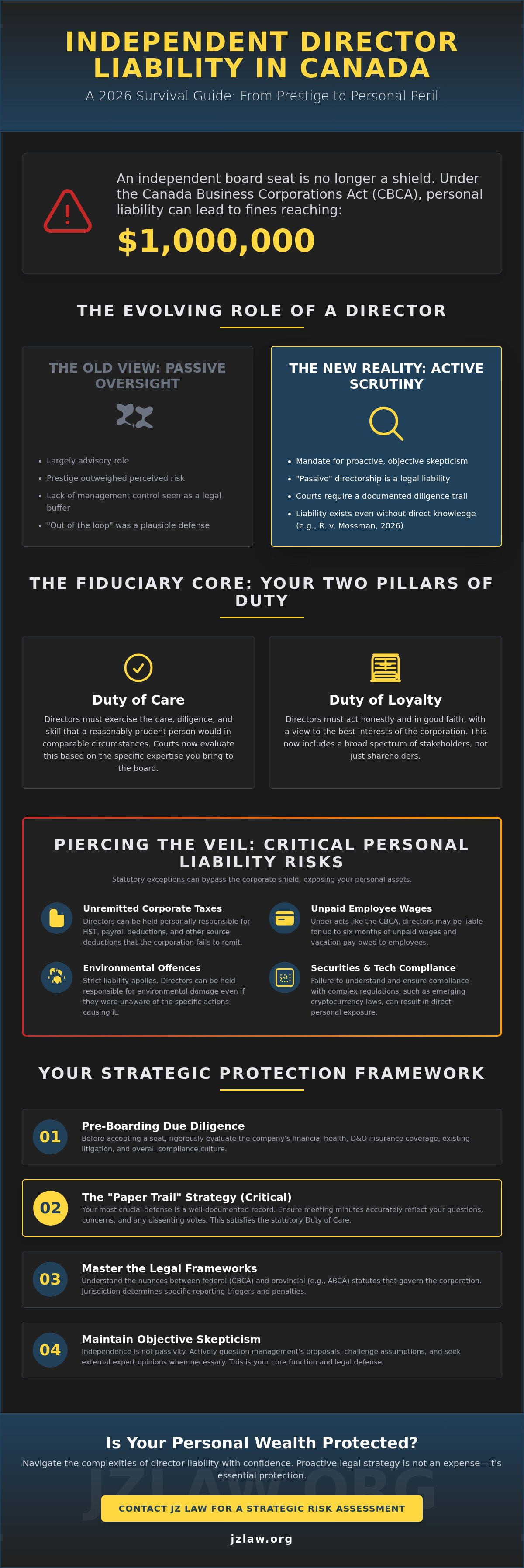
An independent board seat is no longer a shield against corporate fallout; it's a mandate for proactive, objective skepticism that requires a documented diligence trail. You likely recognize that the prestige of a directorship shouldn't come at the cost of your personal financial security. It's natural to feel concerned when facing a legal landscape where independent director liability in canada can result in personal fines reaching $1,000,000 under the Canada Business Corporations Act or strict penalties for environmental oversights you didn't personally authorize. Recent rulings, such as the February 2026 decision in R. v. Mossman, emphasize that directors can be held liable even without direct knowledge of an offence.
This article will help you master the legal complexities of independent directorship and demonstrate how to protect your personal assets through strategic diligence and a robust understanding of your fiduciary duties. We'll examine the "Business Judgment Rule" in light of recent 2026 court decisions, analyze why D&O insurance rates declined by 6% in early 2026, and provide a pre-boarding checklist to ensure your legal protection strategy is airtight.
Key Takeaways
Learn why the 2026 regulatory environment has transformed "passive" oversight into a significant legal risk, necessitating a more rigorous approach to corporate governance.
Understand the specific statutory exceptions that trigger independent director liability canada, allowing authorities to bypass the corporate shield and target personal assets.
Identify the personal risks associated with unremitted corporate taxes and how to mitigate these exposures through strategic tax structuring and oversight.
Discover the critical importance of the "Paper Trail" strategy in documenting dissent and informed decision-making to satisfy the statutory Duty of Care.
Acquire a structured framework for pre-boarding due diligence to evaluate the integrity of corporate transactions and securities regulation compliance before accepting a seat.
Table of Contents
The Landscape of Independent Director Liability in Canada
The traditional view of the independent director as a prestigious but largely advisory figure has evaporated. In 2026, the Canadian legal system demands active participation and rigorous inquiry. The complexities of independent director liability canada are often underestimated by those who believe their lack of day-to-day management control serves as a legal buffer. On the contrary, the law views independence not as an excuse for ignorance, but as a mandate for objective oversight. "Passive" directorship, where a member merely attends meetings and votes with the majority without inquiry, is now a documented legal liability. Courts don't accept the defense that a director was "out of the loop" when the statutory duty of care required them to stay informed.
Understanding the Canadian Corporate Law Framework is the first step in recognizing how these duties are codified across different levels of government. Whether a corporation is governed by the Canada Business Corporations Act (CBCA) or a provincial statute like the Alberta Business Corporations Act (ABCA), the core expectation remains the same: the exercise of "objective skepticism." This requirement is especially critical in specialized sectors. For instance, the rapid evolution of cryptocurrency law and shifting securities regulations create unique liability profiles. In these environments, an independent director's failure to understand the underlying technology or regulatory compliance can lead to personal exposure that the corporate veil won't protect.
The Role of Independence in Corporate Governance
The Toronto Stock Exchange and other Canadian trading platforms maintain strict criteria for what defines an "independent" member. Independence isn't merely the absence of a salary; it's the absence of any relationship that could reasonably interfere with independent judgment. Courts expect these members to act as a vital check on executive compensation structures and management's strategic ambitions. This skepticism is a mandatory component of a director's duties. If an independent member fails to challenge questionable management decisions, they risk being held to the same standard of independent director liability canada as the executives who initiated the action.
Federal vs. Provincial Liability Frameworks
Directors must navigate a patchwork of regulations that vary significantly by jurisdiction. A Calgary-based energy firm operating under the ABCA faces different reporting triggers and statutory penalties than a Toronto-based tech firm under the CBCA. The "Mind and Management" test remains the primary tool for determining which laws apply in multi-jurisdictional corporate structures. When decisions are made across provincial or national borders, directors must account for potential conflict of laws. A strategic approach to governance ensures compliance with federal mandates while respecting the specific nuances of provincial statutes, effectively minimizing unforeseen personal risk.
The Fiduciary Core: Duty of Care and Duty of Loyalty
At the heart of independent director liability canada lie two foundational pillars: the statutory duty of care and the fiduciary duty of loyalty. These aren't merely abstract legal concepts; they're the benchmarks against which every board decision is measured during litigation. The duty of care requires directors to exercise the care, diligence, and skill that a reasonably prudent person would exercise in comparable circumstances. While some competitors suggest this is a purely subjective test, modern courts increasingly evaluate directors based on the specific expertise they bring to the board. An independent director with a financial background, for example, is expected to apply that specific lens when reviewing complex audits or corporate transactions.
The duty of loyalty demands that directors act honestly and in good faith with a view to the best interests of the corporation. In the current Canadian legal climate, the definition of "best interests" has evolved beyond simple shareholder primacy. Directors must now consider a broader spectrum of stakeholders, including employees, creditors, and the environment. This shift adds layers of complexity to decision-making, particularly when a corporation faces financial distress. One of the most common pitfalls leading to personal exposure is "blind reliance" on management reports. Accepting executive summaries at face value without independent verification can be viewed as a failure of oversight. This is particularly dangerous regarding tax obligations, as detailed in the government’s guide on Director's Liability for Corporate Tax, where ignorance of unremitted deductions is rarely a valid defense.
The Business Judgment Rule as a Defense
The Business Judgment Rule serves as a primary defense, reflecting the court's reluctance to second-guess board decisions with the benefit of hindsight. However, this protection isn't automatic. To invoke it, directors must prove their decision was informed, independent, and made in good faith. If the process was flawed or if the board failed to perform adequate due diligence, the shield vanishes. Case law consistently shows that the rule fails when directors can't demonstrate a clear trail of inquiry and deliberation. It's not enough to be right; you must show that your process was rigorous.
Sector-Specific Duty Nuances
High-growth and highly regulated industries demand a more specialized form of diligence. In the cannabis sector, for instance, directors must maintain a granular understanding of cannabis licensing requirements to avoid regulatory sanctions that could trigger personal liability. Similarly, managing fiduciary duties during insolvency requires a delicate balance between competing creditor interests. Engaging a strategic legal partner can help directors navigate these high-stakes scenarios and mitigate the risk of independent director liability canada with the necessary precision and foresight.
Piercing the Veil: When Personal Liability Becomes Reality
The concept of the "corporate veil" often provides a false sense of security for those serving on Canadian boards. While limited liability is a cornerstone of corporate law, it's not an impenetrable shield. Numerous statutory exceptions allow regulators and courts to bypass the corporation and target the personal assets of its leaders. For those navigating independent director liability canada, understanding these triggers is essential for personal asset protection. If a corporation fails to meet specific statutory obligations, directors can be held personally responsible, regardless of their "independent" status or lack of day-to-day operational involvement. This reality is underscored by the Torys' Guide to Directors' Duties, which highlights how modern legislation increasingly leans toward individual accountability.
One of the most common areas of personal exposure involves unremitted payroll taxes and source deductions. Under the Income Tax Act, directors are personally liable for these corporate debts if the company fails to pay. The Canada Revenue Agency (CRA) has a two-year window to assess a director for this liability after they've left the board. Similarly, employment standards legislation across various provinces makes directors personally liable for up to six months of unpaid wages and accrued vacation pay. These aren't hypothetical risks; they're strict liabilities that require proactive financial oversight to mitigate.
Statutory Liabilities Beyond the CBCA
While the Canada Business Corporations Act sets high penalties, including fines up to $1,000,000 for providing misleading information, other statutes carry even heavier weight. In the energy sector, directors must be particularly mindful of environmental legislation. Those involved in oil and gas law face rigorous standards where "control and management" of a corporation can lead to personal liability for environmental remediation orders. Recent 2026 enforcement actions highlight this trend. ArcelorMittal was fined $100 million in May 2026 for Fisheries Act violations, while Estee Lauder faced a $750,000 fine in February 2026 for environmental breaches. A February 2026 British Columbia Court of Appeal decision confirmed that directors can be held liable for environmental offences even without proof they had specific knowledge of the wrongdoing.
The Oppression Remedy and Derivative Actions
Personal risk isn't limited to government regulators. Minority shareholders and other stakeholders can use the "oppression remedy" to target directors for conduct that's "unfairly prejudicial" to their interests. If a court finds a director personally participated in the oppressive conduct, it can award damages directly against that individual. Derivative actions allow shareholders to sue the board on behalf of the corporation itself. In these cases, independent director liability canada can manifest as personal cost awards if the court finds the director didn't act in good faith. Protecting yourself requires more than just attending meetings; it demands a documented history of diligence and, when necessary, formal dissent.
A Protection Framework for Independent Directors
Personal asset protection for board members isn't achieved through a single policy or a passive stance. It requires a procedural fortress built on rigorous inquiry and documented evidence. While the legal environment has become more demanding, the tools for mitigation have also evolved. Managing independent director liability canada effectively means shifting from a reactive mindset to a proactive governance model. This framework ensures that even if a corporation faces litigation, your personal conduct remains defensible under the Business Judgment Rule. Relying solely on the corporate shield is a strategy of the past; today's directors must secure their own legal standing through specific, verifiable actions.
One of the primary layers of this fortress is Directors and Officers (D&O) insurance. In the first quarter of 2026, the Canadian D&O market remained soft, with financial and professional lines rates declining by 6%. While these declining premiums are favorable for buyers, the quality of the policy matters more than the cost. You must audit your policy specifically for "Insured vs. Insured" exclusions, which can sometimes prevent coverage in derivative actions where the corporation sues its own board. Beyond insurance, a robust indemnification agreement is vital. This contract should ensure the corporation advances your defense costs in real-time, rather than only reimbursing you after a legal victory. To ensure your current protections meet these 2026 standards, you can consult with John Zang for a comprehensive board risk audit.
Pre-Acceptance Checklist
Due diligence starts before you ever sign a board mandate. You should request and review the last three years of audited financial statements and management letters to identify any recurring red flags. Assessing the "Tone at the Top" is equally critical. If the corporate compliance culture seems dismissive of regulatory standards, no amount of insurance will fully mitigate your risk. Verify the adequacy of the existing D&O insurance limits and ensure the coverage scope aligns with the specific risks of the industry, whether that involves complex securities regulation or environmental mandates.
Ongoing Diligence and Crisis Management
Once on the board, your most powerful defense is the "Paper Trail" strategy. Board minutes shouldn't just record the final vote; they should reflect the rigorous debate and the specific questions you asked to reach an informed decision. If you disagree with a high-risk proposal, you must ensure your dissent is formally recorded in the minutes. There may come a point where resignation is the only way to halt escalating independent director liability canada. Identifying this "Point of No Return" requires professional judgment. If you do resign, confirm that you have "tail coverage" and that your indemnification rights continue to protect you for actions taken during your tenure.
Strategic Risk Management with JZ Law
The 2026 regulatory climate has shifted from a focus on general oversight to a demand for technical proficiency and documented skepticism. Relying on internal corporate counsel isn't always sufficient when your personal assets are at stake. JZ Law serves as a strategic partner, providing the objective distance needed to evaluate independent director liability canada without the conflicts of interest that often plague internal board dynamics. We specialize in structuring indemnification agreements and D&O frameworks that don't just look good on paper; they're designed to withstand the scrutiny of Canadian courts. Our firm provides the precision required to ensure that your protection strategy is as robust as the corporations you oversee.
We provide tailored legal audits for independent directors operating in Canada’s primary economic hubs, including Calgary, Toronto, and Vancouver. These audits go beyond a simple review of insurance policies. We analyze the intersection of provincial statutes and federal mandates to identify hidden gaps in your coverage. Whether you're navigating the complexities of oil and gas law in Alberta or managing tech-sector volatility in Ontario, our approach is rooted in a deep understanding of sectoral risk. We ensure your board's governance protocols align with the latest judicial trends, effectively insulating you from the rising tide of statutory claims.
The JZ Law Approach to Board Counsel
Proactive risk identification is the cornerstone of our practice, particularly in high-growth, high-risk sectors. We offer specialized guidance for boards involved in cryptocurrency law and digital asset management, where regulatory clarity is often elusive. Our team provides independent legal opinions during complex corporate transactions, giving directors the "informed" status necessary to invoke the Business Judgment Rule. If litigation arises, we represent directors against oppression remedies and statutory claims, ensuring that your defense is built on a foundation of rigorous due diligence and professional excellence.
Secure Your Directorship Today
Generic legal advice is insufficient for directors serving on specialized industry boards. The nuances of independent director liability canada require a counselor who understands both the letter of the law and the commercial realities of your industry. John Zang provides the sophisticated, strategic oversight necessary to protect your professional legacy and personal financial security. Don't wait for a regulatory inquiry to test the strength of your current protections. Protect your assets and legacy with expert counsel from JZ Law and ensure your directorship is defined by its success, not its liabilities.
Securing Your Professional Legacy in a High-Stakes Environment
The evolution of independent director liability canada in 2026 has fundamentally redefined the threshold for personal exposure. You can't rely on the corporate shield as a passive participant; modern courts and regulators now demand a documented trail of inquiry and informed dissent. By mastering the fiduciary core and implementing a rigorous pre-boarding checklist, you transform your role from a point of vulnerability into a position of strategic strength. Protecting your personal assets requires a precise alignment of indemnification agreements, D&O insurance audits, and specialized legal oversight that accounts for both federal and provincial jurisdictional nuances.
JZ Law provides the sophisticated, strategic partnership necessary to navigate these complexities. With deep expertise in the regulatory frameworks of Calgary, Toronto, and Vancouver, we offer tailored counsel for directors in high-risk sectors like Cannabis and Cryptocurrency. Our focus on executive risk mitigation ensures your governance practices remain defensible under the most rigorous scrutiny. Consult with JZ Law for Strategic Board Counsel to fortify your legal protection strategy. Your leadership deserves the security that only meticulous, professional diligence can provide.
Frequently Asked Questions
Can an independent director be held personally liable for a corporation’s unpaid taxes in Canada?
Yes, independent directors face significant personal risk for unremitted payroll taxes and source deductions under the Income Tax Act. The Canada Revenue Agency can assess you for these debts if the corporation fails to pay, and this liability is often strict, meaning your lack of involvement in daily financial management is not a valid defense.
Does D&O insurance cover all types of director liability?
No, D&O insurance does not provide universal coverage for every form of independent director liability canada. Policies typically exclude intentional fraudulent conduct, criminal acts, and certain intra-board disputes through "Insured vs. Insured" clauses. It's essential to audit your policy to ensure it covers the specific regulatory risks of your industry.
What is the Business Judgment Rule and how does it protect Canadian directors?
The Business Judgment Rule is a judicial doctrine where Canadian courts defer to board decisions provided they were made in good faith and on an informed basis. It protects you from being penalized for a decision that resulted in a poor outcome, as long as your deliberative process was rigorous, documented, and free from conflicts of interest.
Can I be sued by shareholders even if I voted against a board decision?
You can still be named in a lawsuit even if you voted against a decision, though a formal dissent is your strongest defense. Recording your opposition in the board minutes prevents the legal presumption that you acquiesced to the action, which is vital for mitigating independent director liability canada during litigation.
What are the most common statutory liabilities for directors in Alberta and Ontario?
In both Alberta and Ontario, directors are personally liable for up to six months of unpaid employee wages and accrued vacation pay. Other common statutory triggers include environmental remediation orders and violations of provincial securities regulations during corporate transactions or when taking a company public.
How long does director liability last after I resign from a board?
Your liability doesn't end immediately upon resignation; for instance, the Canada Revenue Agency has a two-year limitation period to assess directors for unremitted taxes. You remain exposed for actions taken during your tenure, which makes securing tail coverage and continuing indemnification rights essential components of your exit strategy.
What is the difference between an indemnity agreement and D&O insurance?
An indemnity agreement is a direct contract where the corporation promises to pay your legal costs and damages, while D&O insurance is a policy purchased from a third-party insurer. Indemnity is only as strong as the company's balance sheet, so D&O insurance provides a necessary second layer of protection if the corporation becomes insolvent.
Can independent directors be liable for environmental damage caused by the company?
Yes, independent directors can be held personally liable for environmental offences even if they weren't directly involved in the incident. A February 2026 court decision in British Columbia confirmed that the prosecution doesn't need to prove you had specific knowledge of the circumstances to impose liability for environmental damage or remediation costs.


Comments