


John Zang Views: AGLC Cannabis Retail License Requirements: A 2026 Guide for Calgary Entrepreneurs
- jzanglaw
- Apr 4
- 13 min read
You likely recognize that entering the Alberta cannabis market requires more than just startup capital; it demands a meticulous adherence to a regulatory framework that often feels both intrusive and financially taxing. Successfully meeting the AGLC cannabis retail license requirements involves passing rigorous financial audits and personal background checks that leave no stone unturned for cannabis entrepreneurs. It's a process where a minor error in documentation can result in a total loss of your initial investment and months of wasted effort.
This guide provides a definitive roadmap to securing and maintaining your license by synchronizing provincial mandates with specific City of Calgary land use bylaws. We'll examine the 2026 fee structures, the critical intersection of municipal zoning, and the strategic steps necessary to ensure your application moves through the system without costly administrative delays. By adopting a preventive legal strategy, you'll transform these complex hurdles into a structured path toward a compliant and profitable retail presence.
Key Takeaways
Understand the essential "dual-track" approval process required to satisfy both provincial AGLC mandates and municipal Calgary zoning bylaws for your retail location.
Prepare for the rigorous "Fit and Proper" background check by meticulously completing Personal Disclosure Forms for all corporate directors and officers to ensure regulatory eligibility.
Identify the specific physical security standards and Calgary-specific separation distance requirements necessary to secure an optimal and compliant storefront location.
Master the step-by-step application strategy, including the submission of the initial C$3,000 fee and the specific aglc cannabis retail license requirements needed to transition from a Letter of Intent to full operational status.
Establish a framework for long-term operational success by implementing the mandatory inventory reporting and waste management protocols outlined in the AGLC Retail Cannabis Store Handbook.
Table of Contents
JOHN ZANG's VIEWS ON: Navigating the AGLC Cannabis Retail Licensing Landscape in 2026
The Alberta Gaming, Liquor and Cannabis Commission (AGLC) serves as the central authority governing the distribution and sale of cannabis across the province. By 2026, the AGLC mandate has evolved to prioritize market stabilization and rigorous background oversight. Aspiring entrepreneurs must recognize that securing a storefront in Calgary involves a "dual-track" approval process. You aren't just applying to one office; you're managing a synchronous dance between provincial requirements and Calgary's specific municipal land-use bylaws. One cannot proceed effectively without the other.
The legal foundation of your enterprise rests upon the Gaming, Liquor and Cannabis Act and the Gaming, Liquor and Cannabis Regulation. These statutes define the boundaries of legal operation, from security protocols to inventory management. Because the regulatory environment is unforgiving of clerical or procedural errors, the role of legal counsel has shifted from simple filing to strategic risk management. We act as your primary interface with regulators, ensuring that every communication aligns with the long-term viability of your license. Precise legal phrasing in your application can be the difference between a seamless launch and a multi-month standstill.
The Legal Definition of a Cannabis Retailer
John Zang advises that in Alberta, a cannabis retailer is a distinct legal entity authorized only for the sale of recreational cannabis and approved accessories. You won't find the "lifestyle" retail crossover seen in other jurisdictions. The provincial "cannabis-only" rule remains strict; stores cannot sell tobacco, liquor, or general convenience items. Ownership restrictions are equally firm. The AGLC** cannabis retail license requirements** mandate that any individual with significant financial interest must pass a comprehensive "key person" background check. Those with ties to organized crime, recent relevant criminal records, or minors are legally barred from the industry. As retailers plan their inventory, understanding popular product categories like THC-infused beverages is a key business decision. For insights into this growing market segment, industry resources like drinklodo.com can be valuable.
Why Regulatory Precision Matters
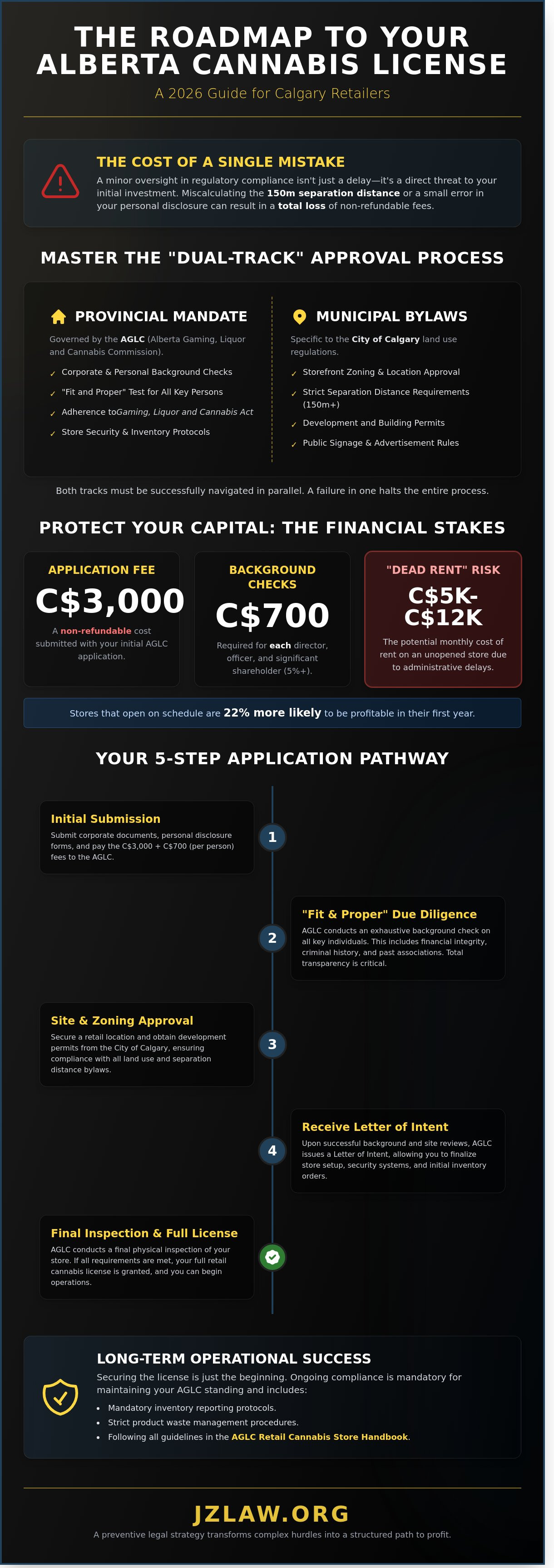
Financial efficiency in the cannabis sector is tied directly to regulatory speed. John Zang of JZ Law advises that the AGLC requires a non-refundable C$3,000 application fee, alongside a C$700 background check fee for each key individual. These costs are sunk the moment you submit. Administrative errors don't just result in requests for more information; they trigger delays that impact your commercial lease. In Calgary's 2026 commercial market, "dead rent" during a licensing delay can cost an entrepreneur between C$5,000 and C$12,000 per month depending on the location. Compliance is your most effective tool for protecting your initial capital investment. A store that opens on its target date has a 22% higher chance of reaching profitability within its first year compared to those mired in regulatory corrections. Your ability to meet aglc cannabis retail license requirements on the first attempt is your primary competitive moat.
Personal and Corporate Due Diligence: The AGLC Background Check
John Zang advises the "Fit and Proper" test serves as the foundation of the Alberta cannabis regulatory framework. AGLC investigators don't merely review your application; they conduct an exhaustive inquiry into your character, honesty, and financial integrity. As of 2026, the threshold for passing this scrutiny has become increasingly rigorous. Investigators look for any history of regulatory non-compliance, associations with criminal elements, or patterns of financial instability that could jeopardize the integrity of the provincial market. Meeting the AGLC** cannabis retail license requirements** requires total transparency regarding your professional and personal history.
Every director, officer, and shareholder holding a "significant interest" must complete a Personal Disclosure Form (PDF). In 2026, the AGLC defines a significant interest as any individual or entity owning 5% or more of the voting shares. This document requires a 10-year history of residence, employment, and legal involvements. It's a common mistake to omit minor legal issues from a decade ago, but such omissions are often viewed as a lack of candor, which can lead to an immediate denial. You can review the official AGLC application requirements to understand the full scope of the documentation needed for these background checks.
The Financial Disclosure Process
The AGLC maintains a strict "clean money" policy to prevent illicit funds from entering the legal market. Corporate applicants must provide two years of certified financial statements to demonstrate fiscal health. If you're launching a new entity, the focus shifts to the "trail of funds" for all initial business investments. If an investor contributes C$50,000 to your Calgary startup, you must provide bank statements or tax records proving exactly where that capital originated. Our team at JZ Law provides strategic representation during this phase, ensuring your financial disclosures are structured to meet provincial standards without inviting unnecessary delays. Beyond the initial application, successful entrepreneurs also engage in advanced tax planning to optimize their financial structure. Firms like Neil Jesani Advisors, Inc. specialize in wealth management strategies for business owners navigating complex regulatory environments.
Background Checks for Key Employees
Your staff must also meet specific criteria before they can step onto the retail floor. Every employee requires a Qualified Cannabis Worker (QCW) designation, which involves a separate background check and mandatory training. For store managers and "key employees," the security clearance levels are even more demanding. In 2026, certain criminal records remain absolute deal-breakers. Convictions related to drug trafficking, money laundering, or violent offenses within the last 10 years typically disqualify an applicant. However, minor, non-violent offenses may not be an automatic rejection if you adopt a preventative approach and disclose them proactively during the initial filing. The AGLC values honesty above a perfect record, provided the history doesn't suggest a risk to public safety or the industry's reputation.
Site Requirements and Calgary Zoning: Securing Your Retail Location
Securing a physical location is the most capital-intensive stage of the application process. It's not merely a real estate decision; it's a complex regulatory hurdle where municipal bylaws and provincial mandates intersect. Meeting the aglc cannabis retail license requirements starts with a compliant footprint. You must ensure the premises are a permanent "bricks and mortar" building. Portable structures or kiosks don't qualify under current 2026 standards. The AGLC retail cannabis portal provides the foundational checklist for these physical spaces, emphasizing that all cannabis products must be stored and sold within a secure, enclosed environment.
Calgary's Land Use Bylaw 1P2007 imposes strict separation distances that can disqualify a site instantly. You cannot operate within 150 meters of a school or 100 meters of a municipal park. Additionally, a 300-meter separation distance between existing cannabis stores remains a critical barrier in high-traffic districts like 17th Avenue or Stephen Avenue. These "buffer zones" are measured from the closest property line of the proposed store to the property line of the protected use. Entrepreneurs often sign a lease "subject to licensing" to protect their capital; however, this is a calculated risk. If the City of Calgary denies your Development Permit (DP), you might find your deposit tied up in a lengthy appeal process while your competitors secure adjacent territories.
Physical Security and Vault Standards
The AGLC mandates a rigorous security infrastructure before you can receive your first shipment. You must install a high-definition CCTV system that covers every square inch of the sales floor and storage areas. Digital recordings must be retained for a minimum of 60 days and be accessible for immediate inspection. The "vault" or storage room requires reinforced construction; typically 1.5mm steel plating or reinforced masonry; to prevent unauthorized entry. Your intrusive alarm system must be monitored 24/7 by a third-party security firm, ensuring a rapid response to any perimeter breach.
Calgary Municipal Development Permits
John Zang advises the hierarchy of approval is absolute; the City of Calgary must issue a Development Permit before the AGLC will finalize your AGLC** cannabis retail license requirements**. If your initial application is refused due to zoning conflicts, you have 21 days to file an appeal with the Subdivision and Development Appeal Board (SDAB). Success at the SDAB requires a strategic legal argument focusing on how your business won't negatively impact the neighborhood's character. Identifying "green zones" in emerging communities like Seton or Mahogany often provides a smoother path than fighting for space in the oversaturated downtown core.
The Alberta Cannabis License Application: A Strategic Step-by-Step Guide
John Zang advices the road to market entry in 2026 requires more than just capital; it demands a meticulous adherence to a multi-phased regulatory sequence. Meeting the AGLC** cannabis retail license requirements** is a process that begins long before the first product arrives on your shelves. This structured approach ensures that every legal and financial vulnerability is addressed before the state grants operating authority.
Step 1: Submission of the Letter of Intent. This initial phase involves a non-refundable C$3,000 application fee. It's your formal entry into the AGLC queue and triggers the beginning of the provincial review.
Step 2: The Municipal Phase. You can't bypass the City of Calgary's Land Use Bylaw 1P2007. Securing Development and Building Permits is mandatory. The AGLC won't grant a license if your location fails to meet municipal setback rules from schools, provincial health care facilities, or other retail stores.
Step 3: The Background Phase. Expect exhaustive personal and financial due diligence. The AGLC investigates any stakeholder holding a 10% or greater interest in the business to ensure the industry's integrity remains intact.
Step 4: The Construction Phase. You must build your store according to the AGLC Retail Cannabis Store Handbook. This includes specific requirements for high-definition surveillance and secure product storage areas that must be operational before the final check.
Step 5: The Final Inspection. An AGLC inspector will perform a physical walkthrough. If your facility aligns with every regulatory standard, they'll issue your license.
Managing the AGLC Application Portal
Digital submissions often stall due to document discrepancies. Ensure the corporate names on your municipal permits match your provincial filings exactly. For a 2026 opening, you should forecast a timeline of 120 to 180 days for full processing. Technical errors in the portal, such as incorrect file formats or incomplete disclosure forms, can add weeks to this estimate. Precision in the digital phase is the only way to maintain your projected launch date.
Pre-Inspection Checklist for Calgary Owners
John Zang advises to avoid the "inducement" trap by ensuring window displays don't promote consumption or target minors. Your signage must be discreet and compliant with both the Cannabis Act and provincial laws. Every staff member must complete SellSafe certification before the inspector walks through the door; there are no exceptions for 100% compliance. Finally, verify that your Point of Sale (POS) system integrates seamlessly with AGLC tracking software to prevent reporting failures on day one. To navigate these complexities without risking your capital, it's wise to consult with a legal strategist who understands the intersection of municipal bylaws and provincial mandates.
Zang Operational Compliance and Maintaining Your AGLC Standing
To uphold the AGLC** cannabis retail license requirements** throughout the life of your business, you must treat this handbook as a living document. Compliance isn't a one-time achievement; it's a continuous obligation that requires rigorous attention to detail.
Inventory management remains the most scrutinized area of operations. You're required to report sales, stock levels, and waste through the provincial tracking system with absolute precision. Any cannabis designated for destruction must be weighed, recorded, and destroyed in the presence of a witness, with all records maintained for a minimum of six years. Discrepancies in these logs often serve as the first red flag for regulators during a desk audit.
The legal consequences of selling to a minor are catastrophic. Alberta operates under a zero-tolerance policy. In 2024, AGLC data indicated that even a single failure to verify age resulted in administrative penalties starting at C$750, with repeat offenses leading to license revocation. It's your responsibility to ensure staff are trained beyond the basic "SellSafe" certification. JZ Law provides ongoing regulatory counsel for multi-unit operators to ensure that standard operating procedures remain robust across all Calgary locations.
Marketing and Promotion Restrictions
Navigating the intersection of the federal Cannabis Act and provincial AGLC guidelines requires a conservative approach. You can't use "lifestyle" advertising that depicts glamour, recreation, or vitality. As of 2026, social media compliance demands strict age-gating; failing to restrict your profile to those 18 and older is a direct violation. Furthermore, loyalty programs cannot offer free cannabis or "buy-one-get-one" incentives. These price-based promotions are strictly prohibited and can trigger a comprehensive review of your AGLC** **cannabis retail license requirements.
Audit Preparedness and License Renewals
John Zang advises that surprise AGLC audits are a standard reality of the industry, typically occurring every 12 to 18 months. Inspectors will verify your physical stock against digital records and review your surveillance footage, which you must retain for at least 60 days. Staying prepared means conducting internal mock audits quarterly. Your annual license renewal involves a C$700 fee and an updated corporate registry filing. If you're planning to expand your retail footprint, JZ Law offers strategic counsel to ensure your corporate structure supports multiple licenses while remaining compliant with Alberta's ownership cap regulations.
Maintain video surveillance logs for a minimum of 60 days.
Ensure all "SellSafe" certifications for staff are current and documented.
Update your corporate registry annually before the license expiry date.
Conduct monthly internal inventory reconciliations to prevent reporting errors.
Zang Advises On How to Secure Your Future in Calgary’s 2026 Cannabis Market
Navigating the local industry in 2026 demands a precise strategy that prioritizes the AGLC** cannabis retail license requirements**. Entrepreneurs must account for the C$3,000 non-refundable application fee while ensuring their selected site complies with Calgary’s Land Use Bylaw, which often mandates 150-meter or 300-meter separation distances from sensitive locations. Success hinges on passing rigorous personal and corporate due diligence checks that can span several months. Maintaining your standing requires an operational framework that withstands ongoing AGLC inspections and remains adaptable to shifting provincial regulations.
John Zang offers specialized expertise in Alberta regulatory law to help you navigate these complexities with confidence. His Calgary-based practice provides strategic counsel for corporate transactions, ensuring your business structure is as resilient as your retail vision. It's vital to address these legal nuances early to avoid the pitfalls of a rejected application or costly zoning disputes. Consult with John Zang on your AGLC licensing strategy to ensure your venture is built on a foundation of legal excellence. Your path to a successful retail opening starts with professional, localized legal oversight.
Frequently Asked Questions
How much does an AGLC cannabis retail license cost in 2026?
An AGLC cannabis retail license involves a non-refundable C$3,000 application fee and an annual C$700 license fee. You'll also need to provide a C$3,000 deposit for the mandatory background check process. These costs ensure the regulatory framework remains robust. Entrepreneurs should budget at least C$6,700 for initial AGLC-specific fees before considering municipal permits or lease costs.
Can I own more than one cannabis retail store in Alberta?
You can own multiple stores, but Alberta law limits a single entity or person to 15% of the total retail cannabis licenses issued in the province. This regulation prevents market monopolies and ensures a competitive landscape for diverse business owners. If Alberta has 800 active licenses, your maximum ownership cap would be 120 locations. Strategic expansion requires monitoring the total license count quarterly.
What is the minimum distance a cannabis store must be from a school in Calgary?
The minimum distance a cannabis store must maintain from a school in Calgary is 150 meters. This measurement follows the shortest distance between the property lines of the proposed store and the school site. Calgary's Land Use Bylaw 1P2007 also enforces a 300-meter separation between different cannabis retail locations to prevent over-saturation in specific commercial zones.
Do I need a separate license to sell cannabis accessories or vape products?
You don't need a separate license to sell cannabis accessories or vape products within your licensed premises. The primary aglc cannabis retail license requirements cover the sale of both cannabis and related hardware. You're strictly prohibited from selling tobacco or nicotine products alongside cannabis. Accessories must comply with Federal Cannabis Act packaging and promotion standards to ensure legal compliance.
How long does the background check process take for a new AGLC applicant?
The background check process for a new AGLC applicant typically takes between 60 and 120 days to complete. This thorough investigation examines financial history, criminal records, and personal associations of all key stakeholders. Delays often occur if documentation for out-of-province or international history is incomplete. Providing a comprehensive financial disclosure package at the start of the process can reduce this timeline by several weeks.
Can a non-Canadian citizen apply for an Alberta cannabis retail license?
A non-Canadian citizen can apply for an Alberta cannabis retail license if they hold permanent resident status or have incorporated a business entity in Canada. The AGLC requires all applicants to demonstrate they're legally entitled to work and conduct business in the country. International investors often establish a Canadian corporation to satisfy these aglc cannabis retail license requirements while maintaining their global investment structure.
What happens if my Calgary municipal development permit is denied?
If the City of Calgary denies your municipal development permit, you have 21 days to file an appeal with the Subdivision and Development Appeal Board (SDAB). The SDAB is a quasi-judicial body that hears arguments and makes final decisions on land use applications. Success at this stage requires a precise demonstration that your store meets all specific Land Use Bylaw criteria and doesn't negatively impact the local community.
Is SellSafe training mandatory for all employees in a retail cannabis store?
SellSafe training is mandatory for every employee working in a retail cannabis store, including security staff and managers. All personnel must complete this certification before they begin their first shift. The AGLC requires stores to maintain a digital or physical registry of these certificates for inspection at any time. Failure to ensure 100% staff compliance can lead to administrative penalties or license suspension.


Comments