


Navigating Alberta Energy Regulator (AER) Directives: A 2026 Legal Strategic Guide
If you treat regulatory compliance as a mere operational box to check, you're likely overlooking a liability that could destabilize your entire corporate balance sheet. The rapid evolution of alberta energy regulator (aer) directives in 2026, underscored by the $750 million industry-wide closure spend requirement, has transformed compliance from a technical task into a high-stakes legal strategy. Treating these directives with the same level of scrutiny as a financial audit is no longer optional; it's a prerequisite for corporate survival.
It's understandable to feel pressured by the opaque nature of recent changes, such as the April 21, 2026, revisions to Directives 067 and 088, which demand unprecedented levels of financial disclosure. You're right to be concerned about the rising costs of audits and the potential for severe administrative penalties. This guide provides the expert legal insights required to master these complexities and mitigate regulatory risks effectively. We'll examine the current regulatory hierarchy, detail strategies for risk mitigation during corporate acquisitions, and outline the steps for successfully navigating AER enforcement actions in this new era of licensee capability assessment.
Key Takeaways
Establish a clear understanding of the legal hierarchy between Directives and Manuals to ensure your compliance strategy rests on a firm statutory foundation.
Gain expert insights into the 2026 alberta energy regulator (aer) directives, focusing on the rigorous financial disclosure requirements and new flaring standards.
Protect your capital during corporate transactions by identifying latent regulatory liabilities through enhanced due diligence processes tailored for the Alberta energy sector.
Navigate AER enforcement actions with precision by utilizing strategic counsel on voluntary self-disclosure and administrative penalty defense.
Anticipate future regulatory shifts by understanding the AER’s expanded oversight into innovative sectors like geothermal and brine-hosted minerals.
Table of Contents
Understanding the Alberta Energy Regulator (AER) Directives in 2026
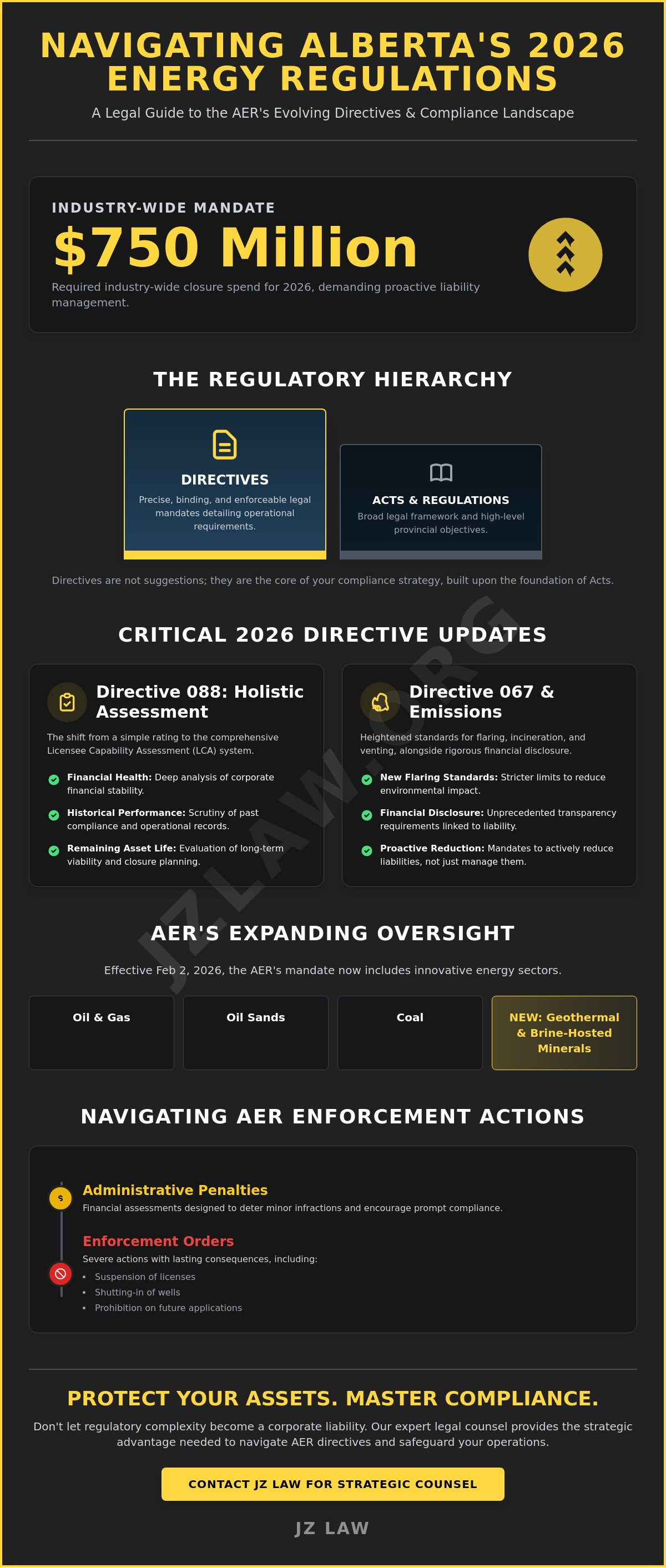
The Alberta Energy Regulator (AER) operates as the central authority for energy development, deriving its statutory power from the Responsible Energy Development Act (REDA). While provincial Acts and Regulations provide the broad legal framework, alberta energy regulator (aer) directives serve as the precise, binding instruments that dictate operational requirements. These directives aren't merely suggestions for best practices. They're enforceable legal mandates that govern the entire lifecycle of an energy project, from the initial seismic exploration to the final certificate of reclamation.
In 2026, the distinction between legislation and directives has become increasingly critical for corporate strategy. Legislation sets the high level objectives for the province, but the directives define the technical and financial thresholds that determine a project's viability. The significant updates released on April 21, 2026, regarding liability management, signal a transition toward a more rigorous, data driven regulatory roadmap. This shift ensures that every licensee is evaluated not just on their current production, but on their long term capability to meet environmental and closure obligations.
The Scope of Regulatory Authority
The AER mandate focuses on ensuring the safe, orderly, and environmentally responsible development of Alberta's energy resources. This oversight extends across the traditional oil, gas, oil sands, and coal sectors. However, as of February 2, 2026, the scope has expanded to include geothermal and brine hosted mineral resource development. This evolution reflects a modernizing economy where the regulator maintains a consistent floor for environmental protection across all resource types. Whether a firm is drilling a traditional well or developing a geothermal facility, the directives provide the granular rules for waste management, water usage, and public safety.
Legal Consequences of Non-Compliance
Failure to adhere to these standards triggers a tiered enforcement response. It's vital to distinguish between administrative penalties and enforcement orders. Administrative penalties are typically financial assessments designed to deter minor infractions. Enforcement orders, however, are more severe. They can result in the suspension of licenses, the shutting in of wells, or a complete prohibition on future applications. Such actions don't just carry immediate costs. They create a permanent record that the AER reviews during any future licensing or corporate transaction. John Zang Services offers specialized oil and gas law expertise to help firms implement proactive compliance auditing. By identifying regulatory gaps early, we help clients maintain their standing as responsible operators and protect their long term growth potential in the province.
Critical Directives for 2026: Liability Management and Emissions
The regulatory landscape in 2026 is defined by a rigorous focus on accountability. The AER has moved beyond simple ratios to a more sophisticated assessment of a company's financial and operational health. Central to this transition are the updated alberta energy regulator (aer) directives that mandate transparency and proactive liability reduction. With the industry wide closure spend requirement set at $750 million for 2026, operators must align their abandonment and reclamation schedules with these heightened expectations. Understanding the specific nuances within the alberta energy regulator (aer) directives is now a cornerstone of effective risk management. It's no longer enough to manage assets; you must manage the entire liability profile with precision.
Navigating Directive 088 and the Holistic Assessment
Directive 088 represents a fundamental shift toward the Licensee Capability Assessment (LCA) system. Unlike the previous Liability Management Rating, the LCA provides a holistic view of a licensee's ability to meet its obligations throughout the entire life cycle of a project. This assessment includes a deep dive into financial health, historical performance, and remaining asset life. Legal strategies in oil and gas law now prioritize the management of security deposit requests, which the AER may trigger if the LCA reveals significant risk. Effective advocacy involves presenting a comprehensive case that demonstrates technical competence and financial stability to mitigate these capital intensive demands.
Emissions Compliance and Methane Reduction
Methane reduction remains a primary regulatory pillar for the province. The most recent version of Directive 060, effective as of March 27, 2026, introduces stricter requirements for flaring, incinerating, and venting. This coincides with the anticipated federal methane equivalency agreement expected by April 2026, which aims to streamline provincial and national standards. Non compliance with Directive 060 carries substantial risk, including administrative penalties that can disrupt cash flow and damage corporate reputation. For oil sands operators, Directive 085 continues to impose stringent timelines for tailings management, ensuring that fluid tailings are ready for reclamation within a specified period. You can review the full list of current AER Directives to verify specific technical benchmarks for your operations.
Abandonment requirements under Directive 020 have also seen increased scrutiny, particularly regarding timelines for inactive wells. The regulator is increasingly unwilling to grant extensions without a robust justification and a clear path toward closure. Navigating these technical requirements requires a partner who understands the intersection of law and energy operations. You might find it beneficial to consult with John Zang Services to ensure your current emissions reporting and abandonment plans align with the latest 2026 standards.
The Regulatory Hierarchy: Directives, Manuals, and Acts
The legal authority for energy regulation in Alberta is structured as a strict pyramid. At the apex sits the Responsible Energy Development Act (REDA), followed by sector specific regulations. Below these legislative tiers, alberta energy regulator (aer) directives function as the primary source of mandatory technical and financial requirements. It's vital for licensees to distinguish between these directives and AER Manuals. While directives carry the weight of law and non compliance leads to enforcement, manuals are intended as procedural guides. They explain how to comply rather than what is required. In a legal dispute, a directive will almost always take precedence over a manual's guidance.
Informational Letters and Bulletins occupy a more fluid space. They don't technically create new laws, but they provide the regulator's current interpretation of existing rules. Ignoring a Bulletin is risky. It often signals how the AER intends to exercise its discretion during audits or enforcement actions. Occasionally, Ministerial Orders from the Government of Alberta can override existing alberta energy regulator (aer) directives to address urgent public policy shifts or economic crises. Understanding this hierarchy is essential for building a defensible compliance framework that can withstand regulatory scrutiny.
Interpreting Regulatory Change Reports
Staying current requires monitoring the Regulatory Change Report, which the AER publishes every Thursday. This report is the definitive source for active and completed initiatives. For instance, the "Notice of Contamination" process under AER policy isn't just a reporting step; it's a legal trigger that can impact land titles and future liability. Our team at John Zang Services monitors this regulatory drift to ensure our clients aren't blindsided by incremental policy shifts that aggregate into significant compliance burdens. We focus on the proctative identification of these changes before they manifest as enforcement risks.
Watercourse Crossing and Environmental Directives
The integration of the Water Act into the AER’s single window approach adds another layer of complexity. Environmental directives governing watercourse crossings require precise engineering and legal alignment. During complex corporate transactions, environmental liabilities related to water usage or historical contamination often become the most contentious points of negotiation. We've seen asset purchases stall because a buyer failed to account for the long term reclamation costs mandated by these integrated environmental directives. Strategic counsel ensures these risks are quantified and addressed within the transaction's tax and corporate structure, preventing hidden liabilities from eroding deal value.
Compliance Audits and Risk Mitigation in Energy Transactions
In the current 2026 fiscal environment, the success of a merger or acquisition hinges on more than asset quality or projected cash flow. The alberta energy regulator (aer) directives have evolved into significant legal instruments that can dictate the feasibility of a corporate deal. Integrating a rigorous audit of these directives into the due diligence process is essential to avoid inheriting unforeseen environmental or financial obligations. While share purchase agreements offer continuity, they also carry the full weight of the target's historical non-compliance. Conversely, asset purchase agreements allow for more selective acquisition, yet they face the high hurdle of AER license transfer approvals. These approvals are now strictly tied to the buyer’s holistic liability assessment and financial standing as defined in the April 2026 updates.
OneStop filings serve as the primary source of truth for verifying a company's regulatory standing. Discrepancies between internal records and OneStop data often signal deeper operational risks that can devalue an acquisition. Negotiating robust representations and warranties for regulatory compliance is no longer a standard formality; it's a critical risk-shifting mechanism. Buyers must ensure that sellers provide specific indemnities for any latent non-compliance with alberta energy regulator (aer) directives that may surface post-closing. This level of precision prevents the erosion of deal value and protects the purchasing entity from sudden administrative penalties.
Step-by-Step Regulatory Due Diligence
A comprehensive due diligence process begins with a deep dive into historical compliance records and any outstanding enforcement orders. Under Directive 088, the AER evaluates the liability transfer during asset sales by looking at the post-transaction health of both the buyer and the seller. If the acquisition significantly lowers the buyer's capability score, the regulator may demand a security deposit as a condition of the transfer. Verifying reclamation certificates and site closure statuses is equally vital. In 2026, with an industry-wide closure spend of $750 million, any ambiguity in a site's closure status represents a direct financial liability that must be accounted for in the purchase price.
Structuring Transactions for Regulatory Success
Mitigating the risk of license transfer denials requires a strategic alignment of the deal structure with AER expectations. This often involves a multi-jurisdictional approach where securities regulation and corporate governance are synchronized with energy-specific mandates. For companies seeking to fund acquisitions through public markets, the transparency required by the AER mirrors the disclosure standards of provincial securities commissions. Our team at John Zang Services provides the integrated legal counsel necessary to navigate these overlapping regimes. We ensure that your corporate transactions are structured to withstand both financial scrutiny and the stringent requirements of the Alberta energy regulator.
Strategic Counsel for AER Enforcement and Dispute Resolution
When a licensee receives a notice of non-compliance, the immediate priority is to stabilize the regulatory relationship while protecting corporate interests. The alberta energy regulator (aer) directives provide the framework for enforcement, but the regulator’s application of these rules is often subject to interpretation. Defending against administrative penalties or compliance orders requires more than technical corrections; it demands a strategic legal defense that challenges the regulator’s findings or demonstrates a high standard of due diligence. We've seen that a well-documented history of proactive compliance can be the deciding factor in whether a minor infraction escalates into a major enforcement action.
The voluntary self-disclosure process presents a complex strategic choice for energy executives. Disclosing a breach before an audit can significantly reduce financial penalties and foster a collaborative relationship with the AER. However, it also creates a formal record of non-compliance that could impact future Licensee Capability Assessments. Deciding whether to disclose requires a careful weighing of the potential enforcement severity against the benefits of transparency. It's a decision that should never be made without a comprehensive review of the specific alberta energy regulator (aer) directives involved and the potential long-term impact on the firm's regulatory standing.
The AER Hearing Process
Gathering robust evidence and securing qualified expert testimony are the foundations of success in formal regulatory hearings. These proceedings are quasi-judicial and require a sophisticated understanding of both administrative law and technical energy operations. Whether you're navigating concerns regarding sour gas developments or managing the complexities of major oil sands projects, protecting stakeholder interests is paramount. Strategic advocacy at this stage doesn't just resolve disputes; it secures the necessary licence amendments and project approvals that allow your operations to proceed. We focus on building a record that stands up to the scrutiny of the regulator's decision-making panel.
Mitigating Administrative Penalties
The AER operates on a risk-based enforcement model, where the severity of the penalty is often tied to the potential environmental or safety impact of the violation. Legal arguments for reducing or waiving these penalties often focus on the licensee’s proactive efforts to mitigate harm or the presence of external factors beyond their control. By demonstrating a history of adherence to regulatory standards and a commitment to immediate remediation, firms can often negotiate more favorable outcomes. Resolving high-stakes regulatory disputes requires a partner who understands the business implications of every legal move. If your organization is facing an enforcement action or requires representation in a hearing, contact JZ Law for expert legal counsel in Calgary and beyond.
Securing Your Operational Future in Alberta
The landscape of Alberta’s energy sector has fundamentally shifted toward a model where financial stability and environmental accountability are inseparable. By mastering the 2026 updates to alberta energy regulator (aer) directives, your organization can transform compliance from a reactive burden into a strategic advantage. Success now requires a precise understanding of the regulatory hierarchy and a proactive approach to liability management during every stage of an asset's lifecycle. It's no longer enough to react to changes; you must anticipate them to protect your corporate standing.
Navigating these complexities demands a partner who understands the intersection of oil and gas law and corporate strategy. John Zang Services provides the expertise in Calgary energy law necessary to guide you through high-stakes acquisitions and enforcement actions. As a strategic partner for complex corporate transactions, we focus on proactive regulatory risk mitigation to ensure your business remains resilient against administrative penalties and licensing delays. We treat your regulatory standing with the same precision as your financial balance sheet.
Consult with JZ Law for Strategic Regulatory Counsel to safeguard your interests and streamline your compliance processes. Methodical preparation today is the most effective way to ensure long-term stability and growth in Alberta’s evolving energy market.
Frequently Asked Questions
What is the primary purpose of AER Directives in Alberta?
The primary purpose of these documents is to establish mandatory requirements and technical processes that energy companies must follow throughout the lifecycle of a project. These alberta energy regulator (aer) directives ensure that the development of Alberta's energy resources remains safe, orderly, and environmentally responsible. They translate broad provincial legislation into specific operational rules for oil, gas, oil sands, and coal sectors.
How often does the AER update its Directives and where can I find changes?
The regulator updates its requirements as industry practices and government policies evolve, rather than on a fixed calendar schedule. You can track these changes in real time through the Regulatory Change Report, which the AER publishes every Thursday. This report provides a comprehensive summary of all active and completed regulatory initiatives, including the major updates to financial disclosure rules released on February 5, 2026.
Can a company be fined for non-compliance with an AER Manual?
Directives are the legally binding instruments, while manuals are intended as procedural guides that explain how to meet those requirements. While you typically won't be fined for a manual deviation alone, failing to follow the mandatory standards within the associated alberta energy regulator (aer) directives will result in enforcement actions. It's vital to understand that manuals provide the "how-to" for the "what" that is legally required by the directives.
What is Directive 088 and why is it critical for oil and gas transactions?
Directive 088 governs Licensee Life-Cycle Management and introduces the Holistic Assessment system for evaluating a company's capability. It's critical for corporate transactions because the AER uses this assessment to decide whether to approve license transfers or demand significant security deposits. Since the April 21, 2026, updates, the regulator's scrutiny of a buyer’s financial health has become a primary factor in deal viability.
How does the AER handle enforcement for environmental releases?
The regulator employs a risk-based enforcement model that scales based on the severity and impact of the release. This process often begins with a "Notice of Contamination" and can escalate to administrative penalties, compliance orders, or the suspension of operations. The AER focuses on immediate remediation and long-term reclamation, as evidenced by the $750 million industry-wide closure spend requirement set for 2026.
What is the difference between an AER Directive and a Ministerial Order?
Directives are technical requirements issued by the regulator under its statutory authority from the Responsible Energy Development Act. Ministerial Orders are high-level commands issued by the provincial government that can override existing regulatory rules during public policy shifts or economic emergencies. While directives handle day-to-day operations, Ministerial Orders represent the government's direct intervention in energy policy.
How can a legal audit help my company avoid AER administrative penalties?
A legal audit identifies latent compliance gaps before they are discovered during a regulatory inspection or audit. By reviewing your internal processes against the most recent 2026 updates, you can implement corrective actions or utilize the voluntary self-disclosure process. This proactive approach demonstrates due diligence, which is a primary factor the AER considers when deciding whether to waive or reduce administrative penalties.
Does the AER regulate cryptocurrency mining operations in Alberta?
The AER only regulates cryptocurrency mining if the operation is directly integrated with energy resource development, such as using co-produced gas for on-site power generation. In these specific cases, the mining infrastructure must comply with directives related to noise, emissions, and public safety. Standalone mining facilities that pull power from the provincial grid generally fall under different municipal or provincial jurisdictional oversight.


Comments