


New York OCM Application: Strategic Legal Guide 2026
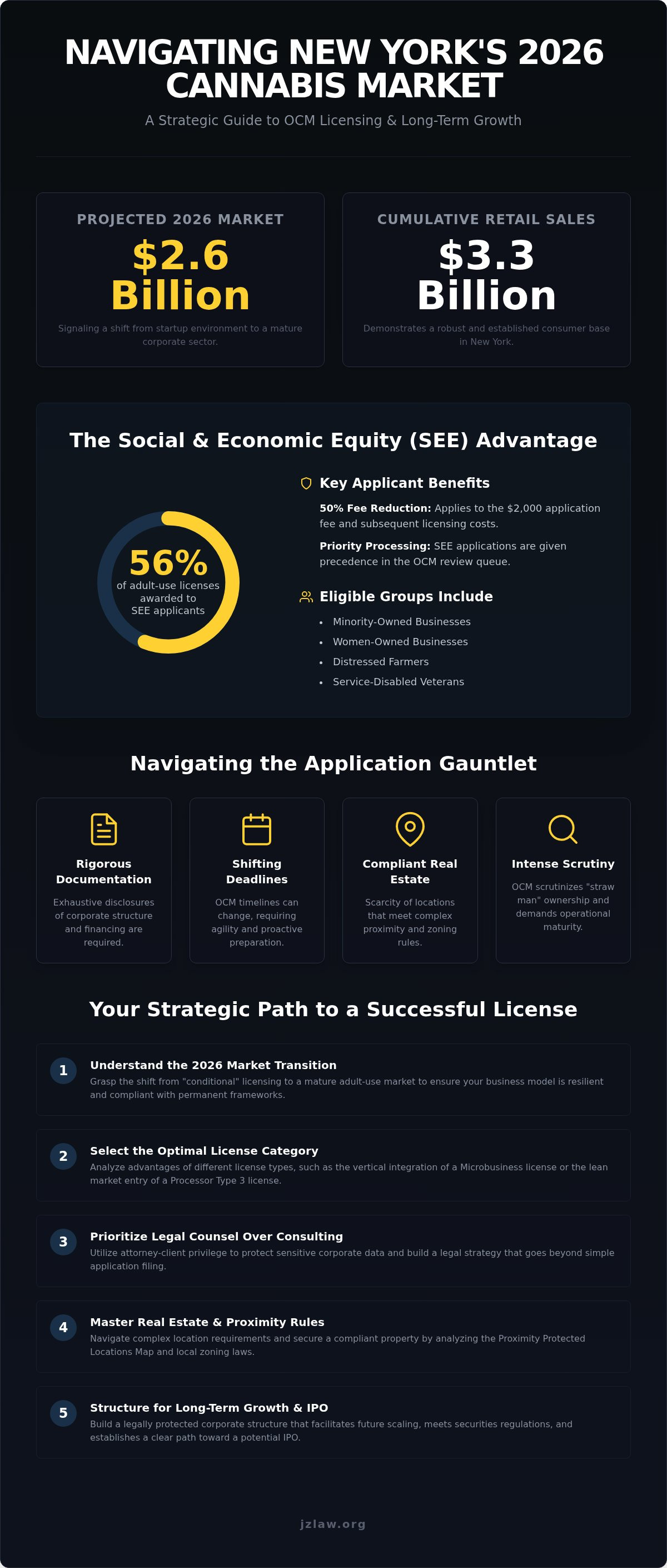
56% of all adult-use cannabis licenses in New York have been awarded to Social and Economic Equity (SEE) applicants, yet many high-potential ventures remain stalled by the rigorous documentation required to prove eligibility. You're likely aware that the opportunity to capture a share of a market projected to reach $2.6 billion in 2026 requires more than just a viable business plan; it demands absolute regulatory precision. The frustration of shifting OCM deadlines and the scarcity of compliant real estate can make the process feel like a moving target that puts your initial capital at risk.
This strategic guide provides the professional legal strategies you need to secure your business future through expert New York OCM application help. We'll outline how to navigate the current 2026 regulatory environment to achieve a successful license acquisition. You'll learn to build a legally protected corporate structure that doesn't just meet today's compliance standards but also establishes a clear path toward future scaling or a potential IPO. By approaching your application as a foundational legal asset rather than a bureaucratic hurdle, you can ensure your enterprise is built on a framework of long-term stability and professional dignity.
Table of Contents
The 2026 New York OCM Licensing Landscape: A Strategic Overview
The era of speculative entry into the New York cannabis market has officially concluded. By May 2026, the state's cumulative retail sales surpassed $3.3 billion, signaling a transition from a volatile startup environment to a mature, multi-billion dollar corporate sector. The New York Office of Cannabis Management (OCM) now operates as a sophisticated regulatory body focused on market equilibrium rather than mere expansion. For entrepreneurs seeking New York OCM application help, this shift means that the Cannabis Control Board (CCB) prioritizes applicants who demonstrate not just basic compliance, but long-term fiscal and operational maturity. The early "Green Rush" has been replaced by a rigorous corporate environment where legal precision is the only currency that matters.
Current Market Dynamics and Regulatory Shifts
The regulatory calendar for 2026 is dominated by the adult-use license renewal window, which requires submissions between 60 and 120 days prior to expiration. This cycle creates a dual-track environment where new applicants must compete for administrative attention alongside over 307 established dispensaries seeking to maintain their status. The OCM manages application queues with a level of scrutiny that mirrors traditional securities regulation, often requiring exhaustive disclosures of corporate structure and financing. Additionally, the Cannabis Advisory Board continues to refine the market by recommending adjustments to license types based on real-time economic data, ensuring the supply chain remains functional and profitable. Success in this environment requires a proactive stance that anticipates these regulatory shifts before they become obstacles.
Why 2026 is a Pivot Year for NY Cannabis
2026 marks the definitive end of the "conditional" era. With provisional CAURD and other conditional licenses extended only through December 31, 2026, the industry is currently undergoing a massive conversion to permanent adult-use frameworks. This transition opens specific doors for sophisticated entrants, particularly through Processor Type 3 Branding licenses and specialized Flower licenses. These categories allow companies to build brand equity without the heavy capital expenditure of full-scale cultivation, providing a leaner path to market entry. The OCM’s 2026 mandate focuses on ensuring long-term market stability and economic viability for existing licensees rather than rapid, unchecked expansion. Securing New York OCM application help during this pivot year is no longer a luxury; it's a structural necessity for any business aiming to survive the transition from a local startup to a scalable corporate entity. Aligning your application with the CCB's latest priorities is the only way to ensure your business isn't left behind as the market reaches full maturity.
Deciphering OCM License Types and SEE Eligibility Requirements
Selecting the correct operational framework is the most consequential decision an applicant will make in the 2026 market. The New York Office of Cannabis Management (OCM) Licensing portal lists several distinct paths, ranging from large-scale cultivation to specialized distribution. For many boutique operators, the Microbusiness license offers a unique strategic advantage by allowing for limited vertical integration, combining cultivation, processing, and retail under a single entity. This model reduces reliance on third-party supply chains, though it comes with strict canopy and production limits that require careful legal planning. Seeking professional New York OCM application help is essential to determine whether these boutique benefits outweigh the scaling potential of standalone licenses.
The SEE Advantage: More Than Just a Quota
Social and Economic Equity (SEE) status is a cornerstone of the New York regulatory framework, with 56% of all adult-use licenses currently held by SEE applicants as of May 2026. This designation offers tangible financial benefits, including a 50% reduction on the $2,000 application fee and subsequent licensing costs. Priority processing remains a key driver for minority-owned and women-owned businesses, along with distressed farmers and service-disabled veterans. However, the OCM has intensified its scrutiny of "straw man" ownership structures where equity partners hold title without meaningful control. To maintain priority without sacrificing necessary capital, corporate bylaws must be drafted with extreme precision to ensure the SEE individual retains at least 51% ownership and sole decision-making authority. This balance is critical for long-term viability and regulatory favor.
Choosing the Right License for Your Business Model
The choice between vertical integration and standalone operations depends entirely on your long-term capital strategy. While standalone retail dispensaries are currently the most competitive sector, Cooperative licenses offer a communal path for small-scale cultivators to pool resources and compete with larger entities. It's helpful to review our Cannabis Licensing Guide 2026 to understand how these New York structures compare to global regulatory hubs. Each license type carries specific tax implications and proximity restrictions that can impact your bottom line. Before finalizing your entity formation, you should ensure your corporate transactions are structured to withstand both OCM audits and future investor due diligence. Proper structuring today prevents the need for costly reorganizations during your first renewal window.
Legal Counsel vs. General Consultants: Why Strategy Trumps Filing
Many entrepreneurs mistakenly view the licensing process as a simple administrative task. They often hire general consultants who promise a turnkey solution but lack the legal standing to protect the client's interests. While a consultant might help you organize a business plan, they cannot offer the protective shield of attorney-client privilege. This distinction is vital because the OCM requires deep financial and personal disclosures that you don't want exposed in future litigation or regulatory disputes. Professional New York OCM application help ensures that your application is treated as a foundational legal asset rather than a mere set of forms.
The High Cost of Administrative Errors
Relying on non-legal services often leads to "deficiency notices" that can delay your opening by months. OCM examiners are trained to spot inconsistencies in corporate disclosures and ownership maps. We've seen cases where improper disclosures of "true parties of interest" led to immediate application rejection, forfeiting the $2,000 application fee and, more importantly, your business's momentum. Legal privilege is vital during the OCM disclosure process because it ensures that your sensitive financial strategies and proprietary internal structures remain confidential. Every Standard Operating Procedure (SOP) we draft isn't just a template; it's a legally sound document that stands up to the highest level of regulatory scrutiny.
Strategic Corporate Structuring
Building a cannabis business in New York requires a sophisticated approach to tax and corporate law. You must navigate the complexities of Section 280E of the Internal Revenue Code while simultaneously complying with evolving state tax structures. For founders with Multi-State Operator (MSO) interests, the legal hurdles are even higher. You must ensure your New York entity doesn't inadvertently trigger "undue influence" violations that could jeopardize licenses in other jurisdictions. We focus on preparing your enterprise for future corporate transactions from day one. This proactive approach means your operating agreements and capitalization tables are ready for institutional investment or a public offering whenever the opportunity arises.
JZ Law doesn't just file your paperwork. We build the legal foundation for a resilient, scalable enterprise. By integrating high-level New York OCM application help with securities and corporate expertise, we bridge the gap between initial approval and long-term market leadership. This methodical approach avoids the rush and unfounded decisions that often plague less experienced applicants.
The Critical Path: Proximity Strategy and Real Estate Law
The most common reason for application failure in 2026 isn't a lack of capital, but a failure to secure a site that meets the state's rigorous proximity standards. The Proximity Protected Locations Map (PPLM) is the OCM's primary instrument for managing dispensary density, yet its data can be deceptively static and often fails to account for pending applications in the queue. You must strictly adhere to the 500-foot rule regarding houses of worship and the 1,000-foot rule for school grounds, as these distances are measured with mathematical precision from property line to property line. Securing professional New York OCM application help is essential to verify these distances before you commit to a location. In highly competitive zones, we also assist in drafting Public Convenience and Advantage (PCA) requests to demonstrate how your specific location serves the community's interests, effectively strengthening your case for approval.
Real Estate as a Competitive Moat
A strategic approach to real estate involves using the LOCAL map to identify geographic gaps where consumer demand is high but licensed competition remains low. To satisfy the OCM's "control of premises" requirement, you must provide a deed, a fully executed lease, or a binding letter of intent that explicitly permits cannabis operations. Negotiating these commercial leases requires specialized expertise to include "contingency clauses" that protect your investment. These provisions allow you to terminate the lease or abate rent if your license is delayed or denied, preventing you from being tethered to a high-cost asset you cannot legally use. For a deeper analysis of these protective frameworks, review our guide on Real Estate Law 2026.
Zoning and Municipal Compliance
Municipal dynamics add another layer of complexity to the licensing process. While New York City has established specific zoning resolutions for adult-use retail, approximately one-third of New York municipalities have opted out of allowing dispensaries as of 2026. In jurisdictions that permit cannabis businesses, the 30-day Community Board or municipal notification is a mandatory legal step that can invite public opposition. We manage this notification process through strategic legal advocacy, presenting a professional and compliant business case to local officials before concerns can escalate into formal objections. Our firm provides the comprehensive New York OCM application help needed to navigate these municipal hurdles and secure your market position with professional dignity and precision.
Beyond the License: Structuring for IPO and Long-Term Growth
Securing a license is merely the first milestone in a much larger corporate journey. For founders aiming to capture a significant portion of New York’s projected $2.6 billion in 2026 sales, the focus must immediately shift toward scalability and institutional readiness. Most applicants view their business through a local lens, but a sophisticated legal strategy treats the enterprise as a vehicle for future capital events. This involves more than just operational compliance; it requires a deep understanding of how New York OCM application help can be leveraged to build a corporate structure that satisfies both the Office of Cannabis Management and future institutional investors. A legally sound foundation is what separates a short-term retail operation from a dominant market leader.
Cannabis and Capital Markets
The transition to a mature market involves navigating complex private placements and capital raises while strictly adhering to the OCM’s "True Parties of Interest" (TPI) regulations. Any change in ownership or significant investment must be disclosed and approved, making the initial corporate framework vital for future liquidity. We specialize in taking your cannabis company public, ensuring that your governance documents meet the rigorous standards of international securities exchanges. Additionally, as the industry evolves, the intersection of cryptocurrency law and cannabis payments offers innovative solutions for banking hurdles, provided the structures are built on a foundation of absolute regulatory transparency. These payment frameworks must be integrated carefully to avoid triggering anti-money laundering concerns that could jeopardize your standing with the Cannabis Control Board. We ensure that every financial instrument used to fund your growth is compliant with both state cannabis law and federal securities standards.
Your Long-Term Strategic Legal Partner
John Zang’s expertise in securities regulation serves as a critical differentiator for New York startups entering this high-stakes environment. We don't just facilitate your entry; we manage your ongoing corporate evolution through rigorous compliance audits designed to prevent license revocation. These audits are essential in a market where enforcement against non-compliant actors has intensified throughout 2026. For example, staying ahead of the 2026 Potency Limits and Marketing Act (PLMA) requires a pro-active legal partner who can audit your advertising and loyalty programs before they draw regulatory heat. By choosing a partner who understands both local licensing and global corporate finance, you ensure your business is protected against regulatory volatility. If you're ready to move beyond the initial filing phase, contact JZ Law for a comprehensive OCM application strategy session to secure your place in the future of the New York market. Our methodical approach focuses on eliminating risks before they manifest, providing the professional dignity and peace of mind necessary for long-term success.
Securing Your Market Position for 2026 and Beyond
Success in New York's mature cannabis market requires a definitive shift from simple administrative filing to sophisticated legal planning. As we've explored, navigating the Proximity Protected Locations Map and maintaining Social and Economic Equity status are not merely bureaucratic hurdles; they are opportunities to build a competitive moat around your enterprise. By prioritizing attorney-client privilege and a robust corporate structure from day one, you protect your sensitive disclosures while preparing for future institutional capital. It's no longer enough to simply enter the market. You must build an enterprise that is ready for the scrutiny of public markets and long-term scaling.
John Zang provides the specialized New York OCM application help needed to bridge the gap between local licensing and global securities standards. With expertise in complex regulatory sectors and strategic corporate counsel, our firm offers the global reach and local New York expertise required to protect your business future. Secure your New York cannabis license with JZ Law today to ensure your venture is built on a foundation of professional dignity and legal resilience. Your future in this multi-billion dollar industry begins with a commitment to methodical, strategic advocacy.
Frequently Asked Questions
How long does the New York OCM application process take in 2026?
The processing time for a New York OCM application in 2026 typically ranges from six months to over a year, depending on your license type and applicant status. Social and Economic Equity (SEE) applicants often receive priority in the queue, which can expedite the initial review. However, the OCM's thorough vetting of "true parties of interest" and proximity requirements means that any administrative inconsistency can lead to significant delays.
What is the difference between a CAURD license and an Adult-Use Retail license?
The CAURD program was a conditional initiative for justice-involved individuals that is now closed to new applicants, while the Adult-Use Retail Dispensary license is the permanent framework for the current mature market. All existing CAURD licenses must transition to permanent adult-use status by the December 31, 2026, deadline. The 2026 licensing process focuses on long-term market stability and broader SEE eligibility rather than the initial conditional requirements.
Do I need a physical location before I apply for an OCM license?
You can often submit an initial application without a site, but you must demonstrate "control of premises" through a deed or lease to secure final approval. Most successful entrepreneurs secure New York OCM application help to identify a site and negotiate a cannabis-contingent lease before filing. This proactive approach prevents the risk of your application being stalled because your chosen location violates the state's strict proximity rules.
Can a non-NY resident apply for a cannabis license under SEE status?
Non-residents are eligible to apply for New York cannabis licenses, but qualifying for SEE status involves meeting specific criteria that often favor those with ties to disproportionately impacted communities. While New York residency isn't a strict barrier to entry, the SEE designation is reserved for minority-owned businesses, women-owned businesses, distressed farmers, or service-disabled veterans. Your corporate structure must ensure the qualifying individual maintains 51% ownership and genuine decision-making authority.
What are the main reasons the OCM rejects cannabis applications?
The OCM frequently rejects applications due to incomplete financial disclosures or violations of the Proximity Protected Locations Map. Failure to disclose all individuals with a financial interest or providing generic Standard Operating Procedures (SOPs) that don't meet New York's specific safety standards often leads to rejection. Additionally, any attempt to use "straw man" ownership structures to improperly claim SEE status is a primary trigger for a permanent denial during the vetting process.
How much does it cost to get help with a New York OCM application?
The cost of professional New York OCM application help varies based on the complexity of your corporate structure and the specific license category you are pursuing. While we don't quote fixed fees, investors should view legal counsel as a necessary capital expense to protect against the $2,000 non-refundable application fee and potential site loss. Comprehensive legal advocacy covers everything from entity formation to real estate negotiation and long-term compliance audits.
Can I hold multiple cannabis licenses in New York at the same time?
New York law generally prohibits "cross-ownership" between the supply side and the retail side, meaning you cannot hold an interest in both a cultivation license and a retail dispensary. The primary exception is the Microbusiness license, which allows for limited vertical integration on a boutique scale. Understanding these restrictions is vital to ensure your corporate transactions don't accidentally violate state laws that prevent monopolies and undue market influence.
What is the Proximity Protected Locations Map (PPLM) and why does it matter?
The PPLM is the OCM's official tool for managing dispensary density and enforcing the 500-foot and 1,000-foot distance requirements from schools and houses of worship. It tracks both active dispensaries and pending applications to prevent new businesses from opening in protected zones. Because the map is updated as new applications enter the queue, you need a strategic legal partner to verify your site's viability in real-time before you sign a lease.


Comments