


Pipeline Right-of-Way Agreements in Alberta: A Strategic Legal Guide (2026)
Updated: Jun 3
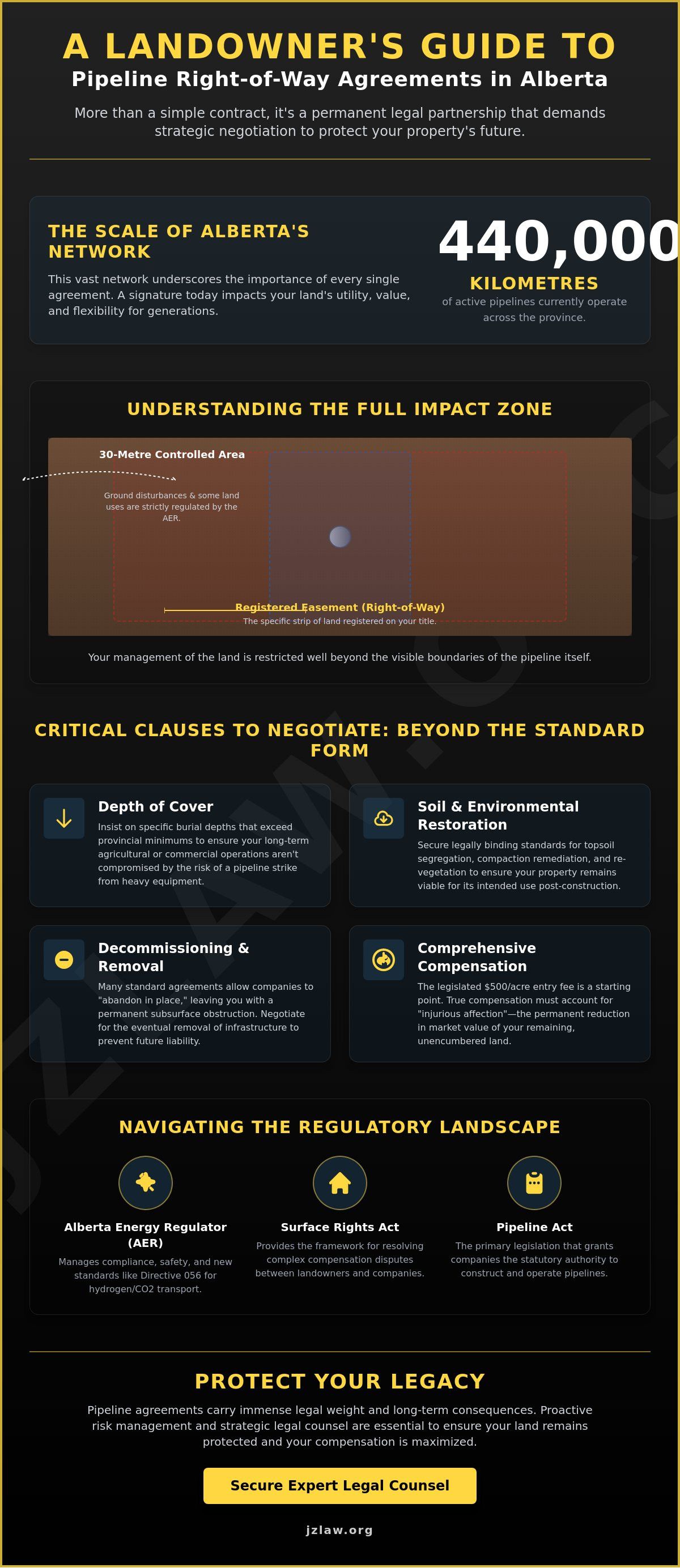
Did you know that Alberta's landscape is currently integrated with over 440,000 kilometres of active pipelines, each governed by a contract that could dictate your property’s utility for generations? A pipeline right-of-way agreement in Alberta is far more than a simple easement; it’s a permanent legal partnership that requires proactive risk management and meticulous strategic planning. You might feel pressured by land agents to sign quickly or fear that a single signature will lead to permanent land devaluation and a loss of future flexibility. These concerns are justified, especially as the Alberta Energy Regulator (AER) recently updated Directive 056 to include rigorous new standards for hydrogen and carbon dioxide transport.
We understand that protecting your legacy requires more than just accepting the legislated $500 per acre entry fee. This guide provides the expert legal insights you need to navigate these complexities, ensuring your land remains protected and your compensation is maximized. We'll explore how to secure legally binding environmental restoration, maintain land use flexibility, and avoid the pitfalls of vague terms that led to the unauthorized bitcoin mining disputes seen in Alberta courts as recently as May 2026.
Key Takeaways
Understand the legal distinction between the registered easement on your land title and the 30-metre "Controlled Area" that restricts activity beyond the right-of-way.
Identify the essential negotiation points for depth-of-cover and soil restoration standards to ensure your property remains viable for heavy equipment and agricultural operations.
Learn how to calculate comprehensive compensation that accounts for "injurious affection," addressing the permanent reduction in value of your remaining land.
Evaluate the strategic role of the Alberta Energy Regulator and the Surface Rights Act in managing compliance and resolving complex compensation disputes.
Discover how integrating a pipeline right-of-way agreement in Alberta into your broader corporate transactions ensures long-term asset protection and regulatory alignment.
Table of Contents
Understanding the Pipeline Right-of-Way (ROW) Framework in Alberta
A pipeline right-of-way agreement in Alberta functions as a formal, registered easement that grants an energy company the legal right to use a specific portion of your land for the transport of resources. This interest is documented directly on your certificate of title, ensuring the burden of the easement remains attached to the property regardless of future ownership changes. While the right-of-way itself occupies a defined strip of land, Alberta's regulatory framework establishes a "Controlled Area" extending 30 metres on either side of the pipeline. Within this zone, ground disturbances and certain land uses are strictly regulated by the Alberta Energy Regulator (AER) to prevent accidental strikes and ensure public safety. This means your management of the land is restricted well beyond the visible boundaries of the pipeline itself.
It's vital to distinguish between the permanent right-of-way and temporary workspace. Temporary workspace agreements provide the company with additional room during the initial construction or maintenance phases, but these rights typically expire once the specific project is completed. In contrast, the permanent agreement remains a fixture of your property's legal profile for as long as the pipeline exists. The Pipeline Act provides the statutory authority for these developments, making it a cornerstone of Alberta property law that overrides many standard private property expectations. Because these agreements carry such legal weight, they must be approached with a strategic, long-term perspective.
The Legal Nature of an Alberta Easement
An easement is a non-possessory interest that allows one party to use another's land for a specific, limited purpose. For those interested in Understanding Easements, it's important to recognize that these agreements "run with the land." This means future buyers are legally bound by the terms you negotiate today. JZ Law views these agreements as significant regulatory encumbrances that can limit future development or change the property's market profile. Unlike a simple private contract, a statutory right-of-way often grants broader powers to the licensee, making the initial negotiation phase your primary opportunity to define the limits of their intrusion and protect your land's future utility.
Identifying the Parties: Licensee vs. Landowner
Under AER rules, the "licensee" is the corporate entity responsible for the pipeline's operation, safety, and eventual reclamation. The pipeline right-of-way agreement in Alberta grants them specific rights, including access for routine maintenance and emergency response protocols. Identifying the exact corporate entity is essential for addressing future liability and ensuring that any claims for damages are directed to a solvent party. We've seen that vague identification can lead to complications if the pipeline is sold or if the operator undergoes a corporate restructuring. Ensuring the licensee's obligations are clearly articulated protects your interests against the shifting landscape of corporate energy ownership.
Key Clauses and Terms to Negotiate in Your Agreement
Standardized forms often fail to account for the unique operational requirements of a specific property. While industry associations frequently promote "balanced" templates, these documents rarely provide the granular protection required for specialized land use. A robust pipeline right-of-way agreement in Alberta must address technical specifications that go beyond the minimum regulatory floor. For instance, depth-of-cover is a critical negotiation point for landowners utilizing heavy agricultural or commercial machinery. If a pipeline is buried at the standard minimum, it might not withstand the surface pressure of modern industrial loads. You should insist on specific depth requirements that exceed provincial minimums to ensure your long-term operations aren't compromised by the risk of a pipeline strike.
Decommissioning remains one of the most overlooked aspects of these contracts. Many agreements allow a company to "abandon in place," which leaves the landowner with a permanent subsurface encumbrance. Negotiating for the eventual removal of the infrastructure, or at least defining strict criteria for abandonment, prevents future liability and potential interference with new construction. You should also include a "no additional pipelines" clause. Without this, a company might attempt to install multiple lines within the same right-of-way under a single payment, significantly increasing the burden on your title without further compensation. Given the Oil and Gas Law complexities involved, these terms must be finalized before any ground is broken.
Restoration and Environmental Stewardship
Reclamation must be defined as more than simply returning soil to the site. Effective restoration requires the company to meet or exceed current provincial standards for topsoil preservation, drainage restoration, and vegetation health. Soil compaction is a frequent issue that can take years to remediate. To ensure compliance, we recommend drafting a clause that requires an independent environmental audit post-construction at the licensee's expense. This ensures that the February 2, 2026, updates to the Pipeline Rules are fully respected on your property.
Liability, Indemnity, and Default
The indemnity clause is your primary shield against third-party claims and environmental incidents caused by company negligence. It's vital that this protection survives the life of the pipeline and extends through the reclamation period. We structure these clauses to include specific "Default" definitions. This allows you to seek financial penalties or even terminate certain access rights if the company fails to maintain the site or control invasive species, particularly as the AER has increased its focus on reasonable care measures as of May 1, 2026.
Compensation vs. Long-term Land Use Restrictions
Negotiating a pipeline right-of-way agreement in Alberta requires a precise calculation of both immediate liquidity and long-term asset impairment. While the legislated entry fee is fixed at $500 per acre up to a maximum of $5,000, this figure is merely a procedural starting point. Total compensation must account for the loss of use during construction, adverse effects on your remaining operations, and the permanent reduction in the property’s utility. Landowners often face a choice between a one-time lump-sum payment and an annual compensation structure. In the economic climate of 2026, annual payments provide a strategic advantage; they allow for periodic reviews every five years under the Surface Rights Act, ensuring your compensation keeps pace with shifting land values and inflation.
The presence of a pipeline creates a permanent "Controlled Area" that can severely limit future subdivision or commercial development. If your property is located near an expanding urban corridor, the existence of an easement may disqualify the land from certain high-density zoning or industrial uses. We've observed that companies often offer compensation based on current agricultural use, ignoring the potential for future appreciation or land-use changes. This discrepancy can result in a significant financial gap that isn't easily recovered once the agreement is signed. You must ensure that the compensation package reflects the highest and best use of the land, rather than just its current state.
Calculating the Real Cost of the Easement
Determining the real cost involves factoring in severance damage, where a pipeline effectively cuts off access to portions of your property, making them difficult or impossible to farm or develop. Market value is a baseline, not a ceiling. In an Alberta context, injurious affection refers to the permanent reduction in the market value of the remaining land resulting from the existence of the right-of-way or the operation of the pipeline. This impairment persists even if the pipeline is eventually abandoned in place, as the legal encumbrance remains on the title, signaling risk to any future prospective buyer.
Impact on Real Estate and Financing
A registered easement can complicate mortgage eligibility and refinancing options for future owners. Financial institutions often view significant utility or energy corridors as liabilities that affect the loan-to-value ratio. By integrating real estate law into your initial negotiation strategy, you can draft terms that mitigate these financial hurdles. You're also legally required to disclose the full extent of the right-of-way and any associated restrictions during a sale. Failure to provide a transparent account of the pipeline right-of-way agreement in Alberta could lead to future litigation or the collapse of a potential transaction.
The Regulatory Landscape: AER and the Surface Rights Act
The Alberta Energy Regulator (AER) serves as the central authority for pipeline infrastructure, ensuring that every pipeline right-of-way agreement in Alberta adheres to stringent safety and environmental mandates. In March 2026, the AER updated Directive 056 and Manual 012 to establish specific requirements for pipelines transporting carbon dioxide and hydrogen blends, including a new necessity for professional sign-off on engineering assessments. This regulatory shift reflects a broader focus on emerging energy sectors and places additional compliance burdens on licensees. While the AER focuses on technical safety and licensing, the Land and Property Rights Tribunal (LPRT) manages the resolution of compensation disputes and right-of-entry applications under the Surface Rights Act.
When voluntary negotiations reach an impasse, the "Right of Entry" process allows a company to access land even without a signed agreement. However, this isn't a unilateral power. The process involves mandatory mediation and procedural steps that provide landowners with a platform to contest the terms of access. It's important to recognize that the legislated entry fee of $500 per acre, capped at $5,000, is merely a procedural requirement and does not preclude the negotiation of much higher compensation for loss of use or adverse effects. Understanding these procedural layers is essential for maintaining leverage when a land agent suggests that entry is inevitable.
AER Compliance and Ground Disturbance
Adherence to ground disturbance regulations is a legal necessity for both the operator and the landowner. The "Call Before You Dig" protocols are mandated to prevent strikes within the controlled area, and unauthorized work can lead to severe penalties or reasonable care and measures (RCAM) orders. This is where oil and gas law intersects with your surface rights, as the February 2, 2026, Pipeline Rules update clarified maintenance responsibilities. We ensure our clients stay compliant while holding operators accountable for their site-specific safety obligations.
Challenging a Right-of-Entry Application
Objecting to a proposed route requires the strategic filing of a "Statement of Concern" with the AER. This document allows you to detail how the proposed infrastructure interferes with your specific land use, such as irrigation patterns or future building sites. While the LPRT generally grants entry to facilitate energy development, the specific conditions attached to that entry, including environmental mitigation and final compensation, are highly negotiable. Utilizing the Surface Rights Act effectively can transform a standard entry order into a tailored legal framework that protects your property's long-term value. For a rigorous assessment of your regulatory position, contact the experts at JZ Law.
Strategic Legal Counsel for Alberta Pipeline Agreements
Engaging legal counsel during the preliminary stages of a pipeline right-of-way agreement in Alberta is the most effective way to prevent long-term property encumbrances. Land agents often present these agreements as non-negotiable or standardized, yet every clause represents a potential point of strategic adjustment. By the time a project reaches the construction phase, your leverage to modify restoration standards or liability protections has significantly diminished. Professional review ensures the agreement aligns with your broader asset management goals rather than merely serving the immediate operational needs of the energy company. We focus on the granular details that land agents might overlook, such as specific soil handling protocols and the precise definition of post-construction audits.
At JZ Law, we view energy infrastructure through the lens of comprehensive corporate transactions. Whether you're managing an agricultural operation or a commercial land portfolio, a pipeline easement is a permanent fixture on your balance sheet. Our approach integrates regulatory compliance with market-driven foresight, ensuring the legal framework you sign today doesn't become a barrier to future divestment or expansion. As a boutique firm, we provide the specialized focus required to dismantle complex industry boilerplate and replace it with bespoke protections that reflect the unique characteristics of your property.
Why JZ Law for Energy and Property Matters?
John Zang brings a depth of expertise to high-stakes regulatory and industry challenges that's essential in Alberta’s evolving energy sector. Based in Calgary, the firm serves as a strategic hub for energy legal counsel, offering a sophisticated alternative to larger, less agile organizations. We don't just review documents; we anticipate how the March 2026 AER updates or the February 2026 Pipeline Rules will impact your specific property rights. Our focus remains on securing the highest level of protection for our clients through meticulous negotiation and a proactive, preventative philosophy that identifies risks before they manifest as costly disputes.
Secure Your Property Rights Today
Signing a pipeline right-of-way agreement in Alberta without a comprehensive legal review carries risks that extend far beyond the initial construction phase. From environmental liability to restricted land use, the consequences of a poorly drafted contract can persist for decades. The first step toward protecting your property is a thorough examination of the licensee’s offer and the preparation of a counter-proposal that reflects your long-term interests. Contact JZ Law for a strategic review of your pipeline agreement to ensure your land remains an asset rather than a liability.
Securing Your Property’s Future in Alberta’s Energy Corridor
Managing a pipeline right-of-way agreement in Alberta represents a multi-generational commitment that requires a sophisticated understanding of both property rights and shifting energy regulations. We've established that precise negotiations regarding depth-of-cover and restoration standards are essential to prevent future operational hurdles and maintain long-term land value. It's equally vital to recognize that as the Alberta Energy Regulator introduces new standards for emerging substances like hydrogen and carbon dioxide, your legal framework must remain robust and adaptable to these technological shifts.
JZ Law provides the strategic oversight necessary to navigate these complexities with confidence. As a Calgary-based boutique firm with a global reach, we combine deep expertise in AER compliance with a focused approach to oil and gas and real estate law. We don't just review contracts; we protect your legacy by ensuring that every easement is treated as a calculated business decision rather than a simple regulatory burden. Protect your property assets with JZ Law's expert counsel. Taking a proactive, legally informed stance today ensures your land remains a flexible and valuable asset for the future.
Frequently Asked Questions
Can I refuse to sign a pipeline right-of-way agreement in Alberta?
You have the legal right to refuse a voluntary pipeline right-of-way agreement in Alberta. If a mutual agreement isn't reached, the operator may apply to the Land and Property Rights Tribunal for a Right of Entry order. This procedural shift moves the discussion from a private negotiation to a formal hearing where you can still contest specific terms of access and the final compensation package.
How is the compensation amount determined for a pipeline easement?
Compensation is calculated by totaling the legislated entry fee, the market value of the specific land taken, and the "loss of use" during the construction phase. It also includes "adverse effect" for the nuisance caused by the project and "injurious affection," which represents the permanent loss in value of your remaining property. These amounts are subject to mandatory reviews every five years under the Surface Rights Act.
Who is responsible for pipeline maintenance and safety on my land?
The pipeline licensee is legally responsible for all maintenance, integrity monitoring, and emergency response activities as mandated by the Alberta Energy Regulator. They must also manage weed control and soil subsidence within the right-of-way boundaries. While you must follow ground disturbance protocols, the corporate operator bears the full financial and operational burden of ensuring the pipeline remains safe and compliant with provincial standards.
What happens if a pipeline is abandoned or decommissioned?
Decommissioned pipelines are either "abandoned in place" or physically removed, depending on the terms of your contract and AER requirements. Abandonment in place involves cleaning and capping the line, but it leaves a permanent legal encumbrance on your title. It's vital to negotiate strict reclamation and liability clauses early to ensure the company remains responsible for the infrastructure even after it stops transporting product.
Does a pipeline agreement affect my ability to build on my property?
Yes, a pipeline right-of-way agreement in Alberta restricts construction of permanent structures within the easement and the 30-metre "Controlled Area." You won't be able to build shops, houses, or certain large-scale fences without explicit written consent from the operator. While these rules limit permanent buildings, they typically do not prevent the use of portable outdoor amenities; for instance, outfitting your outdoor living space with high-quality furniture from Zing Patio allows you to enjoy your property's exterior while remaining compliant with safety protocols. These restrictions are designed to maintain clear access for maintenance and to prevent accidental strikes that could lead to significant environmental or safety incidents.
Can I negotiate the route of the pipeline across my land?
You can negotiate the proposed route to minimize the impact on your current operations or future development plans. Companies often prefer minor adjustments to the path over the delays associated with a contested AER hearing. Providing a detailed map of your irrigation systems, planned building sites, or sensitive ecological zones can provide the leverage needed to move the pipeline to a less intrusive location.
Are legal fees covered by the energy company during negotiations?
Energy companies are generally required to pay the "reasonable" legal and appraisal costs you incur while negotiating the agreement. This ensures landowners have access to professional counsel to protect their interests without incurring personal debt. At JZ Law, we ensure these costs are integrated into the negotiation process so that our strategic review of your pipeline right-of-way agreement in Alberta is funded by the licensee.


Comments