


Private Placement Financing in Canada: A Strategic Legal Guide for 2026
The most efficient path to scaling your enterprise shouldn't be blocked by the prohibitive costs of a full-form prospectus; yet many Canadian firms wait months for capital that could have been secured in weeks. Implementing a strategic approach to private placement financing canada allows your business to bypass the friction of public markets while maintaining the rigorous compliance standards that institutional investors demand. This method offers the agility required in a competitive market where the criminal interest rate cap of 35 percent APR remains a critical consideration for commercial loans under $500,000.
You likely recognize that while the speed of private capital is attractive, the intricate layers of National Instrument 45-106 can feel like a minefield of potential non-compliance. This guide will provide you with the legal precision needed to master these complexities, ensuring you select the optimal exemption for your specific investor base while protecting your cap table for future liquidity events. We will examine the latest 2026 regulatory updates, including the October expiration of key CSA blanket orders and the current thresholds for accredited investors, to help you execute a seamless capital raise.
Key Takeaways
Understand how the Canadian 'Exempt Market' allows your enterprise to secure significant capital while bypassing the extensive costs and delays associated with public filings.
Master the application of National Instrument 45-106 to identify the most advantageous exemptions for your investor base, a cornerstone of successful private placement financing canada.
Gain a step-by-step overview of the financing lifecycle, ensuring your Term Sheets and Subscription Agreements are structured with long-term strategic precision.
Navigate the specialized intersection of securities law and industry-specific regulations, particularly within the evolving cannabis and cryptocurrency sectors.
Implement preventative legal strategies that safeguard your company’s cap table, positioning you for seamless future transitions toward an IPO or strategic acquisition.
Table of Contents
Understanding Private Placement Financing in the Canadian Market
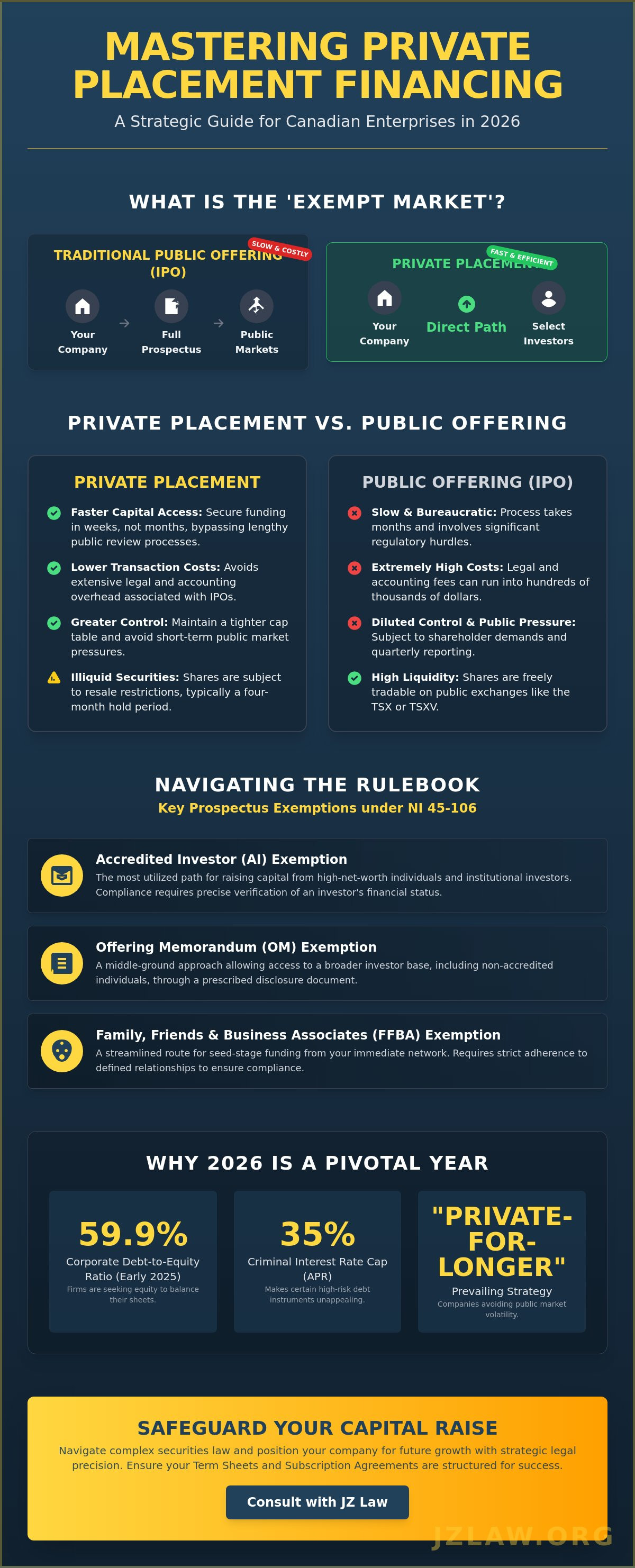
Raising capital doesn't always require the fanfare or the friction of a public listing. In the context of Understanding Private Placement Financing, this process involves the sale of securities directly to a pre-selected group of investors, bypassing the need for a formal prospectus reviewed by provincial regulators. This mechanism forms the backbone of the Canadian 'Exempt Market', a sophisticated regulatory environment that allows companies to access liquidity without the exhaustive disclosure cycles typical of public exchanges. For many mid-market enterprises, private placement financing canada serves as a vital instrument for growth that balances institutional-grade structure with operational agility.
The ecosystem relies on three primary pillars: the issuers seeking capital, exempt market dealers (EMDs) who facilitate the transactions, and sophisticated investors. These investors are often individuals or entities with significant financial assets who don't require the same level of protection as the general public. By focusing on a targeted group, firms can secure funding with a significantly faster speed to market and lower legal overhead than a traditional initial public offering (IPO).
Private vs. Public Financing: The Critical Differences
Choosing between a private placement and a listing on the TSX or TSXV is often a question of strategic timing. Public filings involve substantial legal and accounting overhead, frequently costing hundreds of thousands of dollars before a single share is sold. Conversely, private placements offer a lower barrier to entry. However, this ease of access comes with trade-offs. Securities issued through these exemptions are typically illiquid; they're subject to resale restrictions, often a four-month hold period, which prevents immediate trading on secondary markets. From a governance perspective, issuers retain tighter control over their cap table, though sophisticated investors may negotiate for board seats or specific veto rights that wouldn't exist in a broad public offering.
Why 2026 is a Pivotal Year for Private Capital
The financial landscape in 2026 reflects a distinct shift in how Canadian firms approach maturity. In hubs like Calgary and Toronto, resource and tech companies are increasingly adopting 'private-for-longer' strategies to avoid the volatility and short-term pressures of public quarterly reporting. With corporate debt-to-equity ratios reaching 59.9 percent in early 2025, many firms are looking toward equity-based private placement financing canada to balance their sheets without triggering the 35 percent criminal interest rate cap associated with certain high-risk debt instruments. Private placement financing serves as a strategic alternative to public markets for mid-market firms in 2026, offering a disciplined path to capitalization while preserving the long-term vision of the founders.
Navigating NI 45-106: The Essential Prospectus Exemptions
The regulatory architecture of private placement financing canada is built upon National Instrument 45-106. This instrument serves as the definitive rulebook, providing issuers with specific "safe harbors" to raise capital without the exhaustive requirements of a full prospectus. Without these exemptions, every securities offering would require a level of disclosure that is often cost-prohibitive for private enterprises. Mastering these rules isn't just about avoiding penalties; it's about selecting a strategy that aligns with your specific investor demographic and long-term corporate goals.
While several exemptions exist, the Accredited Investor (AI) exemption remains the most utilized path for institutional and high-net-worth capital. For earlier stages, the "Family, Friends, and Business Associates" exemption provides a streamlined route for seed rounds, though it requires strict adherence to the defined relationships to prevent regulatory scrutiny. If you're looking to reach a broader base, the Offering Memorandum (OM) exemption offers a middle ground, allowing you to solicit capital from non-accredited individuals provided you deliver a structured disclosure document.
The Accredited Investor: Criteria and Compliance
In 2026, compliance hinges on precise verification of an investor's financial status. To qualify as an accredited investor, an individual must meet specific thresholds: a net income exceeding $200,000 (or $300,000 with a spouse) in the last two years, or net financial assets exceeding $1 million, excluding their primary residence. If an individual relies on total net assets, the requirement rises to $5 million. It's the issuer's legal responsibility to verify these claims. Relying solely on an investor's "self-certification" is a significant risk that can lead to "bad actor" complications or a rescission of the trade. Expert securities regulation counsel can help implement robust verification protocols to safeguard your firm.
The Offering Memorandum (OM) Strategy
The OM exemption is particularly advantageous when the pool of accredited investors is insufficient for your capital needs. Unlike the AI exemption, the OM path requires a formal document detailing risk factors, financial statements, and the intended use of proceeds. However, it opens the door to "eligible investors" who can invest up to $30,000 annually, or $100,000 if they receive advice from a registered dealer. Non-eligible investors are generally capped at $10,000 per year. You must also navigate provincial nuances; for instance, the Alberta Securities Commission (ASC) and the Ontario Securities Commission (OSC) maintain subtle differences in filing deadlines and reporting forms. With several CSA blanket orders set to expire in late 2026, staying ahead of these shifting provincial requirements is essential for a clean regulatory record.
The Private Placement Process: From Term Sheet to Closing
Executing a successful capital raise requires more than just finding a willing investor; it demands a disciplined, five-phase chronological roadmap. The journey begins with the Term Sheet, a non-binding but critical document that outlines valuation, liquidation preferences, and board rights. Once the commercial framework is established, the process transitions into Due Diligence, where legal and financial records are scrutinized to validate the issuer's claims. Simultaneously, counsel prepares the Subscription Agreement, the definitive contract governing the purchase. This procedural precision is vital to maintaining the integrity of private placement financing canada, ensuring that every step withstands regulatory scrutiny.
Marketing the offering involves rigorous 'Know Your Client' (KYC) and anti-money laundering checks to ensure each participant meets the criteria for the chosen exemption. The Closing phase follows, where signatures are collected, funds are wired, and security certificates are issued. These certificates often carry mandated restrictive legends regarding resale. The final, yet frequently overlooked, phase is Post-Closing Compliance, involving the filing of reports of exempt distribution with provincial securities commissions to maintain the legal standing of the raise.
Drafting the Subscription Agreement
A robust Subscription Agreement acts as a shield for both the issuer and the investor. It must contain detailed representations and warranties regarding the company’s intellectual property, tax standing, and corporate authority. These terms must be meticulously harmonized with your existing shareholder agreement terms to prevent conflicting rights or unintended dilution triggers. While lead investors often negotiate for custom registration rights or indemnities, follow-on participants usually accept standardized terms, requiring careful tiered drafting to manage different investor classes within the same round.
Post-Closing Compliance and Reporting
The transaction isn't legally finalized until the regulatory filings are complete. Under National Instrument 45-106, issuers must file Form 45-106F1—the Report of Exempt Distribution—within 10 days of the closing. This filing must be made in every jurisdiction where an investor resides, accompanied by the requisite filing fees which vary by province. Failure to meet this 10-day deadline can trigger late fees or regulatory audits. Additionally, companies must vigilantly monitor their total number of security holders to maintain their "Private Issuer" status. Exceeding the 50-person limit, excluding employees and former employees, can inadvertently transform a private firm into a reporting issuer, suddenly imposing the very public disclosure burdens the private placement was intended to avoid.
Sector-Specific Financing: Cannabis, Crypto, and Resource Law
High-growth sectors demand more than a standard subscription agreement. In these industries, the legal framework isn't just about the securities act; it's about the intersection of financial regulation and industry-specific mandates. Executing private placement financing canada for a licensed producer or a blockchain firm requires a deep understanding of operational statutes alongside National Instrument 45-106. A generic approach often overlooks critical triggers that can jeopardize a company's standing with secondary regulators like Health Canada or the Canadian Securities Administrators (CSA) crypto-asset task force.
For resource-based firms, particularly in the oil and gas sector, financing exploration often involves the use of flow-through shares. This unique Canadian tax incentive allows corporations to renounce certain exploration expenses in favor of investors, which requires precise tax structuring to ensure the credits remain valid. Balancing these tax benefits with the structural requirements of a private placement is essential for maintaining investor confidence and project liquidity.
Cannabis Financing Nuances
Raising capital in the cannabis sector involves navigating complex cannabis licensing requirements that extend far beyond simple share issuance. Any significant change in ownership often triggers mandatory notification or approval processes with Health Canada. Investors must often pass "fit and proper" person tests, which include extensive security clearances. If a new lead investor fails these checks, the entire capital raise could collapse or, worse, result in the suspension of the company’s operating license. Structuring deals to attract US-based capital also requires careful planning to remain compliant with Canadian law while respecting the federal restrictions still present in the American market.
Crypto and Blockchain Capital Raises
In 2026, the regulatory stance on digital assets is clearer, yet the distinction between utility tokens and security tokens remains a point of intense legal scrutiny. Most token-related capital raises are now treated as securities offerings. Issuers frequently utilize a Simple Agreement for Future Tokens (SAFT) within the framework of private placement financing canada to bridge the gap between early funding and technical deployment. Our expertise in cryptocurrency law helps DeFi projects and fintech startups implement preventative legal measures that satisfy institutional due diligence requirements. This strategic oversight ensures that your tokenomics align with current provincial blanket orders, protecting the project from future enforcement actions. If your firm is operating in these high-stakes sectors, contact our team for specialized securities regulation counsel.
The Strategic Advantage of JZ Law in Corporate Finance
Successful capital raising is rarely a standalone event; it's a foundational step toward a larger corporate evolution. At JZ Law, we move beyond simple legal execution to serve as a strategic partner for our clients. Our preventative legal strategy identifies potential regulatory roadblocks before they can stall a transaction, ensuring that your private placement financing canada is structured to withstand the rigorous scrutiny of future liquidity events. Whether you are eventually taking companies public or seeking a strategic acquisition, the structural integrity of your early rounds determines your future success. We bridge the gap between regional hubs like Calgary and Toronto and global financial centers including New York and Berlin, providing the cross-border capabilities necessary for modern, globalized business.
Our approach is rooted in the belief that an attorney should understand the market as well as the law. We don't just process documents; we analyze how each clause in a subscription agreement affects your voting control and your ability to raise debt in the future. This high-level oversight is particularly critical given the 2026 regulatory environment, where shifting CSA blanket orders require a proactive rather than reactive stance to compliance.
Why Boutique Legal Counsel Matters for Mid-Market Issuers
Mid-market issuers often find themselves underserved by larger firms where their files are frequently delegated to junior associates. Working with a boutique firm provides direct access to the senior expertise of John Zang, ensuring that every nuance of your deal is handled with seasoned precision. This direct involvement allows for greater efficiency and a cost-effective approach tailored specifically to the size of your raise. By integrating our securities counsel with expert tax structuring, we ensure that the outcomes for founders are optimized, protecting personal wealth alongside corporate growth.
Next Steps: Initiating Your Private Placement
Initiating a raise requires a high degree of organizational readiness. Before approaching institutional investors or high-net-worth individuals, you must ensure your corporate records are pristine. A preliminary legal audit can reveal gaps in your minute books or intellectual property assignments that might otherwise derail due diligence during the closing phase. Taking these preventative steps today ensures a swifter capital injection tomorrow. If you are preparing to scale your operations or restructure your debt, Consult with JZ Law to structure your next financing round.
Mastering Capital Growth through Strategic Compliance
Success in the 2026 exempt market requires more than just meeting the basic criteria of National Instrument 45-106; it demands a proactive approach to corporate governance and investor relations. By selecting the optimal prospectus exemption and adhering to a disciplined transaction roadmap, your enterprise can secure the liquidity needed to scale without the prohibitive burdens of public filings. Whether you're operating within the specialized regulatory frameworks of cannabis and cryptocurrency or managing traditional resource assets, the structural integrity of your private placement financing canada will define your company's long-term trajectory.
At JZ Law, we serve as your strategic partner, ensuring that every term sheet and subscription agreement is prepared with an eye toward future IPO scrutiny or M&A opportunities. Our expertise in securities regulation and corporate finance allows us to bridge the gap between complex legal requirements and your specific business objectives. Secure your company's future with strategic financing counsel from JZ Law and benefit from our specialized knowledge in taking companies public across global financial hubs. With the right legal foresight, your next financing round won't just be a capital injection; it'll be a calculated step toward market leadership.
Frequently Asked Questions
What is the definition of an 'Accredited Investor' in Canada for 2026?
An Accredited Investor is defined by specific financial thresholds: an individual with a net income of at least $200,000 (or $300,000 with a spouse) in the last two years, net financial assets exceeding $1 million excluding their primary residence, or total net assets of at least $5 million. These criteria ensure that participants in private placement financing canada possess the financial sophistication to evaluate risk without the protections of a formal prospectus.
How long is the hold period for shares issued under a private placement?
Securities issued by a non-reporting issuer are generally subject to an indefinite hold period unless a subsequent prospectus is filed or another exemption is used. For reporting issuers, a standard four-month and one-day restricted period typically applies. This "seasoning period" prevents the immediate resale of private securities into the public market, ensuring the integrity of the exempt distribution and protecting the broader market from sudden liquidity shifts.
Can a private company raise money from US investors using Canadian exemptions?
Canadian exemptions under NI 45-106 don't apply to investors residing in the United States. While you can include US participants in your raise, those specific subscriptions must comply with US SEC regulations, typically under Regulation D. We coordinate these cross-border transactions to ensure that both Canadian provincial rules and American federal laws are satisfied simultaneously, preventing jurisdictional conflicts during the closing process.
What is the difference between an Offering Memorandum and a Prospectus?
An Offering Memorandum (OM) is a streamlined disclosure document used specifically for exempt market distributions, whereas a Prospectus is a comprehensive public document reviewed and "cleared" by securities commissions for an IPO. While both describe risks and financial standing, the OM doesn't provide the same level of liquidity and is not intended for listing on a major exchange. It's a specialized tool for reaching eligible investors within the private placement financing canada framework.
Do I need a licensed dealer to conduct a private placement in Alberta or Ontario?
You don't always need a registered dealer to raise capital from accredited investors, but their involvement is often strategically beneficial. In Alberta and Ontario, certain exemptions, such as the Offering Memorandum path, may require the use of an Exempt Market Dealer (EMD) to facilitate the trade and perform suitability assessments. Relying on professional intermediaries helps mitigate the risk of regulatory non-compliance and ensures that all "know your client" obligations are met.
What happens if I fail to file a report of exempt distribution on time?
Failing to file Form 45-106F1 within the 10-day deadline triggers automatic late fees and places your firm under regulatory scrutiny. In provinces like Ontario, these fees can accumulate daily, significantly increasing the administrative cost of your capital raise. Persistent delays can lead to enforcement actions or the loss of your ability to rely on specific exemptions for future rounds, potentially stalling your long-term growth strategy.
Are there limits on how much money a private company can raise through exemptions?
The Accredited Investor exemption typically has no limit on the total capital raised or the number of participants. However, other paths like the Listed Issuer Financing Exemption (LIFE) are capped at the greater of $5 million or 10 percent of market value, up to a $10 million maximum within a 12-month period. We help you select the exemption that best accommodates your specific funding requirements while maintaining a clean cap table.
How much does it typically cost in legal fees to close a private placement?
Legal fees vary based on the complexity of the deal structure and the number of jurisdictions involved in the raise. A standard round involving a single class of shares and accredited investors is more cost-effective than a complex, multi-jurisdictional raise requiring an Offering Memorandum and audited financial statements. Investing in precise legal drafting early prevents the much higher costs associated with correcting regulatory errors or addressing investor disputes later.



Comments