


Selling a Licensed Cannabis Retail Store in Alberta: The 2026 Legal Guide
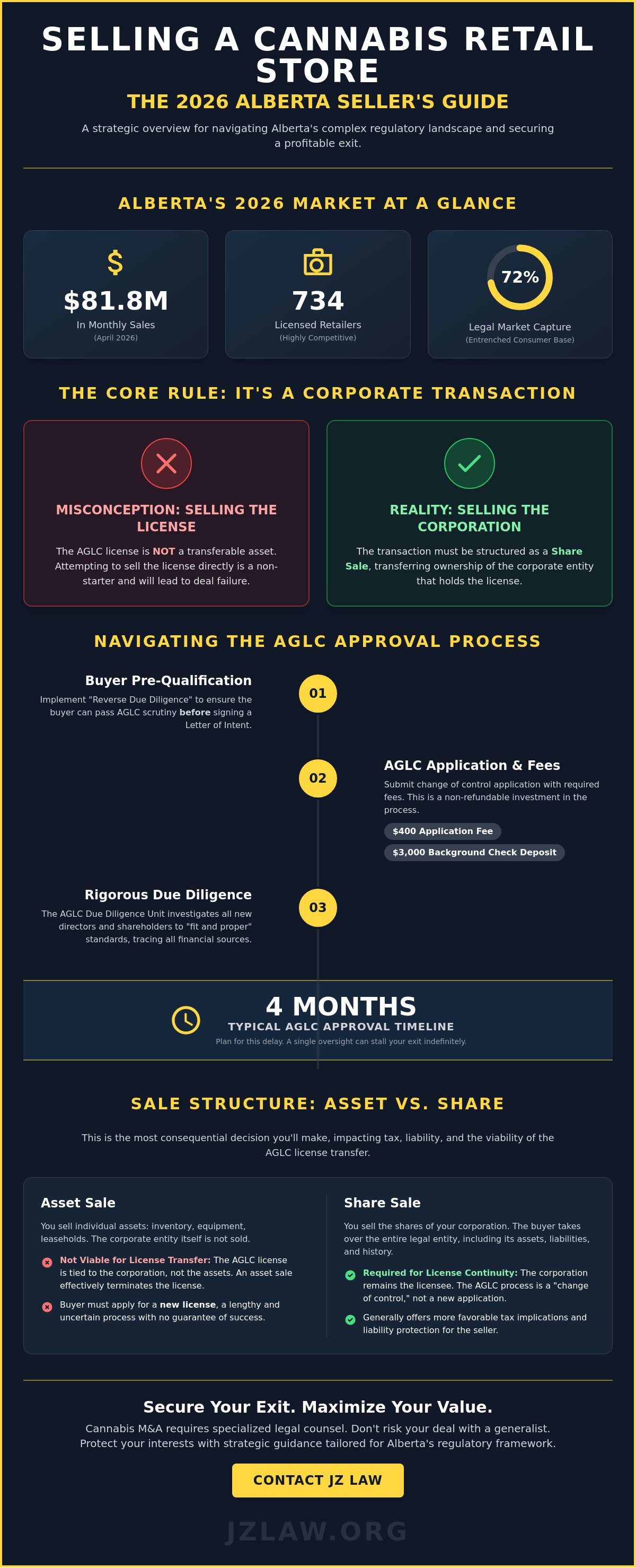
Selling a licensed cannabis retail store in Alberta is a regulatory transition first and a business transaction second. If you are currently planning on selling a licensed cannabis retail store alberta, you've likely realized that the AGLC's rigorous standards can transform a promising deal into a four-month bureaucratic stalemate. It's a high-stakes environment where 734 licensed retailers compete in a market that reached $81.8 million in sales during April 2026 alone. A single oversight in buyer pre-qualification, particularly regarding the $3,000 background check deposit, can stall your exit indefinitely.
We understand the pressure to secure a clean exit that protects your personal interests and maximizes the value of the enterprise you've built. You've navigated the second-highest cannabis duty rate in Canada at 16.8% and constant policy shifts; now, you deserve a transition that doesn't leave you exposed to post-closing liabilities. This guide provides the strategic precision required to manage complex municipal zoning transfers and sophisticated tax structuring while minimizing regulatory friction with the AGLC.
You'll learn how to structure your divestiture to satisfy modern compliance requirements, the critical legal differences between asset and share sales, and the exact steps to ensure your 2026 exit is as profitable as it is legally sound.
Key Takeaways
Identify the critical legal distinctions between asset and share sales to determine which structure offers the most favorable tax implications and liability protection for your specific exit strategy.
Understand the technical reality that AGLC licenses are not directly transferable, requiring a strategic focus on the sale of the corporate entity to maintain operational continuity.
Prepare for the AGLC’s rigorous four-month approval timeline by securing the necessary $400 application fee and the $3,000 background check deposit well in advance of your closing date.
Implement a "Reverse Due Diligence" protocol to verify that your prospective buyer possesses the financial integrity required to pass provincial scrutiny before committing to a Letter of Intent.
Leverage professional legal counsel to navigate the complexities of selling a licensed cannabis retail store alberta, ensuring your transaction aligns with both current securities regulations and municipal zoning requirements.
Table of Contents
The 2026 Landscape for Selling Cannabis Retail in Alberta
Alberta's cannabis market has transitioned from a period of rapid, speculative expansion into a phase of mature consolidation. As of February 2026, the province supports 734 licensed cannabis retailers, a figure that reflects a highly competitive environment where operational efficiency and strategic positioning dictate survival. The market generated approximately $808 million in retail sales throughout 2025, representing a 2% year-over-year increase. This stability makes selling a licensed cannabis retail store alberta an attractive proposition for owners looking to exit, provided they understand that the province treats these transactions as regulatory transitions rather than simple asset transfers. Today, the legal market captures 72% of all cannabis spending in the province, signaling a deeply entrenched consumer base that values the safety and variety of the regulated framework established for Cannabis in Alberta.
A common misconception among vendors is the belief that the retail license itself is a piece of property that can be sold. In reality, the Alberta Gaming, Liquor and Cannabis (AGLC) commission does not permit the direct transfer of a license from one individual to another. Instead, the transaction involves selling the corporate entity that holds the license. This distinction is critical because it triggers a comprehensive re-evaluation of the business. The AGLC acts as a gatekeeper in these divestitures, ensuring that any new controlling interest meets the same stringent "fit and proper" standards as the original applicant. Sellers often face significant risks during this phase, particularly when dealing with Toronto-based Multi-State Operators (MSOs) or large investment groups that may have complex ownership structures. If a buyer's financial backing cannot be traced with absolute transparency, the AGLC may withhold approval, effectively killing the deal after months of negotiation.
Key Regulatory Bodies and the Cannabis Act
Success in a retail sale requires a precise understanding of how federal law intersects with the AGLC Retail Cannabis Store Handbook. While the federal Cannabis Act governs production and high-level health standards, the AGLC Due Diligence Unit manages the granular details of the sale process, including the mandatory $3,000 background check deposit for new directors and shareholders. This unit investigates every financial contributor to ensure no criminal interests influence the industry. In Alberta's 2026 regulatory environment, a 'Change of Control' is defined as any transaction or series of transactions that results in a person or entity acquiring 5% or more of the shares or voting rights in the licensed corporation, an event that mandates immediate AGLC notification and a full investigative cycle.
Why Specialized Legal Counsel is Non-Negotiable
Utilizing a generalist corporate lawyer for a cannabis divestiture often leads to expensive delays. Cannabis M&A requires a strategic partner who understands the specific "organized crime" background check requirements and the nuances of the AGLC's 120-day inter-retailer transfer rules. We provide the preventitive oversight necessary to pre-qualify buyers before a Letter of Intent is even signed, protecting you from the fear of post-closing liabilities. For a deeper look at the foundational requirements of the industry, consult our Cannabis Licensing Guide 2026. Our approach ensures that your corporate records and compliance documentation are beyond reproach, maximizing your valuation in a market where April 2026 sales alone reached $81.8 million.
Asset Sale vs. Share Sale: Structuring Your Divestiture
Deciding between a share sale and an asset sale is the most consequential choice you'll make when selling a licensed cannabis retail store alberta. This decision dictates how the AGLC views the change in "beneficial ownership" and determines the tax burden you'll carry post-closing. In a share sale, the corporate entity remains the licensee, but the individuals behind it change. Conversely, an asset sale involves a complete break; the buyer acquires specific physical assets and inventory but must submit a fresh AGLC retail cannabis store licence application. The AGLC monitors these changes with extreme scrutiny to ensure that the "fit and proper" status of the licensee remains intact throughout the transition.
Tax structuring is another area where precision is required. Share sales often allow Alberta business owners to utilize the Lifetime Capital Gains Exemption (LCGE), provided the corporation meets the criteria for a Qualified Small Business Corporation. Asset sales typically result in higher tax liabilities for the seller. You may face significant recapture of capital cost allowance on leasehold improvements and equipment, while inventory sales are taxed as straight business income. We recommend coordinating with specialized legal and accounting experts to model these outcomes before settling on a deal structure.
Pros and Cons for the Seller
Share sales provide the path of least resistance for maintaining the store's operational status because the license stays active within the corporation. However, buyers will demand extensive indemnities to protect themselves from any historical compliance failures or tax arrears. Asset sales allow you to "cherry-pick" your most profitable locations. This strategy is effective if you operate multiple stores in Calgary or Edmonton and wish to divest from specific municipal permits while retaining others. While an asset sale protects the buyer from your company's past debts, it leaves you responsible for winding down the remaining corporate shell and its liabilities.
Drafting the Purchase Agreement
The Purchase Agreement must be a specialized instrument that accounts for the unique volatility of the cannabis sector. It's not enough to use a standard corporate template. You need robust "Regulatory Out" clauses that allow for a clean termination if the AGLC denies the buyer’s background check. We also recommend including specific representations regarding your Seed-to-Sale tracking records and adherence to the 16.8% provincial duty rate. Given that AGLC approvals can take between 60 and 120 days, structured escrow accounts and holdbacks are essential to bridge the gap between signing and the final transfer of control. For those navigating these high-stakes negotiations, securing expert corporate transactions counsel is the only way to ensure the deal doesn't collapse under regulatory weight.
Navigating the AGLC License Transfer Process
The procedural reality of selling a licensed cannabis retail store alberta is defined by the AGLC’s investigative timeline, which typically spans two to four months. While the legal structure of the deal is finalized between private parties, the commission remains the ultimate arbiter of the closing date. Sellers must facilitate this by providing comprehensive corporate disclosure, allowing the buyer’s due diligence team to verify that the store’s history is free from compliance infractions. This transparency is vital when managing the non-refundable $400 application fee and the mandatory $3,000 background check deposit required for new applicants in 2026. Any unused portion of this deposit is eventually refunded, but the initial capital must be secured to initiate the vetting process.
Closing also requires a meticulous inventory reconciliation. The 'Seed-to-Sale' tracking software handover is not merely a technical task; it's a regulatory requirement. Both parties must conduct a joint audit to ensure that every gram of product is accounted for in the AGLC-mandated reporting systems. This prevents post-sale disputes over the 16.8% provincial duty rate or missing stock. It's also the moment when inter-retailer transfers are finalized, a process that, as of January 2024, no longer requires a 120-day waiting period, providing significantly more flexibility during the transition phase.
The Background Check Hurdle
Under the 2026 AGLC Retail Cannabis Store Handbook, a 'Key Employee' includes any individual with the authority to hire, fire, or manage inventory, while an 'Associate' encompasses any person or entity with a financial interest of 5% or more. Pre-screening buyers for these roles is a preventive necessity. If a buyer’s associates have problematic financial histories or undisclosed foreign interests, the entire deal may collapse after months of effort. Directors of the buying entity must provide an exhaustive personal disclosure that includes 10 years of employment history, detailed financial statements, and a notarized criminal record check to satisfy the AGLC’s 2026 integrity standards.
Municipal and Zoning Considerations
Beyond provincial approval, the transfer of municipal land-use permits and Business Improvement Area (BIA) licenses requires local coordination. In cities like Calgary or Edmonton, the '100-meter' buffer zone rules from schools or provincial health care facilities remain a fixed constraint. If a store’s zoning status was grandfathered in under previous regulations, a change of ownership might trigger a re-evaluation of these buffers by municipal planners. Managing these overlapping jurisdictions is a core component of our Strategic Corporate Transactions 2026 services, ensuring that municipal hurdles don't derail your provincial exit strategy.
Seller’s Due Diligence: Protecting Your Interests
While most business transactions focus on the buyer's scrutiny of the seller, selling a licensed cannabis retail store alberta requires a rigorous process of "Reverse Due Diligence." You must verify that your prospective buyer possesses the financial integrity necessary to satisfy the AGLC’s stringent vetting process. If a buyer’s capital is sourced from unverified foreign entities or lacks a transparent trail, the AGLC will likely reject the application, leaving you with a collapsed deal and months of wasted operational costs. We advise our clients to demand proof of funds and a preliminary financial history before granting exclusivity in a Letter of Intent.
Preparing for an exit also involves an internal compliance audit to ensure your store is "inspection-ready." The AGLC will review your historical adherence to the Retail Cannabis Store Handbook, specifically looking for past infractions related to minor access or improper storage. You should also verify that all staff members have current ProServe and SellSafe certifications. Since the legal age for purchase in Alberta remains 18, any lapse in age-verification records can become a significant liability during the transfer process. Ensuring these records are pristine prevents the AGLC from flagging your corporation as a high-risk entity during the "Change of Control" investigation.
Financial and Tax Clean-up
Clean financial records are the foundation of a high valuation. You must resolve any outstanding 'Cannabis Excise Tax' liabilities and ensure that your GST/HST filings are current through the closing date. Alberta's cannabis duty rate remains the second-highest in Canada at 16.8%, and the AGLC will not approve a transfer if there are arrears in provincial payments. Strategic tax structuring is essential here; we work to position your sale to utilize the Lifetime Capital Gains Exemption (LCGE), which can significantly increase your net proceeds if your corporation qualifies as a Small Business Corporation.
Inventory and Supply Chain Contracts
Managing the physical transfer of stock requires precision. Since the AGLC acts as the sole wholesaler in Alberta, you cannot simply "sell" the inventory to the buyer without formal documentation. You must conduct a final count on the day of closing to reconcile with the Seed-to-Sale tracking system. Additionally, most commercial leases for cannabis retail contain "change of control" clauses that require landlord consent. Landlords often use this as leverage to renegotiate terms, so we recommend starting these discussions early to ensure the premises remain secured for the new owner. If you are ready to begin this transition, contact us for strategic corporate transactions counsel to protect your interests from the first negotiation to the final signature.
JZ Law: Strategic Counsel for Cannabis M&A
Our firm provides the sophisticated oversight required for selling a licensed cannabis retail store alberta by operating at the precise intersection of corporate finance and provincial regulation. We recognize that a retail divestiture is rarely a standalone event; it's often a pivotal transition in a broader business lifecycle. While generalist firms may struggle with the AGLC’s specific "fit and proper" investigative cycles, we apply a preventative approach that identifies regulatory red flags before they can jeopardize your deal. By pre-qualifying buyers against the 2026 financial integrity standards, we ensure that your time is invested only in candidates capable of reaching the closing table.
John Zang brings a specialized depth of experience to the table, having guided numerous entities through the complexities of securities regulation and corporate transactions. His background includes not only managing private exits for independent retailers but also the high-stakes requirements of taking companies public. This dual perspective is invaluable for Alberta store owners who may be selling to large Multi-State Operators (MSOs) or publicly traded entities. We understand how to bridge the gap between local retail realities and the rigorous compliance demands of national capital markets, ensuring your valuation is protected through every stage of negotiation.
Beyond the Sale: Securities and Tax Structuring
The conclusion of a cannabis retail sale is often the beginning of a new investment chapter. We assist our clients with the strategic reinvestment of sale proceeds, leveraging our firm’s deep roots in Alberta’s economic pillars, including Oil and Gas law and the evolving Cryptocurrency sector. Our team provides comprehensive tax structuring advice to ensure your exit remains as profitable as possible, whether you are a single-store operator in Calgary or a multi-jurisdictional player with assets in British Columbia and Ontario. For those considering a different trajectory, we offer specialized guidance on Taking Your Cannabis Company Public, helping you navigate the transition from private ownership to the public stage.
Contact John Zang for an Exit Strategy
Confidentiality is the cornerstone of our M&A practice. We maintain strict protocols to protect your business's reputation and operational stability while we seek the right suitor for your divestiture. With a strategic presence in Calgary, Vancouver, and Toronto, JZ Law is uniquely positioned to manage national deals that require a nuanced understanding of Alberta’s specific 16.8% duty rate and municipal zoning constraints. We invite you to schedule a confidential consultation to discuss your retail divestiture. Our firm will conduct a specialized cannabis legal audit of your current operations, ensuring that when you are ready to begin selling a licensed cannabis retail store alberta, your corporate house is in perfect order for a clean, high-valuation exit.
Securing Your Legacy in Alberta’s Mature Cannabis Market
The transition from owner to successful reinvestor requires more than just a willing buyer. It demands a sophisticated understanding of how the AGLC’s 2026 investigative protocols intersect with your corporate structure. Whether you've chosen a share sale to preserve license continuity or an asset sale to mitigate historical risks, the precision of your purchase agreement remains the ultimate safeguard against post-closing liabilities. By conducting "Reverse Due Diligence" and preparing for the mandatory $3,000 background check deposit, you ensure your transaction proceeds with minimal friction.
Success in selling a licensed cannabis retail store alberta is achieved through meticulous preparation and strategic foresight. JZ Law provides the expert oversight necessary to navigate these high-stakes divestitures, leveraging active experience in the Calgary, Toronto, and Vancouver markets. We specialize in the complex interplay between cannabis licensing and securities regulation, ensuring your exit is handled with the dignity and professionalism it deserves.
If you're ready to explore your options, we invite you to consult with John Zang on your cannabis retail exit strategy today. Protecting your business interests is a preventive process; let’s ensure your legacy is secure.
Frequently Asked Questions
Can I sell my Alberta cannabis license separately from my business?
No, you cannot sell a cannabis license as a standalone asset. The AGLC issues licenses to specific legal entities for approved locations; therefore, the license is legally inseparable from the entity that holds it. To transfer control to a buyer, you must sell the shares of the corporation that owns the license, which triggers a comprehensive AGLC "Change of Control" investigation to vet the new owners.
How long does the AGLC take to approve a change of ownership in 2026?
The AGLC typically requires between two and four months to approve a change of ownership. This 60 to 120-day window allows the Due Diligence Unit to perform exhaustive background checks and financial audits on the purchasing party. Sellers should ensure their purchase agreements account for this timeline to prevent the deal from collapsing due to unforeseen regulatory delays.
What happens to my cannabis inventory during a retail store sale?
Inventory remains with the licensed entity, but it must be meticulously reconciled through a joint audit on the closing date. All stock transfers are recorded in the provincial Seed-to-Sale tracking system to maintain compliance with the 16.8% provincial duty rate. Because the AGLC is the sole wholesaler, any discrepancy in inventory during the handover can lead to significant fines or delays in final approval.
Is a share sale or an asset sale better for selling a dispensary in Calgary?
A share sale is generally the more efficient route for selling a licensed cannabis retail store alberta because it allows the license and municipal permits to remain active within the corporation. While an asset sale provides the buyer with better protection against your past liabilities, it requires them to apply for a completely new license, which can lead to a prolonged period of store closure and lost revenue.
Do I need municipal approval to sell my licensed cannabis store?
Yes, you must coordinate with municipal authorities to transfer business licenses and land-use permits. In Calgary and Edmonton, planners may review the store's development permit during a change of ownership to ensure it still complies with the 100-meter buffer zone requirements. Failure to secure these local approvals can prevent the buyer from legally operating, even if they have obtained provincial consent from the AGLC.
What are the common reasons the AGLC rejects a buyer during due diligence?
The AGLC frequently rejects buyers who cannot provide a transparent trail for their investment capital or who have undisclosed "associates" with criminal records. If the mandatory $3,000 background check deposit reveals financial links to high-risk jurisdictions or individuals who fail the "fit and proper" test, the commission will deny the transfer. This underscores the necessity of performing reverse due diligence on your buyer's financial backing.
Can a non-Canadian resident buy my Alberta cannabis retail store?
Non-Canadian residents can legally purchase a retail store, but they are subject to much more stringent investigative protocols. The AGLC requires exhaustive financial and personal disclosures from foreign shareholders, which often extends the approval process beyond the standard four-month timeline. International buyers must prove that their funds are legitimate and that their involvement doesn't compromise the integrity of Alberta's regulated market.
How do I protect myself from liability after the sale of my cannabis business?
Protection is achieved by drafting a purchase agreement that includes specific indemnification clauses and limited "Representations and Warranties" regarding past compliance. These clauses ensure that once the 120-day transition period is complete, your personal and corporate liability for the store's historical operations is clearly defined and capped. Using structured escrow holdbacks can also provide a secure method for addressing any regulatory adjustments that occur immediately after the closing date.


Comments