


Strategic Business Amalgamation in Alberta: The 2026 Corporate Guide
Updated: Aug 20
An amalgamation is far more than an administrative filing; it's a high-stakes surgical procedure for your corporate structure that can either catalyze growth or entrench unforeseen liabilities. You likely recognize that a business amalgamation in Alberta offers a powerful path to scale, yet the sheer complexity of the Business Corporations Act often creates a paralyzing fear of inheriting a predecessor's hidden debts. It's a valid concern, especially when navigating the intricate regulatory landscapes of the energy or cannabis sectors where oversight is exceptionally rigorous.
This guide provides the strategic clarity you need to transform these legal hurdles into a competitive advantage. You'll master the nuances of BCA compliance, sophisticated tax structuring, and the seamless transfer of intellectual property. We'll examine the 2026 regulatory updates, including the recent 3% increase in registry fees, to ensure your consolidated entity emerges with a streamlined structure and full Alberta Corporate Registry approval. By the end of this analysis, you'll possess a roadmap for executing a long-form or short-form amalgamation that secures your assets and positions your firm for a potential public offering.
Table of Contents
Understanding Business Amalgamation under the Alberta Business Corporations Act (BCA)
Short-Form vs. Long-Form Amalgamations: Choosing the Right Legal Structure
Strategic Advantages and Regulatory Risks of Combining Alberta Corporations
The Step-by-Step Process for a Successful Corporate Amalgamation in Alberta
Strategic Counsel: How JZ Law Navigates Complex Alberta Amalgamations
Understanding Business Amalgamation under the Alberta Business Corporations Act (BCA)
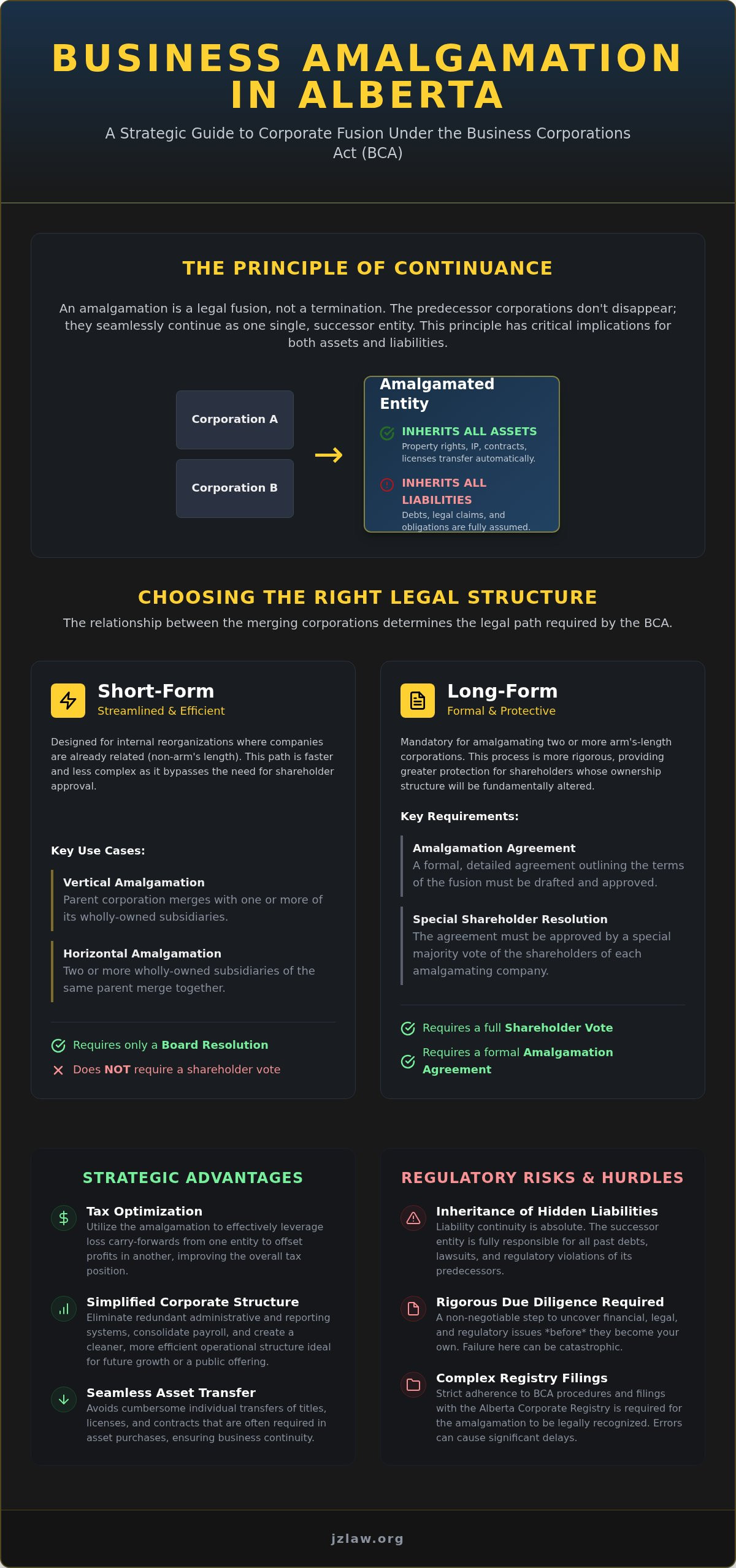
A business amalgamation in Alberta represents a sophisticated legal fusion where two or more existing corporations converge to form a single successor entity. Unlike a simple partnership or a joint venture, this process is strictly governed by the Alberta Business Corporations Act (BCA). The BCA provides the necessary statutory framework to ensure that the transition is recognized by the Alberta Corporate Registry and all relevant regulatory bodies. While the terms "merger" and "consolidation" are often used interchangeably in casual conversation, Understanding Business Amalgamation through the lens of Alberta law reveals a very specific legal path designed for corporate continuity.
The cornerstone of this process is the principle of continuance. This means the predecessor corporations don't cease to exist in the traditional sense; rather, they continue as one. This allows for a seamless transition of legal standing, which is vital for businesses in regulated sectors like oil and gas or cannabis where licensing continuity is paramount. Every Alberta-registered entity must adhere to these BCA requirements to ensure the resulting corporation is legally sound and its actions are enforceable.
The Legal Status of the Successor Corporation
The successor corporation "continues" the existence of its predecessors. This isn't just semantics. It means the new entity automatically inherits every property right and intellectual asset without the need for separate deeds of transfer or assignments. However, liability continuity is equally absolute. You can't use a business amalgamation in Alberta to shed unwanted debt or legal obligations. The successor entity remains fully responsible for all claims against its predecessors. This is why rigorous due diligence remains a non-negotiable step in the strategic planning phase.
Amalgamation vs. Other Restructuring Methods
Choosing between an amalgamation and other methods like asset or share purchases requires a strategic evaluation of your long-term goals. In a share purchase, you acquire ownership but often keep the entities separate, which can lead to administrative bloat. Asset purchases allow for "cherry-picking" specific items, but they frequently require cumbersome individual transfers of titles and contracts. Amalgamation offers a cleaner operational unity. It's often the preferred route for internal reorganizations where a parent company wants to simplify its structure or as a necessary precursor to taking a company public. By merging entities, you eliminate redundant reporting systems and consolidate your payroll, creating a more efficient platform for future growth.
Short-Form vs. Long-Form Amalgamations: Choosing the Right Legal Structure
Selecting the appropriate legal framework for a business amalgamation in Alberta depends entirely on the existing corporate relationship between the entities involved. The Alberta Business Corporations Act (BCA) provides two distinct paths: short-form and long-form. Understanding the nuances of Short-Form vs. Long-Form Amalgamations is critical for minimizing procedural delays and ensuring regulatory compliance. While both methods result in a single successor corporation, the administrative requirements and shareholder protections vary significantly between them.
Vertical and Horizontal Short-Form Amalgamations
Short-form amalgamations are designed for non-arm's length transactions, primarily serving internal corporate reorganizations. A vertical short-form amalgamation occurs when a parent corporation merges with one or more of its wholly-owned subsidiaries. Conversely, a horizontal short-form amalgamation involves two or more wholly-owned subsidiaries of the same parent company merging into one entity. These processes are streamlined because they don't require a formal Amalgamation Agreement. Instead, the board of directors for each corporation can approve the transaction through simple resolutions, provided the resulting entity's bylaws remain consistent with the parent company's articles. This path is efficient, cost-effective, and avoids the need for a shareholder vote.
Long-Form Amalgamation: For Arm’s-Length Transactions
When corporations with different shareholder bases decide to merge, the BCA mandates a long-form amalgamation. This is the standard for third-party acquisitions or mergers between unrelated entities. Unlike the short-form path, a long-form transaction requires a comprehensive Amalgamation Agreement. This document acts as the blueprint for the new entity, defining share exchange ratios, management structures, and the new corporate bylaws. Because this path fundamentally alters shareholder rights, the BCA requires approval via a special resolution from the shareholders of each amalgamating corporation. Shareholders also possess dissent rights, allowing them to be paid the fair value of their shares if they oppose the merger. This added layer of protection is essential for maintaining corporate integrity during complex corporate transactions.
The procedural path you choose directly impacts your timeline and budget. Short-form amalgamations are generally faster since they bypass the need for shareholder meetings and complex agreement drafting. Long-form transactions require significant lead time for negotiations, valuations, and regulatory filings. In 2026, Alberta's 3% increase in registry fees applies across all corporate filings, making it even more important to select the most efficient structure from the outset. Strategic planning prevents the unnecessary expense of a long-form process when a short-form alternative is legally available for your business amalgamation in Alberta.
Strategic Advantages and Regulatory Risks of Combining Alberta Corporations
Beyond the procedural mechanics discussed in earlier sections, the decision to pursue a business amalgamation in Alberta often hinges on sophisticated financial and regulatory objectives. A well-executed merger doesn't just simplify an organizational chart; it creates a more robust vehicle for capital deployment and risk management. While operational synergy is a common goal, the most significant advantages are found in the strategic alignment of tax positions and the consolidation of regulatory standing in specialized markets.
Tax Structuring and Financial Optimization
One of the most compelling reasons for an amalgamation is the ability to utilize corporate loss carry-forwards effectively. When corporations combine under the BCA, the successor entity can often apply the tax losses of a predecessor against future profits, a benefit that's frequently restricted or lost in standard asset sales. This structural choice avoids the immediate tax triggers, such as recaptured depreciation or capital gains, that typically accompany the sale of assets to a third party. To maximize these benefits, a pre-amalgamation tax audit is essential. This proactive measure ensures that the "continuance" of the entities doesn't inadvertently trigger complex tax rules regarding changes in corporate control, allowing for a seamless flow-through of financial benefits.
Regulatory Compliance in High-Stakes Industries
Strategic consolidation also introduces significant regulatory risks that demand a specialized approach. In Alberta’s energy sector, for instance, a business amalgamation in Alberta requires a meticulous review of Alberta Energy Regulator (AER) licenses. Failing to account for environmental liabilities or inactive well obligations can lead to the successor entity inheriting crippling financial security requirements. Similarly, in the cannabis industry, the continuity of Alberta Gaming, Liquor and Cannabis (AGLC) licenses is not automatic. Security clearances and site-specific approvals must be synchronized with the amalgamation date to prevent a lapse in legal operations.
For firms in the cryptocurrency and fintech sectors, the merger process must satisfy FINTRAC’s anti-money laundering protocols and securities reporting standards. This level of transparency is particularly beneficial for companies preparing for an Initial Public Offering (IPO). A consolidated corporate history and a clean capitalization table make the entity far more attractive to institutional investors and underwriters. By integrating these regulatory requirements early, the successor corporation establishes the governance foundation necessary for public market listing and long-term securities regulation compliance. This strategic foresight transforms a legal necessity into a platform for accelerated growth.
The Step-by-Step Process for a Successful Corporate Amalgamation in Alberta
Executing a business amalgamation in Alberta requires a disciplined sequence of legal and administrative actions. It begins long before any documents reach a registry agent. Success depends on a foundation of rigorous due diligence, where you must conduct a comprehensive review of minute books, share registers, and financial statements for all amalgamating entities. This scrutiny ensures the successor corporation doesn't inadvertently inherit unresolved disputes or non-compliant records that could jeopardize future growth or a public listing.
Once the groundwork is laid, directors must draft and approve formal resolutions. As previously established, the complexity of this stage depends on whether you've chosen a short-form or long-form path. While short-form mergers rely on board resolutions, long-form transactions necessitate a special resolution from shareholders. These documents must be precise, as they form the permanent record of the corporate transformation and are often scrutinized during future audits or securities reviews.
The Solvency Test: A Legal Prerequisite
A critical safeguard in the process is the Statutory Declaration of Solvency. Directors from each amalgamating corporation must swear that the successor entity will be able to pay its liabilities as they become due. They must also confirm that the realizable value of the new corporation's assets will not be less than the aggregate of its liabilities and stated capital. This isn't a mere formality; it's a sworn statement. A negligent or false declaration can expose directors to personal liability and invite legal challenges from creditors. This step provides the essential creditor protection required under the BCA, ensuring the merger isn't used to circumvent financial obligations.
Filing the Articles of Amalgamation
The final administrative stage involves submitting the Articles of Amalgamation to the Alberta Corporate Registry through an authorized service provider. This package must include a Notice of Address and a Notice of Directors for the new entity. Given the 2026 3% increase in registry fees, ensuring the accuracy of these filings on the first attempt is a matter of fiscal efficiency. Upon successful processing, the registry issues a Certificate of Amalgamation. The "Effective Date" on this certificate marks the precise moment the predecessor companies legally merge into one.
After receiving the certificate, the focus shifts to operational integration. You'll need to update bank accounts, transfer insurance policies, and notify all contractual partners of the successor's name. In regulated sectors, this is the window to finalize the transfer of licenses and security clearances. For expert guidance on managing these corporate transactions, professional oversight ensures that every post-filing requirement is met with precision.
Strategic Counsel: How JZ Law Navigates Complex Alberta Amalgamations
Executing a business amalgamation in Alberta requires more than a standard filing; it demands a sophisticated understanding of how corporate structures interface with long-term commercial goals. JZ Law approaches these transactions as a strategic transformation rather than a mere administrative exercise. By integrating deep expertise in Corporate Transactions with a proactive risk-mitigation mindset, the firm ensures that the resulting entity is not only compliant with the BCA but also optimized for its next phase of growth. This is particularly critical for organizations operating across provincial lines, where the interplay between Calgary and Vancouver business hubs necessitates precise extra-provincial registration and a unified approach to governance. For firms consolidating real estate assets during such a move, professional oversight from Lenny Yeung can help stabilize property management operations across the British Columbia market.
The firm's experience extends into highly regulated and innovative sectors where standard legal templates often fail. Whether managing the complexities of Oil and Gas Law regarding asset transfers or addressing the unique security clearance requirements in Cannabis Licensing, JZ Law provides the specialized oversight needed to maintain operational continuity. In the rapidly evolving fields of Cryptocurrency Law and fintech, the firm ensures that the amalgamation process satisfies both FINTRAC protocols and the rigorous expectations of securities regulators, providing a stable foundation for technical and financial innovation.
A strategic business amalgamation in Alberta is frequently the final precursor to taking a company public. Public exchanges, including the TSX and NASDAQ, demand a transparent corporate history and a clean capitalization table that many fragmented corporate groups lack. During the merger process, share structures must be meticulously aligned with these exchange requirements to avoid costly delays during the underwriting phase. JZ Law implements a rigorous compliance framework to ensure that every aspect of the amalgamated entity’s governance meets the stringent requirements of provincial and federal securities commissions. This foresight allows private firms to transition into the public eye with a robust, institutional-grade corporate structure.
Boutique Legal Support for Strategic Transactions
High-stakes restructurings benefit from the direct involvement of a principal lawyer who understands the nuances of Tax Structuring and Securities Regulation. John Zang provides this level of dedicated counsel, offering tailored solutions that larger, more rigid firms often overlook. By focusing on the unique needs of each client, JZ Law identifies opportunities for financial optimization that protect assets while facilitating aggressive market expansion. This boutique approach ensures that every detail, from the initial solvency test to the final certificate of amalgamation, is handled with the precision required for complex deals. If your organization is ready to consolidate its operations and prepare for future scale, schedule a consultation with JZ Law for your corporate restructuring.
Securing Your Corporate Future Through Strategic Consolidation
A successful business amalgamation in Alberta serves as the definitive architecture for your corporation’s next era of expansion. By navigating the nuances of the BCA and the 2026 registry requirements, you've established a foundation that protects assets while consolidating operational efficiency. Whether you're integrating wholly-owned subsidiaries through a short-form process or executing a complex long-form merger, the focus remains on long-term stability and regulatory precision. This guide has outlined the critical steps, from the mandatory solvency test to the final issuance of the Certificate of Amalgamation.
JZ Law delivers the specialized counsel required to transform a complex restructuring into a competitive advantage. The firm’s principal lawyer, John Zang, brings deep expertise in tax structuring and securities regulation to every deal, specifically supporting high-stakes sectors such as energy, cannabis, and cryptocurrency. This proactive approach eliminates regulatory hurdles while preparing your entity for potential public offerings or extra-provincial scaling. Don't leave your corporate legacy to chance during this critical transition. We're ready to provide the methodical, expert guidance your transaction deserves.
Contact JZ Law for Strategic Corporate Amalgamation Counsel
Frequently Asked Questions
What is the main difference between an amalgamation and a merger in Alberta?
In Alberta, an amalgamation is the specific statutory process defined by the Business Corporations Act, whereas "merger" is a broader commercial term. The legal distinction lies in the principle of continuance; the predecessor corporations do not dissolve but instead continue as one unified entity. This ensures that all legal rights and obligations remain intact. While other jurisdictions might use different terminology, a business amalgamation in Alberta is the only method that provides this specific statutory continuity for provincially registered firms.
Do shareholders have to approve a business amalgamation?
Shareholder approval is mandatory for long-form amalgamations, requiring a special resolution passed by at least two-thirds of the votes cast. However, short-form amalgamations between a parent and its wholly-owned subsidiaries, or between sister companies, typically only require a board of directors' resolution. This streamlined approach avoids the administrative burden of a full shareholder meeting. It's essential to review your specific corporate bylaws to confirm if additional voting thresholds or consent requirements were established during the initial incorporation.
What happens to existing contracts and leases after an amalgamation?
Most contracts and leases transfer automatically to the successor corporation through the principle of statutory continuance. Because the new entity is a continuation of the predecessors, it remains the same "person" in the eyes of the law. You must, however, carefully examine individual agreements for "change of control" or "non-assignment" clauses. Some sophisticated leases or licenses in the energy and tech sectors may specifically require written consent from the counterparty even in a statutory business amalgamation in Alberta.
Can an Alberta corporation amalgamate with an extra-provincial company?
An Alberta corporation cannot directly amalgamate with an extra-provincial company while they remain in different jurisdictions. To facilitate this, one corporation must first "continue" into the other's jurisdiction, effectively moving its home base so both entities are governed by the same legislation. Once both companies are registered under the Alberta Business Corporations Act, they can proceed with the amalgamation. This multi-stage process requires careful coordination with registry agents in both jurisdictions to ensure a seamless legal transition.
Is a new GST/HST number required after an amalgamation?
The Canada Revenue Agency typically requires the successor corporation to apply for a new GST/HST number and a new corporate tax account. While the entity continues the legal existence of its predecessors, it's considered a new registrant for federal tax purposes. The predecessor corporations' accounts are usually closed as of the date of the amalgamation. It's critical to coordinate this with your final tax filings to ensure that input tax credits are properly captured and transitioned to the new account.
How long does the corporate amalgamation process take in Alberta?
The timeline for a corporate amalgamation in Alberta varies significantly based on the chosen legal structure. A short-form amalgamation can often be completed within two to four weeks, provided all corporate minute books are up to date. Long-form transactions involving arm's-length parties usually require three to six months. This extended duration accounts for the time needed to negotiate the Amalgamation Agreement, conduct thorough financial due diligence, and provide the mandatory notice periods for shareholder meetings and voting.
What is a Statutory Declaration of Solvency and why is it required?
A Statutory Declaration of Solvency is a sworn statement by the directors confirming the successor corporation's ability to meet its financial obligations. It's a mandatory requirement under the BCA designed to protect creditors from being disadvantaged by the merger. Directors must swear that the realizable value of the new entity's assets exceeds its total liabilities. Failing to perform this test accurately can lead to personal liability for directors if the amalgamated company becomes insolvent shortly after the transaction is finalized.
Can we choose a specific date for the amalgamation to become effective?
You can select a specific "Effective Date" for your amalgamation, provided it is not prior to the date the documents are filed with the registry. Many businesses strategically choose the first day of a new fiscal quarter or a specific year-end date to simplify their accounting and tax reporting. This request must be clearly stated on the Articles of Amalgamation. The Alberta Corporate Registry will then issue the Certificate of Amalgamation reflecting your chosen date, ensuring a clean break for financial record-keeping.


Comments