


Strategic Corporate Tax Structuring in Calgary: A 2026 Legal Framework for High-Growth Ventures
Updated: Aug 22
By the time a Calgary venture reaches the threshold of a major acquisition or IPO in 2026, the most critical financial decisions have usually already been made years prior, often in silence. Successful founders understand that scaling isn't just about revenue; it's about the structural integrity of the vehicle carrying that wealth. You're likely aware that the disconnect between tax advice and securities regulations often creates unforeseen liabilities during high-stakes transactions. It's a common anxiety, especially when the complexity of tax-deferred transfers meets the increasing scrutiny of CRA audits in innovative sectors like cannabis or digital assets.
This guide explores how sophisticated corporate tax structuring in Calgary provides more than just a lower bill; it builds a foundation for regulatory resilience and exit-readiness. You'll discover how to leverage Alberta's 8% general corporate tax rate while ensuring your legal framework is prepared for the rigorous transparency required by public markets. We'll examine the 2026 legal landscape, focusing on asset protection and the strategic alignment of tax efficiency with long-term corporate goals. By the end, you'll have a clear roadmap for minimizing liability and securing your venture's future in an evolving economic environment.
Table of Contents
The Fundamentals of Corporate Tax Structuring in Alberta
Structuring a corporation isn't merely an exercise in administrative filing. It's the deliberate engineering of a legal entity to maximize its resilience and long-term value. In Calgary, high-growth ventures often outgrow simple incorporation within their first few years of operation. Relying on a basic setup can lead to significant friction when it's time to raise capital or negotiate an acquisition. Effective corporate tax structuring in Calgary requires a deep understanding of how the Alberta Business Corporations Act (ABCA) provides the flexibility needed to build a truly scalable enterprise.
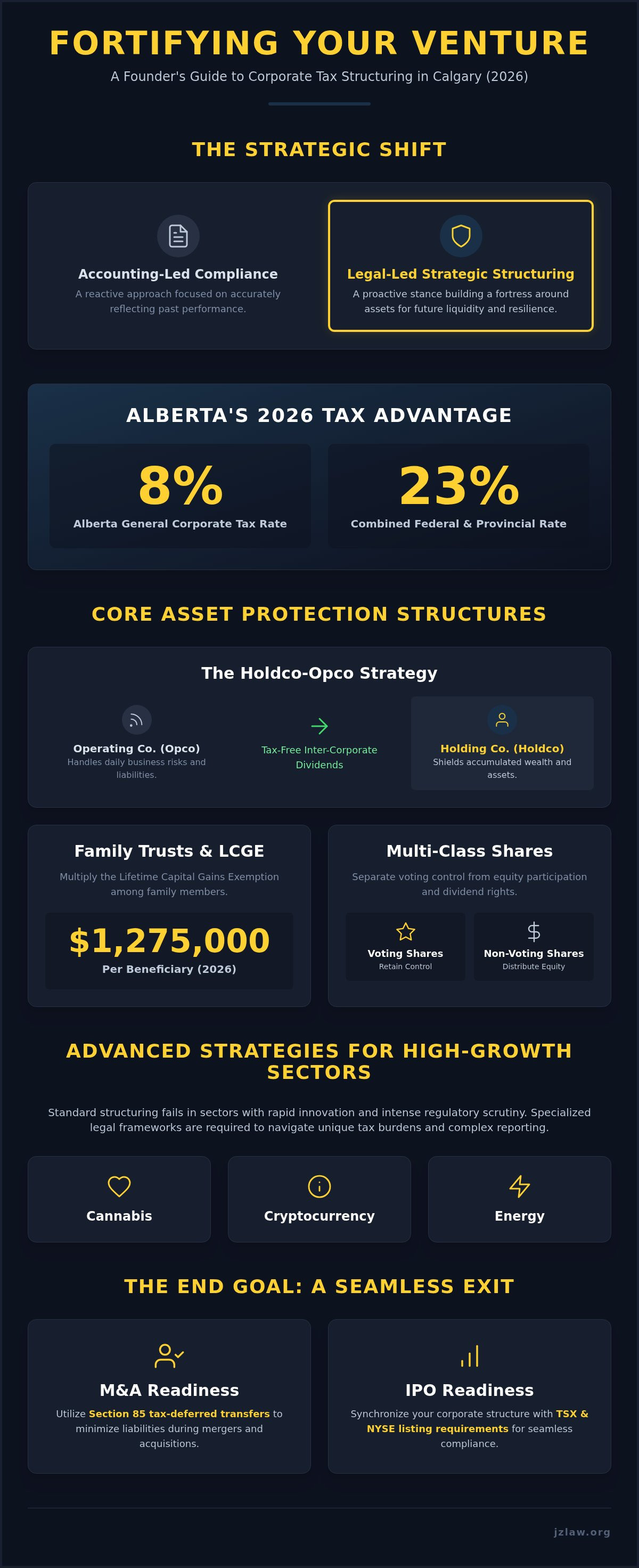
There's a sharp contrast between accounting-led compliance and legal-led strategic structuring. While an accountant ensures that your filings reflect past performance accurately, a legal partner looks ahead. We focus on how your share structure affects your control during a Series A round or how an inter-corporate dividend policy might protect your retained earnings from future creditors. This proactive stance ensures that the business isn't just compliant, but strategically positioned for a future liquidity event. It's about building a fortress around your assets before the pressure of a transaction begins.
Essential Legal Structures for Calgary Businesses
When implementing corporate tax structuring in Calgary, the most robust frameworks typically involve a multi-tiered approach. A holding company (Holdco) serves as a reservoir for wealth, while the operating company (Opco) handles the daily risks of the marketplace. This separation allows you to move profits out of the line of fire without triggering immediate tax consequences. Key components of this strategy include:
The Holdco Strategy: Moving inter-corporate dividends from an Opco to a Holdco to shield cash from operational liabilities.
Family Trusts: Utilizing trusts to multiply the Lifetime Capital Gains Exemption, which is indexed to $1,275,000 for 2026, among family members.
Multi-Class Share Structures: Using different classes of shares to separate voting control from equity participation and dividend rights.
These structures provide the precision necessary to manage different stakeholder interests. By using various classes of shares, you can retain leadership even as you distribute dividends to family members or employees, keeping the core of the business secure.
Why Alberta’s Tax Environment Matters in 2026
Alberta continues to offer the most competitive corporate environment in the country. The provincial general corporate tax rate sits at 8% for 2026, creating a combined federal and provincial rate of 23%. To fully leverage this, founders must understand the Fundamentals of Corporate Tax in Canada and how federal rules intersect with provincial opportunities. While the federal Income Tax Act sets the baseline, Alberta's regulatory landscape offers unique avenues for energy and tech firms to reinvest capital efficiently.
Navigating this landscape requires more than just knowing the numbers; it requires a grasp of how these regulations apply to your specific industry. Whether you're in the energy sector or a burgeoning tech startup, your structure determines how much of your profit stays in the business to fund innovation. Tax-efficient structuring is a proactive risk management tool that safeguards capital against unforeseen regulatory shifts and litigation.
Advanced Strategies for High-Growth Sectors: Crypto, Cannabis, and Energy
High-stakes industries in Calgary operate at the intersection of rapid innovation and intense regulatory scrutiny. Standard corporate tax structuring in Calgary often fails these ventures because it treats them as traditional entities, ignoring the unique tax burdens and incentives specific to their sectors. In 2026, the complexity of managing Federal corporate tax rates alongside industry-specific duties requires a specialized legal framework. Specialized industry knowledge prevents costly missteps that often occur when tax advice is disconnected from regulatory reality.
Cannabis Industry Tax Optimization
Alberta's cannabis producers navigate a challenging environment where the provincial duty rate stands at 16.8%. While the elimination of the 2% early payment fee on April 1, 2026, offers a modest liquidity benefit, the broader tax hurdles remain significant. Structuring for multi-jurisdictional retail licensing requires a proactive approach to ensure that corporate entities are isolated from operational risks. Founders should consult a comprehensive JZ Law's Cannabis Licensing Guide to align their corporate structure with evolving provincial mandates and federal tax obligations.
Cryptocurrency and Blockchain Tax Structures
The Canada Revenue Agency continues to treat digital assets as property, creating a distinct divide between capital gains and business income. As of 2026, all crypto asset service providers must adhere to rigorous reporting rules for both fiat and crypto-to-crypto transactions. Effective corporate tax structuring in Calgary for blockchain startups involves more than just tax efficiency; it requires structures that satisfy both FINTRAC and securities standards. Understanding the nuances of Cryptocurrency Law 2026 is essential for ventures looking to scale without attracting undue regulatory friction.
Alberta's energy sector is also seeing a shift toward targeted incentives, such as the federal Carbon Capture, Utilization, and Storage (CCUS) investment tax credit. As of April 28, 2026, credit rates for eligible capture equipment are set at 25%, providing a significant opportunity for firms that structure their investments correctly. Additionally, the new Alberta Data Centre Levy, effective January 1, 2026, impacts grid-connected facilities with 75 megawatts of capacity or more, though the levy is creditable against provincial corporate income tax. Optimizing oil and gas corporate entities for Alberta Energy Regulator (AER) compliance while capturing these credits is a delicate balance. Securing a strategic legal partner ensures that your corporate architecture supports both operational goals and fiscal resilience.
Tax-Efficient Corporate Transactions: M&A, Amalgamations, and Dissolutions
Corporate transactions represent the most volatile periods in a company's lifecycle. Without a rigorous legal framework, the tax consequences of a merger or acquisition can erode the very value the deal was designed to create. Central to this process is the Section 85 rollover, a legal mechanic that allows for the transfer of assets to a corporation on a tax-deferred basis. When executing corporate tax structuring in Calgary, founders must ensure that these transfers are documented with extreme precision to avoid immediate capital gains triggers that could jeopardize the transaction's liquidity.
The strategic use of Alberta's corporate income tax system allows local businesses to consolidate their position before a major transaction. It's not just about filing paperwork; it's about aligning the legal architecture of the deal with the long-term fiscal goals of the shareholders. Whether you're considering an amalgamation to combine losses or a strategic wind-down, the legal steps taken today determine the net proceeds you'll retain tomorrow. A methodical approach to these transitions ensures that the business remains a vehicle for wealth preservation rather than a source of tax liability.
The M&A Tax-Legal Checklist
The choice between an asset purchase and a share purchase is rarely simple. In a share purchase, Calgary founders may benefit from the Lifetime Capital Gains Exemption, which is indexed to $1,275,000 for 2026. Conversely, buyers often prefer asset purchases to "step up" the tax basis of the acquired assets, which can lead to friction during negotiations. Navigating these conflicting interests requires a deep understanding of Strategic Corporate Transactions 2026 and the specific due diligence required for tax-deferred rollovers. Key considerations include:
Structure Selection: Evaluating the trade-offs between capital gains treatment for sellers and asset depreciation for buyers.
Rollover Compliance: Verifying that all previous Section 85 elections were filed correctly with the CRA to prevent retroactive tax hits during the sale.
Liability Shielding: Using the transaction to isolate legacy risks from the new corporate entity.
Amalgamations and Corporate Reorganizations
Preparing for Liquidity: Tax Structuring for IPOs
Transitioning to a public offering serves as the ultimate stress test for a private venture's internal architecture. While previous sections focused on asset protection and internal reorganizations, the shift toward public markets introduces a new variable: the scrutiny of securities regulators. Effective corporate tax structuring in Calgary becomes a matter of public record the moment a preliminary prospectus is filed. This transition requires a meticulous cleanup of the balance sheet to ensure that legacy tax strategies don't become red flags for institutional investors or exchange auditors.
Aligning your structure with TSX or NYSE requirements isn't just about compliance; it's about marketability. Investors seek clarity and predictability. If your corporate hierarchy is overly convoluted with multiple layers of holding companies that lack a clear business purpose, it can depress your valuation during the roadshow. Pre-IPO restructuring often involves simplifying these layers while preserving the tax-efficient foundations built during the company's early growth stages. It's a delicate balance that requires a strategic partner who understands both the Income Tax Act and the provincial securities acts.
The IPO Tax Roadmap
A successful transition to the public markets follows a structured legal progression. This roadmap ensures that the venture is not only compliant but optimized for the influx of public capital. The process generally follows these stages:
Step 1: Audit of Share Structures: Reviewing all previous share issuances and Section 85 rollovers to ensure no latent tax liabilities exist that could disrupt a listing.
Step 2: Public-Ready Hierarchy: Consolidating subsidiaries and streamlining inter-company agreements to create a transparent, auditable corporate group.
Step 3: Cross-Border Readiness: Addressing the complexities of New York or Denver listings, including the impact of U.S. tax treaties and potential passive foreign investment company (PFIC) issues.
Securities Compliance and Tax Transparency
Securities regulations demand a level of disclosure that often contrasts with the privacy-focused goals of private tax planning. Every material tax risk must be disclosed, meaning that aggressive tax positions can become liabilities in the eyes of the public market. This is particularly true for firms pursuing reverse takeovers (RTOs), where the tax history of the shell company must be thoroughly vetted before the transaction closes. For specialized sectors, the path is even more nuanced, as detailed in our guide on Taking Your Cannabis Company Public.
Managing founder equity during this phase is equally critical. You'll need to structure exit strategies that respect lock-up periods while utilizing the indexed Lifetime Capital Gains Exemption to its fullest potential. If you're preparing for a liquidity event, partner with a firm that bridges the gap between tax and securities to ensure your venture is truly public-ready.
Navigating Regulatory Compliance and CRA Oversight in Calgary
The regulatory environment in 2026 has shifted toward a model of aggressive transparency. The Canada Revenue Agency (CRA) now utilizes advanced technology and data analytics to identify inconsistencies that previously might have gone unnoticed. For high-growth ventures, this means that corporate tax structuring in Calgary is no longer just a method for optimizing cash flow; it's a necessary shield against increasingly sophisticated enforcement. Proactive legal oversight ensures that your corporate architecture isn't just efficient on paper but is also defensible under the weight of a full-scale audit.
Managing complex reporting for international corporate structures requires a level of precision that generalist firms often overlook. As Calgary businesses expand into global markets or deal with digital assets, they face a web of reporting requirements from both federal and provincial authorities. Every transaction between parent companies and subsidiaries must be documented with the same rigor as an arms-length deal. This precision bridges the gap between ambitious business growth and the rigid requirements of regulatory compliance, allowing founders to focus on scaling without the constant threat of retroactive penalties.
Audit Defense and Risk Mitigation
CRA oversight in 2026 focuses heavily on unreported income and unusual expense claims, particularly in sectors like cannabis and cryptocurrency. Common red flags include inconsistent reporting between federal T2 returns and Alberta’s AT1 returns, or complex tax-deferred transfers that lack sufficient legal documentation. While an accountant can help you file, only a legal partner can offer the protection of solicitor-client privilege. This privilege ensures that sensitive discussions regarding your corporate tax strategies remain confidential and protected from disclosure during an investigation.
John Zang’s strategic approach reduces long-term legal exposure by aligning every structural shift with established judicial precedents and regulatory mandates. By anticipating how a regulator will view a reorganization today, we prevent the costly disputes of tomorrow. This foresight is especially vital when navigating the 2026 reporting rules for crypto asset service providers, where the line between business income and capital gains is frequently scrutinized.
Securing Your Corporate Future
High-growth ventures must maintain 'shelf-ready' corporate records to capitalize on unexpected opportunities, whether that's a sudden buyout offer or a strategic merger. Incomplete minute books or poorly documented share issuances can stall a transaction for months or even kill a deal entirely. Annual tax-legal reviews have become a necessity rather than a luxury for Calgary’s innovative sectors. These reviews ensure that your structure remains optimized as your revenue grows and as provincial regulations evolve.
A well-maintained corporate structure is the foundation of institutional trust. When investors or buyers see a history of precise, legally-backed tax planning, it reduces their perceived risk and increases your venture's valuation. If you're ready to move beyond basic compliance and build a resilient framework for your business, consult JZ Law for sophisticated corporate tax structuring in Calgary.
Building a Resilient Architecture for Global Scale
Success in 2026 demands a departure from reactive accounting toward a model of proactive, legal-led strategy. Effective corporate tax structuring in Calgary isn't merely a tool for annual savings; it's the bedrock of your venture's valuation and its ultimate exit-readiness. By aligning your corporate hierarchy with the rigorous demands of public markets and complex regulatory frameworks, you transform tax compliance from a burden into a strategic asset. This approach ensures that your holdings remain protected while your business stays agile enough to seize high-stakes opportunities in the crypto, cannabis, or energy sectors.
Navigating the intersection of securities regulation and tax efficiency requires a partner who understands the nuances of the current legal landscape. John Zang brings specialized expertise in taking companies public and managing the intricate requirements of high-growth industries. Whether you're preparing for an IPO or consolidating through a strategic merger, our focus remains on creating a secure, scalable foundation for your enterprise. Secure your business growth with expert corporate tax structuring from JZ Law. Your venture's future depends on the structural integrity you establish today.
Frequently Asked Questions
What is the difference between tax planning and tax structuring for a corporation?
Corporate tax planning focuses on annual compliance and the immediate optimization of current income streams within an existing entity. Structuring, however, involves the deliberate engineering of the company's legal foundation to dictate how revenue and liabilities are taxed across multiple decades. It's the difference between managing a ledger and designing a strategic fortress. Effective corporate tax structuring in Calgary ensures that your share classes and holding companies are ready for future investment.
How can a Calgary business use a holding company to reduce tax?
A holding company reduces tax by serving as a central reservoir for inter-corporate dividends, which are typically transferred from the operating company on a tax-deferred basis. This setup allows founders to reinvest capital or distribute funds to family trusts without triggering the high personal tax rates associated with direct salaries. It also isolates retained earnings from the legal risks and creditors of the operating business, effectively preserving your long-term wealth.
Are there specific tax benefits for tech and crypto startups in Alberta?
Alberta's tech and crypto sectors benefit from the lowest combined general corporate tax rate in Canada at 23% for 2026. Startups can leverage the Scientific Research and Experimental Development (SR&ED) program and federal manufacturing credits to offset operational costs. For crypto ventures, structuring determines whether digital asset gains are treated as capital gains or business income, which significantly impacts the net tax liability on every transaction during a fiscal year.
When should a company begin restructuring for a potential IPO?
Restructuring should ideally begin eighteen to twenty-four months before a planned liquidity event. This lead time allows for a thorough audit of previous share issuances and the implementation of a transparent corporate hierarchy that meets TSX or NYSE standards. Waiting too long creates friction during due diligence. It often forces founders to accept less favorable terms to resolve latent tax liabilities discovered by institutional investors during the roadshow process.
How does the Alberta Energy Regulator impact tax structuring for oil and gas firms?
The Alberta Energy Regulator (AER) influences tax structuring by imposing strict liability management requirements on oil and gas assets. Your corporate architecture must ensure that tax-efficient transfers don't inadvertently trigger a review of your Licensee Management Rating (LMR). Strategic structuring allows firms to utilize federal Carbon Capture credits, such as the 25% credit for eligible equipment, while maintaining the financial standing required by provincial energy regulators for ongoing operations.
Can I change my corporate structure after the company has already been established?
You can reorganize an established business through legal mechanisms like Section 85 rollovers or vertical amalgamations. These tools allow you to move assets or combine entities without triggering immediate capital gains taxes. However, the process requires precise legal documentation to satisfy CRA scrutiny. Proactive corporate tax structuring in Calgary often involves refining an existing setup to prepare for a pivot into new markets or to facilitate a major corporate sale.
What are the tax implications of taking a Calgary company public on the TSX?
Taking a company public on the TSX changes its status to a "public corporation," which usually results in the loss of the small business deduction. This shift requires a total recalibration of your tax strategy to manage higher rates on active business income. Additionally, the disclosure requirements of securities law demand absolute transparency in your tax filings, making it essential to resolve any aggressive positions before the preliminary prospectus is filed with regulators.
How does JZ Law differ from an accounting firm regarding tax advice?
JZ Law provides strategic legal counsel that bridges the gap between tax efficiency and securities compliance, whereas accounting firms typically focus on historical filing and compliance. We offer the protection of solicitor-client privilege, which is essential when discussing sensitive corporate reorganizations. Our approach is proactive; we design structures that anticipate regulatory shifts and transaction requirements, ensuring your business is shielded from legal exposure while it scales toward an exit.


Comments