


Strategic Oilfield Service Agreement Review: 2026 Legal Guide for Energy Operators
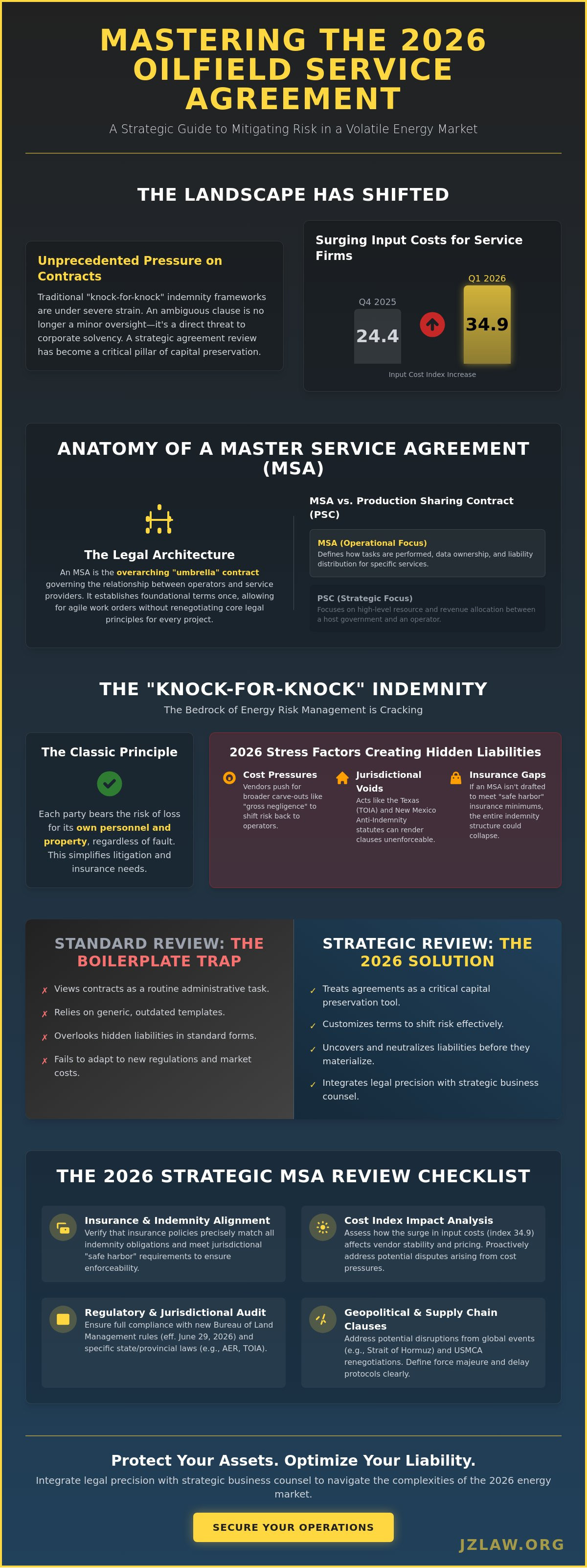
In the 2026 energy market, a single ambiguous indemnity clause is no longer just a legal oversight; it's a potential catalyst for corporate insolvency. You likely recognize that the traditional knock-for-knock framework is under unprecedented pressure as input cost indices for service firms have surged from 24.4 to 34.9 in the first quarter alone. A rigorous oilfield service agreement review has evolved from a routine administrative task into a critical pillar of your capital preservation strategy, especially with the Bureau of Land Management's new leasing fees and royalty rules becoming effective on June 29, 2026.
We understand the pressure to maintain operational speed without sacrificing legal safety in an era of geopolitical volatility and supply chain disruptions. This guide provides a strategic framework to master Master Service Agreements, ensuring you clearly shift risk away from your company while staying aligned with 2026 ESG and regulatory standards. We'll examine how to insulate your assets against catastrophic liability, navigate the latest USMCA renegotiations, and ensure your contracts remain resilient in the face of shifting global energy flows and the recent disruptions in the Strait of Hormuz.
Key Takeaways
Understand why the Master Service Agreement structure remains the preferred framework for streamlining energy services while managing complex operational risks.
Evaluate the "knock-for-knock" indemnity model against the rising input costs and geopolitical disruptions defining the 2026 landscape.
Master a strategic oilfield service agreement review process that moves beyond boilerplate templates to uncover hidden liabilities in standard forms.
Implement a 2026-ready checklist for auditing jurisdictional compliance with bodies like the AER and ensuring insurance policies align with indemnity obligations.
Discover how integrating legal precision with strategic business counsel protects your energy assets and optimizes your liability profile.
Table of Contents
What is an Oilfield Master Service Agreement (MSA)?
An Master Service Agreement (MSA) serves as the primary legal architecture governing the relationship between energy operators and service providers. It's the overarching contract that dictates the terms under which all future work will be performed. Unlike individual project contracts that require exhaustive negotiation for every well site or pipeline repair, the MSA establishes the foundational terms once. It acts as an umbrella, allowing subsequent work orders to be issued with agility while maintaining a consistent legal posture across multiple sites. In the high-stakes upstream sector, this structure is indispensable for drilling and completions, yet its utility extends equally into midstream infrastructure and downstream refining services.
While a Production Sharing Contract (PSC) focuses on the high-level allocation of resources and revenue between a host government and an operator, the MSA is strictly operational. It defines how specific tasks are performed, who owns the resulting data, and how liability is distributed. For operators, a meticulous oilfield service agreement review ensures that these operational nuances don't conflict with broader corporate objectives or regulatory mandates. This is especially vital as we navigate the 2026 regulatory environment, where federal leasing rules and input costs have shifted significantly.
The Anatomy of a Modern Oilfield Service Contract
Modern contracts are composed of several critical layers. The core document outlines the scope of work, payment schedules, and the intended duration of the partnership. However, the true complexity often lies in the ancillary documents. Work orders, technical exhibits, and safety manuals are incorporated by reference, creating a multi-tiered legal obligation. Operators in energy hubs like Calgary and Denver must ensure these documents reflect local regulatory nuances. This includes alignment with Alberta Energy Regulator (AER) directives or specific state-level environmental compliance standards that govern daily operations.
Why MSAs are the Backbone of Energy Operations
Efficiency is the primary driver behind the "Master" structure. By setting the rules of engagement once, companies avoid the bureaucratic drag of re-litigating indemnity and insurance clauses for every minor service request. This consistency is vital for risk management across a diverse vendor pool. It ensures every contractor on a site operates under the same legal expectations. A proactive approach to oil and gas law helps stabilize these long-term partnerships. It provides a predictable framework for dispute resolution and cost management. Conducting a periodic oilfield service agreement review allows operators to update these frameworks to match evolving market conditions, such as the rising input cost index which reached 34.9 in early 2026.
The "Knock-for-Knock" Indemnity: A Deep Dive into Liability
The "knock-for-knock" indemnity serves as the fundamental bedrock of energy risk management. It operates on a deceptively simple premise: each party bears the risk of loss for its own personnel and property, regardless of who actually caused the incident. While this model traditionally simplifies litigation and reduces the need for overlapping insurance, a comprehensive deep dive into liability reveals that the clarity of this arrangement is under significant pressure. During a modern oilfield service agreement review, operators must determine if these mutual indemnities remain equitable or if they've evolved into a vehicle for lopsided risk exposure.
In 2026, this industry-standard model faces unprecedented strain. Rising operational costs for service providers, reflected in an input cost index that climbed to 34.9 in early 2026, have prompted many vendors to seek broader carve-outs for "gross negligence" or "willful misconduct." These exceptions can strip an operator of contractual protection at the moment of greatest need. Furthermore, jurisdictional nuances like the Texas Oilfield Indemnity Act (TOIA) or New Mexico’s Anti-Indemnity statutes can render certain provisions unenforceable. If an agreement isn't drafted to meet specific "safe harbor" insurance requirements, the entire indemnity structure could collapse under judicial scrutiny.
Allocating Risk for Catastrophic Events
Catastrophic incidents, such as loss of well control or underground reservoir damage, require treatment that goes beyond standard personnel indemnity. Operators typically assume liability for "pollution from the well," while contractors are held responsible for surface spills originating from their equipment. A strategic oilfield service agreement review must define "Pollution" with extreme precision to avoid unlimited cleanup exposure. Failing to negotiate the "Gross Negligence" threshold effectively can leave an operator vulnerable to litigation that bypasses the knock-for-knock framework entirely, potentially resulting in uninsurable losses.
Insurance Requirements and the "Additional Insured" Clause
An indemnity obligation is only as reliable as the insurance policy supporting it. Most agreements require the contractor to name the operator as an "Additional Insured" to ensure the contractor’s policy pays first in the event of a claim. However, the "Waiver of Subrogation" remains a common pitfall. If this waiver isn't properly executed, a contractor’s insurer might attempt to recover their losses from the operator after a claim is settled, effectively nullifying the intended protection. Verifying that insurance limits align with 2026 benchmarks is essential for maintaining asset security. For those seeking to refine these complex risk allocations, engaging with a partner experienced in oil and gas law provides the strategic clarity required to protect long-term interests.
Standard vs. Strategic Review: Why Boilerplate is a Trap
In the high-pressure environment of energy production, "Boilerplate Bias" often leads operators to accept standard forms as a matter of convenience. This psychological trap suggests that because a document is standard, it must be safe. However, a routine check often misses the subtle shifts in language that create significant financial exposure. A strategic oilfield service agreement review moves beyond a simple checklist. It analyzes how every clause serves your long-term business objectives. While a standard review ensures the blanks are filled, a strategic approach identifies hidden liabilities that only surface during a crisis or a major corporate shift.
The consequences of neglecting this strategic depth are most visible during corporate transactions. For example, an operator seeking an exit might find their M&A deal derailed because their MSAs contain overly restrictive non-assignment clauses or ambiguous change-of-control provisions. Potential buyers scrutinize these agreements to ensure they aren't inheriting unquantifiable risks. A poorly reviewed agreement can effectively "poison" an asset pool, leading to price reductions or even the total collapse of the transaction during due diligence. Precision in the early stages of contract formation is what preserves value in the final stages of a company’s lifecycle.
The "Battle of the Forms": Operator vs. Contractor Templates
Deciding which party’s template to use is the first strategic hurdle. While contractors often push for their own forms to limit their liability, operators generally benefit from using their own standardized documents to maintain consistency across their vendor pool. Intellectual property and data ownership have become primary points of contention in 2026. As digital oilfield technologies proliferate, ensuring the operator retains rights to the data generated on their lease is critical. Resolving these impasses requires a partner who understands that operational speed cannot come at the expense of long-term data sovereignty.
ESG and Social License in 2026 Contracts
Modern energy contracts must now account for emissions tracking and social license requirements. In jurisdictions like Canada, incorporating local content clauses and indigenous consultation frameworks is no longer optional; it's a prerequisite for operational stability. These ESG-focused provisions are directly linked to the securities regulation of public energy firms, as investors demand transparent reporting on supply chain sustainability. A strategic oilfield service agreement review ensures that your vendor contracts provide the data necessary to meet these stringent reporting standards, protecting both your social license and your standing with capital markets.
The 2026 Checklist for Oilfield Service Agreement Reviews
A rigorous oilfield service agreement review is no longer a static exercise. It's a dynamic audit that must account for the rapid regulatory shifts seen in the first half of 2026. With the Bureau of Land Management's final rule on federal leasing fees becoming effective on June 29, 2026, and the USDA Forest Service modernizing energy management on National Forest System lands, your checklist must be exhaustive. Operators who rely on outdated templates risk non-compliance with these new federal standards, leading to avoidable penalties and project delays.
Your strategic review should follow a structured five-step protocol to ensure no liability remains unaddressed. First, verify jurisdictional compliance by checking against the latest AER liability management programs or EU energy directives. Second, audit the indemnity and insurance alignment to confirm that your "Additional Insured" status isn't undermined by state anti-indemnity statutes. Third, redefine "Force Majeure" to include modern disruptions like cyber-attacks or the recent supply chain collapses seen in the Strait of Hormuz. Fourth, scrutinize termination clauses; distinguish clearly between termination for cause and termination for convenience to maintain flexibility in a volatile market. Finally, execute a conflict of laws analysis, which is particularly vital as the USMCA undergoes renegotiation in 2026.
Local Nuances: Calgary, Denver, and Berlin
In Calgary, the focus remains on the Alberta Energy Regulator’s (AER) evolving liability management programs, which require specific financial security provisions in your MSAs. Denver-based operations must prioritize compliance with Colorado’s stringent air quality and water regulations, ensuring contractors are contractually obligated to meet these local environmental benchmarks. Meanwhile, in Berlin, agreements must align with the EU’s strict environmental liability directives and the total ban on Russian crude oil that commenced on January 1, 2026, requiring precise origin-of-service clauses.
Managing Force Majeure in 2026
The early 2026 closure of the Strait of Hormuz, which disrupted 20% of the world's seaborne oil supply, proved that "Acts of God" clauses are insufficient. Modern force majeure provisions should explicitly include supply chain collapses, government-ordered shipping restrictions, and military conflicts. Your contracts must specify strict "Notice Requirements" to prevent a party from claiming relief weeks after an event occurs. Crucially, include mitigation obligations that require a contractor to demonstrate they've taken all reasonable steps to resume service before they're excused from performance. To ensure your contracts are resilient against these global shifts, consider a professional oil and gas law consultation to fortify your operational framework.
How JZ Law Protects Your Energy Assets
JZ Law operates on the foundational principle that legal precision should never exist in a vacuum; it must be coupled with strategic business foresight. We don't treat your contracts as mere administrative paperwork. Instead, we view them as the primary defense mechanism for your corporate capital. Every oilfield service agreement review we conduct is designed to address the specific economic pressures of 2026, from surging input costs to the tightening of federal leasing regulations. Our boutique approach ensures your portfolio receives the dedicated attention of senior counsel, a level of focus that Big Law often fails to provide.
John Zang’s extensive experience in real estate law offers a distinct advantage for energy operators. The development of energy infrastructure is inextricably linked to land rights and complex surface agreements. By applying a real estate lens to your service contracts, we ensure that site access, facility maintenance, and reclamation obligations are perfectly synchronized with your operational goals. This integrated perspective is essential for stabilizing long-term partnerships in high-stakes energy hubs like Calgary and Denver.
A Strategic Partner for Complex Regulatory Landscapes
Managing cross-border energy transactions requires a sophisticated understanding of disparate legal systems. Whether you're operating in the Western Canadian Sedimentary Basin, the DJ Basin in Colorado, or navigating the EU's evolving energy directives in Germany, we provide the necessary jurisdictional expertise. Our firm focuses on proactive risk mitigation. We identify and neutralize hidden liabilities in your MSAs before they can evolve into expensive litigation or derail a future corporate divestiture.
Secure Your Operations Today
The most prudent move for an operator in the current climate is a comprehensive "Legal Health Check" of their existing service contracts. This audit identifies where your indemnity structures might be failing to keep pace with 2026 benchmarks or new AER liability programs. We also assist forward-thinking firms in integrating cryptocurrency law insights into their payment frameworks, ensuring digital transactions with international vendors are both secure and compliant. Protecting your assets requires more than just a signature; it requires a strategic alliance.
Contact JZ Law for an Oilfield Service Agreement Review to ensure your operations are built on a foundation of legal and strategic excellence.
Securing Your Operational Future in the 2026 Energy Market
Navigating the complexities of the modern energy sector requires a transition from reactive administration to proactive legal strategy. The standard knock-for-knock model is facing unprecedented pressure from rising input costs and shifting federal regulations. Relying on boilerplate templates in this environment doesn't just create operational inefficiency; it invites catastrophic exposure that can derail corporate transactions and jeopardize your social license. Performing a meticulous oilfield service agreement review is the most effective way to insulate your capital from unforeseen geopolitical and regulatory shocks.
JZ Law provides the specialized expertise necessary to align your contracts with the stringent standards of Calgary, Denver, and international energy hubs. We offer boutique, principal-level attention that combines deep regulatory knowledge with a pragmatic business perspective. By auditing your current MSA portfolio now, you ensure that your operations remain resilient, compliant, and ready for the opportunities of the coming years. Our team is committed to transforming your legal framework into a strategic asset that supports long-term growth. We look forward to securing your interests in this evolving landscape.
Schedule a Strategic Oilfield Contract Review with JZ Law
Frequently Asked Questions
What is the difference between an MSA and a Work Order in the oilfield?
An MSA establishes the foundational legal terms for all future interactions, while a Work Order defines the specific scope, price, and timeline for an individual project. The MSA acts as the overarching framework, and the Work Order is issued under its authority to trigger performance. This separation allows parties to negotiate complex legal risks once and then deploy services rapidly as operational needs arise.
Is a "Knock-for-Knock" indemnity clause always enforceable?
Enforceability of knock-for-knock indemnity is not absolute and often depends on specific jurisdictional statutes or the presence of gross negligence. In states like Texas and New Mexico, anti-indemnity laws may limit these clauses if they aren't supported by specific insurance requirements. A strategic oilfield service agreement review identifies these regional limitations to ensure your risk allocation remains legally sound and enforceable under local court scrutiny.
How does the Alberta Energy Regulator (AER) affect my service agreements?
The Alberta Energy Regulator (AER) influences service agreements primarily through its liability management programs and Directive 088. Operators must ensure their MSAs include provisions that account for the AER's holistic assessment of a company’s ability to meet its closure and reclamation obligations. Failure to align contract terms with these regulatory expectations can result in increased financial security requirements or restrictions on license transfers.
Can I limit my liability for environmental pollution in an MSA?
You can limit your liability for environmental pollution by clearly defining which party is responsible for surface spills versus subsurface events. Operators typically assume responsibility for pollution originating from the wellbore; contractors are held liable for spills from their own equipment or personnel negligence. Precise definitions of "pollution" and "cleanup costs" are essential to prevent open-ended financial exposure during an incident.
What is a "Mutual Indemnity" and why is it common in the energy sector?
Mutual indemnity is a reciprocal arrangement where both the operator and the contractor agree to bear the risk of loss for their respective employees and property. This model is common in the energy sector because it simplifies the insurance process and reduces the need for costly, overlapping coverage. By agreeing to this "knock-for-knock" approach, parties avoid protracted litigation over fault for minor injuries or equipment damage on complex job sites.
How often should I update or review my Master Service Agreements?
Master Service Agreements should be reviewed at least every two to three years or whenever a significant regulatory change occurs. Given the June 29, 2026, effective date for the BLM's new leasing rules and the recent surges in input costs, an oilfield service agreement review is necessary right now to ensure alignment with current market realities. Regular audits prevent your legal framework from becoming obsolete as environmental and economic conditions evolve.
What happens if there is a conflict between the MSA and a specific Work Order?
If a conflict arises, the MSA typically contains a "precedence" clause that establishes it as the dominant document over any individual Work Order. However, parties can explicitly state in a Work Order that certain project-specific terms should override the MSA for that specific job. Without clear language defining this hierarchy, courts generally favor the foundational terms of the MSA to maintain consistency in risk allocation.
Do I need a local lawyer in Calgary or Denver for a cross-border MSA?
Engaging a lawyer with specific expertise in Calgary or Denver is highly recommended for cross-border MSAs to navigate unique provincial or state regulations. Alberta’s liability management framework differs significantly from Colorado’s air quality standards; a single template rarely addresses both effectively. Local counsel ensures that your agreements comply with specific statutory requirements like the Texas Oilfield Indemnity Act or Alberta’s specific environmental directives.


Comments