


Subscription Agreement for Private Placement: A Strategic Legal Guide for 2026
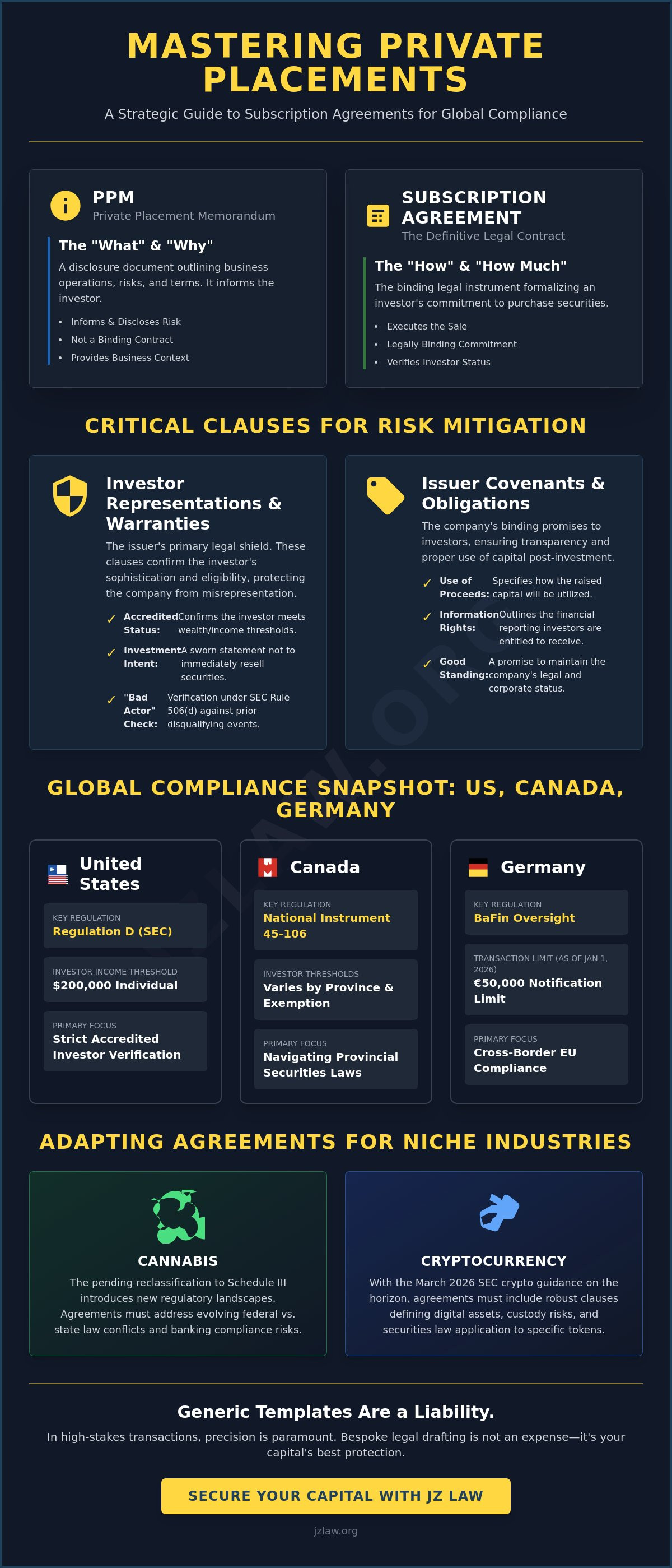
A subscription agreement for private placement is not a mere administrative formality; it is the most critical legal shield between your capital and a regulatory audit. You likely recognize that the margin for error has narrowed as global regulators tighten their oversight of exempt offerings. With the SEC maintaining strict $200,000 individual income thresholds and Germany’s BaFin raising transaction notification limits to €50,000 as of January 1, 2026, the burden of precision falls squarely on the issuer. Managing these cross-border complexities while verifying investor accreditation across different legal frameworks requires a level of diligence that goes beyond standard templates.
This guide provides the clarity you need to master these legal intricacies, ensuring your capital remains protected and your operations stay compliant. We'll examine the specific requirements for US, Canadian, and German markets, including the implications of the March 2026 SEC crypto guidance and the pending reclassification of cannabis to Schedule III. By the end of this analysis, you'll understand how to structure robust representations and warranties that satisfy regulators and facilitate a seamless closing in this sophisticated economic environment.
Key Takeaways
Understand the functional distinction between a Private Placement Memorandum and the subscription agreement for private placement to ensure every investor commitment is contractually binding.
Identify critical representations and warranties that mitigate the risk of future securities litigation and protect the company from investor misrepresentation.
Compare the specific accredited investor thresholds and notification requirements across the United States, Canada, and Germany to maintain seamless cross-border compliance.
Learn to adapt your legal documentation to address the unique volatility and specific regulatory requirements of the cryptocurrency and cannabis sectors in 2026.
Recognize the strategic necessity of bespoke legal drafting over generic templates to secure high-stakes corporate transactions and safeguard your capital.
Table of Contents
What is a Subscription Agreement for Private Placement?
A subscription agreement for private placement serves as the definitive legal instrument that formalizes an investor's commitment to purchase securities. While many mistakenly view it as a mere administrative form, it's actually the foundational contract that governs the relationship between the "issuer," which is the entity seeking capital, and the "subscriber," the individual or institution providing it. This document creates the legal framework necessary for a company to issue shares, units, or debt instruments without the exhaustive requirements of a public registration. To understand the broader context of these offerings, one might ask What is a Private Placement? Essentially, it's a capital-raising event that targets a select group of sophisticated investors rather than the general public.
The document's primary role is to bridge the gap between the Private Placement Memorandum (PPM) and the actual transaction. While the PPM acts as a disclosure document that outlines risks and business operations, the subscription agreement is the mechanism for the sale itself. It's where the investor makes legally binding promises regarding their financial status and intent. By utilizing a robust subscription agreement for private placement, companies can bypass the need for a full, government-vetted prospectus, provided they strictly adhere to specific regulatory exemptions like Regulation D in the United States or National Instrument 45-106 in Canada.
The Legal Function of the Agreement
This contract does more than just list a price; it establishes the exact number of shares being sold and the specific timing of the capital injection. It creates a binding commitment that remains in effect until the closing date, providing the issuer with the certainty required to execute a strategic corporate transaction. Without this level of contractual finality, companies would face immense risk when planning mergers, acquisitions, or large-scale capital expenditures. The agreement also contains the "investor questionnaire," a critical tool used to verify that each subscriber meets the necessary wealth or sophistication thresholds.
Private Placements vs. Public Offerings
Choosing a private placement over a public offering significantly reduces the administrative and regulatory burden on a growing company. Public offerings require exhaustive filings and ongoing reporting that can drain resources. Sophisticated investors often prefer the structured terms of a subscription agreement because they offer more direct protections than standardized public shares. However, maintaining high legal precision during this stage is vital, especially for founders who intend on taking companies public in the future. Any errors in the early subscription documents can create "toxic" cap tables or regulatory hurdles that complicate later IPO efforts.
Critical Clauses for Risk Mitigation and Compliance
The structural integrity of a subscription agreement for private placement depends on the precision of its protective clauses. These provisions serve as the primary defense against securities litigation and regulatory scrutiny. By clearly defining the obligations of both the issuer and the subscriber, the agreement transforms a speculative investment into a legally secured transaction. Every clause must be drafted with the foresight to withstand a future audit or a disgruntled investor's legal challenge.
Investor Representations and Warranties
These clauses aren't mere formalities; they're the issuer's primary insurance policy. They confirm that the subscriber possesses the financial sophistication to evaluate the risks independently. A critical component is the "investment intent" representation, where the subscriber swears they're not purchasing the shares for immediate resale. This prevents the offering from inadvertently violating registration requirements by becoming a de facto public distribution. Additionally, modern agreements must include a "Bad Actor" disqualification check under SEC Rule 506(d) to ensure no party involved has been subject to specific enforcement actions that could void the exemption.
Issuer Covenants and Obligations
The issuer's promises are equally vital to the deal's longevity. These covenants typically include maintaining the company's legal standing and providing regular financial updates to the subscribers. They also specify the "use of proceeds," ensuring capital is deployed exactly as described in the offering materials. For those managing complex fundraisings, seeking expert guidance on securities regulation ensures these obligations don't become unintended liabilities during the company's growth phase.
Indemnification acts as a necessary financial backstop within the contract. If an investor's misrepresentation about their accredited status leads to a regulatory fine or a lawsuit, this clause requires the investor to cover the company's losses. This shift of risk is essential for maintaining the issuer's solvency in the face of third-party claims. Finally, the document must outline "Conditions Precedent" and "Termination Rights." These define the specific milestones, such as the successful filing of a Form D within 15 calendar days of the first sale, that must occur before the transaction is officially closed. If these conditions aren't met, the termination rights provide a structured exit ramp for both parties, preventing a failed deal from lingering as a legal ghost.
Navigating Global Regulatory Frameworks: US, Canada, and Germany
Raising capital across international borders requires an intricate understanding of divergent regulatory regimes. A subscription agreement for private placement that works for an entity in Calgary might be entirely insufficient for an offering targeting investors in Berlin or New York. Issuers must navigate a patchwork of rules where the definition of a sophisticated investor changes as soon as you cross a border. For instance, the US Securities and Exchange Commission (SEC) relies heavily on Rule 501 of Regulation D, while Canadian authorities look to National Instrument 45-106. Germany presents an even steeper challenge; BaFin maintains a highly regulated environment that lacks a direct equivalent to the North American private placement exemption for investment funds.
In the United States, the criteria for an accredited investor are rigid. An individual must have an annual income exceeding $200,000, or $300,000 jointly with a spouse, for the past two years. Alternatively, they must have a net worth over $1 million, excluding their primary residence. Since the 2020 rule expansion, individuals holding Series 7, 65, or 82 licenses also qualify. Across the border in Canada, the thresholds are similar but calculated in local currency, requiring a pre-tax income of CAD $200,000 or financial assets exceeding CAD $1,000,000. For high-stakes offerings, the "Minimum Amount" exemption allows a sale to any person who invests at least CAD $150,000 in cash, provided they aren't an individual.
The Accredited Investor Hurdle
Verification is where most issuers stumble. It's not enough to take an investor's word; you've got to take "reasonable steps" to confirm their status. In the US, this often involves reviewing tax returns or brokerage statements. If you fail this duty, investors may gain rescission rights, allowing them to demand their full investment back if the venture sours. This creates a massive contingent liability that can derail future growth. Germany's oversight is equally strict, with BaFin raising the notification threshold for managers' transactions to €50,000 as of January 1, 2026, signaling a continued focus on transparency and professional standards.
Anti-Money Laundering (AML) and KYC
Global standards for 2026 demand rigorous Know Your Customer (KYC) protocols within every subscription agreement for private placement. In Canada, FINTRAC requires detailed reporting for high-value transactions to prevent money laundering. Your agreement must act as a data collection tool, capturing beneficial ownership information and verifying the source of funds. Germany's KAGB framework is particularly strict regarding the marketing of funds, requiring notification to BaFin and a clear distinction between retail, semi-professional, and professional investors. By centralizing these checks within the subscription document, you create a proactive audit trail that satisfies regulators in all three jurisdictions.
Tailoring Agreements for Niche Industries: Cannabis and Crypto
Generic templates often fail when applied to highly regulated and volatile sectors. A subscription agreement for private placement in 2026 must go beyond standard financial representations to address the specific legal risks inherent in cannabis and digital assets. In these industries, an investor's background can be just as critical as their capital. If a subscriber doesn't meet the "suitability" standards set by regional regulators, their very presence on your cap table could jeopardize your operational standing. Precision in drafting these specialized clauses is the only way to safeguard the issuer's long-term viability.
Cannabis Industry Investment Nuances
The cannabis sector is currently navigating a pivotal transition. As of April 2026, the US Department of Justice has initiated the process to reclassify cannabis to Schedule III. While this move is expected to unlock significant banking opportunities, it's not full federal legalization. Your agreement must include clauses that address this "patchwork" legality, ensuring that investors understand the ongoing federal risks. Furthermore, with 36,169 active cannabis licenses in the US and approximately 5,800 licensed operators in Canada as of Q1 2026, the competition for compliant capital is fierce. Agreements must include disclosure requirements for "Key Personnel" to ensure no investor's history negatively impacts the company's cannabis licensing status. If a significant shareholder fails a state-mandated background check, the agreement should provide a mechanism for the mandatory redemption of their shares.
Cryptocurrency and Blockchain Placements
Digital asset offerings require a different level of technical and legal sophistication. Following the SEC and CFTC's joint interpretive release on March 17, 2026, issuers now have a clearer token taxonomy to work with. Your subscription agreement for private placement must explicitly define whether the assets are "Utility Tokens" or "Security Tokens" based on this latest guidance. This distinction determines the level of regulatory oversight and the specific exemptions required. Additionally, the document must address the practicalities of asset custody and the closing mechanics for on-chain transactions. Navigating the diverse cryptocurrency law frameworks in hubs like New York and Berlin requires proactive risk management. For those operating in these innovative sectors, our firm offers the bespoke legal counsel necessary to structure these high-stakes placements correctly.
Transfer restrictions are particularly stringent in these niches. Because secondary sales could inadvertently trigger a change-of-control review or violate securities exemptions, the agreement must strictly control how and to whom shares can be sold. By embedding these industry-specific protections directly into the subscription document, you prevent future litigation and ensure your company remains attractive to institutional partners during market consolidation.
Closing the Deal: The Role of Legal Counsel
The final execution of a subscription agreement for private placement is more than a signing ceremony; it's the culmination of a rigorous risk-management strategy. While digital templates are widely available, they often fail to address the specific nuances of your jurisdiction or the unique demands of sophisticated investors. Relying on generic documents during high-stakes corporate transactions exposes the issuer to future securities litigation that could have been avoided with bespoke drafting. Legal counsel serves as the architect of the deal, ensuring that every signature collected and every dollar transferred is backed by a robust contractual framework.
Managing the closing process requires meticulous coordination between several moving parts. This involves overseeing escrow accounts to ensure that capital is only released once all conditions precedent are satisfied. Counsel handles the collection of signatures and verifies that the investor questionnaires are completed with the precision required by regulators in New York, Toronto, or Berlin. Once the deal closes, the work continues with mandatory post-closing filings. In the United States, a notice of the exempt offering on Form D must be filed with the SEC within 15 calendar days after the first sale. In Canada, companies must navigate the specific requirements for a Report of Exempt Distribution under provincial securities laws to maintain their exempt status.
Strategic Negotiation of Terms
Legal counsel acts as a strategic partner by balancing investor demands with the founder's need for control and operational flexibility. Investors often push for "side letters" that grant them additional rights, such as board observation seats or specific information rights. Counsel identifies red flags in these requests that might conflict with the company's long-term goals or existing shareholder agreements. By negotiating these terms proactively, you prevent the "death by a thousand cuts" that occurs when too many disparate investor promises are made during a fundraise.
Ensuring Long-term Enforceability
The choice of law and dispute resolution clauses are the final pillars of a secure subscription agreement for private placement. For cross-border deals involving entities in Calgary and Berlin, selecting the most favorable jurisdiction is a strategic decision. Whether you opt for the established precedents of New York law or the specific corporate frameworks in Germany, these clauses dictate how future conflicts will be resolved. A successful closing checklist should include:
Verification of all accredited investor documentation and "reasonable steps" taken.
Confirmation of escrow release triggers and fund distribution.
Timely filing of SEC Form D and provincial Reports of Exempt Distribution.
Integration of the new subscribers into the company’s cap table and minute book.
By treating the subscription process as a strategic legal exercise rather than a clerical task, you build a foundation of trust with your investors and a shield against regulatory interference.
Securing Your Capital through Strategic Legal Precision
Mastering the subscription agreement for private placement is a fundamental requirement for any issuer looking to scale in 2026. You've seen how the convergence of strict accreditation verification, cross-border regulatory nuances, and industry-specific risks in the cannabis and crypto sectors demands a proactive approach. Relying on standardized templates is no longer a viable strategy when the stakes involve multi-jurisdictional compliance and long-term investor relations. Precision in your representations and warranties doesn't just satisfy regulators; it builds the necessary trust to close high-stakes deals with confidence.
Strategic growth requires a partner who understands the intricacies of securities regulation in the US, Canada, and Germany. Led by principal lawyer John Zang, our firm provides specialized counsel for those navigating the evolving landscapes of cryptocurrency and cannabis law. We ensure your corporate transactions are built on a foundation of legal dignity and modern business insight. Consult JZ Law for your strategic corporate transactions and private placements. We're ready to help you navigate these complexities and secure a successful future for your enterprise.
Frequently Asked Questions
Is a subscription agreement legally binding?
Yes, a subscription agreement is a legally binding contract once it's signed by both the issuer and the subscriber and all conditions precedent are satisfied. It establishes a definitive commitment for the investor to provide capital and for the company to issue securities. Because it's a foundational document, it remains enforceable until the closing date or until specific termination rights are triggered according to the contract's terms.
What is the difference between a subscription agreement and a shareholder agreement?
A subscription agreement focuses on the initial entry and purchase of shares, while a shareholder agreement governs the ongoing relationship and governance of the company. The subscription document defines the price, quantity, and terms of the investment. In contrast, the shareholder agreement outlines voting rights, board seats, and dividend policies that apply after the investor becomes a part of the cap table. Both are essential for a robust corporate structure.
Who qualifies as an accredited investor for a private placement?
In 2026, the SEC defines an individual as accredited if their income exceeded $200,000, or $300,000 jointly with a spouse, in each of the two most recent years. Alternatively, an individual qualifies with a net worth over $1 million, excluding their primary residence. Professionals holding active Series 7, 65, or 82 licenses also meet these criteria. Canadian regulations under NI 45-106 maintain similar income and asset thresholds calculated in local currency.
Can a subscription agreement be cancelled after signing?
Cancellation is generally not permitted unless the agreement contains specific termination clauses or the parties reach a mutual written consent to rescind. If an issuer fails to meet a condition precedent, such as filing a Form D within 15 calendar days or maintaining legal standing, the subscriber might have grounds to exit. Without these specific triggers, the document remains a binding financial commitment that survives until the transaction is finalized.
What is Rule 506(b) vs. 506(c) in a subscription agreement?
Rule 506(b) permits a private placement without general solicitation and allows up to 35 non-accredited investors, while Rule 506(c) allows for public advertising but requires mandatory verification of all investors' accredited status. The choice between these rules significantly alters the verification requirements in your subscription agreement for private placement. Under 506(c), the issuer must take reasonable steps, such as reviewing tax returns, rather than relying solely on investor self-certification.
Do I need a lawyer to draft a subscription agreement for my startup?
Enlisting specialized counsel is critical because generic templates often fail to address cross-border regulatory complexities or industry-specific risks. A bespoke agreement ensures compliance with SEC, CSA, and BaFin regulations while protecting the issuer from future securities litigation. For startups targeting global hubs like Calgary, New York, or Berlin, professional drafting is a strategic investment that prevents "toxic" cap tables and facilitates smoother subsequent funding rounds.
What happens if an investor lies on their subscription agreement?
If an investor provides false information regarding their accredited status or financial sophistication, the indemnification clause in the agreement protects the company from resulting losses. The issuer can hold the investor liable for regulatory fines or legal costs incurred due to the misrepresentation. In many cases, the investor also loses their right to sue the company for rescission if the investment doesn't perform as expected.
How does a subscription agreement work for a crypto token sale?
A subscription agreement for private placement in the crypto sector must distinguish between utility and security tokens based on the March 17, 2026, SEC and CFTC joint guidance. It addresses technical mechanics like digital asset custody and the specific "investment contract" status of the tokens under the Howey test. These documents also include specialized transfer restrictions to ensure that secondary sales don't inadvertently trigger a public registration requirement.



Comments