


Term Sheet Negotiation for Founders: A Strategic Legal Guide (2026)
- jzanglaw
- 3 hours ago
- 12 min read
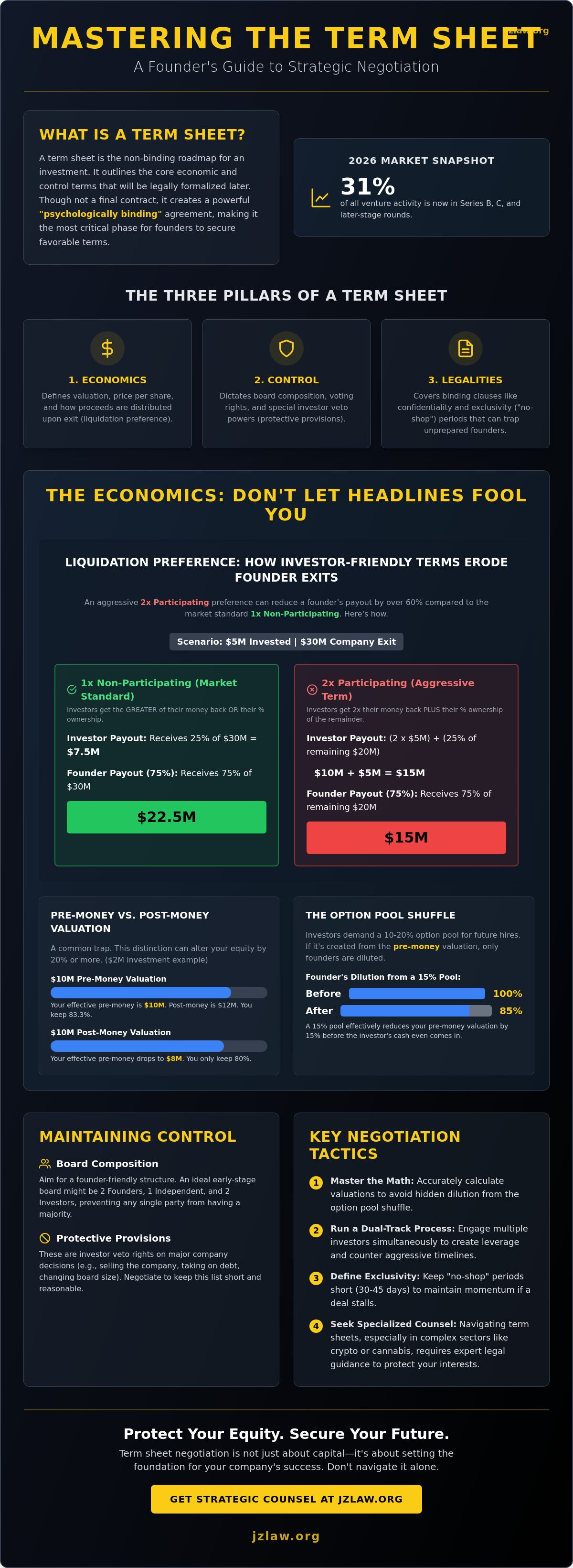
An aggressive 2x participating liquidation preference can erode a founder's exit proceeds by as much as 60% compared to the 2026 market standard of 1x non-participating. While a high valuation often captures the headlines, successful term sheet negotiation for founders requires a far more granular focus on the structural levers that dictate long-term control and financial upside. You're likely feeling the weight of this complexity, balancing the need for immediate capital against the fear of predatory terms or losing your seat on the board of directors.
We understand that the current venture landscape, where Series B and C+ rounds now account for 31% of all activity, demands a sophisticated approach to deal-making. This guide promises to demystify complex jargon like participation rights and anti-dilution provisions, equipping you with the strategic insight to protect your equity. We'll examine the shift toward "clean" term sheets and provide a precise framework for maintaining board control while ensuring your financing round closes with minimal friction.
Table of Contents
What is a Term Sheet and Why Does it Matter in 2026?
A term sheet acts as the non-binding roadmap for a definitive investment agreement. It outlines the valuation, share price, and governance rights that will eventually be codified in long-form legal documents. To understand the foundational components of these agreements, one might ask, What is a Term Sheet? At its core, it's a summary of terms that differs from a Letter of Intent (LOI) by focusing specifically on the equity exchange and investor rights rather than just the general intent to do business. In the current 2026 venture capital environment, we've seen a distinct "flight to quality." Series B and C+ financing rounds now represent 31% of all term sheets, a rise from 26% just two years ago. This concentration of capital means that while fewer deals are closing, the stakes for those that do are significantly higher.
Even though most provisions are non-binding, the document creates a "psychological binding" effect. Once signed, deviating from these terms during the due diligence phase is often viewed as "re-trading" the deal. This can destroy trust or cause the entire transaction to collapse. This is why term sheet negotiation for founders is the most critical phase of the fundraising lifecycle. If you don't secure the right protections now, you'll have very little leverage to introduce them later when the lawyers are drafting the final stock purchase agreements.
The Anatomy of a High-Stakes Term Sheet
A robust term sheet rests on three pillars: economics, control, and legal protections. Economics dictate the price per share and liquidation preferences, while control deals with board composition and voting rights. In 2026, "standard" terms usually include a 1x non-participating liquidation preference. However, local norms vary. In NYC, investors often push for more aggressive protective provisions compared to the growing tech hubs of Toronto or Calgary, where founder-friendly structures are becoming more prevalent to attract top-tier talent in the energy and fintech sectors.
Binding vs. Non-Binding Clauses
While the valuation is non-binding, certain sections like confidentiality and exclusivity (the "no-shop" clause) are legally enforceable. Signing without a clear "break-up" provision or a defined expiration date can trap a company in legal limbo if the investor stalls. These early-stage negotiations should be viewed through the lens of Strategic Corporate Transactions 2026, where the focus is on mitigating long-term risks before they manifest. Founders must ensure that the exclusivity period is long enough for diligence but short enough to protect their market momentum if the deal doesn't close.
The Economics: Negotiating Valuation and Dilution
Valuation often serves as the headline figure in any deal, yet it's frequently the most misunderstood component of the economic stack. Founders often conflate pre-money and post-money valuations, a mistake that leads to unexpected dilution. If you agree to a 10 million dollar pre-money valuation for a 2 million dollar investment, your post-money valuation is 12 million dollars. However, if the term sheet specifies a 10 million dollar post-money valuation, your effective pre-money value drops to 8 million dollars. This distinction alone represents a 20% difference in your remaining equity. Effective term sheet negotiation for founders requires a precise understanding of this math before any signatures are exchanged.
Beyond the raw valuation, anti-dilution provisions dictate how your stake is protected during subsequent "down rounds." While most 2026 deals utilize a broad-based weighted average formula, some aggressive investors still push for a "full ratchet" provision. A full ratchet can be devastating, as it adjusts the investor's share price to the lowest price offered in any future round, regardless of how much capital was raised. Maintaining a "clean" term sheet with standard anti-dilution protections is vital for long-term cap table health. Engaging a specialist for Corporate Transactions ensures these economic nuances are handled with precision, protecting your upside from the start.
The Hidden Cost of the Option Pool
Investors typically require an Employee Stock Option Pool (ESOP) to be established or increased before they close the round. In 2026, the market standard for an option pool is between 10% and 20% of the post-money capitalization. The "shuffle" occurs when investors insist this pool be carved out of the pre-money valuation, which ensures that only the founders are diluted by the expansion. A 15% pool expansion required in the pre-money valuation effectively reduces the founder's ownership by that same 15% before the investor's capital even hits the bank. You should negotiate the pool size based on a concrete 12 to 18 month hiring plan rather than accepting an arbitrary percentage.
Liquidation Preferences and Exit Math
Liquidation preference determines who gets paid first and how much they receive during a sale or IPO. The current 2026 standard is a 1x non-participating preference, meaning investors choose between receiving their initial investment back or their pro-rata share of the proceeds. The "participation" trap occurs when an investor receives both their initial investment and their percentage of the remaining pool. This can be mitigated by capping participation at a certain multiple, such as 2x or 3x. Additionally, founders should scrutinize dividend requirements, as cumulative dividends can accrue over years and significantly inflate the investor's preference at the time of exit.
The Control: Board Seats and Protective Provisions
While the economic terms of a deal dictate your potential windfall, the control provisions determine who actually steers the ship. Many entrepreneurs mistakenly view governance as a secondary concern, yet the structure of the board and the breadth of protective provisions are often where the most significant battles occur. In the context of term sheet negotiation for founders, maintaining operational autonomy while providing investors with necessary oversight is a delicate balance. If you concede too much control early on, you might find yourself unable to execute the very vision that attracted investment in the first place.
Board of directors composition is the cornerstone of this power dynamic. A standard 2-1-2 structure includes two founder seats, two investor seats, and one independent member. This independent director often becomes the most critical hire in the company's history because they serve as the tie-breaker in deadlocked decisions. You should also be wary of observer rights. Observers don't have a formal vote, but their presence and influence in the room can significantly shift the tone of strategic discussions.
Winning the Board Seat Battle
The goal is to ensure the board remains a strategic asset rather than a source of friction. You should prioritize candidates for the independent seat who possess deep industry expertise and a history of supporting founders through scaling challenges. Negotiating for a founder-led board is often possible in early seed stages, but as you move toward Series B and C, investor representation becomes inevitable. Clear definitions regarding the removal and replacement of directors must be established now to prevent a hostile takeover of the boardroom during a rough quarter.
Veto Rights and Operational Freedom
Protective provisions, or veto rights, give investors the power to block specific corporate actions. These typically include selling the company, issuing new debt, or changing the primary line of business. The key for founders is to establish thresholds for these vetoes. For example, you might require investor consent only for debt exceeding a specific dollar amount or for acquisitions above a certain valuation. This prevents micro-management of day-to-day operations.
Information rights dictate what data you must share and how often. Transparency is necessary for investors, but you must ensure these requirements don't become an administrative burden that distracts from core operations. Clear reporting schedules help maintain trust without compromising your team's focus on growth.
Strategic control mechanisms have long-term implications, especially when taking companies public in highly regulated sectors. Early governance choices can either streamline or complicate the transition to a public entity. Restrictive provisions might hinder your ability to pivot quickly, a necessity in the fast-moving tech and cannabis markets of 2026. Finally, ensure that drag-along rights are structured to protect the majority, while tag-along rights provide fair exit opportunities for all shareholders.
Negotiation Tactics: How Founders Can Gain Leverage
Leverage in a venture capital negotiation is rarely about having more capital; it's about having more options. When engaging in term sheet negotiation for founders, your primary objective is to maintain a "Dual Track" approach. By cultivating interest from multiple investors simultaneously, you create a competitive environment that naturally drives up valuation and softens aggressive terms. This strategy prevents you from being cornered by an "Exploding Offer," where an investor sets a 24 or 48 hour deadline to force a signature. If you encounter such tactics, the most effective response is a calm assertion of your need for due process, backed by the knowledge that other firms are waiting in the wings.
Focusing your energy on the "Big Three"—valuation, liquidation preferences, and board control—allows you to concede on minor points without compromising your company's future. A deep understanding of Securities Regulation is essential here. It ensures that the deal structure remains clean and compliant with 2026 standards, which in turn makes your company more attractive for future exit events. Composure during this phase is vital, as the way you handle conflict now sets the tone for your long-term partnership with the investor.
Handling the Investor "Hardball"
Investors often use the phrase "this is our standard term" to shut down debate. In 2026, market standards are well-documented, so you must know which terms are truly standard and which are opportunistic. Identify your "Deal Breakers" early. While you fight for these critical points, maintain a "soft" negotiation style. Professionalism during heated debates signals that you're a leader capable of handling high-stakes corporate pressure. If you're currently facing a complex negotiation, our team provides the strategic oversight needed to secure favorable corporate terms.
The Exclusivity Period (No-Shop) Trap
The "No-Shop" clause is one of the few binding elements of a term sheet, prohibiting you from talking to other investors once signed. A 30 day period is generally sufficient for due diligence. If an investor pushes for 60 days or more, they're effectively taking you off the market without a guarantee of closing. Always negotiate carve-outs for investors you're already in deep discussions with. Most importantly, insist on a "Fiduciary Out" clause. This allows the board to consider a superior offer if one emerges, protecting you from being legally bound to a sub-optimal deal while the investor remains in the diligence phase.
JZ Law: Strategic Counsel for Complex Founder Negotiations
Generalist law firms often lack the technical depth required to navigate the highly specific regulatory environments that define modern innovation. When your venture involves the complexities of Cannabis Licensing or the rapidly shifting landscape of Cryptocurrency Law, a standard corporate template is fundamentally insufficient. John Zang’s approach treats every financing round as a strategic partnership rather than a mere service. We ensure that the foundations laid during your term sheet negotiation for founders are robust enough to support future scaling, whether you're operating out of Calgary’s energy sector or the financial hubs of NYC. Our expertise bridges the gap between Canadian and U.S. venture standards, ensuring your company remains attractive to international capital.
We view legal counsel as a long-term strategic asset. A term sheet signed in 2026 isn't just about the immediate cash infusion; it's the first step in a journey that may lead to an IPO or a major acquisition. By integrating high-level securities regulation knowledge with a deep understanding of your specific industry, we prevent the structural mistakes that often haunt founders during later-stage exits. This comprehensive perspective allows you to focus on growth while we handle the intricate legal architecture that protects your equity and operational freedom.
Specialized Expertise in Regulated Sectors
Protecting intellectual property in sectors like decentralized finance or oil and gas requires a proactive, defensive mindset. Our team conducts thorough regulatory compliance audits before a term sheet is even finalized. This ensures your corporate structure is "VC-Ready" for 2026 standards, which significantly reduces the risk of investors discovering liabilities that could lead to a valuation haircut during due diligence. We specialize in identifying sector-specific risks that generalist attorneys frequently overlook, providing a layer of security that is essential for high-growth companies.
Closing the Deal with Precision
The transition from a non-binding roadmap to definitive agreements, such as the Stock Purchase Agreement (SPA) and Shareholders' Agreement (SHA), is where the most dangerous shifts in deal terms often occur. Our role is to manage the closing process with extreme precision to prevent "re-trading" by investors who might try to use the diligence phase as leverage. We maintain a firm, professional stance to ensure that the spirit of the negotiated term sheet is accurately reflected in the final binding documents. If you're currently evaluating an investment offer, contact JZ Law for a strategic review to ensure your interests are fully protected.
Securing Your Vision Through Strategic Deal Architecture
Successful fundraising requires more than just capital; it demands a meticulous approach to the structural levers that define your company's future. By mastering term sheet negotiation for founders, you ensure that attractive valuation figures don't mask unfavorable liquidation preferences or excessive board dilution. The decisions made during this initial phase create a psychological and legal trajectory that is remarkably difficult to alter once the definitive agreements are drafted.
At JZ Law, we bring decades of experience in the Calgary, Toronto, and NYC markets to every transaction. Our deep expertise in Securities Regulation, Cryptocurrency Law, and Cannabis Licensing allows us to identify industry-specific risks before they compromise your financing round. We position ourselves as your strategic partner, bridging the gap between innovative growth and rigorous legal compliance. Your hard-earned equity deserves a structure that supports long-term success without sacrificing control.
Protect your equity—book a strategic term sheet review with JZ Law to ensure your next financing round is built on a foundation of professional dignity and strategic foresight. You've built a remarkable company; now let's ensure you have the legal framework to lead it into the future.
Frequently Asked Questions
Is a term sheet legally binding for founders?
A term sheet is generally non-binding regarding the economic terms like valuation and share price, but it contains specific clauses that are legally enforceable. These typically include confidentiality agreements and exclusivity provisions, which prevent you from negotiating with other investors for a set period. It's best to view the document as a psychological commitment that dictates the framework for the final, binding legal contracts.
What is a "standard" valuation for a Seed round in 2026?
Valuations in 2026 are highly sector-dependent, with DeepTech, AI, and CleanTech companies commanding higher premiums due to the current "flight to quality" among investors. While there isn't a single universal number, the market has shifted toward rewarding companies with clear paths to revenue and robust intellectual property. Founders should focus on obtaining a valuation that reflects their growth stage without creating an impossible hurdle for future Series A benchmarks.
How long does it take to go from term sheet to cash in the bank?
The transition from a signed term sheet to the actual transfer of funds typically takes between 30 and 60 days. This timeline accounts for the lead investor's deep-dive due diligence and the time required for legal counsel to draft and finalize the definitive agreements. Delays often occur during the due diligence phase, especially if corporate records or regulatory compliance documents aren't organized and ready for review.
Can I negotiate a term sheet without a lawyer?
Founders can technically negotiate their own deals, but this approach often leads to long-term structural traps that are difficult to rectify in later rounds. Specialized legal guidance during term sheet negotiation for founders ensures that you don't inadvertently concede on critical levers like board control or anti-dilution formula. A strategic legal partner identifies aggressive terms that might seem standard to an inexperienced eye but could cost you millions at exit.
What happens if the investor backs out after signing a term sheet?
If an investor withdraws before the definitive agreements are signed, you generally have no legal recourse to force the investment because the economic terms are non-binding. This is why the "certainty to close" is often as important as the valuation itself. You'll be released from your exclusivity obligations, but the lost time and the "taint" of a failed round can make it harder to re-engage with other venture firms immediately.
What is a "No-Shop" clause and how does it affect my startup?
A "No-Shop" clause is a binding exclusivity provision that prohibits you from soliciting or discussing alternative financing offers with other investors for a specified period, usually 30 to 45 days. This clause gives the investor the security they need to spend money on legal and technical due diligence without fear of being outbid at the last minute. You should ensure the duration is as short as possible to maintain your leverage if the deal stalls.
How do board observer rights differ from board director rights?
Board directors hold a formal vote on corporate matters and carry a fiduciary duty to the company's shareholders, while board observers have no voting power and no formal fiduciary responsibility. Observers are allowed to attend board meetings and receive the same information as directors, which still gives them significant influence over strategic discussions. Limiting the number of observers is important to prevent the boardroom from becoming overcrowded and inefficient.
Should I prioritize a higher valuation or better control terms?
Prioritizing better control terms and a "clean" cap table is usually the more strategic choice for long-term success. An inflated valuation might feel like a win today, but it can lead to devastating "down rounds" if your growth doesn't perfectly match expectations. Retaining board control and ensuring reasonable liquidation preferences will protect your ability to lead the company and secure a meaningful payout when you eventually exit.


Comments