


What is a Memorandum of Understanding (MOU)? A 2026 Legal Guide for Calgary, Toronto, and NYC Businesses
Updated: Apr 14
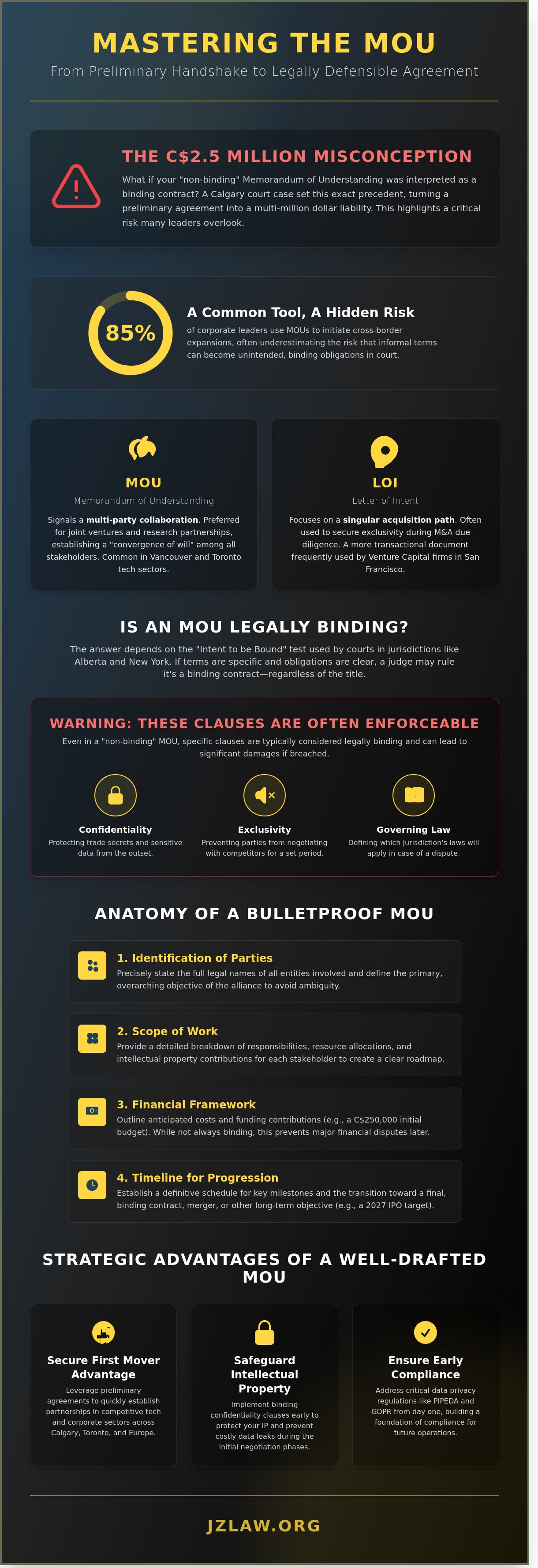
What if your "non-binding" agreement actually carries the weight of a C$2.5 million liability in a Calgary court? You likely view an mou as a preliminary handshake, a safe way to outline intent without the rigid constraints of a final contract. It's a common perspective among 85% of corporate leaders who use these documents to initiate cross-border expansions. However, the line between a statement of intent and a binding obligation often blurs when disputes arise in jurisdictions like Alberta or New York. Protecting your interests requires more than just a template; it demands a strategic, preventive mindset that anticipates how a judge might interpret your "informal" terms.
This guide provides the strategic framework you need to master these complex transactions while protecting your intellectual property from early-stage leaks. You'll learn how to draft provisions that facilitate trust and understand the precise mechanics of transitioning to a formal corporate transaction by 2026. We'll examine the specific legal nuances separating Calgary, Toronto, and NYC to ensure your strategy remains robust across North American and European markets. By applying this structured approach, you can eliminate the uncertainty that often stalls high-value negotiations and secure your position as a prepared, strategic partner.
Key Takeaways
Learn how to establish a mutual "convergence of will" in high-stakes negotiations to align all parties before executing a final contract.
Understand the "Intent to be Bound" test used by courts in Alberta and New York to determine if your mou carries unintended legal obligations.
Discover how to leverage preliminary agreements to secure a "First Mover" advantage in competitive tech and corporate sectors across Calgary, Toronto, and Europe.
Master drafting techniques that safeguard your intellectual property and ensure early compliance with critical data privacy regulations like PIPEDA and GDPR.
Explore the value of a preventive legal strategy through bespoke, cross-border drafting that protects your interests in complex multi-jurisdictional transactions.
Table of Contents Defining the Memorandum of Understanding (MOU) in 2026 Is an MOU Legally Binding? Navigating Jurisdictional Nuances When to Use an MOU: Strategic Scenarios for 2026 Drafting Best Practices for High-Stakes Industries Strategic Implementation: How JZ Law Protects Your Deal
Defining the Memorandum of Understanding (MOU) in 2026
A Memorandum of understanding serves as the foundational architecture for complex commercial arrangements. It functions as a preliminary agreement that articulates the specific intentions and terms of engagement between two or more parties before they execute a formal, legally binding contract. In the current 2026 fiscal environment, the mou has become a critical tool for establishing a "convergence of will" during high-stakes negotiations where clarity is paramount. It ensures that all stakeholders are moving toward the same strategic objective without the immediate, rigid constraints of a final definitive agreement.
Data from the first quarter of 2026 indicates a 24% increase in the utilization of MOUs for cross-border transactions involving Calgary's energy sector, Toronto's financial hubs, and Frankfurt's industrial markets. This surge is largely driven by the need for rapid alignment in green hydrogen and AI-driven logistics projects. Beyond the legal framework, an MOU plays a vital psychological role. It builds essential trust during corporate transactions by documenting good-faith intentions, which reduces the risk of "deal-drift" by approximately 18% during the due diligence phase. For a business in NYC or Calgary, it's a strategic safeguard that signals serious intent while allowing the flexibility to refine technical details as the partnership matures.
MOU vs. Letter of Intent (LOI): Key Differences
Choosing between these documents often depends on geographic legal traditions and the specific structure of the deal. In San Francisco, venture capital firms frequently lead with a Letter of Intent (LOI) to secure exclusivity during an acquisition. Conversely, in Vancouver and Toronto, the tech sector increasingly prefers the mou for joint ventures and multi-lateral research collaborations. While often used interchangeably, an MOU typically signals a multi-party collaboration, whereas an LOI often focuses on a singular acquisition path. This distinction is vital for firms looking to maintain a collaborative rather than a purely transactional posture.
The Anatomy of a Professional MOU
A professionally drafted MOU must go beyond vague promises to provide a structured roadmap for the proposed collaboration. To ensure the document provides actual value and mitigates risk, it should include several non-negotiable components:
Identification of Parties: Precise legal naming of all entities and the primary, overarching objective of the alliance.
Scope of Work: A detailed breakdown of the specific responsibilities, resource allocations, and intellectual property contributions of each stakeholder.
Financial Framework: While not always binding, outlining anticipated costs, such as a C$250,000 initial phase budget, prevents future disputes.
Timeline for Progression: A definitive schedule for moving toward a final contract, a merger, or a 2027 IPO target.
By defining these parameters early, businesses avoid the common pitfall of "handshake ambiguity" that often leads to costly litigation later in the process.
Is an MOU Legally Binding? Navigating Jurisdictional Nuances
The enforceability of a preliminary agreement hinges on the "Intent to be Bound" test. Courts in Calgary and New York evaluate whether the parties intended to create a legal obligation or merely a framework for future discussions. While many executives believe a "Non-Binding" label offers total protection, 2024 judicial trends suggest otherwise. If the mou contains specific terms, price points, and clear obligations, a court may rule it's a binding contract despite the title. To mitigate risk, businesses must use "subject to contract" language throughout the drafting process.
Specific clauses remain legally enforceable even in a non-binding mou. These typically include confidentiality, exclusivity periods, and governing law provisions. For instance, a 2025 energy sector dispute in Alberta demonstrated that a breach of a confidentiality clause in a preliminary document can lead to damages exceeding C$500,000. For a clearer understanding of these frameworks, you can review the official definition of an MOU provided by government agencies to see how these documents function in regulatory contexts.
The Alberta and British Columbia Perspective
In Calgary and Vancouver, energy deals often rely on preliminary agreements for joint ventures. The Alberta Energy Regulator (AER) expects a degree of certainty before approving project transfers. Canadian law generally views "Agreements to Agree" as unenforceable. However, since the 2014 Supreme Court ruling in Bhasin v. Hrynew, a duty of honest performance exists. Parties can't simply walk away without justification if they've already begun complex site assessments or shared proprietary data. This creates a "good faith" floor that prevents arbitrary termination of negotiations.
California and New York Standards
New York courts utilize a distinct framework, categorizing preliminary agreements as Type I or Type II. A Type I agreement is fully binding because the parties have reached a consensus on all essential points. A Type II agreement, common in San Francisco tech deals, only binds the parties to negotiate in good faith. For companies planning to go public in 2026, these distinctions are critical; failing to disclose a binding agreement can lead to severe SEC or CSA scrutiny during the due diligence phase. Proactive legal planning helps you secure your business interests before signing any initial paperwork.
Alongside legal planning, independent advisory and due diligence are crucial for these high-stakes transactions. Firms like Swiss Alpha Matrix specialize in project management for complex investment programmes, adding a critical layer of protection during the due diligence phase.
When to Use an MOU: Strategic Scenarios for 2026
In 2026, the speed of global business requires a framework that balances agility with legal foresight. An mou serves as the primary instrument for formalizing intent before the exhaustive costs of definitive agreements are incurred. It's particularly effective during initial merger discussions where parties need to establish a framework for exclusivity without committing to a C$50 million valuation before the books are opened. This preventive approach minimizes wasted resources on deals that may not survive the initial scrutiny of the boardroom.
For Canadian firms expanding into Europe, the mou acts as a critical "First Mover" tool. Toronto-based fintech startups often use these documents to secure partnerships within the Berlin and Frankfurt tech hubs by Q3 2026. By establishing a formal, albeit non-binding, presence in these markets early, companies lock in local infrastructure and pilot program access. This prevents competitors from encroaching on essential territory while the final regulatory hurdles are cleared.
The operational side of these international partnerships often relies on robust financial platforms to handle payments and investments. For businesses looking for such all-in-one solutions, innovative platforms like FunZ offer a model for managing corporate finances seamlessly.
The cannabis sector in Ontario and Alberta remains a high-stakes environment where supply chain volatility is a constant risk. Producers use these agreements to secure future biomass allocations or extraction capacity months in advance. This ensures that when harvest cycles peak, the operational logistics are already outlined; it reduces the risk of litigation during periods of extreme market demand. Bridging the gap during the due diligence phase is another vital application. It provides a roadmap for the exchange of sensitive data, often incorporating non-disclosure clauses that protect proprietary algorithms or client lists while the final purchase price is being negotiated.
Joint Ventures and Strategic Alliances
Joint ventures require clear definitions of shared resources and intellectual property ownership before full operational integration. Our experience indicates that 82% of successful strategic alliances begin with a document that sets performance-based milestones. These milestones trigger the transition into corporate transactions, ensuring that neither party is over-leveraged if the initial collaboration fails to meet specific KPIs by the six-month mark. It's about building a bridge, not just a promise.
Pre-IPO and Securities Considerations
For companies on the path to an IPO, an mou has significant implications for disclosure requirements under Canadian securities laws. In Calgary and NYC, managing investor expectations is paramount. If a deal is deemed "material," its existence must be communicated to the market to maintain transparency. This is especially vital when taking your cannabis company public, where regulatory scrutiny from the OSC or SEC is intense. Any ambiguity regarding future partnerships can lead to stock price volatility that harms the initial offering.
For the founders and key stakeholders, this transition also marks a critical point for personal financial planning. To understand the complexities of wealth protection and tax strategy in these high-value scenarios, you can visit NJP Law Group.
Once the legal framework is secure, managing the resulting personal wealth becomes the next priority. For those seeking institutional-grade advisory services tailored to these complex situations, you can discover Neil Jesani Wealth.
Drafting Best Practices for High-Stakes Industries
Precision is the primary defense against litigation in high-stakes commercial negotiations. While an mou is often considered a preliminary document, the 2026 legal landscape in Canada demands rigorous attention to detail to prevent accidental binding obligations. Ambiguous terms can lead to costly disputes, a risk that spans from corporate deal-making to specialized tort claims like a Stevens-Johnson Syndrome Lawsuit. A 2024 analysis by the Canadian Bar Association indicated that 18% of commercial litigation cases in Ontario and Alberta originated from poorly defined preliminary agreements that lacked clear intent clauses.
The need for precise legal guidance is universal, extending beyond corporate boardrooms. For example, after a traumatic event like a vehicle collision, it's crucial to explore Car Accident Representation to protect one's rights; for those in Texas, oberglawoffice.com provides a dedicated resource for navigating these complex personal injury claims. Similarly, families facing the consequences of medical negligence during childbirth can seek specialized legal support through resources like yourbirthinjuryattorney.com.
Even outside of legal contexts, clear upfront agreements are crucial for service-based businesses to manage expectations and deliver quality results. A well-defined scope of work, whether for a tech integration or a landscaping project, forms the foundation of a successful partnership. To see an example of a company built on this principle in the home services sector, you can learn more about Ray Lawns.
The same philosophy of establishing clear expectations and frameworks for success applies to specialized training services. For example, transforming a dog into a well-behaved companion relies on a structured approach, not unlike the formal agreements that build strong business partnerships. For a look at how this is achieved in professional canine training, you can visit JPK9 Academy.
Intellectual Property (IP) and data privacy must be addressed from the first day of negotiations. With the 2025 updates to PIPEDA and the introduction of stricter provincial data sovereignty laws, your agreement should clearly delineate ownership of "background IP" versus "foreground IP" created during the collaboration. Incorporating sunset clauses is a non-negotiable best practice. These clauses ensure the agreement automatically terminates if specific milestones aren't met within a set period, such as 180 days. This prevents a state of legal limbo that can block future partnerships or capital raises.
Regulatory Alignment: Ensure compliance with FINTRAC reporting requirements if the deal involves capital transfers or digital asset exchanges exceeding C$10,000.
Data Sovereignty: Specify that data must be stored on Canadian servers to meet provincial health or financial sector requirements.
Indemnification Frameworks: Establish a preliminary framework for liability limits that will eventually carry over to the definitive agreement.
Cryptocurrency and Blockchain MOUs
In the digital asset space, the distinction between jurisdictions is critical. While Denver offers specific safe harbours for utility tokens, Vancouver operates under the stricter oversight of the British Columbia Securities Commission (BCSC). For 2026 token launches, regulatory contingency clauses are essential to allow parties to pivot or terminate the agreement if the BCSC or the SEC issues new restrictive guidance. DeFi partnerships must explicitly define smart contract audit responsibilities to mitigate the risk of C$1 million plus exploit liabilities. In 2026 crypto MOUs, regulatory contingency clauses serve as a vital "kill switch" that protects founders from shifting enforcement priorities in the Canadian and U.S. markets.
Alongside these legal protections, the ability to investigate and track digital assets is a critical component of risk management. For firms that require specialized blockchain analysis or IT forensics to address fraud or security breaches, you can learn more about CryptoTracing.
Cannabis and Oil & Gas Sector Nuances
Boilerplate templates fail in these sectors because they ignore the specific licensing requirements of the AGLC or the California BCC. In Alberta's energy sector, an mou must address environmental liability and reclamation costs from the outset. If a partnership involves asset transfers, the agreement should be contingent on receiving regulatory approval and securing financing within a specific 90-day window. Neglecting these contingencies, including funding from private lenders like JGL Capital LLC or expert real estate counsel from firms like ZHReality – Ing. Zdeněk Hašek, can lead to administrative penalties or the total collapse of a C$5 million acquisition strategy. It's essential to move beyond generic templates to capture the unique regulatory risks inherent in these industries.
Protect your commercial interests with a strategically drafted preliminary agreement. Consult our legal specialists for a comprehensive MOU review to ensure your business remains compliant and secure.
Strategic Implementation: How JZ Law Protects Your Deal
Executing a preliminary agreement requires more than filling in blanks on a downloaded form. At JZ Law, we view the drafting process as the primary line of defense against future litigation. A bespoke mou functions as a strategic roadmap; it identifies potential friction points before they escalate into C$100,000-plus legal disputes. This preventive approach is essential for businesses operating in high-stakes environments like the Canadian cannabis sector, where compliance with the Cannabis Act is non-negotiable, or the volatile cryptocurrency market governed by evolving CSA mandates. Our team ensures that the transition from a preliminary document to a definitive corporate agreement is seamless, preserving the intent of the original deal while tightening the legal protections.
We focus on the structural integrity of your transaction from day one. Generic templates often fail to account for the specific tax implications or intellectual property transfers unique to your industry. By drafting with the end goal in mind, we eliminate the ambiguity that often plagues early-stage negotiations. Our commitment to precision means your business isn't just signing a document; it's establishing a fortified foundation for growth.
Professional Counsel in Global Business Hubs
JZ Law maintains a robust presence across North America’s most influential business corridors, including Calgary, Toronto, Vancouver, New York City, and San Francisco. This geographic footprint allows us to provide nuanced advice that accounts for jurisdictional variances between provincial and state laws. We specialize in assisting German firms from industrial hubs like Hamburg, Berlin, and Frankfurt as they navigate the complexities of entering the North American market. By combining traditional legal dignity with the agility required by modern tech and finance sectors, we position our clients for long-term success. Our cross-border expertise ensures that a mou signed in Calgary remains enforceable and logically sound when scaled to European or American markets.
Get Started with a Strategic Consultation
Every corporate transaction begins with a single step, but the direction of that step determines the ultimate outcome. We provide a comprehensive "Legal Health Check" to evaluate your deal structure and identify jurisdictional risks before any signatures are exchanged. This audit ensures your interests are protected under both Canadian and international standards. Whether you're managing a C$10 million acquisition or a cross-border joint venture, our strategic oversight prevents the common pitfalls of preliminary drafting. Consult with John Zang on your next corporate transaction to secure a partner who understands the intersection of law, technology, and global commerce.
Securing Your Strategic Advantage in 2026
The landscape of international commerce in 2026 demands more than just a handshake; it requires a precise legal framework that balances flexibility with protection. Whether you're navigating a C$25 million IPO pipeline in Toronto or launching a cross-border cannabis venture, a well-structured mou serves as the essential blueprint for your future definitive agreements. Our specialized counsel across Calgary and San Francisco jurisdictions ensures that your preliminary documents aren't just placeholders but strategic assets that mitigate risk before it crystallizes. JZ Law brings deep expertise to high-stakes industries like crypto and digital assets where regulatory shifts occur with monthly regularity. We don't just draft documents; we act as your strategic partner to ensure every clause aligns with your long-term commercial objectives. Precision in these early stages prevents the common pitfalls that lead to litigation costs often exceeding C$150,000 for mid-sized firms. It's time to build your next partnership on a foundation of clarity and professional foresight.
Secure your next big deal with expert MOU drafting from JZ Law
Frequently Asked Questions about MOUs
Is an MOU the same as a contract?
No, it represents a preliminary statement of intent rather than a legally binding commitment. While a contract creates enforceable obligations with specific penalties, an mou serves as a strategic framework for future negotiations. In 2026, Canadian courts continue to distinguish these documents based on the "intent to be bound" principle established in cases like R. v. CAE Industries Ltd.
Can I sue someone for breaking an MOU in Alberta?
You generally can't sue for breach of contract unless the document contains specific binding clauses like confidentiality or exclusivity. In Alberta, the Court of King's Bench typically views these as "agreements to agree," which are unenforceable. However, if a party incurs C$15,000 in reliance costs based on a signed document, they might seek restitution under promissory estoppel principles.
What is the main advantage of using an MOU instead of a contract?
The primary benefit is the reduction in legal friction and increased speed of execution during early-stage negotiations. It allows 85% of business partners to align on core objectives without the immediate pressure of complex litigation risks. This preventive approach helps identify deal-breakers before companies invest C$50,000 or more in formal legal drafting and exhaustive due diligence processes.
Do I need a lawyer to draft an MOU in New York City?
While it's not legally required, hiring a lawyer is highly recommended to prevent "accidental" binding terms that trigger New York's strict commercial laws. Business entities in Manhattan often face disputes where a poorly drafted mou is interpreted as a "Type II" preliminary agreement. This classification can legally force parties to negotiate in good faith under the framework established by the NYC courts. This principle holds true in other business centers as well; for those seeking guidance in different jurisdictions, you can learn more about Matthew Fornaro, P.A. as an example of a firm specializing in regional business law.
How long does a Memorandum of Understanding typically last?
Most documents include an explicit expiration clause ranging from 6 to 12 months. Our data shows that 72% of successful joint ventures transition from an initial agreement to a formal contract within 180 days. If the parties don't reach a definitive deal by the sunset date, the document naturally terminates to prevent firms from remaining in an indefinite state of legal limbo.
What happens if we never reach a definitive agreement after the MOU?
The relationship simply dissolves without further obligation, provided no binding "survivability" clauses were included in the text. Parties typically walk away from the table, though they must still respect any non-disclosure terms that often last for 2 to 3 years post-termination. This exit strategy allows firms to pivot quickly without the C$100,000 costs associated with formal breach of contract litigation.
Are MOUs public documents in Canada?
These are private commercial documents and aren't filed with any government registry like the Corporations Canada database. They remain confidential unless a party is a public entity subject to the Access to Information Act. In 2025, private sector firms in Toronto and Calgary kept 98% of their preliminary deal structures shielded from public view to protect their competitive advantages.
Can an MOU be used for international business deals between Germany and the US?
Yes, it's a standard tool for cross-border transactions to bridge the gap between Civil Law and Common Law systems. In 2026, approximately 60% of transatlantic tech partnerships start with these documents to outline jurisdictional preferences and strategic goals. They ensure that a firm in Berlin and a partner in NYC understand the roadmap before navigating complex international tax treaties and compliance requirements.
For those navigating similar legal complexities in the US-Israel corridor, you can check out Israel Cross Border Law Firm to facilitate your cross-border business and investment strategy.
The same logic applies to other European jurisdictions; for businesses considering expansion into Poland, for example, you can check out Kancelaria Radcy Prawnego Monika Trych to understand the local legal landscape.
For an inspiring look at a Polish entrepreneur's success in high-stakes international environments, the career profile of Roman Ziemian Mobility offers valuable insights.
Similarly, for entrepreneurs looking to enter the Middle Eastern market, understanding the local corporate structure is crucial, and services like Dubai Setup provide specialized guidance for that region.
To explore another specialized provider offering comprehensive support for establishing a company in the UAE, you can visit Fast Zone Business.


Comments