


AGCO Cannabis Retail Application Guide: Strategic Legal Licensing in Ontario
Securing approval to open a dispensary in Ontario isn't an administrative checklist exercise; it's a high-stakes corporate structuring challenge. You already know that commercial landlords won't pause lease obligations while your file sits in regulatory limbo. Waiting months on AGCO background checks or stumbling over complex disclosure mandates can quickly drain working capital before your doors ever open. This AGCO cannabis retail application guide provides the strategic roadmap you need to streamline the process, protect your commercial investments, and eliminate debilitating licensing delays.
Ahead, we break down the mandatory licensing triad of Retail Operator Licences (ROL), Retail Store Authorizations (RSA), and management requirements, alongside the strict 150-metre school buffer rules and municipal authorities that govern your retail footprint. You'll gain a clear blueprint for vetting your corporate structure, managing public notice hurdles, and advancing from initial filing to fully authorized operation with disciplined legal precision.
Table of Contents
Understanding the AGCO Cannabis Retail Framework: Mandatory Licences
Step-by-Step Corporate Structuring and iAGCO Application Process
Real Estate Selection, Municipal Zoning, and Public Notice Strategy
Store Buildout, Physical Security Standards, and Pre-Opening Inspection
Long-Term Regulatory Compliance and Corporate Expansion Strategies
Understanding the AGCO Cannabis Retail Framework: Mandatory Licences
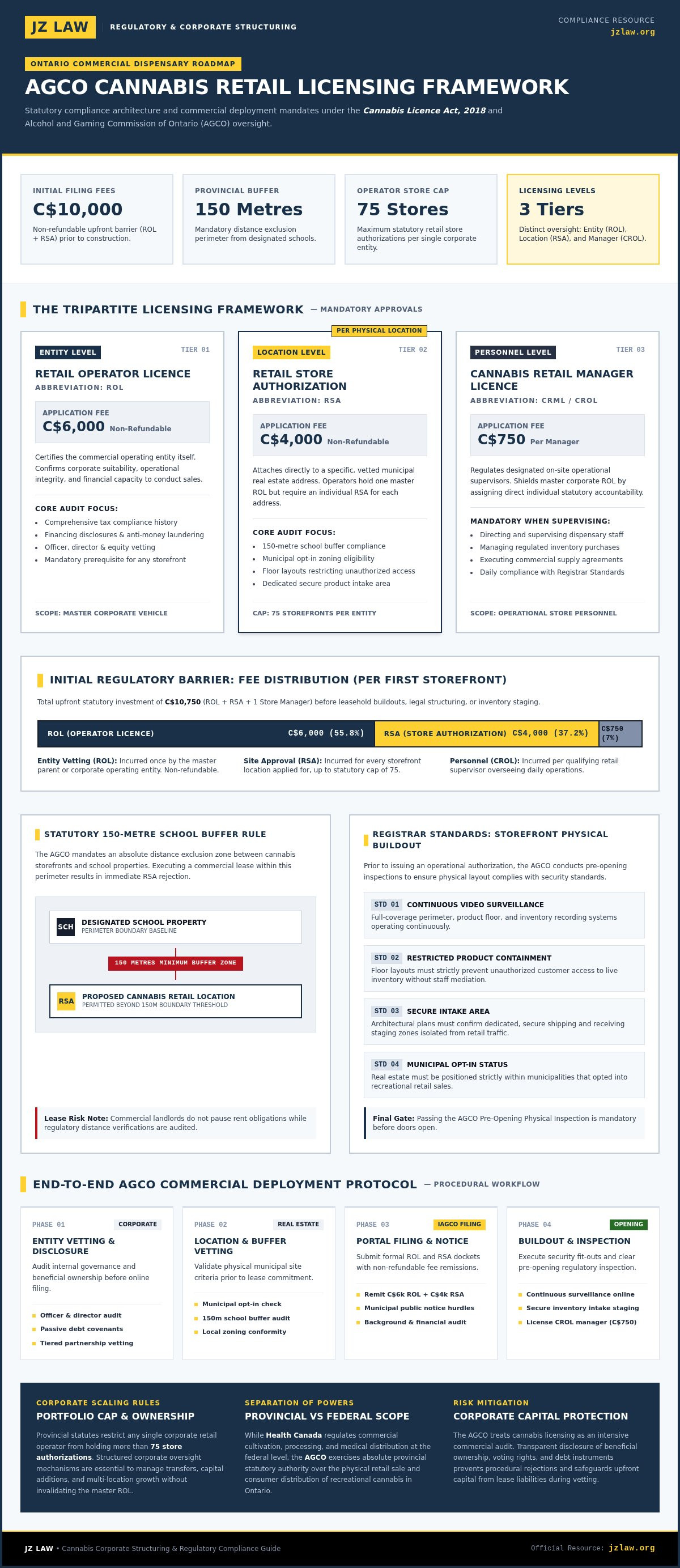
Commercial cannabis sales in Ontario operate under the statutory authority of the Alcohol and Gaming Commission of Ontario (AGCO), pursuant to the Cannabis Licence Act, 2018. Unlike federal regimes administered by Health Canada, which govern commercial cultivation, processing, and medical sales, the provincial framework strictly regulates the retail sale and distribution of recreational product to consumers. Navigating this landscape requires understanding that the regulator enforces a three-part structure. Commercial applicants must obtain distinct approvals for the operating entity, the physical store, and key personnel. In this AGCO cannabis retail application guide, we break down how these regulatory instruments function together so you can prevent procedural rejections.
While an individual can legally apply as a sole proprietor, commercial scale operators overwhelmingly utilize incorporated entities. A corporate structure limits commercial liability, facilitates outside capital, and accommodates complex shareholding arrangements. Understanding the broader evolution of Cannabis in Ontario demonstrates why the AGCO evaluates corporate governance so rigorously: the regulator must ensure that behind every corporate entity sits a transparent, compliant ownership group.
Retail Operator Licence (ROL) Requirements
The Retail Operator Licence (ROL) certifies the legal entity itself, confirming its operational integrity, financial suitability, and general competence to retail cannabis. Corporate applicants must submit to extensive background reviews, including full tax compliance history and corporate financing disclosures. The initial application fee stands at C$6,000, which is non-refundable. Securing this licence is the mandatory prerequisite before opening any retail location, making early corporate vetting vital for multi-store scaling.
Retail Store Authorization (RSA) Mechanics
A Retail Store Authorization (RSA) attaches directly to a specific, vetted municipal address. While an operator holds one ROL, each physical storefront requires its own RSA alongside a non-refundable C$4,000 application fee. Under provincial rules, no single corporate retail operator may hold more than 75 store authorizations. Additionally, each proposed site must meet strict operational criteria:
Full compliance with municipal zoning and mandatory distance buffers.
Floor layouts that restrict unauthorized customer access to inventory.
Approved architectural plans confirming dedicated, secure product intake areas.
Cannabis Retail Manager Licence (CROL) Oversight
The Cannabis Retail Manager Licence (CRML or CROL) governs individuals with on-site accountability. It carries a C$750 application fee. Any individual who directs dispensary staff, manages inventory purchases, or enters into customer-facing commercial supply agreements must hold this certification. By distinguishing executive leadership under the ROL from physical store supervisors through the CROL, the AGCO holds both owners and on-site staff directly responsible for regulatory compliance. Strategic operators often utilize this AGCO cannabis retail application guide framework to establish internal compliance policies, shielding the master corporate licence from frontline operational violations.
Step-by-Step Corporate Structuring and iAGCO Application Process
Treating cannabis licensing as a simple administrative filing is the primary reason dispensary ventures run into dead ends. Under the statutory framework outlined in the official AGCO Cannabis Retail Regulation Guide, the regulator treats an application as an intensive commercial audit. Every dollar of equity, corporate debt instrument, and officer background undergoes exhaustive anti-money laundering and suitability checks. Approaching this process through a structured corporate transaction mindset protects your initial C$10,000 regulatory filing fees and prevents long delays before store construction begins.
Entity Vetting and Beneficial Ownership Disclosure
Before creating an online filing, companies must conduct comprehensive audits of their internal governance. The AGCO demands clear visibility into anyone exercising direct or indirect control over the business. This includes directors, officers, substantial equity holders, and passive debt providers funding your commercial buildout. Applying proven frameworks for strategic corporate transactions ensures that debt covenants, voting rights, and tiered parent company models remain transparent and defensible under regulatory review.
Navigating iAGCO Portal Procedural Submissions
All filings run exclusively through the provincial iAGCO digital portal. Rushing an incomplete filing leads to immediate delays. A clean submission package requires thorough preparation across several distinct operational categories:
Constitutional filings, including Articles of Incorporation, comprehensive corporate profile reports, and current director registers.
Unanimous shareholder agreements defining voting thresholds and management rights.
Personal and Entity History Disclosures (PHDs and EHDs) accompanied by clear tax compliance records.
Audited bank statements, loan agreements, and institutional underwriting files proving legitimate source of funds.
Strategic operators often submit the corporate ROL and initial RSA packages simultaneously once site control is secured, minimizing the time commercial real estate sits idle while waiting for approval.
Responding to AGCO Regulatory Inquiries and Audits
Once you lodge your submission, the AGCO issues formal Requests for Information (RFIs) to probe ambiguous share transfers, complex funding layers, or foreign capital injections. These statutory inquiries arrive with strict response windows. Missing a deadline or providing contradictory explanations can prompt the Registrar to propose an application refusal. Establishing a rigorous compliance trail from day one ensures inquiries receive precise, documented responses. If your corporate ownership involves complex cross-jurisdictional entities or institutional private equity, retaining experienced legal counsel through JZ Law provides the strategic oversight needed to resolve regulatory scrutiny and protect your commercial runway.
Real Estate Selection, Municipal Zoning, and Public Notice Strategy
Securing a retail address is often the most financially hazardous phase of dispensary licensing. Ontario municipalities retain statutory power under provincial rules to opt out of commercial retail sales entirely. Signing an unconditional commercial lease in an ineligible township or inside an excluded zone can permanently strand your capital. Beyond municipal eligibility, every location must comply with strict Ontario cannabis laws, requiring strategic site selection before filing the Retail Store Authorization.
Municipal Opt-Outs and Zoning Diligence
Municipal opt-out decisions dictate viable trade areas across the province. Even within participating municipalities, applicants must confirm that target storefronts satisfy provincial buffer rules. Ontario mandates that retail stores remain at least 150 metres away from schools. This distance is calculated from property boundary to property boundary, not front door to front door. Failing to audit surrounding parcels against active educational institutions or registered private facilities creates immediate grounds for application refusal. Integrating specialized counsel in real estate law ensures that property rights, municipal variances, and land-use restrictions align before committing equity.
Drafting Protective Commercial Lease Clauses
Landlords typically demand multi-year commitments with fixed rent schedules. Commercial tenants, however, cannot legally distribute cannabis until the AGCO issues an RSA. Applying this AGCO cannabis retail application guide strategy requires structuring conditional retail leases with specific protective covenants:
Licensing Contingency: Explicit clauses permitting lease termination without penalty if the Registrar denies the RSA application.
Abated Rent Intervals: Staged base rent structures during regulatory review periods, limiting carrying costs before sales commence.
Buildout and Signage Covenants: Clear authorization to install heavy security vaults, privacy films, and exterior surveillance infrastructure.
Managing the 15-Day Public Notice Process
Upon initial processing of your RSA application, the AGCO triggers a mandatory 15-day public notice period. The applicant must physically display a large, visible placard on the storefront exterior to notify the surrounding community. Local residents, businesses, and municipal officials may submit formal written objections directly to the Registrar during this window. These submissions must center on public interest criteria, such as public health, community safety, youth protection, or illicit market activity. When local objections arise, drafting concise, legally grounded rebuttals detailing your security controls and compliance mechanisms often determines whether the Registrar issues the authorization or initiates formal hearings.
Store Buildout, Physical Security Standards, and Pre-Opening Inspection
Transforming an authorized commercial space into an active dispensary requires strict adherence to the AGCO Registrar's Standards for Cannabis Retail Stores. Passing regulatory scrutiny isn't merely about interior design; it demands building an environment that actively prevents product diversion and restricts minor access. Construction timelines must integrate these technical mandates early, as technical deficiencies identified during the site inspection will stall retail openings, triggering unnecessary carrying costs.
Perimeter Security and High-Definition Video Surveillance
The AGCO enforces precise physical security requirements across the entire commercial footprint. Dispensary operators must install a commercial-grade, monitored intrusion alarm system alongside a closed-circuit surveillance network operating 24 hours a day. All video recordings must be retained for a minimum of 30 days. Cameras must deliver clear, high-resolution coverage across several critical vantage points:
All interior point-of-sale registers and product consultation zones.
The complete perimeter of secure back-office storage rooms and perimeter doors.
Receiving bays, inventory loading docks, and exterior client entryways.
Product Vault and Secure Storage Requirements
All cannabis stock, including samples and returns, must remain completely shielded from off-hours access. Retailers must build a reinforced, locked storage vault that remains restricted exclusively to authorized personnel. AGCO standards require that no cannabis inventory be visible from the street exterior, demanding frosted or opaque treatments on street-facing windows. Additionally, strict standard operating procedures (SOPs) must govern daily product counts, employee badge entry logs, and secure delivery intake protocols to prevent employee theft or inventory discrepancies.
The Final AGCO Pre-Opening Inspection Walkthrough
Before issuing your operational authorization, an AGCO Compliance Official conducts an on-site inspection of the completed dispensary. The inspector tests every physical security mechanism, evaluates compliance with permitted operating hours of 9:00 a.m. to 11:00 p.m., reviews mandatory employee CannSell certifications, and audits Point-of-Sale (POS) systems for batch-tracking integrity. Unresolved hardware failures or layout deviations from your approved plans will prompt an inspection failure. Following a strategic cannabis licensing review before booking your walk-through ensures all physical assets satisfy regulatory standards on the first pass, securing your official Retail Store Authorization seal without operational delays.
Long-Term Regulatory Compliance and Corporate Expansion Strategies
Securing your initial store authorizations represents only the foundational phase of commercial operations. Maintaining operational standing requires continuous regulatory vigilance and rigorous corporate maintenance. Ontario's open-market retail environment presents intense competition, making disciplined multi-unit scaling essential for long-term commercial viability. This AGCO cannabis retail application guide outlines how operators can systematically manage corporate expansion, regulatory reporting, and portfolio transactions without triggering administrative sanctions.
Ongoing Reporting and Statutory Audits
Operating authority demands strict operational transparency. Licensees must submit monthly regulatory reports to the AGCO tracking inventory receipts, customer sales volumes, and on-site destruction records. In addition to inventory accounting, operators must notify the Registrar of any material corporate alterations. Appointing a new corporate director, issuing new classes of shares, or shifting equity allocations requires prompt disclosure. Our comprehensive cannabis licensing guide details the governance standards required when updating ownership records across commercial hubs.
Navigating Commercial Promotion and Inducement Prohibitions
Marketing and supply arrangements face stringent statutory limitations. Provincial standards explicitly prohibit licensed retailers from accepting material inducements, shelf-space rental fees, or exclusive distribution agreements from licensed producers. Commercial agreements must withstand intensive regulatory scrutiny. Marketing campaigns must also comply with federal promotional constraints:
Prohibitions against lifestyle advertising, celebrity endorsements, or depictions of persons, characters, or animals.
Bans on promotional pricing models that associate cannabis consumption with glamour, recreation, or risky behaviour.
Strict age-gating mechanisms across all customer-facing digital assets, delivery menus, and brand marketing channels.
Securing Strategic Counsel for Multi-Store Portfolios
Scaling toward Ontario's 75-store cap frequently involves asset purchases, share transactions, and corporate restructurings. Transferring an existing Retail Store Authorization incurs a one-time C$1,000 regulatory fee and requires formal AGCO approval to verify that the acquiring entity satisfies suitability criteria. Additionally, operators must account for recurring operational costs, including licence renewals: an ROL renewal requires C$2,000 for two years or C$4,000 for four years, while each RSA renewal costs C$3,500 for two years or C$7,000 for four years. Structuring institutional debt refinancing, secondary capital raises, or multi-unit mergers demands sophisticated corporate counsel to ensure transaction terms protect operational licences, eliminate shareholder liabilities, and safeguard enterprise equity as your retail footprint expands.
Execute Your Retail Cannabis Licensing Strategy
Launching an authorized dispensary in Ontario requires far more than basic portal submissions. Success demands robust corporate structuring, airtight commercial lease protections, and precise adherence to physical security standards. By applying this AGCO cannabis retail application guide, you can anticipate regulatory inquiries, protect your commercial lease commitments, and move through the licensing pipeline without costly delays.
Navigating these regulatory frameworks requires experienced legal insight. Backed by a decade of high-stakes corporate and regulatory experience, JZ Law provides a boutique strategic focus on complex commercial licensing, cross-border structuring, and corporate transactions across Toronto and key commercial hubs. Consult JZ Law for strategic cannabis licensing counsel to structure your corporate disclosures, negotiate protective lease covenants, and position your retail business for durable commercial growth.
Frequently Asked Questions
What is the primary difference between an AGCO ROL and an RSA in Ontario?
A Retail Operator Licence (ROL) evaluates and authorizes the corporate business entity, whereas a Retail Store Authorization (RSA) licenses the physical retail storefront location. Holding an ROL confirms an operator's character, financial integrity, and regulatory suitability across Ontario. An RSA attaches directly to a vetted municipal address, requiring its own layout review, public notice period, and local zoning adherence. You need both to sell recreational cannabis legally.
How long does the complete AGCO cannabis retail application process take from submission to approval?
Total processing timelines generally range from several weeks to a few months, largely determined by corporate complexity and background check depth. Mandatory milestones include the statutory 15-day public notice placard period and an on-site pre-opening inspection walkthrough. Corporate restructuring, delayed RFI responses, or foreign investment layers can extend timelines significantly. Following an established AGCO cannabis retail application guide helps streamline documentation submissions, ensuring files move smoothly through the iAGCO portal without procedural stalls.
Can a corporation with foreign shareholders or investors obtain an AGCO cannabis licence?
Yes, corporations with foreign shareholders, non-resident directors, or international parent entities can qualify for provincial cannabis licensing in Ontario. However, the AGCO enforces comprehensive disclosure rules across all beneficial owners holding significant equity or debt. Foreign principals must submit complete personal background declarations, extraterritorial tax compliance documents, and clean source-of-funds verifications. Coordinating multi-jurisdictional legal and corporate finance structures ensures cross-border capital satisfies Canadian anti-money laundering and provincial suitability mandates.
What are the minimum distance buffer requirements for cannabis stores near Ontario schools?
Under provincial regulations, every retail cannabis store in Ontario must sit at least 150 metres away from school properties. The AGCO calculates this buffer by measuring the shortest linear path between property boundaries, rather than storefront entrances. While municipalities can't widen this distance through local zoning, some regional councils adopt specific municipal policy statements regarding parks or civic centres. Conducting rigorous municipal property audits protects retail applicants from securing invalid commercial real estate.
Is it legally possible to appeal an AGCO decision if a retail store authorization is refused?
Yes, applicants can challenge proposed licensing refusals before an independent administrative tribunal. If the AGCO Registrar issues a Notice of Proposal to refuse, revoke, or suspend an authorization, the applicant may appeal to the Licence Appeal Tribunal (LAT). Appeals require lodging formal grounds within strict statutory timeframes. Success at the LAT depends on presenting clear evidence demonstrating that operating the store aligns with public interest, local safety, and statutory integrity criteria.
What corporate records and financial documentation must applicants disclose to the AGCO?
Applicants must provide complete transparency regarding their corporate capitalization, governance, and financing. Key documentation includes Articles of Incorporation, shareholder registers, audited financial statements, commercial leases, and corporate tax compliance certificates. Every key director, officer, and major shareholder must also submit personal disclosure filings detailing criminal records, asset sources, and credit history. Applying this AGCO cannabis retail application guide framework ensures all commercial filings remain audit-ready for regulatory evaluators.


Comments