


Cross-Border Corporate Structuring in Frankfurt: Protecting Private-Company Investor Rights
The entity that looks simplest on paper may leave investor rights fragmented across jurisdictions. In cross-border corporate structuring Frankfurt, the key question is not only where to form a company. It is also which jurisdiction’s rules and documents will shape voting, information, transfer, and exit rights when important decisions arise.
That uncertainty is understandable: a structure may involve a German operating company, foreign investors, and agreements prepared under different legal systems. The protections investors expect may not be reflected consistently across those documents, and enforceability requires careful, jurisdiction-specific review. A sound approach treats structuring as a strategic transaction decision, not simply an incorporation exercise.
This article offers a practical framework for comparing possible structures and identifying where core investor protections should be documented. It also explains why governance documents need to work together and how to coordinate Canadian, German, and other relevant legal advice. With qualified German counsel reviewing local-law issues, investors and founders can assess their options more clearly and identify appropriate next steps.
Table of Contents
Why Cross-Border Corporate Structuring in Frankfurt Needs Investor Rights Considered Early
How Entity Choice and Governance Documents Shape Investor Protections
Comparing Cross-Border Structures for a Frankfurt-Linked Private Company
A Due-Diligence Checklist for Investor Rights and German-Law Coordination
How JZ Law Can Support a Frankfurt-Linked Corporate Structuring Review
Why Cross-Border Corporate Structuring in Frankfurt Needs Investor Rights Considered Early
Founders and investors face two connected decisions: how to arrange the business across jurisdictions, and how to document governance so ownership and decision-making are clear. Treating these as separate steps can leave important expectations unaddressed. Cross-border corporate structuring Frankfurt matters because a company’s location, ownership, operations, and governing documents may point to different legal systems.
Cross-border corporate structuring is the arrangement of a company’s ownership, operations, and decision-making across more than one jurisdiction. A Frankfurt connection alone does not determine which law governs every issue or which legal form best fits the business. German company forms and governance principles provide useful context, as outlined in this German company law overview, but specific German-law conclusions should be checked with qualified German counsel.
What counts as a Frankfurt-linked cross-border company?
A business may operate from Frankfurt without being incorporated in Germany. It may instead have a German-incorporated entity, a foreign parent, or operations and investors spread across several countries. These distinctions matter: a Frankfurt operating location does not by itself establish the company’s place of incorporation or resolve which documents and laws apply to a particular decision.
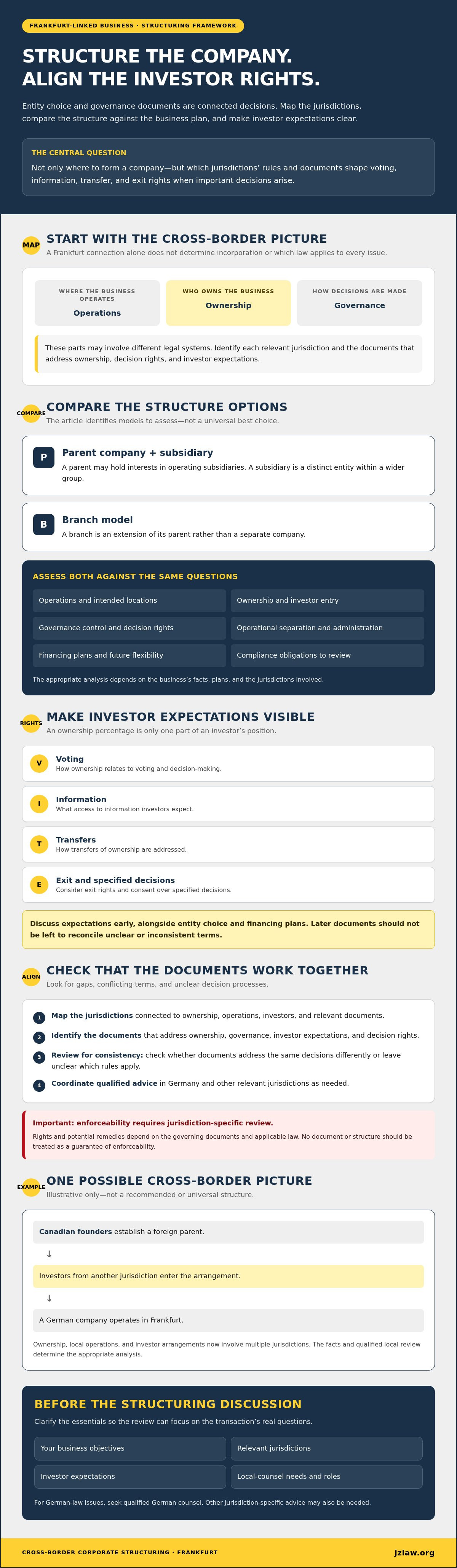
Hypothetical example: Assume Canadian founders establish a foreign parent, bring in investors from another jurisdiction, and operate through a German company in Frankfurt. Ownership, local operations, and investor arrangements now involve multiple jurisdictions. This is an illustration, not a recommended or universal structure. The appropriate analysis depends on the facts and qualified local review.
Why investor rights belong in the initial structuring discussion
An ownership percentage is only one part of an investor’s position. The parties should consider how it relates to voting, access to information, transfers of ownership, and consent over specified decisions. Discussing expectations early allows the parties to assess them alongside entity choice and financing plans, rather than leaving later documents to reconcile them.
Problems can arise when governance documents use inconsistent terms, address the same decision differently, or leave unclear which jurisdiction’s rules apply. That uncertainty may create avoidable disagreement over who can act and what process should be followed. Rights and potential remedies depend on the governing documents and applicable law. No document or structure should be treated as a guarantee of enforceability.
For a Frankfurt-linked venture, start by identifying the jurisdictions involved, the intended ownership and operating arrangements, and the investor decisions that need clear treatment. Qualified German counsel should verify German-law questions, and advice in other relevant jurisdictions may also be needed. Early coordination helps make the structure and its governance documents part of one deliberate transaction plan.
How Entity Choice and Governance Documents Shape Investor Protections
Entity selection shapes how ownership, operations, and financing are organized, but no model is automatically best for every Frankfurt-linked business. At a high level, a parent company may hold interests in operating subsidiaries; a subsidiary is a distinct entity within a wider group; and a branch is an extension of its parent rather than a separate company. The legal consequences depend on the jurisdictions involved and should be assessed against the business’s actual plans.
Consider intended operating locations and assets, who will own the business, how it may seek financing, and which compliance obligations need review. A structure designed without those factors in view may be difficult to adapt as the company grows or brings in investors. Cross-border planning may also require review of regulatory considerations, including Germany’s foreign direct investment (FDI) screening regime. Qualified counsel should assess whether and how it applies to the proposed transaction.
Investor protections can arise from applicable law as well as company documents and negotiated contracts. The distinction matters: constitutional documents set foundational rules for the company, while an investor agreement records negotiated arrangements among its parties. Review their terms together. Do not assume they operate identically or that one overrides another.
Which documents should investors and founders review?
Start with the articles or equivalent constitutional documents, shareholder agreements, and investment terms. Compare them with ownership records and transaction documents to confirm that shareholdings, decision-making provisions, and agreed financing terms align. For a German entity, confirm terminology, formalities, and the effect of each document with qualified German counsel. Translated labels alone may not capture a document’s legal function.
Which investor protections may need explicit treatment?
Identify which decisions require ordinary approval, a higher voting threshold, or specific investor consent. Depending on the entity and applicable law, the parties may also wish to examine board participation, information access, transfer restrictions, dilution provisions, exit mechanics, and dispute processes. These are discussion points, not rights that will necessarily be available in every structure.
For each proposed protection, ask who holds it, what event activates it, which document records it, and how it interacts with the rest of the governance framework. Availability, drafting, and enforceability vary by entity and governing law, so local review is essential before relying on any provision. If you are assessing cross-border corporate structuring Frankfurt, a preliminary discussion about corporate transaction and tax structuring objectives may help clarify which jurisdictions and advisers need to be involved. JZ Law lists these as service areas. Confirm its role in the matter and any German-law coordination before engagement. Explore corporate transaction and tax structuring services.
Comparing Cross-Border Structures for a Frankfurt-Linked Private Company
For cross-border corporate structuring Frankfurt, compare structural models against the company’s intended operations, ownership, investor expectations, and financing plans. The table below is a conceptual framework, not a legal recommendation. Actual governance, registration, liability, and tax consequences depend on the specific entities, jurisdictions, and facts, and require coordinated advice from qualified local counsel.
When might a parent-and-subsidiary model merit consideration?
Ask advisers whether separating group ownership from Frankfurt operations fits the business’s commercial plans. Examine where investors would enter, which entity would hold key operations, and how governance and future financing would work across the group. Treat these as matters for fact-specific review, not as presumed tax, liability, or regulatory advantages. JZ Law’s strategic corporate transactions guide offers broader transaction context for that assessment.
When might a branch or simpler arrangement be evaluated?
A branch is not the same as a separately incorporated subsidiary. Whether it merits consideration depends on planned local activity, risk allocation, ownership expectations, and financing needs. Before comparing options, ask qualified advisers to verify applicable legal, tax, registration, and liability consequences in each relevant jurisdiction. An arrangement that appears administratively simpler should still be tested against investor requirements and the company’s longer-term plans.
Tax outcomes cannot be determined from a structure’s label alone. They depend on the facts and relevant jurisdictions, so coordinate tax and legal analysis before settling on a model or documenting investor arrangements.
A Due-Diligence Checklist for Investor Rights and German-Law Coordination
A disciplined review turns cross-border corporate structuring Frankfurt from a broad planning question into issues advisers can assess. Work through the steps in sequence, recording the evidence available and the questions that still require jurisdiction-specific advice.
Map the jurisdictions. List where the company is formed, where it operates, and where its investors, founders, and material assets are located.
Confirm ownership. Compare the current ownership chart and capitalization table with incorporation records and any investment or financing terms.
Review the documents together. Gather constitutional documents, shareholder arrangements, financing documents, and relevant transaction records. Check for inconsistent ownership details or decision-making terms.
Identify gaps. Record investor expectations, voting and consent rights, information access, financing plans, and intended exit pathways. Note where documents are silent, unclear, or inconsistent.
Obtain local advice. Ask qualified counsel in each relevant jurisdiction to assess the applicable law and proposed documents before implementation.
What information should a company prepare for its advisers?
Prepare ownership charts, incorporation records, cap tables, financing terms, and existing governance documents. Add a list of relevant jurisdictions, operating locations, investors, and material assets. Keep confirmed facts separate from assumptions, particularly where legal or tax treatment has not yet been verified—engaging cross-border tax and regulatory specialists like CiDATax SRL can help evaluate multi-jurisdiction obligations early. This gives advisers a clearer basis for identifying questions that need local review.
How should investors test whether rights are practical?
For each proposed right, establish who can exercise it, what triggers it, and how notice must be delivered. Then examine available remedies and dispute procedures under the relevant governing law. A right that is vague about process may be harder to rely on when a decision is time-sensitive. Coordinate German counsel with advisers in other jurisdictions before finalizing or implementing the arrangements.
Where a German entity or filing is involved, ask qualified German counsel to verify whether references to the German Commercial Register, entity law, or specific registration steps are relevant and accurate for the proposed structure. Do not rely on a translated document or a general checklist as confirmation of a German-law requirement.
JZ Law lists corporate transactions and tax structuring among its services, but its current role in a Frankfurt-linked matter and any German-law coordination should be confirmed before engagement. To discuss your objectives, jurisdictions, investor expectations, and local-counsel needs, discuss your cross-border objectives with JZ Law.
How JZ Law Can Support a Frankfurt-Linked Corporate Structuring Review
A review of cross-border corporate structuring Frankfurt should connect transaction objectives with ownership, governance, and tax considerations across the jurisdictions involved. JZ Law identifies corporate transactions and tax structuring among its services, and lists Hamburg, Berlin, Frankfurt, Calgary, Toronto, Vancouver, New York City, and Denver among its geographic locations. These listings do not establish a Frankfurt office or qualification to practise German law. Before engagement, confirm the firm’s precise role and how any German-law work would be handled with qualified local counsel.
An initial discussion can help establish the scope of the issue before specific steps are considered. Be prepared to outline the company’s objectives, the parties and their roles, the jurisdictions involved, investor expectations, relevant documents, and unresolved questions. This helps clarify whether the matter calls for transaction-focused analysis, tax structuring discussion, German-law review, or advice from other local professionals.
What to clarify before retaining cross-border counsel
Confirm the adviser’s role, professional qualifications, jurisdictions covered, and proposed local-counsel arrangements. Ask how corporate transaction and tax questions will be coordinated, and who will address German-law issues. Before proceeding, seek clarity on the engagement’s scope, expected deliverables, conflicts checks, and communication arrangements. These points establish how responsibilities will be divided without assuming that one adviser covers every jurisdiction.
If the structure involves entities intended to hold commercial property, the relevant issues may also include how those assets fit within the wider ownership and transaction plan. JZ Law’s commercial real estate law guide may provide useful context for that separate consideration. It is relevant only where property-holding entities form part of the proposed arrangement.
What happens after the initial structuring discussion?
The next step may be to organize agreed objectives and open questions into a jurisdiction-by-jurisdiction work plan. That plan can identify which documents need review, which terms may require alignment, and where local counsel should provide jurisdiction-specific input. The appropriate scope depends on the matter and should be confirmed before any work begins.
JZ Law’s listed experience in corporate transactions and tax structuring may be relevant to a preliminary discussion about the business’s priorities and adviser needs. It does not guarantee a particular structure or legal outcome, and German-law conclusions require qualified local review. To explore whether the firm’s role and scope fit your circumstances, contact JZ Law to discuss your matter.
Set a Clear Direction for Your Cross-Border Structure
Strong cross-border corporate structuring Frankfurt begins by aligning the entity model, investor expectations, and governance documents before decisions become difficult to revisit. Comparing parent-and-subsidiary and branch concepts against the company’s actual plans can help founders identify the questions that matter. Coordinated, jurisdiction-specific review can clarify where local advice is needed.
JZ Law lists corporate transactions and tax structuring among its services, and includes Frankfurt among its geographic locations, not as a confirmed firm office. Its role in a particular matter, including any coordination with qualified German counsel, should be confirmed before engagement. No structure or document can guarantee an outcome, but a deliberate review can bring objectives, documents, and unresolved legal questions into clearer focus.
To discuss your jurisdictions, investor priorities, and potential next steps, discuss your cross-border corporate objectives with JZ Law.
Frequently Asked Questions
Is Frankfurt location alone enough to determine which law governs a company?
No. A Frankfurt office or operating location alone does not determine the law governing incorporation, internal governance, contracts, or investor rights. The answer depends on the entity, relevant documents, parties, and applicable conflict-of-law rules. For cross-border corporate structuring Frankfurt, have qualified German counsel assess the specific facts and coordinate advice in other relevant jurisdictions. Do not assume that one location settles every legal question affecting the company.
Can foreign investors hold shares in a German private company?
That depends on the entity, investor, transaction, and applicable legal or regulatory requirements. Foreign ownership should not be assumed to be either unrestricted or prohibited. The company’s constitutional documents, investment terms, ownership records, and any sector-specific rules may affect the analysis. Before committing funds or signing investment documents, ask qualified German counsel to review the proposed investment and confirm relevant requirements based on current law.
What investor rights should a private-company shareholder agreement address?
Depending on the company and governing law, parties may consider voting thresholds and reserved matters, information access, board participation, transfers, dilution, exit arrangements, and dispute processes. Review the agreement alongside the company’s constitutional documents and investment terms, not on its own. For each provision, clarify who can exercise the right and what process applies. Drafting and applicable law affect practical operation and enforceability, and no checklist guarantees protection.
How should a company choose between a German subsidiary and a branch?
Start with planned operations, ownership, investor expectations, risk allocation, financing needs, and administrative requirements. A subsidiary and a branch are distinct arrangements, but their consequences depend on the specific facts and current law. There is no universal choice, and tax outcomes should not be assumed from the structure’s name. Compare the alternatives with qualified German counsel and advisers in other relevant jurisdictions before deciding or implementing a structure.
Do cross-border investor rights need to appear in more than one document?
They may be recorded across constitutional documents, shareholder agreements, investment agreements, and other transaction records, depending on the structure and governing law. If those documents use inconsistent terms or treat the same decision differently, uncertainty can arise about how a right operates. Have counsel review the full document set together, including local-language versions, with the relevant jurisdictions in view. Do not rely on a single agreement to explain every aspect of an investor’s rights.
Can JZ Law advise on German law for a Frankfurt-based company?
The available information does not confirm that JZ Law is qualified to practise German law or has a Frankfurt office. The firm identifies corporate transactions and tax structuring as services, and lists Hamburg, Berlin, Frankfurt, Calgary, Toronto, Vancouver, New York City, and Denver as geographic locations. These listings do not establish local offices or legal qualifications. Before engagement, confirm JZ Law’s precise role and whether qualified German counsel will be involved.
What should I prepare before discussing cross-border corporate structuring with a lawyer?
Prepare an ownership chart, incorporation records, current governance and investment documents, and a list of relevant jurisdictions and operating locations. Summarize the business’s plans, investor expectations, proposed decision rights, financing needs, and intended exit options. Mark assumptions that still need legal or tax review. This preparation helps counsel identify key questions, clarify the proposed scope of work, and determine whether qualified advisers in Germany or other jurisdictions should join the review.


Comments