


IPO Lawyer Canada: Strategic Legal Counsel for Going Public in 2026
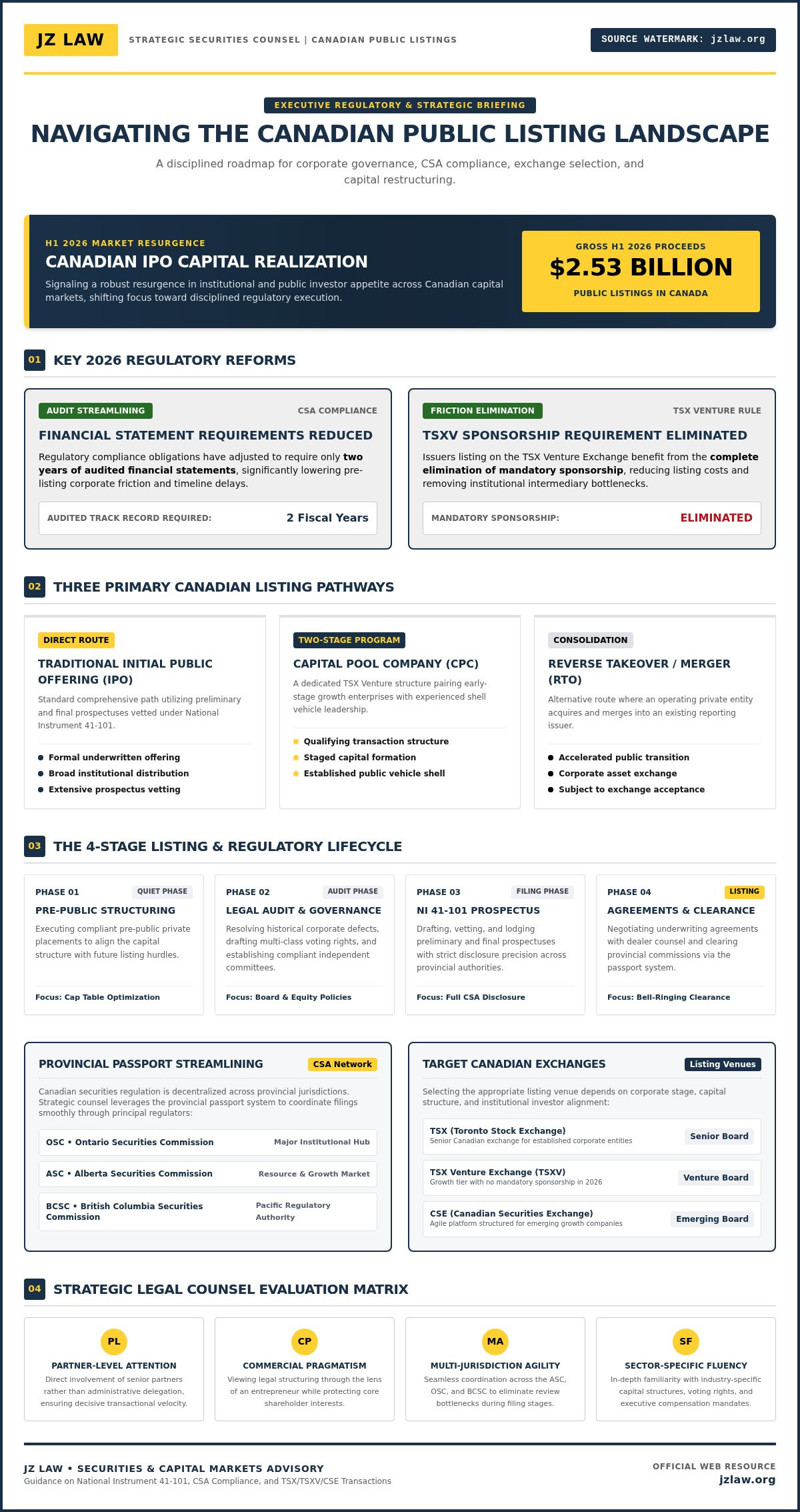
Did you know that Canadian IPO proceeds reached 2.53 billion dollars in the first half of 2026, signaling a robust resurgence in investor appetite? While the window for public listings has reopened, the path to the bell-ringing ceremony remains guarded by a complex web of CSA regulations and exchange-specific mandates. Engaging a strategic ipo lawyer canada is no longer just about compliance; it's about navigating these hurdles with a partner who understands that legal precision must serve your broader business objectives.
It's natural to feel concerned about the potential for prolonged prospectus reviews or the perceived financial burden of a listing. You're likely weighing the merits of the TSX against the TSX Venture or the CSE, while ensuring your corporate structure is ready for institutional scrutiny. We'll show you how specialized securities counsel manages these variables to ensure a seamless transition to the public markets.
This article provides a disciplined roadmap for 2026, covering essential updates like the reduction to two years of audited financial statements and the elimination of the TSXV sponsorship requirement. We'll explore how to optimize your capital table and streamline regulatory filings, ensuring your path from initial audit to listing is both predictable and efficient.
Table of Contents
The Strategic Role of a Canadian IPO Lawyer When Going Public
Key Evaluation Criteria When Selecting IPO Legal Counsel in Canada
Navigating Canadian Securities Regulators and Stock Exchange Rules
Canadian Listing Pathways: Traditional IPOs, CPCs, and Reverse Mergers
Structuring Your Public Listing with JZ Law: Strategic Securities Counsel
The Strategic Role of a Canadian IPO Lawyer When Going Public
Transitioning from a private entity to a publicly traded corporation requires more than just capital; it demands a fundamental shift in legal and operational philosophy. A strategic ipo lawyer canada acts as the architect of this transition, meticulously structuring corporate governance frameworks and clearing regulatory pathways long before the first share is traded. This role extends beyond mere document preparation. Counsel serves as the primary bridge between company executives, investment underwriters, and the stringent oversight of provincial commissions. By engaging legal expertise early, leadership teams can ensure their corporate records are pristine, effectively mitigating the risk of review bottlenecks that often derail listing timelines.
Strategic legal guidance is particularly vital when securing compliant pre-public private placements. These early-stage financings must be structured to align with future listing requirements, ensuring that the capitalization table remains attractive to institutional investors. Because Canadian securities regulation is managed through a decentralized system of provincial authorities, your counsel must possess the multi-jurisdictional fluency to navigate these distinct yet interconnected frameworks. This proactive approach identifies organizational deficiencies and rectifies them during the quiet phase, creating a disciplined roadmap toward the bell-ringing ceremony.
Core Responsibilities Across the Canadian Listing Lifecycle
The journey to the public markets involves a series of high-stakes milestones where precision is non-negotiable. Counsel begins by conducting comprehensive corporate legal audits to identify and resolve structural defects in the company's history. This leads into the drafting and filing of preliminary and final prospectuses under National Instrument 41-101, a process that requires absolute transparency and technical accuracy. Throughout this lifecycle, your ipo lawyer canada also takes the lead in negotiating underwriting or agency agreements. They work alongside investment dealer counsel to ensure the terms of the offering protect the company's long-term interests while satisfying market demands.
Corporate Governance and Capital Table Restructuring Pre-IPO
Effective governance is the cornerstone of institutional investor confidence. Strategic counsel assists in creating multi-class voting structures and protective share provisions that allow founders to maintain vision-aligned control while accessing public capital. In 2026, this also includes implementing executive stock option plans that strictly conform to updated exchange policies. Beyond equity, counsel establishes independent board committees that match specific Canadian regulatory mandates. These structures aren't just bureaucratic requirements; they're essential tools for risk mitigation and long-term value creation. By aligning executive compensation and board oversight with public market expectations, the firm builds a foundation of trust that is indispensable for a successful market debut.
Key Evaluation Criteria When Selecting IPO Legal Counsel in Canada
Selecting a suitable ipo lawyer canada requires looking beyond firm size to focus on transactional velocity and risk mitigation. While institutional prestige has its place, the success of a listing often hinges on the direct involvement of senior partners who can make decisive, strategic calls. This level of partner-led attention ensures that legal strategies remain aligned with business objectives rather than getting lost in the administrative layers of a massive firm. Founders should prioritize commercial pragmatism, seeking a legal partner who views the transaction through the lens of an entrepreneur while maintaining the highest standards of professional dignity.
Agility across provincial lines is equally critical. A seasoned ipo lawyer canada ensures seamless coordination between the Alberta Securities Commission (ASC), the Ontario Securities Commission (OSC), and the British Columbia Securities Commission (BCSC). This cross-provincial regulatory agility prevents filing delays and ensures that your prospectus review process doesn't hit unnecessary bottlenecks. Choosing a firm with multi-jurisdictional capacity allows for a more predictable legal roadmap, regardless of where your principal regulator is located.
Boutique Focus Versus National Full-Service Institutional Law Firms
Founders must evaluate whether they prefer senior lawyer accessibility or a multi-layered associate staffing model. Boutique practices often provide more agile execution, which is essential for fast-moving mid-market corporate financings. These firms coordinate seamlessly across major Canadian hubs like Calgary, Toronto, and Vancouver, offering the same regulatory rigour as larger institutions but with greater cost efficiency. For many companies, the traditional method of obtaining a listing is best handled by a focused team that prioritizes direct communication over bureaucratic institutional overhead. This approach minimizes billing friction and ensures that legal resources are concentrated on high-value strategic execution.
Assessing Sector-Specific Securities Regulatory Acumen
Sector fluency is a non-negotiable criterion in 2026. If your company operates in the blockchain or fintech space, you need counsel with a proven track record in decentralized protocols and digital asset regulations. Similarly, resource companies require deep expertise in property disclosures governed by National Instrument 43-101 to satisfy both regulators and investors. Those in the commercial cannabis sector face unique compliance hurdles that demand specific regulatory fluency. When selecting a partner, look for a firm that bridges the gap between traditional legal dignity and modern economic innovation. If you require a strategic partner who understands these complexities, consider exploring the specialized securities regulation services offered by John Zang to ensure your listing is handled with the necessary precision.
Navigating Canadian Securities Regulators and Stock Exchange Rules
The Canadian regulatory environment operates through a coordinated yet decentralized framework that requires precise navigation. Unlike jurisdictions with a single federal body, oversight is managed by the Canadian Securities Administrators (CSA) through a sophisticated provincial passport system. An experienced ipo lawyer canada assists you in designating a principal regulator, typically the Ontario Securities Commission (OSC) or the Alberta Securities Commission (ASC), based on your head office location or significant market connection. Once your principal regulator clears the prospectus, the passport system allows for relatively seamless entry into other participating provinces, significantly reducing redundant administrative hurdles.
This process isn't merely a matter of filing forms; it involves a rigorous negotiation through the regulatory comment letter process. Regulators often issue detailed inquiries regarding financial disclosures, specialized accounting treatments, and continuous disclosure undertakings. Successfully managing these inquiries within statutory review windows is essential to maintaining your listing timeline. Proactive legal counsel anticipates these questions, ensuring that the initial submission is robust enough to minimize the cycle of revisions.
The Passport System: OSC, ASC, and BCSC Clearance Mechanics
Designating your principal regulator is a strategic decision that dictates the tone of your review. Your ipo lawyer canada leads the communication with the commission's staff, resolving complex inquiries before they become bottlenecks. This includes addressing the new 2026 standards for firm-specific audit reports and the pilot program for semi-annual financial reporting for eligible venture issuers. By mastering these mechanics, counsel ensures that the transition from a private company to a reporting issuer is handled with the necessary professional dignity and technical precision.
TSX Senior Board vs. TSX Venture vs. Canadian Securities Exchange
Choosing the right venue for your shares depends on your enterprise valuation and development stage. The Toronto Stock Exchange (TSX) serves as the senior board, demanding at least 1,000,000 freely trading shares with a market value of 10 million dollars. For growth-stage companies, the TSX Venture Exchange (TSXV) offers Tier 1 and Tier 2 categories with lower net tangible asset requirements, such as 750,000 dollars for Tier 2 technology firms. You can find detailed requirements in the official Toronto Stock Exchange listing guides, which outline the pathways for both traditional IPOs and direct listings.
It's important to recognize that as of March 31, 2026, the TSXV has eliminated the mandatory sponsorship requirement, which notably reduces costs and shortens timelines for new listings. Meanwhile, the Canadian Securities Exchange (CSE) remains a popular choice for unconventional or emerging industries due to its flexible listing standards. Beyond the numbers, exchange committees exercise broad discretion over executive suitability. They conduct thorough reviews of Personal Information Forms (PIFs) to ensure that every member of your leadership team meets the high standards of integrity required for the public markets.
Canadian Listing Pathways: Traditional IPOs, CPCs, and Reverse Mergers
Entering the public markets in Canada is not a uniform procedure. A seasoned ipo lawyer canada identifies the structural pathway that best aligns with your enterprise’s current growth stage and long-term objectives. While large-scale issuers typically pursue the traditional long-form prospectus to maximize institutional reach, mid-market companies often find greater efficiency in specialized vehicles like Capital Pool Companies or reverse takeovers. Linking these listing transactions with strategic corporate transactions ensures that your debut isn't just a financing event, but a foundation for sustained capital stability and disciplined growth.
The Long-Form Prospectus: Process, Timeline, and Requirements
This remains the most rigorous entry method, demanding extensive preparation of business descriptions and Management’s Discussion and Analysis (MD&A). Under the current CSA framework effective through late 2026, issuers benefit from a reduced requirement of only two years of audited financial statements, which significantly lowers the administrative burden for younger firms. Counsel manages the coordination between management and underwriting syndicates during marketing roadshows and bookbuilding. The process culminates in securing final receipts from securities commissions, which permits the commencement of unrestricted secondary trading. This path offers the broadest access to institutional investors but requires a disciplined 12 to 18-month preparation window.
The Capital Pool Company (CPC) Model on the TSX Venture
The TSX Venture Exchange’s CPC program offers a structured two-step mechanism for growth-stage enterprises. It involves a Qualifying Transaction (QT) where a private company is acquired by an established, funded shell company. This pathway allows founders to access public capital while maintaining a disciplined approach to dilution. Counsel navigates the complexities of shareholder approval thresholds and filing statements, ensuring the transaction meets exchange standards for executive suitability. As of March 2026, the removal of mandatory sponsorship for certain listings has further streamlined this route, making it an attractive option for technology and resource companies seeking a faster market entry.
Reverse Takeovers (RTO) and Corporate Amalgamations
Reverse takeovers allow private entities to acquire the reporting issuer status of an existing shell company, often through three-cornered amalgamations. This requires meticulous reverse due diligence to uncover any dormant corporate liabilities or reporting deficiencies in the shell's history. This route is particularly effective for businesses seeking cross-border opportunities, such as taking your cannabis company public across multiple jurisdictions. It provides a faster alternative to the traditional IPO, provided the target shell is clean and the surviving entity meets all listing requirements. If you require a partner to evaluate these structural options, engage John Zang for a strategic assessment of your listing potential.
Structuring Your Public Listing with JZ Law: Strategic Securities Counsel
JZ Law offers specialized securities legal representation designed for companies that value strategic agility over institutional overhead. The firm’s approach centers on the understanding that a public listing is a transformative corporate milestone, requiring more than just administrative filing support. By providing dedicated counsel across Calgary, Toronto, and global capital conduits, the firm ensures that every transaction is executed with the highest level of professional dignity. Engaging a focused ipo lawyer canada means your leadership team deals directly with senior expertise, effectively eliminating the communication gaps often found in multi-layered national firms. This direct model provides a level of security and precision that is essential for navigating the complexities of 2026 capital markets.
Partner-Led Securities and Corporate Finance Practice
The core of the firm’s philosophy is direct collaboration. Every mandate is led by principal lawyer John Zang, ensuring that strategic decisions are made with decisive transactional velocity. This model intentionally avoids the administrative bloat that often leads to billing friction and delayed responses in larger institutional practices. Instead, clients receive responsive, partner-level attention throughout the entire transaction lifecycle, from initial corporate audit to the final listing ceremony. This depth of expertise is particularly evident in the firm’s fluency with emerging sectors, including sophisticated cryptocurrency law and decentralized digital asset frameworks. It's a modern approach that respects the traditions of the legal profession while embracing economic innovation.
Proactive Risk Mitigation and Post-Listing Continuous Compliance
A successful bell-ringing ceremony is merely the beginning of a company's life as a reporting issuer. JZ Law provides a comprehensive legal roadmap that extends well into the post-listing phase, focusing on pro-active risk mitigation. This includes drafting robust corporate governance policies, insider trading guidelines, and rigorous disclosure controls that meet the expectations of both regulators and institutional investors. The firm supports ongoing annual and interim continuous disclosure filings under National Instrument 51-102, ensuring that your company remains in good standing with the relevant securities commissions. Maintaining this status is non-negotiable for preserving shareholder trust and market liquidity.
For clients operating in the energy sector, the firm integrates specialized resource compliance, drawing on deep experience in oil and gas law to manage property disclosures and regulatory reporting. This end-to-end service model ensures that your corporate structure remains resilient in the face of evolving market demands. As a strategic ipo lawyer canada, John Zang provides the stability needed for long-term growth. If your organization is preparing for a public market debut in 2026, take the first step toward a disciplined listing process. Book a confidential capital markets consultation with JZ Law to discuss your specific strategic objectives.
Scaling Your Vision in the 2026 Public Markets
Navigating the transition to a public entity is a defining moment that requires absolute structural precision and a disciplined legal roadmap. As the Canadian market continues its robust recovery through 2026, the choice of listing pathway and the designation of a principal regulator remain the most critical strategic decisions for leadership teams. A dedicated ipo lawyer canada ensures that these complexities are managed with the professional dignity and technical accuracy your enterprise deserves.
JZ Law brings a decade of specialized securities regulation and going-public experience to every mandate. By delivering partner-led corporate finance counsel across Calgary, Toronto, and Vancouver, the firm provides the strategic attention necessary to navigate specialized sectors like technology, energy, cannabis, and cryptocurrency. This focused approach prioritizes your business objectives while maintaining rigorous compliance with CSA mandates and exchange-specific listing requirements.
Securing a successful market debut starts with a conversation about your specific growth trajectory. Schedule a strategic IPO consultation with JZ Law to begin structuring your transition to the public markets with the precision and expertise required for long-term capital stability. Your journey from private innovation to public leadership is within reach.
Frequently Asked Questions
How long does it take to complete an IPO in Canada?
It typically takes 12 to 18 months to complete an initial public offering in Canada, from the initial planning and corporate audit stages to the final bell-ringing. This timeline includes the preparation of audited financial statements, drafting the prospectus, and navigating the regulatory review period with provincial commissions. Engaging an ipo lawyer canada early helps streamline this process by identifying potential bottlenecks in your corporate structure before they delay the filing schedule.
What is the difference between listing on the TSX and TSX Venture?
The Toronto Stock Exchange (TSX) serves as the senior board for mature companies, requiring a market value of at least 10 million dollars for the public float. In contrast, the TSX Venture Exchange (TSXV) is designed for growth-stage enterprises with lower financial thresholds. While the TSX demands broader institutional distribution and at least 300 public shareholders, the TSXV offers a tiered structure that allows smaller companies in sectors like tech or energy to access public capital.
What is a Capital Pool Company (CPC) and how does it work?
A Capital Pool Company is a specialized listing vehicle on the TSX Venture Exchange that allows a shell company with no assets other than cash to go public. Once listed, the CPC has a set period to identify and acquire a private business through a Qualifying Transaction. This two-step mechanism provides private companies with a structured alternative to a traditional IPO, often accelerating the timeline for reaching the public markets while reducing initial underwriter costs.
How much does a Canadian securities lawyer charge for an IPO?
Legal fees for a public listing vary significantly based on the complexity of your corporate structure, the chosen exchange, and specific sector requirements. Rather than focusing on a single number, issuers should evaluate the value of partner-led strategic counsel against the administrative overhead of large institutional firms. Factors influencing the total cost include the rigour of the due diligence process, the number of provincial jurisdictions involved, and the extent of pre-IPO corporate restructuring required.
Can foreign companies list on Canadian stock exchanges?
Foreign companies can and frequently do list on Canadian exchanges, particularly in the mining, technology, and energy sectors. The TSX and TSXV are recognized global hubs for international issuers seeking access to a sophisticated investor base in Calgary, Toronto, and Vancouver. These companies must comply with Canadian disclosure standards and may require specific tax structuring to manage cross-border liabilities. Strategic counsel ensures that the transition for international entities aligns with both Canadian securities laws and their home jurisdiction regulations.
What is the role of a sponsor in a Canadian stock exchange listing?
Historically, a sponsor was a registered investment dealer that conducted due diligence and provided a report to the exchange regarding a company's suitability for listing. However, as of March 31, 2026, the TSX Venture Exchange has eliminated the mandatory sponsorship requirement for new listings. This change is intended to lower entry costs and shorten timelines for issuers. While no longer mandatory, many companies still work closely with dealers to ensure their offering meets institutional quality standards before filing.
What ongoing legal compliance is required after completing an IPO in Canada?
After going public, companies must adhere to strict continuous disclosure requirements under National Instrument 51-102. This includes filing annual and interim financial statements, Management’s Discussion and Analysis (MD&A), and annual information forms. Additionally, reporting issuers must disclose material changes immediately through news releases and formal filings. Maintaining these standards is essential for preserving market liquidity and shareholder trust, requiring disciplined internal controls and regular oversight from an experienced ipo lawyer canada to avoid regulatory sanctions.


Comments