


AGLC Retail Cannabis License Application: The 2026 Strategic Legal Guide
- jzanglaw
- 3 days ago
- 13 min read
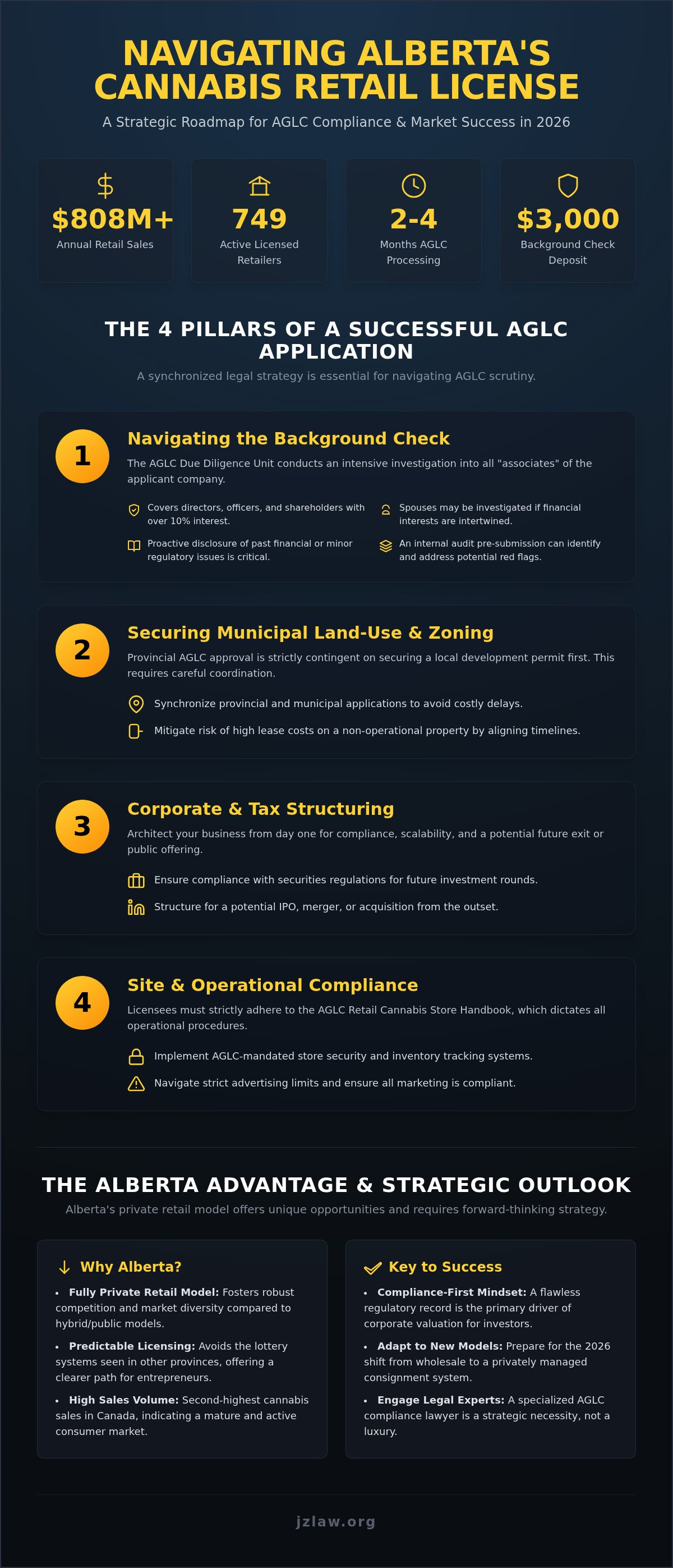
In the competitive Alberta cannabis sector, a retail license is not merely a permit to operate; it is a fundamental financial asset that dictates your company’s valuation and eventual liquidity. As of June 2026, with 749 licensed retailers competing in a mature market that generated over C$808 million in annual sales, the margin for administrative or legal error has effectively vanished. Retaining a specialized aglc cannabis compliance lawyer is no longer a luxury but a strategic necessity for those facing the pressure of high upfront costs and the C$3,000 background check deposit. You're likely concerned that a single oversight in municipal zoning or corporate disclosure could result in a costly rejection, stalling your entry into the market.
This guide provides the strategic clarity you need to move forward with confidence. We'll offer a roadmap to master the 2026 regulatory framework, ensuring your application is built on a foundation of rigorous due diligence and precise corporate structuring. By following these expert insights, you'll learn how to minimize the risk of application failure while positioning your business for future growth or a public offering. This article transforms the licensing process from a daunting hurdle into a structured path toward commercial success.
Table of Contents
Understanding the Alberta Retail Cannabis Framework in 2026
Operating a retail cannabis storefront in Alberta requires a Retail Cannabis Store Licence issued by the Alberta Gaming, Liquor and Cannabis (AGLC). This isn't just a procedural formality; it's a rigorous legal prerequisite under the Gaming, Liquor and Cannabis Act. By June 2026, the province reached a state of market maturity with 749 active stores. In this environment, the expertise of an aglc cannabis compliance lawyer is vital for distinguishing a legitimate enterprise from those that fail during the intensive background check phase. The license serves as the legal foundation of the business, and any breach of its conditions can lead to immediate administrative penalties or license revocation.
Since the initial legalization, Cannabis Regulation in Alberta has shifted from a period of rapid, unchecked expansion to a focus on brand loyalty and operational precision. In 2025, the legal market generated approximately C$808 million in retail sales, a 2% increase year-over-year. This growth occurs within a strictly controlled environment where a compliance-first mindset is the primary driver of corporate valuation. Investors and potential buyers prioritize businesses that demonstrate a flawless regulatory record, as this significantly reduces the risk profile of the asset during a merger or acquisition.
The Role of the AGLC in Private Retail
The AGLC functions as the sole wholesaler for all legal cannabis products in the province. Every product sold in a private store must be purchased through the AGLC, creating a centralized supply chain that ensures product safety and standardized tax collection. Licensees must adhere to the AGLC Retail Cannabis Store Handbook, which acts as a living legal document dictating store security, inventory tracking, and advertising limits. On June 8, 2026, the AGLC announced plans to transition from its current wholesale model to a privately managed consignment model. This shift requires retailers to update their financial reporting and inventory management systems to remain compliant with provincial standards.
Alberta vs. Other Canadian Jurisdictions
Alberta’s model is distinct because it relies entirely on private retailers rather than government-owned storefronts, a significant departure from the hybrid or public models seen in other Canadian provinces. This open-market approach has allowed for a higher density of stores and more robust competition. Entrepreneurs often prefer this jurisdiction because the licensing process is more predictable than the lottery systems previously used in Ontario. For multi-jurisdictional operators, an aglc cannabis compliance lawyer helps translate these provincial nuances into a unified national growth strategy. Alberta remains a preferred destination for cannabis investment due to its transparent regulatory framework and the second-highest cannabis sales volume in Canada as of April 2026.
The Four Pillars of a Successful AGLC Application
Securing a retail cannabis license in Alberta requires more than just meeting a checklist; it demands a structured legal strategy across four critical pillars. While the AGLC suggests a processing window of two to four months, many applicants face significant delays because they treat these pillars as isolated tasks rather than a unified regulatory requirement. A successful submission must synchronize personal background checks, municipal zoning, corporate structuring, and physical site security to pass the scrutiny of the Due Diligence Unit.
Navigating the Background Check Process
The background investigation is the most intensive phase of the application. The AGLC requires an initial C$3,000 deposit to cover the costs of these investigations, and any unused portion is refundable. This process extends to all "associates," which includes directors, officers, and any shareholder holding more than a 10% interest in the company. In some cases, the AGLC may even investigate the spouses of key individuals if their financial interests are intertwined. Proactive disclosure is the only way to manage this phase. Attempting to obscure a past financial setback or a minor regulatory infraction often leads to an immediate "unsuitable" finding. An aglc cannabis compliance lawyer can help you conduct an internal audit before submission to identify and explain potential red flags in your financial history.
Securing Municipal Land-Use and Zoning
Provincial approval is strictly contingent on your ability to secure a local development permit. Every municipality in Alberta has the authority to set its own bylaws regarding store locations, often mandating setbacks of 100 to 300 meters from schools, parks, and other cannabis retail sites. These local rules are shaped by the broader objectives found in Alberta's Cannabis Framework, which prioritizes public safety and the protection of minors. You cannot bypass these local restrictions; the AGLC will not issue a license until they receive a Municipal Approval letter. Securing a lease before confirming zoning is a high-risk move that has cost many entrepreneurs thousands in "dead rent" while they fight for a variance that may never come.
Corporate and Physical Site Standards
Your legal entity must be an Alberta corporation or extra-provincially registered to hold a license. The AGLC reviews your corporate bylaws to ensure no prohibited interests, such as associations with organized crime or certain liquor-related entities, are present. Simultaneously, your physical storefront must meet specific security standards, including 24/7 high-definition surveillance and secure storage rooms that are inaccessible to the public. If you're unsure if your proposed store layout meets the 2026 provincial standards, consulting with an aglc cannabis compliance lawyer during the design phase can prevent expensive retrofitting costs later. Mastering these four pillars ensures your application moves through the queue without the friction that stalls so many other Alberta startups.
Legal Strategies for the AGLC Due Diligence Unit
The Due Diligence Unit (DDU) represents the most significant regulatory hurdle for any prospective licensee in Alberta. While many applicants focus on store aesthetics, the DDU focuses exclusively on the integrity of the corporate entity and its financial backers. Incomplete or inconsistent financial disclosures remain the primary cause of application stagnation. An aglc cannabis compliance lawyer ensures that every line of your disclosure is cross-referenced with bank statements and corporate records to prevent the appearance of concealment. The goal is to provide a narrative of financial transparency that leaves no room for the DDU to suspect the involvement of organized crime or prohibited interests.
If an applicant has a past regulatory infraction or used unconventional funding sources, silence is a liability. Strategic disclosure involves presenting these facts within a legal context that demonstrates current suitability and adherence to the Gaming, Liquor and Cannabis Act. Protecting corporate privacy is equally vital; you must satisfy transparency requirements without exposing sensitive trade secrets or unrelated business interests to unnecessary scrutiny. Precision in these filings prevents the DDU from launching extended, costly investigations that can deplete your initial deposit.
Managing Financial Associate Disclosures
The AGLC defines influence and control broadly within a corporate hierarchy. It isn't just about who sits on the board; it's about who holds the debt. If a third party provides a significant loan or holds a security interest in the business, the DDU may classify them as an associate. Documenting the "source of wealth" is mandatory. This means tracing initial capital back to its origin, whether that's through documented inheritance, corporate dividends, or liquidated assets. Pre-submission auditing by legal counsel mitigates the risk of the DDU finding an "unexplained" influx of cash, which is a red flag that often leads to application rejection.
Handling Application Objections
Once your application reaches the "pending" stage, the AGLC initiates a public notice period. If a community group or local business files an objection, you need a formal legal response to prevent the application from being derailed. These objections often center on perceived safety concerns or land-use conflicts. Ensuring your real estate law strategy is robust helps counter these claims. By demonstrating that your site selection and lease agreements exceed municipal standards, you provide the AGLC with the legal justification to dismiss frivolous objections and move your application toward final approval.
Corporate and Tax Structuring for Cannabis Licensees
The architecture of your business entity is the primary factor in determining your long term scalability and your ability to pass AGLC scrutiny without administrative delays. A loosely defined corporate structure often leads to "red flag" designations during the due diligence phase, as the AGLC requires absolute clarity regarding beneficial ownership and control. By establishing a logically closed corporate framework from the outset, you protect your license from the actions of individual shareholders while positioning the company for future growth. An aglc cannabis compliance lawyer ensures that your bylaws and shareholder agreements are not only legally sound but specifically tailored to meet the rigid transparency standards of the Alberta regulator.
Selecting the Right Legal Entity
Most successful retail operators in Alberta utilize a corporate structure rather than a partnership to provide a clear legal barrier between the business and its investors. Utilizing a holding company can be a strategic advantage, as it allows you to shield valuable assets like real estate or intellectual property from the operational risks of the retail storefront. When drafting shareholder agreements, it's vital to include "disqualified person" clauses. These provisions allow the corporation to buy back shares or force a divestment if a shareholder fails an AGLC background check, ensuring that one individual's personal history doesn't jeopardize the entire organization's license. This proactive approach is essential for maintaining the "suitable" status required for ongoing operations.
Tax Considerations and Financial Reporting
Tax structuring for cannabis entities remains a complex challenge due to the 16.8% provincial cannabis duty rate, which is the second-highest in Canada as of 2026. Strategic tax planning must account for these high overheads while ensuring compliance with the AGLC’s rigorous monthly financial reporting requirements. Since the elimination of the 2% early payment fee for producers in April 2026, cash flow management has become more predictable, yet the need for precise inventory and sales reconciliation remains. Your financial books must be audit-ready at all times to satisfy both the Canada Revenue Agency and the AGLC’s investigative units. Clean financial reporting doesn't just satisfy regulators; it significantly increases your company's attractiveness to institutional investors.
Any significant change in ownership or a merger with another entity triggers a mandatory review by the AGLC. This makes strategic corporate transactions particularly delicate, as the buyer must undergo the same level of due diligence as the original founder. If you're preparing for an acquisition or a major capital raise, you should consult with an aglc cannabis compliance lawyer to review your corporate records and ensure your structure is optimized for a seamless transition of control.
Scaling Your Business: From License to IPO
An AGLC retail license is more than an operational permit; it is a core asset that determines your enterprise's liquidity and terminal value. In a mature Alberta market where legal sales reached C$84.6 million in July 2026 alone, the difference between a local storefront and a scalable corporate entity lies in regulatory precision. For founders eyeing the Canadian Securities Exchange (CSE) or the TSX, the transition from a private retailer to a publicly traded entity requires a level of rigor that begins long before the first filing. Retaining an aglc cannabis compliance lawyer ensures that your internal controls and corporate governance meet the dual requirements of provincial regulators and federal securities commissions.
The path to a public listing is paved with intensive disclosure. Investors in the cannabis sector prioritize companies that demonstrate a "clean" history with the AGLC, as any past administrative penalties can become significant liabilities during the underwriting process. JZ Law specializes in taking your cannabis company public, providing the specialized counsel needed to bridge the gap between local retail compliance and global capital markets.
Securities Regulation for Cannabis Founders
Publicly traded cannabis companies face unique disclosure requirements that extend beyond standard financial reporting. You must be prepared to disclose all "material facts" regarding your AGLC standing, including any pending investigations or municipal zoning disputes. The role of legal counsel in this process is to act as a bridge between your operations and the requirements of the securities commissions. Managing investor relations in this space requires a delicate balance; you must provide the transparency the market demands without compromising the sensitive corporate structures that protect your provincial license. A well-prepared IPO or RTO strategy ensures that your transition to the public markets is viewed as a low-risk, high-reward opportunity by institutional backers.
Exit Strategies and M&A in the Cannabis Space
If your goal is an eventual exit through a merger or acquisition, your AGLC compliance record is your most valuable bargaining chip. During the due diligence phase of an acquisition, a buyer’s legal team will scrutinize your entire history with the AGLC Due Diligence Unit. They aren't just looking for current profitability; they're looking for systemic compliance. Any inconsistency in your financial records or a history of minor regulatory infractions can lead to a significant "haircut" on your valuation or, in the worst cases, cause the deal to collapse entirely. Preparing your retail license for a successful acquisition involves a proactive audit of your corporate books and physical security logs. For founders ready to explore these high-level growth opportunities, contacting JZ Law for a strategic consultation is the final step in securing your legacy within the Alberta cannabis industry.
Securing Your Future in the Alberta Cannabis Market
The path to a successful retail operation in Alberta is defined by more than just a storefront; it's built on a foundation of rigorous regulatory adherence and strategic corporate foresight. By mastering the four pillars of the AGLC application process and implementing a robust disclosure strategy, you transform a complex administrative requirement into a significant business asset. Whether you're navigating the initial due diligence phase or architecting a corporate structure ready for a future public listing, the precision of your legal approach will dictate your long-term valuation. An experienced AGLC Cannabis Compliance Lawyer serves as your strategic partner, ensuring that every detail of your municipal zoning and financial disclosure aligns with provincial expectations.
JZ Law provides the specialized expertise in cannabis licensing and securities regulation necessary to navigate these multifaceted frameworks with confidence. Our team offers a deep understanding of Alberta’s evolving regulations, providing the strategic corporate finance guidance required to scale from a single license to a global enterprise. Consult with JZ Law for your AGLC Cannabis License Application and take the first step toward building a resilient, high-valuation cannabis business. Your vision for growth deserves a legal foundation that's as ambitious as your commercial goals.
Frequently Asked Questions
How long does the AGLC retail cannabis license application take in 2026?
The AGLC retail cannabis license application typically takes between two and four months to process in 2026. This timeline depends heavily on the complexity of your corporate structure and the speed with which the Due Diligence Unit can verify your financial disclosures. If your application involves international associates or unconventional funding, the process may extend beyond this window. Engaging an aglc cannabis compliance lawyer helps ensure your documentation is audit-ready, which prevents administrative delays and inquiries.
What are the total fees associated with applying for a cannabis license in Alberta?
Total provincial fees for a new application in 2026 include a non-refundable C$400 application fee and a C$700 annual license fee per location. Additionally, applicants must provide a C$3,000 initial deposit to cover the costs of background investigations. While the AGLC refunds any unused portion of this deposit, the total upfront provincial cost is approximately C$4,100. These figures don't include municipal development permit fees or the costs associated with physical store security upgrades.
Can I apply for an AGLC license if I have a prior criminal record?
A prior criminal record doesn't result in an automatic rejection, but the AGLC evaluates every applicant on a suitability basis. The regulator focuses on whether an individual’s past conduct suggests a risk to the integrity of the legal market. Full disclosure is mandatory during the background check phase. While JZ Law doesn't provide criminal law representation, an aglc cannabis compliance lawyer can assist in framing your history within a professional compliance narrative to satisfy provincial investigators.
What is the required distance between a cannabis store and a school in Calgary?
In Calgary, the standard separation distance between a retail cannabis store and a school or provincial health care facility is 150 meters. However, municipal bylaws are subject to specific land-use designations and can vary between Calgary and other Alberta hubs. These setbacks are measured from the property line, not the building entrance. It's vital to confirm these local zoning requirements before signing a commercial lease, as the AGLC won't issue a license without a valid municipal development permit.
Do I need a separate license for each retail location I open in Alberta?
Yes, you must obtain a separate AGLC retail cannabis license for every physical storefront you intend to operate in Alberta. Each location requires its own C$400 application fee and is subject to an individual site inspection to ensure security compliance. While your corporate entity remains the same, the AGLC treats each premises as a distinct licensed environment. This modular approach allows chains to scale throughout Calgary and beyond while maintaining clear regulatory boundaries for each retail asset.
What happens to my AGLC license if I sell my business?
Retail cannabis licenses are not transferable between parties in the Alberta market. If you sell your business, the prospective buyer must submit their own application and pass the full AGLC due diligence process. The existing license is typically cancelled upon the closing of the sale, and a new one is issued to the purchaser. Coordinating this transition requires careful legal planning to ensure the store doesn't face a gap in its authority to sell products during the change of ownership.
Is a background check required for every employee at my cannabis store?
A full AGLC background check is only required for associates, which includes owners, directors, and any shareholder with more than a 10% interest. General store employees don't undergo this intensive investigation. However, every staff member involved in the sale of cannabis must be at least 18 years old and hold a valid SellSafe certification. This ensures that the frontline team understands Alberta’s specific regulations regarding purchase limits and the absolute prevention of sales to minors.
Can a retail cannabis store in Alberta sell products online?
Licensed private retailers in Alberta are permitted to sell cannabis products online to customers who are 18 years of age or older. All online sales must be conducted through the retailer’s own website and must adhere to strict age verification protocols at the time of purchase and delivery. This digital expansion has allowed Calgary based retailers to compete more effectively in the mature market of 2026, though advertising restrictions still limit how these online platforms are promoted to the public.


Comments