


Common Legal Mistakes Crypto Startups Must Avoid in 2026
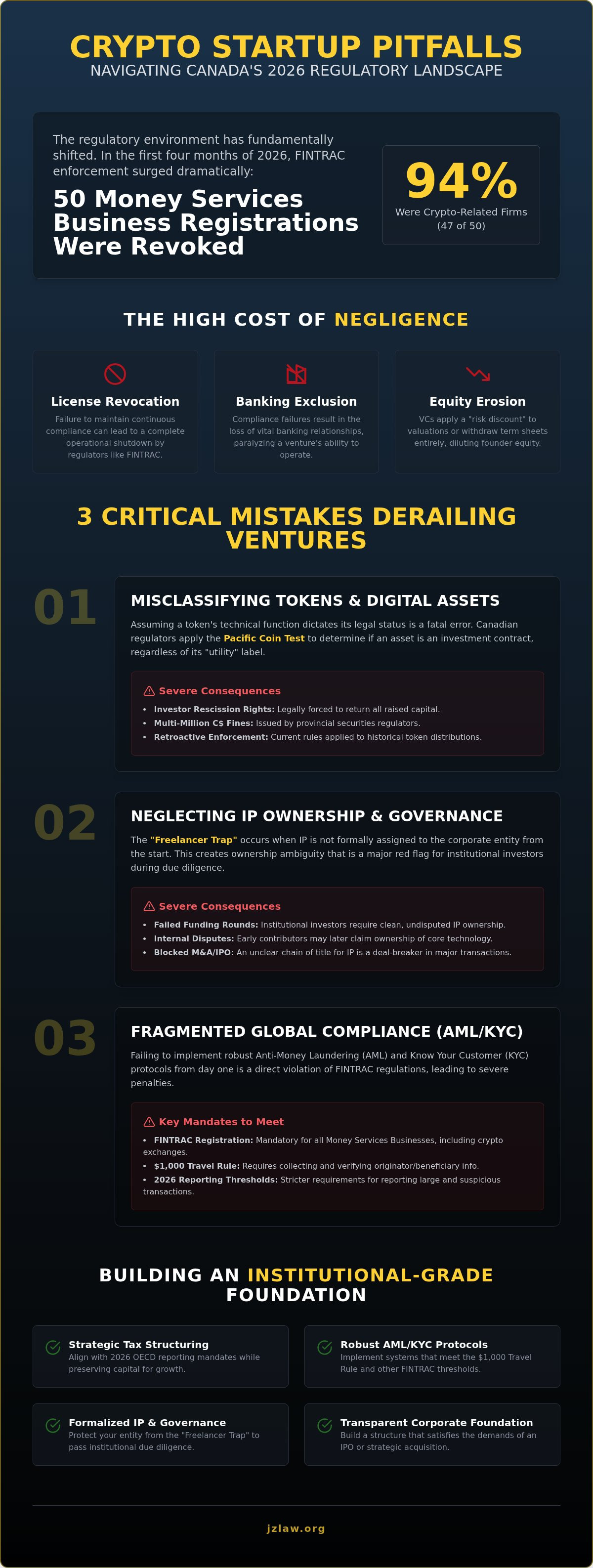
In the first four months of 2026, FINTRAC revoked 50 Money Services Business registrations, with 47 of those involving crypto-related firms. This surge in enforcement signals that the era of "move fast and break things" has officially been replaced by a rigorous, institutional-grade regulatory environment. You likely feel the weight of this shift as you navigate the complexities of token classification and the persistent threat of retroactive enforcement from the CSA. It's exhausting to build a product while looking over your shoulder at evolving mandates like the 2026 Stablecoin Act or the OECD's Crypto-Asset Reporting Framework.
We'll help you identify and rectify the critical legal pitfalls that derail ventures before they reach institutional funding or a planned IPO. This article provides a strategic roadmap for crypto startup tax structuring in Canada, examines the implications of the CIRO Digital Asset Custody Framework, and outlines the steps required to build a corporate foundation that passes the most stringent due diligence.
Table of Contents
The Regulatory Landscape of 2026: Why Crypto Mistakes Are Costlier
The cryptocurrency sector has transitioned from speculative experimentation to a cornerstone of the global financial architecture. In 2026, the Legality of cryptocurrency in Canada is defined by a sophisticated framework where the Canadian Securities Administrators (CSA) and FINTRAC operate with surgical precision. This institutional maturity means that mistakes once dismissed as early-stage friction are now categorized as systemic risks. For founders, implementing a robust crypto startup tax structuring canada strategy is no longer just about optimization; it's about survival in a market where cross-border cooperation between the SEC, CSA, and European regulators is the standard operating procedure.
Retroactive enforcement remains the most significant threat to 2026 startups. Regulators are increasingly looking back at historical token distributions and governance models to apply current standards. If your corporate foundation wasn't built with future compliance in mind, you're essentially building on shifting sand. High-level legal hygiene is now the primary differentiator for ventures seeking to secure Series A or B funding, as institutional investors prioritize regulatory certainty over raw growth metrics.
The Maturation of Global Crypto Standards
The 2026 regulatory environment differs fundamentally from the early DeFi era. Back then, ambiguity was often used as a shield; today, it's a target. The entry of major financial institutions has brought expectations of transparency that match traditional equity markets. The "move fast and break things" philosophy no longer works in fintech. Instead, the "comply to scale" mandate dominates. Startups must now integrate the latest Digital Asset Custody Framework and the 2026 Stablecoin Act requirements from day one. Failing to do so effectively locks you out of the institutional liquidity pools necessary for a successful IPO.
Economic Consequences of Legal Negligence
Legal red flags don't just result in fines; they decimate company valuations. During Series A and B funding rounds, sophisticated venture capital firms perform exhaustive audits of your historical compliance. A single misstep in your crypto startup tax structuring canada can lead to a significant "risk discount" on your valuation or a complete withdrawal of the term sheet. The costs of negligence are often terminal for young firms.
License Revocation: Recent enforcement trends show that compliance is not a one-time event but a continuous requirement for maintaining operational status.
Banking Exclusion: Compliance failures lead to the loss of vital banking relationships, which can paralyze operations overnight.
Equity Erosion: Founders often face massive dilution when forced to pivot their entire structure to satisfy late-stage regulatory demands.
Proactive legal counsel isn't an administrative burden. It's a strategic investment in your company's exit potential. By addressing these complexities early, you ensure that your venture remains attractive to the institutional partners who dictate the market's future.
Mistake #1: Misclassifying Tokens and Digital Assets
Founders often fall into the "Utility vs. Security" trap by assuming that a token's technical function dictates its legal status. In 2026, regulators look past marketing terminology to the underlying economic reality. While the Howey Test remains the benchmark in the United States, Canadian ventures must satisfy the Pacific Coin test. This standard determines if an arrangement constitutes an investment contract based on whether there's an investment of money in a common enterprise with an expectation of profit from the efforts of others. Labeling an asset as a "Governance" or "Utility" token provides no legal immunity if the functional characteristics suggest an investment contract exists.
The consequences of an unregistered securities offering are severe and often terminal. Investors may exercise rescission rights, which legally obligates the startup to return all raised capital. This usually happens at a time when those funds have already been deployed into development. Fines from provincial regulators can reach millions of C$, effectively ending a project before it reaches maturity. Proper crypto startup tax structuring canada requires an early, honest assessment of these classifications to avoid retroactive enforcement actions that derail future institutional interest.
The Security vs. Utility Spectrum
Under 2026 CSA guidelines, a security token is a digital asset that represents a claim on the issuer's profits or assets, regardless of its secondary utility. You must carefully audit your whitepaper for "investment contract" characteristics, such as promises of future returns or token buy-back mechanisms. Stablecoins have also evolved; many are now classified as financial instruments requiring specific capital reserves. The CRA digital currency tax guidance clarifies that these classifications directly impact whether transactions are treated as business income or capital gains, making precision essential for your long-term fiscal health.
The MiCA Impact on Global Startups
Startups eyeing hubs like Berlin and Frankfurt must prioritize MiCA whitepaper standards to remain competitive. The EU's rigorous classification system directly affects your ability to list on global exchanges. There's often friction between EU and North American asset definitions; what qualifies as a utility token under MiCA might still trigger securities laws in Toronto or New York. Managing these jurisdictional overlaps is a core component of crypto startup tax structuring canada. If you're unsure how your token fits into this global puzzle, seeking specialized cryptocurrency law counsel can prevent costly missteps during your next funding round.
Mistake #2: Neglecting IP Ownership and Corporate Governance
The most common internal failure we observe is the "Freelancer Trap," where a startup pays for code development but fails to secure the legal title to that code. In the decentralized world, remote developers often contribute from various jurisdictions, making clear IP assignments mandatory. Without these, your core protocol remains the personal property of individual contributors, a fatal flaw during strategic corporate transactions. Investors won't fund an entity that doesn't own its smart contracts. This lack of clarity often surfaces during due diligence, leading to collapsed funding rounds or significantly reduced valuations.
Founders must also address the myth of the DAO as a liability shield. By 2026, courts have consistently ruled that unincorporated Decentralized Autonomous Organizations are general partnerships, exposing individual members to unlimited personal liability. Effective crypto startup tax structuring canada involves wrapping these activities in a recognized corporate form. This protects founders and prepares the cap table for institutional scrutiny. Avoiding "dead equity" through rigorous vesting schedules ensures that only active contributors retain ownership, which is a prerequisite for any venture eyeing an IPO or major acquisition.
Intellectual Property in the Blockchain Era
Securing IP assignments from remote developers requires precision. You must distinguish between open-source contributions and the proprietary logic that defines your business value. While the protocol might be public, the trademarks and brand assets must be registered in hubs like New York and Toronto to prevent copycat protocols from diluting your market position. The Canada Revenue Agency (CRA) crypto-asset tax guidance highlights that the valuation of these intangibles is a critical component of your annual reporting and long-term tax strategy.
Governance for Institutional Readiness
Institutional readiness requires more than just a functional product. VCs in Calgary and Denver demand traditional corporate safeguards, including formal Board resolutions for any project pivots or significant treasury movements. Managing shareholder agreements in a high-volatility sector is complex, but it's essential for maintaining a clean legal bill of health. A structured approach to governance, combined with precise crypto startup tax structuring canada, demonstrates that the founders are capable of managing the transition from a startup to a public entity. This professional rigor often makes the difference between a project that stagnates and one that reaches institutional scale.
Mistake #3: Fragmented Global Compliance (AML, KYC, and FINTRAC)
In the first four months of 2026, FINTRAC revoked 47 crypto-related Money Services Business (MSB) registrations, a clear indicator that regulatory tolerance for fragmented compliance has evaporated. Many founders treat Anti-Money Laundering (AML) and Know Your Customer (KYC) protocols as secondary administrative tasks. This is a critical error. In the current landscape, these systems must be woven into your technical architecture from the first line of code. Failure to maintain a robust compliance posture doesn't just invite fines; it fundamentally compromises your crypto startup tax structuring canada by triggering reporting irregularities with the Canada Revenue Agency (CRA).
The implementation of the "Travel Rule" is now a non-negotiable requirement for Canadian ventures. As of 2026, any virtual currency transfer of C$1,000 or more requires the immediate and automated exchange of originator and beneficiary information. Manually processing these transactions is no longer feasible or legally defensible. Furthermore, the 2026 implementation of the Crypto-Asset Reporting Framework (CARF) means that your transaction data is now transparent to the CRA. Startups that ignore these automated reporting requirements face significant retroactive enforcement risks that can derail institutional due diligence during a Series A or IPO.
Privacy-enhanced features or the support of "anonymity-enhanced" coins also present a high-risk profile. Canadian regulators, alongside their counterparts in the US and EU, view these features as inherent red flags for illicit activity. Integrating these assets can lead to immediate exclusion from the traditional banking system and a permanent "high-risk" designation from FINTRAC. If you need to ensure your compliance framework meets these rigorous 2026 standards, you can consult with our specialized securities regulation team to build a defensible global strategy.
Cross-Border Regulatory Reporting
Operating between jurisdictions like New York and Berlin requires a sophisticated understanding of the 2026 updates to the Bank Secrecy Act (BSA) and the final implementation phases of MiCA. You cannot rely on a single KYC vendor without verifying their ability to handle the specific reporting nuances of both BaFin and the SEC. Common pitfalls include selecting vendors that lack the data residency capabilities required to satisfy provincial privacy laws while simultaneously meeting federal reporting thresholds of C$10,000 for large virtual currency transactions.
Data Privacy and Blockchain Transparency
There is an inherent tension between blockchain immutability and the "Right to be Forgotten" enshrined in GDPR and similar Canadian privacy mandates. Decentralized storage solutions must now account for these requirements through innovative off-chain metadata management or zero-knowledge proofs. In 2026, privacy-by-design is not just a regulatory hurdle; it's a significant competitive advantage. Ventures that can prove they protect user data while maintaining full transparency for AML purposes are far more likely to secure the trust of institutional partners and global exchanges.
Preparing Your Crypto Venture for Strategic Transactions and IPOs
Your legal hygiene today dictates the exit options available to you tomorrow. In the 2026 market, institutional buyers and underwriters don't just look at your codebase; they scrutinize years of regulatory filings and corporate records. A messy cap table or a history of casual compliance will lead to a significant risk discount during valuation or the total collapse of a deal. Specialized cryptocurrency law expertise is the filter through which every potential acquirer views your asset. They need to see that your historical reporting and internal controls are flawless before they commit significant capital.
The process of taking your company public requires a level of transparency that many startups find daunting. While the path to a public listing is often compared to other high-growth sectors, the securities filings for crypto ventures are uniquely complex due to the decentralized nature of the underlying technology. JZ Law’s approach focuses on building a proactive legal architecture. We don't just react to regulations; we position our clients as global tech leaders who are ready for the scrutiny of the TSX or NASDAQ from their very first funding round.
The Road to a Crypto IPO
Preparing your prospectus involves more than just financial disclosure. Your foundation rests on how well you've documented your governance since inception. Choosing between the TSX, NASDAQ, or the Frankfurt Stock Exchange depends on your specific liquidity needs and where your primary user base resides. Regardless of the venue, your smart contracts and treasury management must be audit-ready. This means providing proof of asset segregation and governance controls that satisfy international standards. A clean bill of health here is non-negotiable for institutional readiness.
Crypto Startup Tax Structuring in Canada
Effective crypto startup tax structuring canada is the bridge between a private project and a global tech leader. You must optimize your corporate structure to handle cross-border operations, especially when managing token grants for employees in Vancouver or NYC. These grants carry significant tax implications that, if handled incorrectly, can create massive liabilities for both the entity and the individual. We help you navigate these complexities to ensure your equity remains a powerful incentive rather than a fiscal burden. Contact JZ Law for a strategic consultation to refine your crypto roadmap and secure your venture's future.
Building a Foundation for Institutional Scale
The 2026 regulatory landscape demands a swift transition from developer-led experimentation to corporate maturity. Success isn't just about code. It's about ensuring your venture stands up to the most rigorous institutional scrutiny. Founders who prioritize crypto startup tax structuring canada and formalize intellectual property ownership early avoid the retroactive enforcement actions that frequently collapse funding rounds. By addressing the nuances of the Pacific Coin test and FINTRAC's automated reporting mandates now, you're building a foundation that supports long-term growth.
Strategic success requires a partner who understands both the code and the courtroom. JZ Law provides deep expertise in securities regulation and a proven track record of taking companies public across global tech hubs from Berlin to Vancouver. Our specialized focus on high-stakes corporate transactions ensures your venture is ready for a successful IPO or acquisition. Secure your crypto venture with expert counsel from JZ Law and ensure your innovation has the legal resilience it deserves. Your vision is worth protecting with professional precision.
Frequently Asked Questions
Is my crypto startup exempt from securities law if we don’t have a headquarters?
No, your physical location does not grant immunity from securities regulation. Jurisdiction is primarily determined by the residency of your users and where your solicitation efforts are directed. If your platform is accessible to investors in Toronto or Vancouver, the Canadian Securities Administrators (CSA) will assert authority. Operating as a "borderless" entity without a formal structure often increases your risk profile during regulatory audits or institutional due diligence.
What is the most common mistake founders make during investor due diligence?
The most frequent failure is the lack of documented Intellectual Property (IP) assignments. Founders often rely on remote developers in hubs like Berlin or Denver without executing formal agreements that transfer code ownership to the corporate entity. This "Freelancer Trap" creates a significant cloud on the title. Institutional investors will typically walk away from a deal if the startup cannot prove it owns its core protocol and smart contracts.
Do I need to register with FINTRAC if my crypto business is based in Calgary?
Yes, if your activities meet the criteria for a Money Services Business (MSB), registration is mandatory. This requirement applies to most platforms facilitating virtual currency transactions or exchanges. Proper crypto startup tax structuring canada involves integrating these compliance milestones early. Failing to register can lead to immediate license revocation and the loss of essential banking relationships, which are vital for your venture's operational stability and future growth.
Can a DAO be sued for breach of contract in 2026?
Yes, Decentralized Autonomous Organizations are no longer shielded by their technical structure. By 2026, courts in North America and Europe have established that unincorporated DAOs function as general partnerships. This classification means that the organization can be sued, and individual members may face unlimited personal liability for the entity's contractual obligations. Wrapping your DAO in a recognized corporate form is the only way to mitigate these significant personal risks.
How does MiCA regulation affect a US-based crypto startup with German users?
If you solicit or provide services to users in Frankfurt or Berlin, you must comply with the Markets in Crypto-Assets (MiCA) regulation. The EU has significantly tightened "reverse solicitation" rules, meaning you cannot bypass local licensing just by being based in New York. You'll need to satisfy specific whitepaper standards and operational requirements. Non-compliance can lead to your platform being geoblocked across the Eurozone and facing substantial administrative fines.
What happens if we issued tokens in 2024 without legal counsel?
You face a high risk of retroactive enforcement from regulators like the SEC or provincial authorities in Canada. If those tokens are now classified as securities under 2026 standards, you may be required to offer rescission rights to all original investors. This involves returning the initial capital raised, which is often impossible for early-stage firms. You should immediately conduct a legal audit to determine if a structured settlement or corporate reorganization is necessary.
Is a whitepaper considered a legal document for an IPO?
While a whitepaper isn't a formal prospectus, it serves as a foundational disclosure document that regulators will scrutinize during the IPO process. Any claims made in your early whitepapers regarding token utility or project milestones must reconcile perfectly with your official filings on the TSX or NASDAQ. Material inconsistencies can trigger fraud investigations. Treat your whitepaper as a high-stakes legal record from the moment it's published to avoid future liability.
How much does legal compliance typically cost a seed-stage crypto firm?
Costs depend entirely on your jurisdiction and the complexity of your token model. While we don't quote specific fees, seed-stage firms in Calgary or Toronto should view compliance as a strategic investment rather than a sunk cost. Allocating resources for crypto startup tax structuring canada and securities audits prevents the terminal expenses associated with regulatory fines. Proactive legal architecture is far more cost-effective than attempting to fix a non-compliant corporate structure during a Series A round.



Comments