


Selling a Licensed Cannabis Retail Store in Alberta: The 2026 Legal Guide
In the high-stakes Alberta cannabis market, a signed purchase agreement is merely a proposal until the AGLC grants its final, silent approval. When you're selling a licensed cannabis retail store in Alberta, the realization that the regulator holds the ultimate veto often comes too late in the transaction process. You've likely spent years managing shifting compliance standards, so the prospect of a deal collapsing due to unexpected regulatory delays or a failed background check is a legitimate concern. It's a complex environment where a single administrative oversight can lead to the automatic cancellation of your license.
Successfully divesting your business requires more than a simple asset transfer; it demands a sophisticated alignment of corporate law and provincial oversight. This guide outlines how to manage the 2026 regulatory landscape with strategic precision, ensuring your exit is both compliant and profitable. We'll explore the updated AGLC fee schedules, the rigorous due diligence requirements for new shareholders, and the specific structural steps needed to minimize post-closing liabilities while maximizing your business valuation.
Table of Contents
Navigating the Regulatory Landscape of Cannabis Divestiture in Alberta
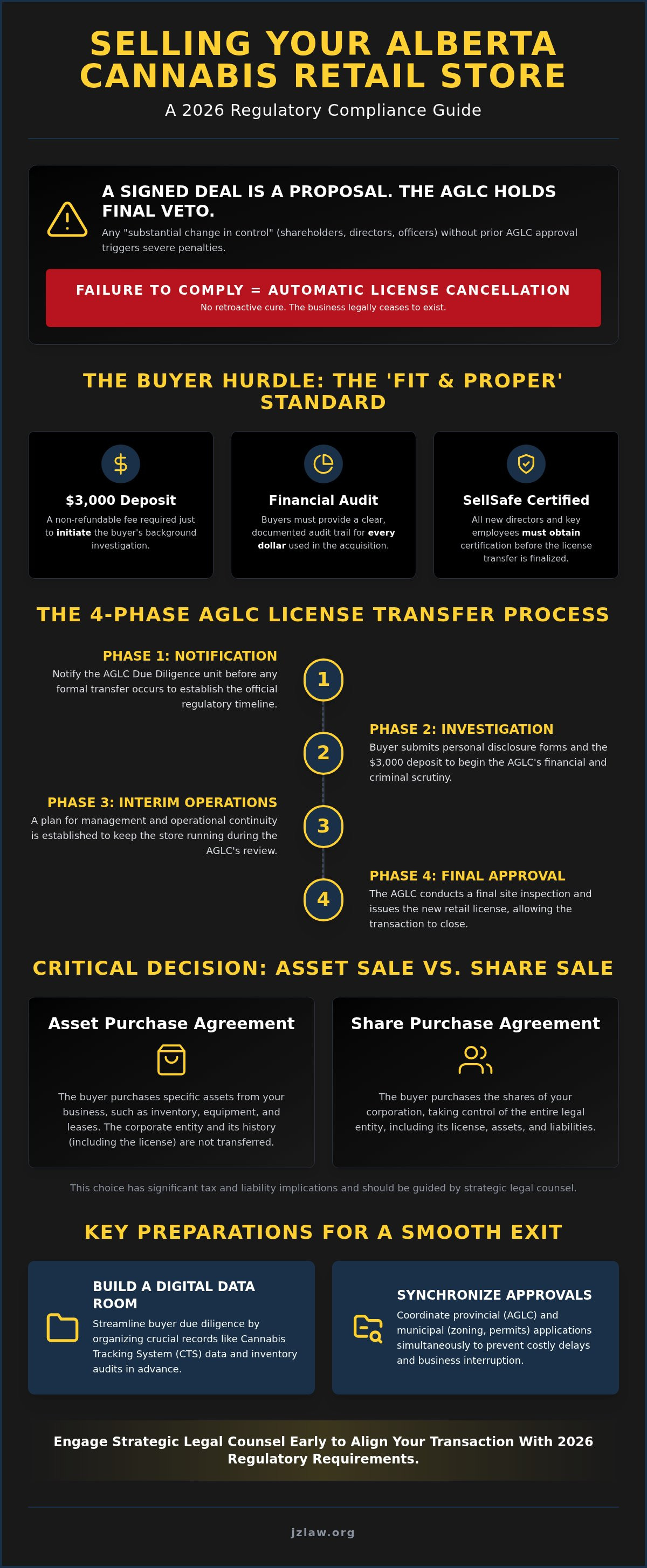
The AGLC acts as the ultimate gatekeeper for every transaction involving Cannabis Regulation in Alberta. When entrepreneurs are selling a licensed cannabis retail store alberta regulations dictate that they aren't simply transferring assets; they're petitioning the provincial government to trust a new operator with a controlled substance. Under the 2026 guidelines, any "substantial change in control" triggers a mandatory and exhaustive review by the AGLC's Due Diligence unit. This definition covers any shift in shareholders, directors, or officers that alters the effective management of the corporation. If a seller completes a transfer without prior written consent, the license is automatically cancelled without any legal mechanism for a retroactive cure; the business simply ceases to exist in the eyes of the law.
Simple business sales frequently fail in this sector because they don't account for the regulator's timeline. The complexities of selling a licensed cannabis retail store alberta demand a strategy that aligns conventional closing dates with the AGLC's investigative pace. While the federal Cannabis Act creates a broad framework, Alberta's specific provincial requirements add layers of scrutiny regarding criminal records and financial transparency. Sellers must realize that their buyer's personal history becomes a deal-breaking risk factor for the seller's own exit strategy. If the buyer doesn't meet the "fit and proper" standard, the transaction cannot proceed to completion.
The 'Fit and Proper' Requirement for Buyers
The AGLC's "fit and proper" standard represents the highest barrier to entry for any prospective purchaser. Buyers must submit a non-refundable $3,000 deposit just to initiate the background investigation process. This inquiry isn't superficial; the Due Diligence unit traces the source of every dollar used for the acquisition to ensure no funds are linked to illegal activity. If a buyer can't provide a clear, documented audit trail for their capital, the AGLC will deny the transfer. Additionally, all incoming directors and key employees must obtain SellSafe certification before the license transfer is finalized, ensuring the new management understands their provincial compliance obligations from day one.
Municipal vs. Provincial Approval Chains
A successful exit requires precise synchronization between provincial and municipal authorities. While the AGLC manages the retail license, municipalities like Calgary, Edmonton, and Red Deer control the land use and specific business permits. If the buyer intends to modify the store's footprint or branding, they must navigate local zoning bylaws that are often more restrictive than provincial rules. When selling a licensed cannabis retail store alberta vendors should not wait for the AGLC to finish its review before engaging with local planning departments. Coordinating these notification chains simultaneously is the only way to prevent the store from sitting dormant during the transition, which protects the business's ongoing valuation and customer base.
The AGLC License Transfer Process: A Step-by-Step Overview
The procedural journey of selling a licensed cannabis retail store alberta involves four distinct regulatory phases that must be navigated with chronological precision. It begins with Phase 1: Pre-disclosure and initial notification. Before any formal transfer of control occurs, the parties must notify the AGLC's Due Diligence unit to establish the official timeline for the regulator. Phase 2 focuses on the background investigation and personal disclosure forms. During this stage, the buyer must submit a non-refundable $3,000 deposit to cover the costs of financial and criminal scrutiny, a step that is fundamental when selling a licensed cannabis retail store alberta. Comprehensive documentation and filing templates are accessible through the AGLC Retail Cannabis Portal, which serves as the primary gateway for these administrative submissions.
Phase 3 addresses interim management and operational continuity, ensuring the store remains functional while the regulator completes its review. Finally, Phase 4 concludes with a final site inspection and the issuance of the new retail license. Only after the AGLC issues this new document can the seller fully relinquish control and finalize the financial closing of the transaction.
Managing the Transition Period
The interim period between signing a purchase agreement and receiving provincial approval is fraught with the risk of "shadow ownership." This occurs when a purchaser begins making operational decisions or receiving profits before they are legally licensed. The AGLC views this as a violation of the Gaming, Liquor and Cannabis Act, which can lead to immediate license revocation. To mitigate this risk, sellers should utilize strictly drafted management agreements that keep the vendor in full legal control while allowing the buyer to act in a consulting capacity. Ensuring these corporate transactions are structured to satisfy provincial standards is essential for protecting the license during the sale. Maintaining SellSafe compliance and clear payroll records during this time prevents the appearance of an unauthorized transfer of authority.
Common Regulatory Bottlenecks
Deal delays most frequently arise from the incomplete financial histories of foreign investors or undisclosed beneficial owners. If a purchaser has capital originating from jurisdictions with opaque banking laws, the AGLC's investigation will stall indefinitely. Any individual holding more than 5% of the shares must be fully vetted; failing to disclose even a minor partner can restart the entire investigative clock. Sellers often find that selling a licensed cannabis retail store alberta requires a proactive approach to the AGLC's 2026 backlog mitigation strategy, which mandates a pre-consultation phase with the Due Diligence unit to verify all beneficial ownership documentation before a file is formally assigned to an investigator. This step prevents incomplete applications from clogging the system and provides a more predictable timeline for closing.
Asset Sale vs. Share Sale: Strategic Considerations for Cannabis Retailers
Choosing the right transaction structure is a pivotal decision when selling a licensed cannabis retail store in Alberta. The legal architecture of your deal typically takes one of two forms: an Asset Purchase Agreement (APA) or a Share Purchase Agreement (SPA). In an APA, the purchaser acquires specific components of the business, such as the leasehold improvements, inventory, and brand assets, while leaving the existing corporate entity and its historical liabilities with the seller. Conversely, an SPA involves the buyer purchasing the shares of the corporation itself. This approach allows the seller to walk away from the business entirely, but it requires the buyer to inherit the corporation's entire history, including any past regulatory or tax disputes.
Buyers in the cannabis sector often favor asset deals to insulate themselves from legacy risks. Given the strict provincial oversight, a buyer might be hesitant to take on a corporate shell that may have had compliance infractions or undisclosed debts in the past. However, sellers generally prefer share sales to access the Lifetime Capital Gains Exemption (LCGE). If your business qualifies as a Small Business Corporation, this exemption can significantly reduce the tax burden on your sale proceeds. Balancing these competing interests requires a clear understanding of your corporation's risk profile and financial health.
The Cannabis License as a Transferable Asset
A common misconception is that a retail license is a property right that can be sold directly to a third party. In reality, the AGLC maintains absolute control over the privilege of operating. When a store is sold through an asset deal, the buyer must meet all AGLC licensing requirements to have a new license issued for that specific location. The seller's license is effectively surrendered or cancelled upon the issuance of the new one. Valuing a store in today's market requires a realistic assessment of goodwill and brand equity. In a saturated Alberta landscape, the value often lies in a strategic location and a clean compliance record. For a deeper look at high-level deal structures, see our guide on Strategic Corporate Transactions 2026.
Tax Structuring for Maximum Exit Value
The financial efficiency of your exit depends heavily on how you've organized your corporate holdings. Utilizing a holding company can provide a buffer for tax planning, allowing for the strategic distribution of dividends before a sale is finalized. Sellers must also be mindful of GST/HST implications; while the "sale of a business as a going concern" often allows for a tax-exempt transfer, specific criteria must be met to avoid an unexpected tax bill at closing. Understanding how tax structuring influences your net proceeds is vital. Proper planning ensures you don't leave significant value on the table due to avoidable tax leakages or poorly timed asset transfers during the sale of your business.
Legal Due Diligence: Protecting Value and Ensuring Compliance
Preparing for a buyer's legal team requires a meticulously organized digital data room. When selling a licensed cannabis retail store in Alberta, the quality of your documentation directly influences the speed and success of the closing. Buyers will scrutinize the Cannabis Tracking System (CTS) records to ensure inventory levels align perfectly with reported sales. Any discrepancy here raises immediate red flags regarding diversion or poor management. Additionally, sellers must secure environmental and zoning compliance certificates to prove the location remains valid under evolving municipal land-use bylaws. These documents serve as the foundation of trust in a high-stakes transaction.
Commercial leases represent a frequent hurdle in the divestiture process. Most Alberta retail leases contain "change of control" clauses that require landlord consent for a business sale. If the landlord views the cannabis industry as high-risk, they may attempt to renegotiate terms or withhold consent. Proactively addressing these clauses ensures the lease remains a transferable asset rather than a liability. You should review your lease early to determine if a transfer fee applies or if the landlord has the right to terminate the agreement upon a change in ownership.
Regulatory Audit: The Compliance Health Check
A buyer's primary fear is inheriting a license on the verge of revocation. You must provide a comprehensive history of AGLC inspections and any past violation notices to prove the business's integrity. This audit includes verifying that all in-store signage and marketing materials strictly adhere to the federal Cannabis Act. Sellers should also confirm that every staff member's SellSafe certification is current and documented. A proactive compliance check prevents last-minute discoveries that could devalue the business or derail the AGLC approval process during the buyer's final review.
Financial and Corporate Due Diligence
Transparency in financial obligations is non-negotiable for a clean exit. This involves analyzing supply agreements and ensuring all debt obligations are clearly disclosed and manageable. In Alberta, employee contracts and potential severance liabilities must be reviewed; the transition of staff often triggers specific legal duties under provincial employment standards. Finally, you must demonstrate clean title to all physical assets, from point-of-sale systems to specialized security equipment. If you need assistance preparing your business for a rigorous buyer review, contact our experts in corporate transactions to secure your exit with strategic precision.
Strategic Legal Counsel for Alberta Cannabis Transactions
JZ Law approaches cannabis retail divestitures through a lens of strategic risk mitigation. When you're selling a licensed cannabis retail store in Alberta, you need a partner who understands that the regulatory file is just as important as the purchase price. Boutique firms offer a distinct advantage in these transactions. They provide the specialized attention required to manage the AGLC's exhaustive scrutiny without the administrative overhead of a generalist firm. John Zang integrates deep expertise in corporate finance with a granular understanding of cannabis licensing. This ensures the financial structure of the deal doesn't inadvertently trigger regulatory red flags. We prevent the delays that often plague larger, less agile firms.
Preparing for the future involves more than just the transfer of keys. We focus on drafting robust post-closing obligations, including non-compete clauses that protect the buyer's investment while ensuring the seller's clean break from the industry. These agreements must be balanced to withstand judicial scrutiny while respecting the unique competitive landscape of the Alberta market. Our approach ensures that tax structuring and securities regulation are aligned with the provincial 'fit and proper' requirements from the outset. This minimizes the risk of post-sale litigation.
Tailored Solutions for Calgary and Beyond
Managing the Calgary municipal landscape requires a localized understanding of land-use bylaws and development permits. When selling a licensed cannabis retail store in Alberta, the complexity increases with each additional storefront. Our firm leverages a broad network of industry professionals to ensure that multi-location retail chains maintain operational continuity across different jurisdictions. We handle everything from Edmonton's zoning requirements to Red Deer's business licensing standards with equal precision. This geographic expertise allows us to anticipate municipal hurdles before they become deal-breakers. Efficiency is our priority.
Closing the Deal with Confidence
The final stages of a transaction are often the most volatile. We utilize sophisticated escrow arrangements to protect both parties during the AGLC's final review period. This ensures that funds are only released once the AGLC handover is complete and the new license is active. Finalizing the operational transition involves a systematic transfer of CTS records and security protocols, leaving nothing to chance. Surprises destroy deal value. If you're ready to secure a compliant and high-value exit, consult with JZ Law for your cannabis retail exit strategy.
Securing Your Legacy in the Alberta Cannabis Market
Divesting from a retail operation in this sector demands more than finding a buyer; it requires a surgical alignment of corporate strategy and provincial compliance. You've already explored how the AGLC's investigative process can stall a deal and why the structure of your purchase agreement is fundamental to your net proceeds. Success hinges on anticipating regulatory bottlenecks so you don't face unexpected delays, ensuring every CTS record and municipal permit is audit-ready before the buyer's team arrives. When you're selling a licensed cannabis retail store alberta, the margin for error is non-existent.
Partnering with a firm that understands the intersection of securities regulation and cannabis law is essential for a clean, profitable exit. John Zang provides specialized expertise in Alberta cannabis licensing and strategic corporate transaction management, ensuring your transition is handled with the precision your business deserves. Secure strategic legal counsel for your cannabis business sale at JZ Law to leverage our deep regulatory experience and finalize your deal with confidence. Your next chapter starts with a compliant, high-valuation closing.
Frequently Asked Questions
How long does it take to get AGLC approval for a license transfer in 2026?
AGLC approval timelines in 2026 depend on the complexity of the buyer's corporate structure and the depth of the required background checks. While the AGLC's backlog mitigation strategy aims to streamline reviews, the process typically spans several months. Sellers should account for this window in their closing schedules. The investigation only begins in earnest once the $3,000 background check deposit is paid and all personal disclosure forms are submitted to the Due Diligence unit.
Can I sell my cannabis retail license without selling the whole business?
You cannot sell a cannabis retail license as a standalone asset. In Alberta, the license is tied to both the physical location and the specific legal entity authorized to operate. When selling a licensed cannabis retail store in Alberta, the transaction involves transferring the underlying business assets or shares. The AGLC then evaluates the new owner's eligibility before re-issuing or approving the continuation of the license under the new ownership structure.
What are the AGLC fees associated with changing ownership of a retail store?
The AGLC fee schedule, amended on June 1, 2026, requires several mandatory payments for ownership changes. The application fee for a cannabis store license is $400 and is non-refundable. Additionally, the annual license fee is $1,200. Buyers must also provide an initial $3,000 deposit for background checks. Any unused portion of this deposit is refunded by the AGLC after the Due Diligence unit completes its investigation into the new shareholders and directors.
Do I need a new municipal permit if I buy an existing cannabis store in Calgary?
Yes, municipal approval is a prerequisite for provincial licensing. Even if the store is currently operational, the City of Calgary requires the new owner to secure a valid business license and meet all local land-use bylaws. This ensures the new operator complies with specific separation distances and zoning requirements. You must coordinate this municipal notification alongside your AGLC application to prevent operational gaps during the transition of ownership between the parties.
What happens to my cannabis inventory during a business sale?
Inventory remains subject to strict Cannabis Tracking System (CTS) requirements throughout the sale process. During an asset sale, the inventory is typically sold to the purchaser at a determined valuation and transferred into their account upon license approval. It's essential to conduct a comprehensive inventory audit before closing. This ensures that all physical stock matches the digital records, as any discrepancies can trigger AGLC sanctions or significant delays in the license transfer.
Is it better to do an asset sale or a share sale for a cannabis dispensary?
The ideal structure depends on your financial goals and risk tolerance. Sellers often prefer share sales to utilize the Lifetime Capital Gains Exemption, which can significantly reduce taxes on the proceeds. However, buyers frequently push for asset sales to avoid inheriting the corporation's historical liabilities or past compliance infractions. When selling a licensed cannabis retail store in Alberta, you must weigh these tax advantages against the buyer's demand for a clean corporate slate.
Can a non-resident of Canada buy a licensed cannabis store in Alberta?
Non-residents can purchase a licensed cannabis store, but they face heightened scrutiny from the AGLC's Due Diligence unit. The regulator requires an exhaustive audit trail for all foreign capital to ensure funds aren't linked to illegal activity. Beneficial owners must undergo the same rigorous background checks as domestic applicants. While residency isn't a strict barrier, the complexity of verifying international financial records often leads to longer approval timelines compared to domestic transactions involving local capital.
How does the AGLC investigate the source of funds for a buyer?
The AGLC investigates the source of funds by tracing the path of every dollar used for the acquisition. This process ensures that the cannabis industry remains free from criminal influence. Buyers must provide bank statements, investment records, and tax returns that clearly document the origin of their capital. If any portion of the funding is opaque or lacks a verifiable audit trail, the AGLC will deny the license transfer regardless of the purchase agreement's terms.



Comments