


Social Equity Cannabis License New York: 2026 Legal Strategic Guide
Securing a social equity cannabis license New York isn't just about meeting a quota; it's about building a corporate fortress that can withstand the intense scrutiny of the Office of Cannabis Management. While New York has already exceeded its statutory goal of awarding 50% of adult-use licenses to equity applicants, many founders still find themselves trapped between rigid "sole control" definitions and the urgent need for institutional capital. It's frustrating to watch priority scoring metrics shift just as you're ready to launch, and it's even more daunting to structure your business for a future M&A or public offering without violating current equity rules.
We believe that your social equity status should be a strategic advantage, not a regulatory bottleneck. This guide provides the expert legal insights you need to navigate the 2026 regulatory landscape and secure your business's future. We'll explore the specific legal definitions of management control, strategies for capital acquisition, and the steps required to establish a robust corporate structure that's ready for the projected $2.7 billion market of 2027. By the end of this analysis, you'll have a clear roadmap for converting provisional status into a permanent, scalable enterprise.
Table of Contents
Understanding the New York Social and Economic Equity (SEE) Framework in 2026
Qualifying for Priority: SEE Groups and 2026 Eligibility Criteria
The Application Process: Navigating OCM Priority and Scoring
Protecting Your Asset: Navigating 'Sole Control' and Operational Compliance
Strategic Growth: From New York SEE Licensee to Public Company
Understanding the New York Social and Economic Equity (SEE) Framework in 2026
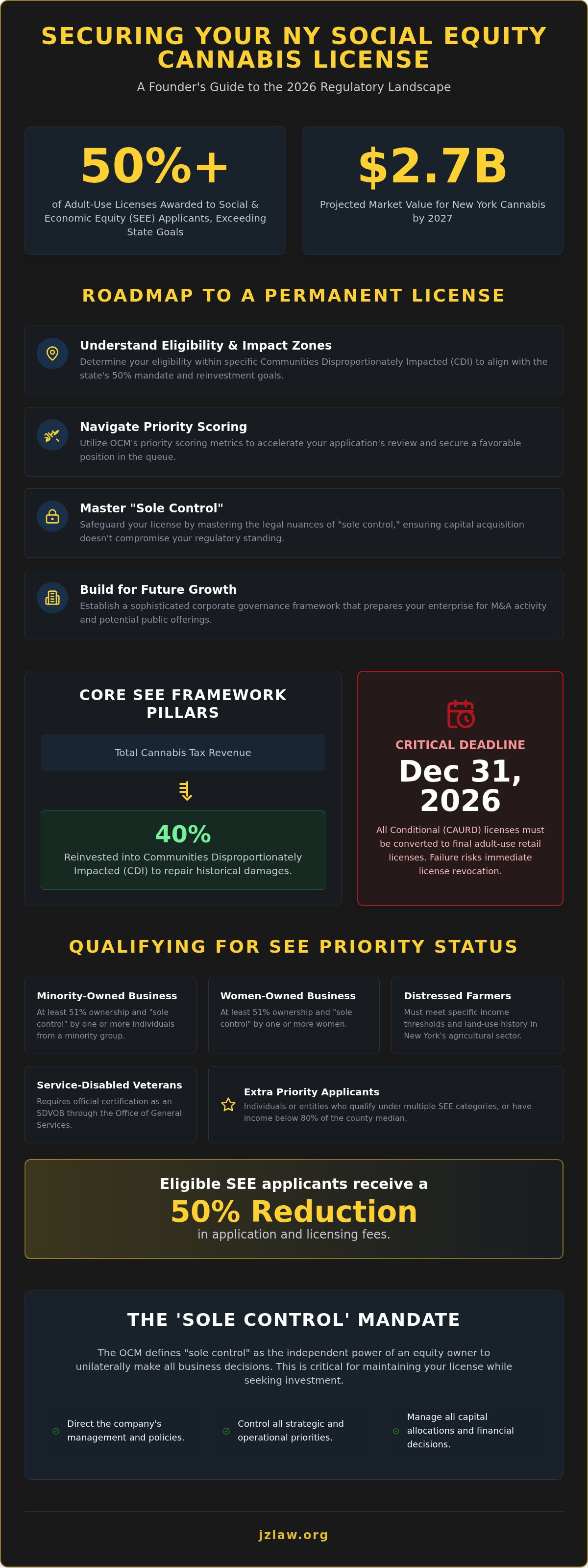
The year 2026 represents a pivotal maturation phase for the New York cannabis market. While the initial years following the Marihuana Regulation & Taxation Act (MRTA) were defined by rapid, often turbulent growth, the current landscape focuses on institutional stability. Central to this stability is the social equity cannabis license New York framework, which has successfully transitioned from a conceptual goal to a functional market cornerstone. The Office of Cannabis Management (OCM) has not only met but exceeded its statutory mandate to award 50% of all adult-use licenses to social and economic equity (SEE) applicants. This achievement signals a shift from mere market entry to long-term operational viability. Legal precision during this phase is paramount, as the OCM now prioritizes applicants who demonstrate not just eligibility, but a sophisticated understanding of the 2026-2027 regulatory requirements.
The Core Philosophy of NY Cannabis Equity
New York’s approach remains unique among global cannabis hubs because of its integrated reinvestment model. The state directs 40% of cannabis tax revenue into Communities Disproportionately Impacted (CDI) to repair the historical damage of prohibition. Understanding the History of New York Cannabis Legalization is essential for founders who wish to align their corporate mission with the state's legislative intent. The Cannabis Advisory Board now plays a more active role in 2026, refining policies that ensure SEE participants aren't just granted access, but are provided the regulatory environment necessary to scale. This strategic alignment often determines which businesses attract the institutional capital required for expansion into the broader market.
Permanent vs. Conditional Licensing
The most critical legal hurdle for many operators in 2026 is the sunsetting of conditional licenses. All Conditional Adult-Use Retail Dispensary (CAURD) licensees must complete their conversion to final adult-use retail licenses by the December 31, 2026 deadline. This transition isn't a mere formality; it requires a rigorous update of corporate governance and reporting standards. Transitioning to a permanent social equity cannabis license New York involves meeting more stringent weekly inventory reporting and strictly adhering to the Metrc seed-to-sale tracking system. Failing to secure this transition by the year-end deadline risks immediate license revocation, effectively ending a business's ability to participate in the projected $2.7 billion market of 2027. Precision in these filings isn't optional. It's the difference between a temporary venture and a lasting brand that is ready for future M&A activity.
Qualifying for Priority: SEE Groups and 2026 Eligibility Criteria
Securing a social equity cannabis license New York is a multi-layered process where the burden of proof rests entirely on the applicant. Achieving this status requires more than a simple declaration of intent; it demands a meticulous validation of your background against the state's rigorous 2026 criteria. The Office of Cannabis Management utilizes a tiered system to prioritize those most affected by past enforcement, ensuring that the market's growth remains rooted in its original restorative goals. This prioritization is not merely a box-checking exercise; it's a competitive filter that determines your position in the review queue and your eventual operational timeline.
Defining Social Equity Groups
The New York Social and Economic Equity (SEE) Framework identifies five distinct categories eligible for priority review and a 50% reduction in application and licensing fees. Minority-owned and women-owned businesses must demonstrate at least 51% ownership and, crucially, "sole control," which the OCM defines as the independent ability to direct the management, strategic priorities, and capital allocations of the business. For Service-Disabled Veteran-Owned Businesses (SDVOB), certification through the Office of General Services is a prerequisite. Distressed farmers must meet specific land-use history and income thresholds that reflect a consistent commitment to New York’s agricultural sector despite economic hardship. The "Extra Priority" tier is reserved for those who occupy the intersection of multiple categories, such as low-income individuals who also reside in a CDI, granting them the highest level of queue precedence.
Income and Residency Verification
Financial eligibility hinges on the 80% median income threshold, calculated based on the specific county of residence. Applicants must provide tax returns and official documentation to prove they fall below this ceiling. Proving residency in a Community Disproportionately Impacted (CDI) involves cross-referencing your history with OCM-validated census tracts. To qualify for priority status in 2026, applicants must provide verifiable evidence of long-term residency within a designated census tract that has historically experienced high rates of cannabis-related arrests.
This level of documentation is the first step in establishing a business that can withstand the scrutiny of institutional investors or future public offerings. Navigating these intersections of income, residency, and ownership requires a proactive legal strategy to avoid the common pitfalls that lead to application rejection. If you are seeking to build a legally robust foundation for your enterprise, exploring professional cannabis licensing services can help ensure your corporate structure aligns with both state mandates and long-term business objectives.
The Application Process: Navigating OCM Priority and Scoring
Applying for a social equity cannabis license New York in 2026 is no longer a simple race for first-mover advantage; it's a rigorous test of regulatory stamina and legal precision. The Office of Cannabis Management (OCM) utilizes a sophisticated priority scoring system to queue the high volume of submissions. This scoring isn't just about your SEE status. It also factors in the completeness of your disclosures and your immediate readiness to operate. While many founders rely on the SEE PATH (Programs, Assistance, and Training Hub) for basic guidance, high-stakes applicants must go beyond generic training to ensure their legal filings are bulletproof. Minor errors in financial disclosures or previous business affiliations can lead to immediate disqualification without an opportunity to appeal.
Pre-Application Strategic Planning
Before you hit submit, your real estate strategy must be finalized. While the DASNY Social Equity Investment Fund provides a pathway for some, many 2026 applicants find more flexibility through independent landlord agreements that offer greater operational control. Regardless of the path, your operational plan must explicitly detail how your business will fulfill SEE community impact requirements. This plan serves as a binding contract with the state. For a deeper look at how these requirements compare to other markets, see our Cannabis Licensing Guide 2026, which explores regulatory frameworks in global hubs.
Managing the OCM Review Cycle
The New York Social and Economic Equity (SEE) Framework allows for specific "Cure Periods" where you can address application deficiencies. It's a critical window. You must respond to OCM inquiries with absolute precision while carefully shielding sensitive corporate trade secrets from public disclosure. In the 2026 cycle, the OCM expects rapid responses to ensure the market reaches its projected potential. With the December 31, 2026 conversion deadline for conditional licenses approaching, the queue is moving faster than ever. Preparing your corporate governance documents ahead of time ensures you can pivot from applicant to operator the moment your license is issued.
Protecting Your Asset: Navigating 'Sole Control' and Operational Compliance
Maintaining a social equity cannabis license New York requires constant vigilance over your corporate structure. While the initial application focuses on eligibility, the operational phase is governed by the strict principle of "sole control." This legal standard is the most frequent point of failure for equity businesses that seek outside investment. The Office of Cannabis Management (OCM) maintains a hawk-eyed focus on ensuring that the individuals who qualified for the license are the ones actually directing the enterprise. If an investor's influence overreaches, the state views it as a "predatory" arrangement, which can lead to immediate license revocation and the loss of your entire business asset.
The Mechanics of Sole Control
The distinction between a passive investor and a controlling interest is often found in the fine print of your operating agreement. The OCM scrutinizes veto rights, board seat allocations, and even specific clauses regarding the removal of managers. If an outside party has the power to block strategic decisions or dictate capital expenditures, you have effectively surrendered sole control. Sole control constitutes the ability to independently direct the management and policies of the licensed business, specifically regarding strategic priorities, capital allocations, and the execution of significant contracts. Protecting your authority requires shareholder agreements that clearly delineate the boundaries of investor involvement, ensuring that financial support doesn't translate into regulatory non-compliance.
Compliance in the Two-Tier Market
New York’s regulatory framework is built upon a strict two-tier market structure designed to prevent the monopolistic vertical integration seen in other states. For a retail social equity cannabis license New York, this means you are legally prohibited from having any direct or indirect interest in a cultivation or processing license. Managing your supply chain requires sophisticated contract management to ensure you aren't inadvertently entering into agreements that the OCM could interpret as a "true party of interest" violation. Compliance also extends to weekly inventory reporting and the rigorous use of the Metrc seed-to-sale system, which provides the state with real-time transparency into your operations.
Establishing a legally robust corporate structure is the only way to secure institutional-grade capital while remaining in the OCM's good graces. Our firm specializes in drafting the complex governance documents required to balance these competing interests. If you need to restructure your business for growth or prepare for an upcoming investment round, you can consult our corporate transaction experts to ensure your equity status remains protected throughout the process.
Strategic Growth: From New York SEE Licensee to Public Company
The acquisition of a social equity cannabis license New York marks the beginning of a corporate lifecycle, not its conclusion. While the immediate focus for many founders remains on operational launch and OCM compliance, the most successful enterprises are built with a clear vision for institutional growth. In a market projected to reach $2.7 billion by 2027, your business must be positioned as an attractive target for merger and acquisition (M&A) activity or as a candidate for the public markets. Transitioning from a local dispensary to a scalable corporate entity requires moving beyond basic regulatory adherence into the realm of sophisticated corporate governance and strategic financial planning.
Structuring for Capital and Exit
Attracting institutional capital requires a corporate structure that mirrors the standards of non-cannabis industries. This involves meticulous tax structuring to mitigate the unique financial burdens of the sector and ensuring that all private placements comply with federal and state securities regulations. Founders must balance the need for capital with the "sole control" mandates that protect their equity status. By implementing these standards early, you create a transparent, auditable history that simplifies the due diligence process during an acquisition. For those looking toward the ultimate liquidity event, our guide on Taking Your Cannabis Company Public provides the specialized roadmap needed to navigate the complexities of an IPO.
The JZ Law Advantage
Strategic legal counsel serves as the bridge between social equity status and global market participation. Our firm does not merely facilitate licensing; we act as a strategic partner to ensure your corporate governance can withstand the scrutiny of international regulators and institutional investors. As the New York market matures, the experience gained here becomes a valuable asset for expansion into global hubs such as Berlin, Toronto, or Calgary. Navigating cross-border regulations and international tax treaties requires a proactive, preventive approach that eliminates risks before they manifest in high-stakes transactions. We invite you to contact JZ Law for a comprehensive consultation on cannabis licensing and corporate strategy to secure your business’s future in the global economy.
Building an institutional-grade business from day one ensures that you remain the architect of your company’s destiny. Whether your goal is to dominate the New York retail landscape or to establish a multi-state footprint, the legal foundation you lay today dictates your ceiling for tomorrow. By combining the restorative intent of the social equity cannabis license New York with modern, disciplined business practices, founders can transform a regulatory opportunity into a lasting legacy of economic power.
Securing Your Legacy in New York's Mature Cannabis Market
Navigating the 2026 regulatory landscape requires more than just meeting initial eligibility criteria. You've seen how maintaining "sole control" serves as the primary defense against license revocation, particularly when you're managing the complexities of New York's two-tier market structure. Building a corporate foundation that's ready for future M&A activity or a public offering separates temporary ventures from lasting market leaders. A social equity cannabis license New York is a powerful tool for economic restoration; however, its true value is only realized through rigorous legal precision and a proactive corporate strategy.
Our firm provides the specialized expertise in cannabis licensing and corporate finance required to bridge the gap between equity status and global expansion. We offer a strategic perspective that spans New York, Canada, and Europe, providing the guidance necessary for taking companies public. Secure your strategic legal consultation with JZ Law to ensure your enterprise remains compliant, protected, and prepared for the institutional stage. Your vision deserves a legal framework that is as ambitious as your business goals.
Frequently Asked Questions
What is a community disproportionately impacted (CDI) in New York?
A CDI is a geographic area, identified by specific census tracts, that has historically experienced high rates of cannabis-related arrests, convictions, and incarceration. The Office of Cannabis Management maintains a comprehensive list of these tracts based on data provided by the state's criminal justice system. Living in a designated CDI for a cumulative period of five or seven years serves as a primary qualification for a social equity cannabis license New York.
Can a woman-owned business also qualify as a minority-owned business for SEE status?
Yes, an applicant can belong to multiple social and economic equity (SEE) categories simultaneously. While you can hold certifications for both Minority-Owned Business Enterprise (MBE) and Women-Owned Business Enterprise (WBE), the OCM utilizes this intersectionality to determine "Extra Priority" status. This can significantly improve your position in the review queue. You must still prove that the qualifying individuals maintain at least 51% ownership and sole control over the corporate entity.
How much of the cannabis tax revenue goes to the SEE program?
New York law mandates that 40% of all adult-use cannabis tax revenue is reinvested into communities disproportionately impacted by the historical prohibition of cannabis. This funding supports the Community Reinvestment Fund, which provides grants for social services, economic development, and youth programs in qualifying areas. This reinvestment model is a core pillar of the state's equity framework, ensuring that the economic benefits of legalization reach those who were previously marginalized by the law.
What happens to CAURD licenses in 2026?
All Conditional Adult-Use Retail Dispensary (CAURD) licenses must be converted to final, permanent adult-use retail licenses by the December 31, 2026 deadline. This transition requires licensees to meet updated regulatory standards and submit detailed documentation regarding their permanent corporate governance. Failure to complete this conversion by the end of 2026 results in the immediate expiration of the license. This effectively bars the business from operating in the legal market during the 2027 cycle.
Is there a limit on how many social equity licenses New York will issue?
There isn't a hard numerical cap on the total number of social equity licenses, but the state has a statutory goal to award 50% of all adult-use licenses to SEE applicants. The OCM monitors market density and strict proximity rules, such as the 500-foot school requirement, to manage the total number of operational dispensaries. As of mid-2026, the state has already exceeded its 50% goal across all issued adult-use licenses throughout the state.
Can I sell my social equity cannabis license to a non-equity investor?
You cannot sell a social equity cannabis license New York to a non-equity investor without risking immediate revocation. The OCM requires that the qualifying SEE individual or group maintains sole control and majority ownership. While you can bring in outside capital for growth, any transfer of ownership or change in management that dilutes the equity applicant's authority below the legal threshold is prohibited. These restrictions ensure the program's benefits stay with the intended recipients.
What is the Cannabis Social Equity Investment Fund?
The Cannabis Social Equity Investment Fund is a public-private partnership managed by DASNY designed to provide turnkey retail locations for CAURD licensees. The fund identifies, leases, and renovates dispensaries to lower the barrier to entry for equity applicants who lack significant capital. In 2026, the focus has shifted toward ensuring these locations meet permanent licensing standards and helping operators transition their businesses into sustainable, long-term enterprises that can eventually scale or go public.
How do I prove my income is below the 80% median for SEE qualification?
You must provide official financial documentation, such as federal and state tax returns from the previous three years, to verify your income status. The OCM compares your reported adjusted gross income against the median income of your specific county of residence. If your income exceeds 80% of that county's median, you won't qualify for the low-income priority status. This holds true even if you meet other residency requirements in a community disproportionately impacted by enforcement.



Comments