


Selling a Business in Calgary: Strategic Legal Advice for 2026
- jzanglaw
- 4 days ago
- 12 min read
Updated: 1 day ago
A business exit is rarely a single event; it's a calculated legal transition where the difference between a legacy secured and a significant tax penalty often rests on a single clause within the purchase agreement. You've spent years building your enterprise in Alberta, so the fear of post-closing liabilities or losing a massive portion of your valuation to tax leakage is a valid concern that requires a proactive, defensive strategy. Most founders realize too late that a handshake deal doesn't protect them from the complexities of the 2026 regulatory environment, which is why obtaining specialized selling a business calgary legal advice remains the most critical step for any entrepreneur seeking a clean break.
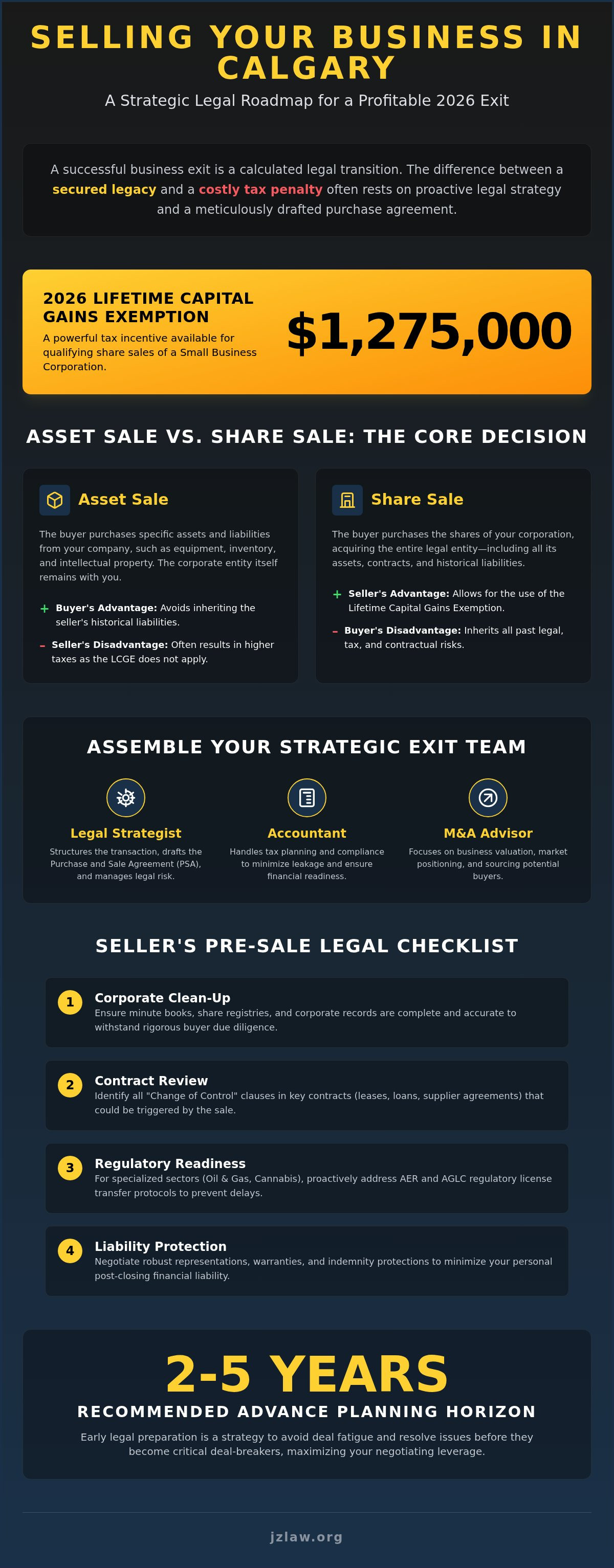
By strategically planning your exit, you can leverage the 2026 Lifetime Capital Gains Exemption of $1,275,000 and ensure your regulatory licenses transition without a hitch. This article examines the critical steps for a clean exit, focusing on tax-efficient structuring, regulatory compliance in specialized sectors, and high-stakes negotiation tactics. You'll learn how to insulate your personal wealth from future lawsuits while achieving the maximum possible valuation for your life's work. We will break down the precise legal frameworks that turn a complex sale into a seamless, profitable transition for your business.
Table of Contents
The Landscape of Selling a Business in Calgary in 2026
Calgary's economic environment in 2026 presents a unique set of opportunities for business owners, yet valuations are increasingly sensitive to regulatory stability and operational efficiency. While energy remains a pillar, the diversification into tech and cannabis has created a fragmented marketplace where a generic legal strategy often results in significant value erosion. Securing specialized selling a business calgary legal advice is no longer a luxury; it's a structural necessity for founders who want to protect their equity. Buyers in 2026 are more sophisticated, often utilizing advanced due diligence protocols that scrutinize every aspect of a company's legal standing before an offer is finalized.
A successful exit requires a clear division of labor within your advisory group. While a business broker focuses on market positioning and finding a buyer, your corporate lawyer manages the underlying risk and structures the transaction to minimize tax leakage. This collaboration culminates in the drafting of the Purchase and Sale Agreement (PSA), a document that serves as the legal foundation for the entire transfer. Your "Exit Team" should ideally include an accountant for tax compliance, an M&A advisor for valuation, and a legal strategist like John Zang who understands high-stakes negotiations and securities regulation.
Defining Your Exit Strategy
Choosing between a third-party acquisition and a management buy-out (MBO) fundamentally changes your legal requirements. In the Calgary market, MBOs are gaining traction as founders look to preserve company culture while exiting. Succession planning requires a different set of contractual protections than a clean-break sale to a competitor. For high-growth firms, the path might even involve taking the company public or a reverse merger. JZ Law provides the specialized counsel needed for these complex corporate transactions, ensuring that whether you're selling to employees or preparing for an IPO, the legal structure supports your long-term financial goals.
Timing the Calgary Market
Market timing in 2026 is heavily influenced by Alberta's regulatory cycles and the stabilization of interest rates, which directly impact a buyer's financing capacity. Planning your exit two to five years in advance isn't just a recommendation; it's a strategy to avoid deal fatigue. Early legal preparation allows you to clean up your corporate minute books and resolve any outstanding regulatory hurdles before they become deal-breakers. With Alberta's general corporate tax rate holding at 8%, the province remains a competitive place for exits, but only for those who have aligned their legal readiness with these favorable fiscal conditions.
Asset Sale vs. Share Sale: Legal and Tax Implications
Selecting the correct transaction structure is perhaps the most consequential decision a founder makes during an exit. In an asset sale, the buyer acquires specific components of the business, such as equipment, inventory, and intellectual property, while the legal entity remains with the seller. Conversely, a share sale involves the transfer of the entire corporation, including its history, contracts, and liabilities. Professional selling a business calgary legal advice is essential here because the tax outcomes diverge sharply between these paths. For 2026, the Lifetime Capital Gains Exemption (LCGE) has been indexed to $1,275,000, offering a powerful incentive for share sales that qualify under the Small Business Corporation criteria.
While share sales often favor the seller due to the LCGE, they carry the burden of historical liability. Buyers inherit every past legal dispute, tax audit, or contractual breach associated with the corporation. To mitigate this, sophisticated tax structuring can sometimes bridge the gap between a buyer's desire for an asset purchase and a seller's need for share sale tax treatment. Sellers should consult the official Government of Canada guidance to understand how these choices impact GST obligations and business number transitions.
The Mechanics of an Asset Purchase
Asset transactions require meticulous documentation for every item being transferred. This includes the assignment of commercial leases, the transfer of registered trademarks, and the formal transition of employees. It is also vital to document the maintenance of physical property; for example, showing a history of professional care from a specialist like L&J Roofing LLC ensures that the building's roof integrity is verified, preventing buyers from requesting repair credits. Under Alberta law, buyers must be wary of successor employer liabilities, which can trigger obligations for past service years. Sellers must also navigate GST considerations; while many asset sales can utilize a Section 167 election to be tax-free, specific criteria must be met to avoid immediate tax hits on the sale of equipment or intangibles. Precise drafting ensures that you don't inadvertently retain liabilities for assets you've already sold.
The SPA is the definitive document in a share sale, governed largely by the strength of representations and warranties. These are the seller's formal promises about the state of the company; for example, in specialized retail where you might check out JZ2U for authentic factory surplus jerseys, warranties must explicitly cover the chain of title and authenticity of all stock. To protect against future claims, sellers must produce detailed Disclosure Schedules that qualify these warranties. Pricing often hinges on working capital adjustments. You'll likely choose between a "locked-box" mechanism, where the price is fixed based on a historical balance sheet, or "completion accounts," which allow for post-closing adjustments based on the actual assets present on the day of the transfer. Choosing the right mechanism prevents unexpected price drops at the final hour.
In the Calgary market, the regulatory environment is as diverse as the industries themselves. A successful exit in 2026 demands more than just financial readiness; it requires a surgical understanding of sector-specific oversight bodies. Whether you're transferring well licenses or retail permits, the friction of regulatory approval can stall a deal indefinitely if not managed pro-actively. This is where specialized selling a business calgary legal advice becomes indispensable, as it bridges the gap between commercial intent and regulatory reality. While a general legal due diligence checklist provides a foundational framework, Calgary's specialized sectors demand deeper scrutiny to avoid post-closing complications.
Energy Sector Compliance
For firms in the oil and gas industry, the Alberta Energy Regulator (AER) dictates the pace of any transaction. A critical component of the sale process is the Liability Management Rating (LMR) assessment, which determines if a company has the financial strength to cover its abandonment and reclamation obligations. If the buyer’s LMR falls below specific thresholds, the AER may require significant security deposits before approving license transfers. Ensuring a clean title for surface rights and mineral leases is equally vital to prevent delays. For a deeper dive into these requirements, consult our Oil and Gas Law Pillar, which outlines strategic frameworks for energy-hub transactions.
Cannabis and Highly Regulated Retail
Selling a cannabis enterprise involves navigating the strict oversight of the Alberta Gaming, Liquor and Cannabis (AGLC) commission alongside federal Health Canada regulations. Ownership changes often trigger mandatory security clearance updates for new directors and major shareholders, a process that can take months. Maintaining operational continuity during this period is essential, as any lapse in compliance can jeopardize the licenses that give the business its value. Our Cannabis Licensing Guide provides detailed insights into managing these transitions without disrupting your bottom line.
Emerging technology firms, particularly those integrated with cryptocurrency, face their own hurdles regarding FINTRAC compliance and securities law. If your business handles digital assets, buyers will scrutinize your anti-money laundering (AML) protocols with extreme rigor. Similarly, real estate transactions within a business sale require focused environmental due diligence and the formal assignment of commercial leases. Landlords often hold significant leverage during a sale; identifying "Change of Control" clauses early allows you to negotiate their consent before it becomes a bottleneck in your exit strategy.
The Legal Due Diligence Checklist for Sellers
Effective due diligence is a defensive maneuver designed to preserve your valuation. Many owners believe that providing access to financial statements is sufficient; however, sophisticated buyers in 2026 look for structural weaknesses that allow them to negotiate a lower purchase price. Obtaining comprehensive selling a business calgary legal advice during the pre-marketing phase ensures that your corporate house is in order before the first offer arrives. This preparation prevents the "deal fatigue" that often occurs when legal defects are discovered mid-transaction.
A primary focus is the corporate clean-up. This involves verifying that all minute books, share registries, and director resolutions are pristine and legally binding. If a share transfer occurred years ago without proper documentation, it creates a cloud on the title that can derail a closing. Simultaneously, a contractual review must identify "Change of Control" clauses. These provisions often require a landlord or major client to provide formal consent before a sale can proceed, giving them undue leverage if discovered too late in the process.
Your intellectual property and employment obligations also require a surgical audit. You must confirm that all patents, trademarks, and trade secrets are registered and that all past contractors have signed formal IP assignments. On the human resources side, reviewing executive contracts and potential severance obligations prevents a buyer from claiming that undisclosed liabilities exist. To ensure your business is fully prepared for the scrutiny of an acquisition, contact us for a comprehensive corporate audit today.
Pre-Sale Internal Audit
Conducting an internal audit allows you to resolve outstanding litigation or threatened claims on your own terms. It's far better to settle a minor dispute now than to have a buyer use it as a weapon during final price negotiations. This proactive approach is a hallmark of Strategic Corporate Transactions, where the goal is to present a business that is essentially bulletproof to outside counsel. Identifying these red flags early protects your leverage and ensures a smoother path to the closing table.
Managing the Virtual Data Room (VDR)
The organization of your Virtual Data Room (VDR) directly influences the buyer’s perception of your operational maturity. A chaotic data room suggests a chaotic business. By staging the disclosure of sensitive trade secrets, you protect your competitive advantage until the buyer has demonstrated a high degree of commitment. The contents of the VDR hold significant legal weight; they serve as the baseline for what was disclosed to the buyer, which can limit your future liability for breach of warranty claims.
Why Strategic Counsel Matters: The JZ Law Advantage
A successful exit is not merely a legal checkbox; it's a strategic maneuver that requires a partner who understands the intricate relationship between corporate law and market dynamics. Generalist firms often lack the depth required to navigate the high-stakes environments of Calgary's core industries. When you seek selling a business calgary legal advice, you aren't just looking for someone to draft a contract. You're looking for a strategist who can anticipate regulatory shifts and structure a deal that maximizes your net proceeds. JZ Law provides this level of focused expertise, ensuring that your transaction is handled with the precision it deserves.
John Zang's approach is rooted in a deep understanding of complex corporate transactions and securities regulation. This is particularly vital for founders in the Tech, Energy, and Cannabis sectors, where the regulatory landscape is constantly evolving. Unlike larger, multi-disciplinary firms where your file might be passed to junior associates, JZ Law offers a boutique experience. You gain direct access to senior legal expertise; the person negotiating your deal is the same person who understands your business's unique value proposition. This direct partnership is essential for maintaining the momentum of a deal while protecting your long-term interests.
From the initial tax structuring phase to the final closing of the transaction, JZ Law provides a comprehensive roadmap for your exit. We don't just facilitate the sale; we manage the entire legal ecosystem surrounding the transition. This includes resolving potential securities hurdles and ensuring that every regulatory license is positioned for a seamless transfer. By focusing exclusively on high-stakes business counsel, we eliminate the distractions of generalist practice areas; this allows us to focus entirely on your strategic objectives.
Beyond the Transaction
The legal relationship shouldn't end when the funds are transferred. Post-closing obligations, such as the enforcement of non-compete agreements and the management of earn-out provisions, require ongoing vigilance. We assist founders in wealth preservation through strategic corporate structuring, ensuring that the proceeds of your sale are protected for the future. Whether you're planning a retirement or preparing for your next venture, our counsel provides the stability needed to transition from operator to investor with confidence.
Securing Your Legacy
Your business is more than a set of assets; it's a legacy that you've built through years of dedication. Professional legal representation ensures that this brand survives the transition and continues to thrive under new ownership. We provide the sophisticated counsel required for transactions in Calgary and beyond, bridging the gap between local market knowledge and international business standards. To ensure your exit is handled with the highest level of professional dignity, contact JZ Law for a confidential consultation.
Securing Your Strategic Exit and Financial Legacy
A successful transition in Calgary’s 2026 market requires more than a simple transfer of assets; it demands a synergy of tax foresight and regulatory precision. By prioritizing a share sale structure to utilize the $1,275,000 Lifetime Capital Gains Exemption and conducting a rigorous pre-sale corporate clean-up, you protect the valuation you’ve spent decades building. Navigating specialized hurdles, such as AER license transfers or cannabis security clearances, shouldn't be a secondary concern; these complexities define the ultimate success of your deal.
Obtaining specialized selling a business calgary legal advice ensures that no detail is overlooked, from the initial letter of intent to the final closing documents. JZ Law provides the expertise in securities and corporate finance, specialized niche industry knowledge, and strategic tax structuring focus necessary for a clean break. Consult with JZ Law for your Calgary business exit to ensure your legacy is preserved and your next chapter begins on solid ground. Your hard work deserves a transition that is as professional and methodical as the business itself.
Frequently Asked Questions
How long does the legal process of selling a business in Calgary typically take?
The legal process typically spans six to twelve months for a well-prepared business in Alberta. This timeline begins with the negotiation of the Letter of Intent and intensifies during the definitive agreement drafting and due diligence phases. Factors such as complex tax structuring or required regulatory approvals from bodies like the AER can extend this period. Early legal preparation is the most effective way to compress this timeline and avoid unexpected delays.
What is a Letter of Intent (LOI) and is it legally binding in Alberta?
An LOI outlines the fundamental terms of a transaction but isn't fully binding except for specific provisions. In Alberta, clauses regarding confidentiality, exclusivity, and governing law are generally enforceable to protect both parties during negotiations. However, the final purchase price and closing conditions remain subject to the results of due diligence. It's essential to have counsel review the LOI to ensure you don't inadvertently commit to unfavorable binding terms prematurely.
Do I need a Calgary lawyer if my buyer is from another province or country?
Yes, engaging local counsel is necessary because the transaction involves an Alberta corporation and must comply with the Business Corporations Act (Alberta). A Calgary lawyer understands the specific provincial statutes and regulatory requirements that out-of-province counsel might overlook. Even if the buyer uses international advisors, your representative must ensure the deal structure adheres to local laws to guarantee a valid and enforceable transfer of shares or assets.
How can I protect my business secrets while a potential buyer is doing due diligence?
Protection starts with a robust Non-Disclosure Agreement signed before any sensitive data is exchanged. You should also utilize a Virtual Data Room with tiered access, ensuring that highly sensitive trade secrets or customer lists are only revealed during the final stages of the process. This staged disclosure strategy, combined with professional selling a business calgary legal advice, prevents competitors from gaining an unfair advantage if the transaction fails to close.
What are the most common legal mistakes Calgary business owners make when selling?
The most frequent errors include failing to resolve "Change of Control" clauses in commercial leases and neglecting corporate minute books. Many owners also wait too long to begin tax structuring, missing out on the 2026 Lifetime Capital Gains Exemption. Another critical mistake is failing to document the "clean-up" of shareholder loans or IP assignments before marketing the business, which often leads to significant price re-negotiations or deal termination during the buyer's review.
How does the Alberta Energy Regulator (AER) affect the sale of my oil and gas service company?
The AER influences the sale through the Liability Management Rating (LMR) system, which assesses the financial strength required to cover reclamation obligations. Even for service firms, the transfer of any associated licenses or surface rights requires formal AER approval. If a buyer's financial standing doesn't meet specific security thresholds, the regulator may block the transfer or demand substantial deposits. This adds a critical layer of complexity to the closing timeline and deal certainty.
What is the difference between a Share Purchase Agreement and an Asset Purchase Agreement?
A Share Purchase Agreement (SPA) involves selling the legal entity itself, which allows the seller to potentially utilize the $1,275,000 capital gains exemption in 2026. An Asset Purchase Agreement (APA) involves selling individual components like equipment or contracts while the seller retains the corporation. While buyers often prefer an APA to avoid historical liabilities, sellers usually favor an SPA for its tax efficiency. This choice fundamentally alters your post-closing liability profile.
Can I sell my business without a lawyer if we have already agreed on the price?
While it's technically possible, selling without counsel is extremely risky because the price is only one component of a complex transaction. A lawyer protects you against post-closing lawsuits and ensures the tax structuring is legally optimized for your specific industry. Without professional selling a business calgary legal advice, you may inadvertently agree to broad indemnities or warranties that put your personal wealth at risk long after the business has changed hands.


Comments